Model Answer:
Financial inclusion provides vulnerable segments timely access to affordable formal financial services, serving as a vital prerequisite for bridging socio-economic disparities and fostering equitable growth.
Financial Inclusion Driving Socio-Economic Inclusion
- Economic Formalization: Integrates unbanked micro-enterprises into formal credit systems, eliminating predatory moneylenders (e.g., PM SVANidhi, PM MUDRA Yojana).
- Leakage-Free Welfare Delivery: Secures direct transfer of subsidies to marginalized citizens, bolstering economic agency (e.g., DBT via JAM Trinity, PM-KISAN).
- Gender Parity & Empowerment: Expands women’s financial autonomy and intra-household decision-making capacity (e.g., DAY-NRLM SHG-Bank Linkage Programme).
- Social Safety Net Creation: Shields low-income households against health and climate shocks through micro-insurance and pensions (e.g., PMJJBY, Atal Pension Yojana).
Strategic Utility of RBI’s FI-Index
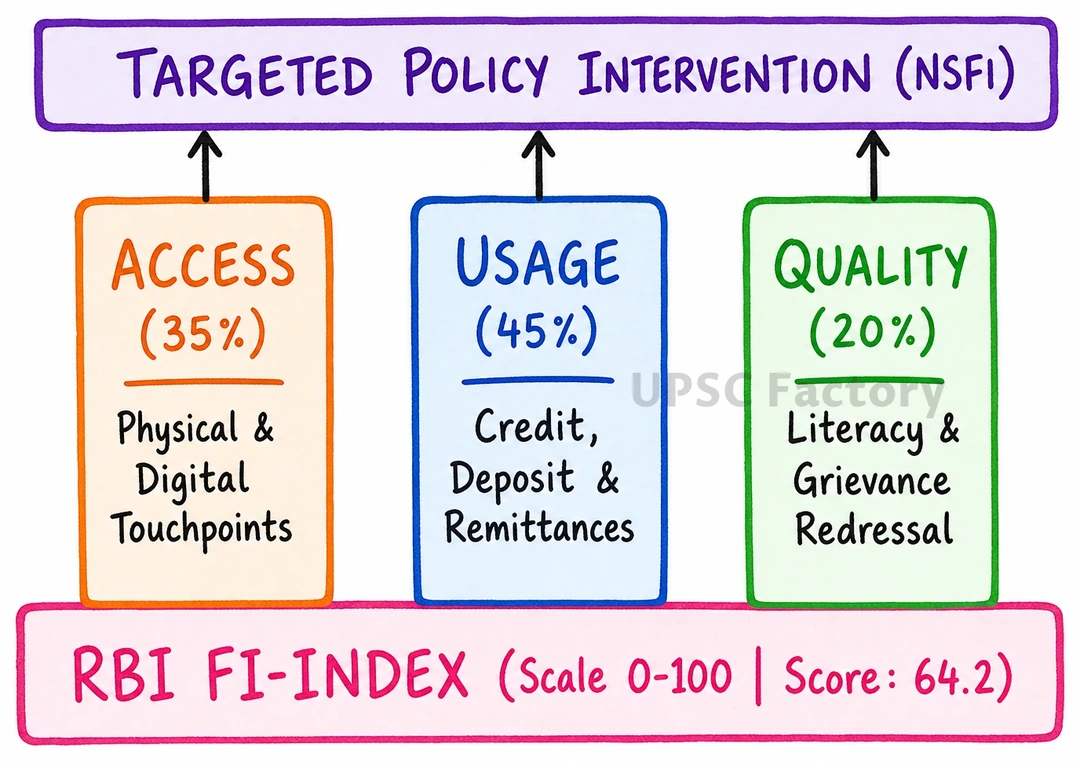
- Comprehensive Measurement: Computes a single metric (0–100) reflecting multi-dimensional progress across Access (35%), Usage (45%), and Quality (20%) (Score: 64.2 in March 2024).
- Beyond Mere Account Opening: Incorporates the ‘Quality’ parameter to track financial literacy, consumer protection, and grievance redressal.
- Evidence-Based Policymaking: Highlights demand-side underutilization versus supply-side deficits, guiding targeted interventions under the National Strategy for Financial Inclusion (NSFI).
Transitioning from basic access to active usage and quality-driven financial integration is essential for achieving equitable, resilient, and inclusive growth (Viksit Bharat @2047).