Model Answer:
The Digital Rupee (e₹) is India’s sovereign Central Bank Digital Currency (CBDC) issued by the Reserve Bank of India (RBI) under the amended RBI Act, 1934, serving as a fungible legal tender backed 1:1 by physical currency.
Working & Architecture of Digital Rupee
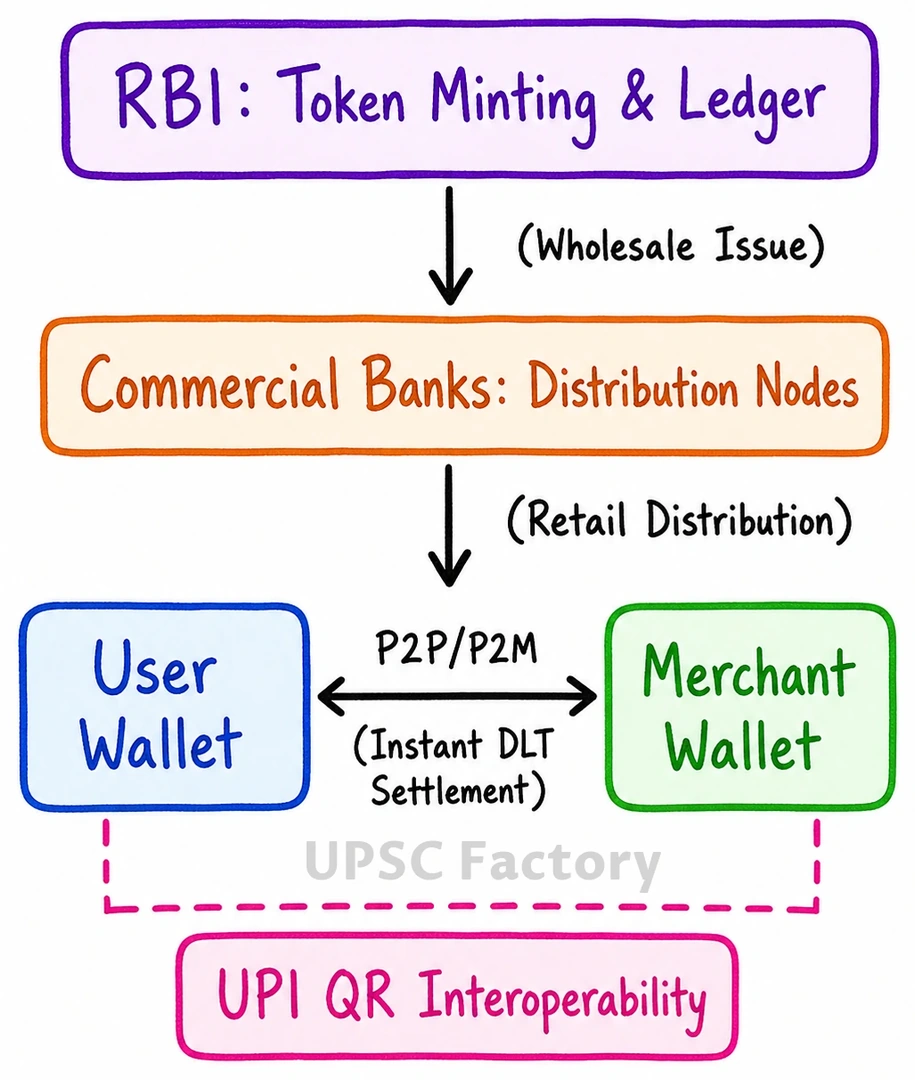
- Two-Tier Distribution Model: RBI mints and transfers e₹ to intermediary commercial banks, which distribute tokens to end-users’ digital wallets.
- Token-Based Architecture: Utilizes cryptography and hybrid Distributed Ledger Technology (DLT) for peer-to-peer (P2P) and peer-to-merchant (P2M) settlement without intermediate bank clearance.
- Cash-Like Finality: Provides instant settlement finality and operational autonomy with tiered privacy protocols for small-value transactions.
Progress of India’s CBDC Pilots
- Wholesale Pilot (e₹-W): Operationalized for interbank secondary market transactions in Government Securities, reducing counterparty settlement risk and transaction costs.
- Retail Pilot (e₹-R): Scaled across closed user groups (CUG) in participating banks, achieving over 1 million daily pilot transactions.
- UPI Interoperability: Integrated single QR-code compatibility, allowing users to scan existing merchant UPI codes via CBDC wallets.
- Programmability & Offline Mode: Tested programmable use-cases (e.g., targeted agricultural subsidies) and NFC-based offline transactions for low-connectivity regions.
The Digital Rupee significantly lowers physical cash-logistics overheads, strengthens monetary sovereignty against private cryptocurrencies, and lays the digital rail for frictionless cross-border remittances.