Model Answer:
The debate between positivism and interpretivism stems from divergent ontologies: whether society is an objective, law-governed system or an intersubjectively constructed web of human meanings.
Epistemological Superiority of Interpretivism
- Internal Meaning vs External Causation: Unlike inert natural matter, human behaviour is driven by conscious motives; Max Weber argues that sociology must prioritize Verstehen (interpretative understanding) over pure statistical correlation.
- The Double Hermeneutic: Anthony Giddens emphasizes that social actors reflexively interpret their environment; interpretivism treats humans as active agents rather than passive cultural dopes responding mechanically to structural stimuli.
- Anti-Reification of Institutions: Peter Berger and Thomas Luckmann demonstrate that social structures are fluid social constructs; interpretivism avoids the positivist fallacy of treating human institutions as immutable natural facts.
- Capturing the Life-World: Alfred Schutz highlights the importance of the intersubjective life-world (Lebenswelt), uncovering common-sense typifications and micro-realities that macro-level surveys systematically miss.
- Symbolic Mediation: Symbolic interactionists like Herbert Blumer show that human action is mediated by continuous interpretive processes, rendering deterministic stimulus-response models inadequate for social reality.
- Ecological Validity: Qualitative methods (e.g., participant observation) preserve natural contexts, capturing lived experiences and unexpected nuances that artificial, standardized indicators flatten.
Structural Blind Spots and Positivism’s Indispensability
- The Voluntaristic Trap: By overemphasizing micro-meanings, interpretivism risks subjective reductionism, ignoring pervasive macro-coercive structures like class, caste, and global capitalism.
- Structural Constraints: Émile Durkheim demonstrated in Suicide that social facts exert sui generis external constraints, revealing macro-level causal regularities that micro-interpretive accounts cannot explain.
- Methodological Relativism: Lacking standardized instruments of verification, interpretivist accounts suffer from low replicability and high vulnerability to researcher bias.
- Policy and Scalability: State planning, redistributive welfare, and demographic tracking require generalizable, aggregated quantitative data that interpretivist ethnographies cannot generate at scale.
- Masking False Consciousness: Interpretivism relies heavily on actors’ stated perceptions, often failing to pierce ideological mystification or systemic power asymmetries that actors take for granted.
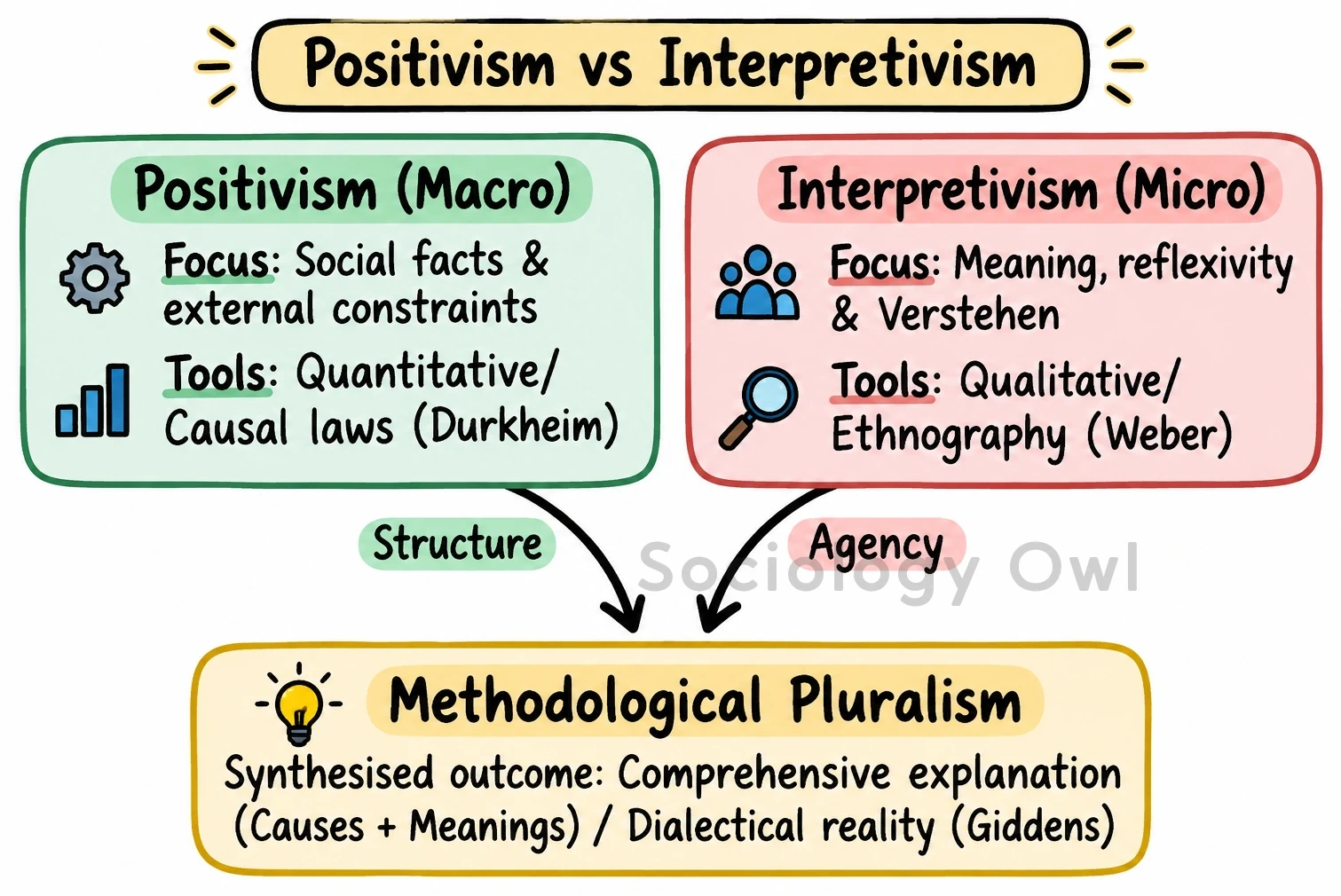
Neither paradigm holds absolute superiority; robust sociology demands methodological pluralism, synthesising structural regularities with subjective meanings.