Model Answer:
Religion and science represent two fundamental ways of making sense of reality—one grounded in transcendent faith and existential meaning, the other in empirical observation and falsifiability. While early modern thought posited their relationship as an irreconcilable zero-sum conflict, contemporary sociology views their interaction as a nuanced continuum ranging from institutional tension to mutual accommodation.
The Conflict Thesis: Epistemological and Structural Friction
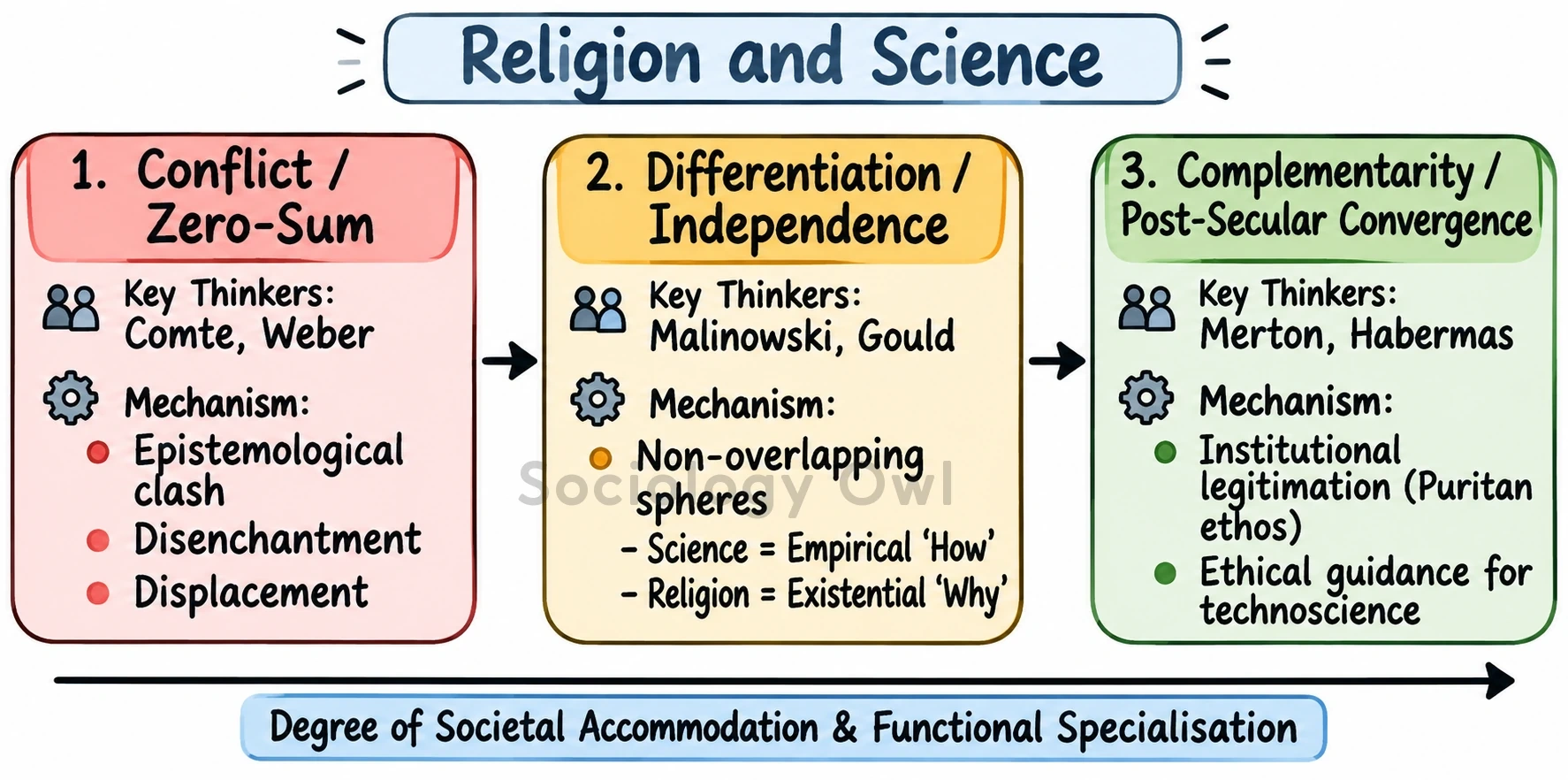
- Disenchantment of the World: Max Weber argued that the advance of scientific rationalisation produces entzauberung (disenchantment), progressively stripping nature of magical and sacred qualities in favour of technical calculability.
- Evolutionary Displacement: Positivists like Auguste Comte conceptualised social evolution through the law of three stages, asserting that the scientific-positive epoch inevitably replaces theological orthodoxy.
- Epistemological Incommensurability: Science operates on institutionalised scepticism, fallibility, and empirical verification, which fundamentally clashes with religion’s reliance on revelation, dogma, and the inviolability of the sacred.
- Contestation Over Plausibility Structures: As Peter Berger observed, scientific hegemony fractures the singular sacred canopy, transforming religious truth from an objective societal given into a privatised, contested cognitive choice.
- Jurisdictional Clashes: Recurrent public disputes over evolutionary biology, reproductive technologies, and stem-cell research demonstrate persistent friction where scientific capability breaches traditional theological moral boundaries.
Beyond Conflict: Differentiation, Complementarity, and Convergence
- Non-Overlapping Magisteria: Sociologists and philosophers note that conflict arises only when boundaries blur; functionally, science explains how the material universe works, whereas religion interprets why humans exist within it.
- Institutional Symbiosis: In Science, Technology and Society in Seventeenth-Century England, Robert K. Merton demonstrated that the ascetic Puritan ethos historically legitimated and accelerated the institutionalisation of modern empirical science.
- Functional Differentiation: Bronislaw Malinowski emphasised that rational-empirical knowledge and sacred rituals satisfy distinct human imperatives; science provides practical mastery over the environment, while religion manages existential anxiety, theodicy, and tragedy.
- Cognitive Compartmentalisation: Modern individuals seamlessly practice selective rationalisation, deploying scientific methodologies in the technocratic sphere while maintaining orthodox religious affiliations for personal identity and community solidarity.
- Post-Secular Reflexivity: Jürgen Habermas suggests that in a post-secular society, unbridled scientism requires the normative, ethical vocabulary of religious traditions to guide contentious dilemmas surrounding artificial intelligence and genetic engineering.
Rather than an inevitable conflict, modern society witnesses functional differentiation, where science provides instrumental mastery and religion addresses ultimate meaning.