Social hierarchy denotes the vertical, asymmetrical ranking of groups within an interconnected social whole, whereas social exclusion represents the structural process of boundary-drawing, detachment, and systemic denial from mainstream societal participation.
Conceptual Divergence: Social Hierarchy versus Social Exclusion
- Structural Nexus (Inclusion vs. Severance): Hierarchy integrates unequal groups into a shared functional or ideological framework; exclusion detaches individuals and groups, severing the relational bonds of full social citizenship.
- Spatial & Relational Demarcation: Hierarchy is vertical, organizing strata through ranked positions; exclusion operates on an inside–outside axis, creating horizontal barriers of social closure.
- Systemic Interdependence: Hierarchy relies on asymmetric reciprocity and graded legitimacy; exclusion thrives on enforced isolation, systemic invisibilization, and complete resource deprivation (Amartya Sen).
- Trajectory of Redressal: Hierarchy generates contestations over status mobility and redistribution; exclusion demands recognition, access to civil spheres, and the restoration of ontological human dignity.
Substantiating the Dichotomy through the Caste Matrix
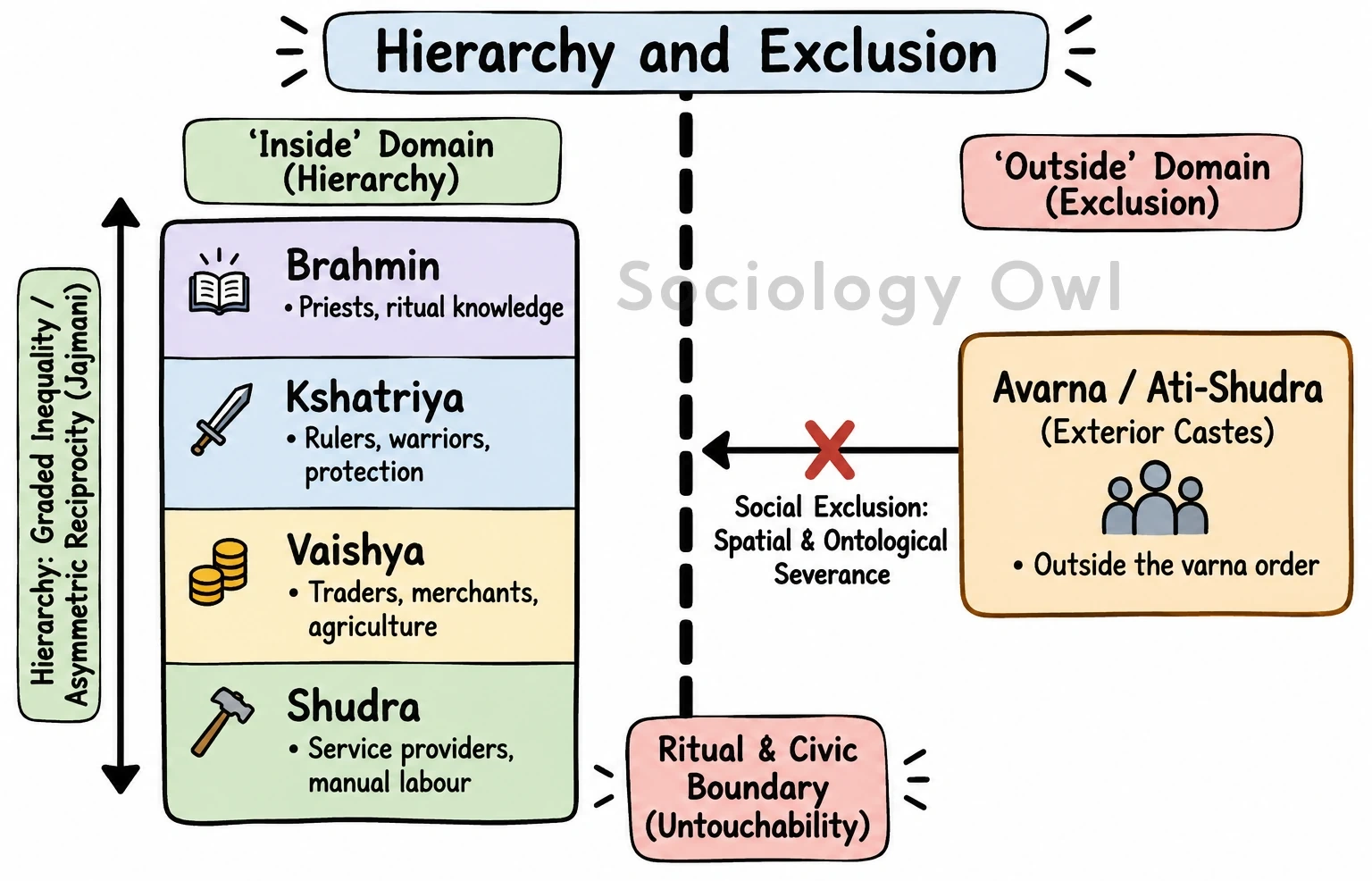
- Varna Ranking vs. The Avarna Boundary: Within the Chaturvarna framework, Louis Dumont in Homo Hierarchicus locates status based on relative purity and pollution; conversely, social exclusion banishes Ati-Shudras (Dalits) outside the ritual matrix altogether as “exterior castes.”
- Economic Reciprocity vs. Enforced Segregation: Hierarchy is maintained through occupational interdependence such as the traditional Jajmani system; exclusion manifests through spatial apartheid, forcefully exiling Dalit settlements to village peripheries.
- Graded Inequality vs. Untouchability: B.R. Ambedkar argued that caste is an architecture of graded inequality (hierarchy); however, the practice of untouchability is a punitive instrument of structural exclusion, stripping groups of basic civic and human agency.
- Relative Mobility vs. Absolute Closure: While intermediary castes negotiate relative rank through M.N. Srinivas’s Sanskritization, excluded groups face absolute epistemic and bodily barricades, historically enforced through bans on public water commons, temple entry, and education.
While hierarchy organizes unequal social participation, exclusion denies belonging altogether; caste uniquely institutionalizes both through graded inequality and untouchability.