Model Answer:
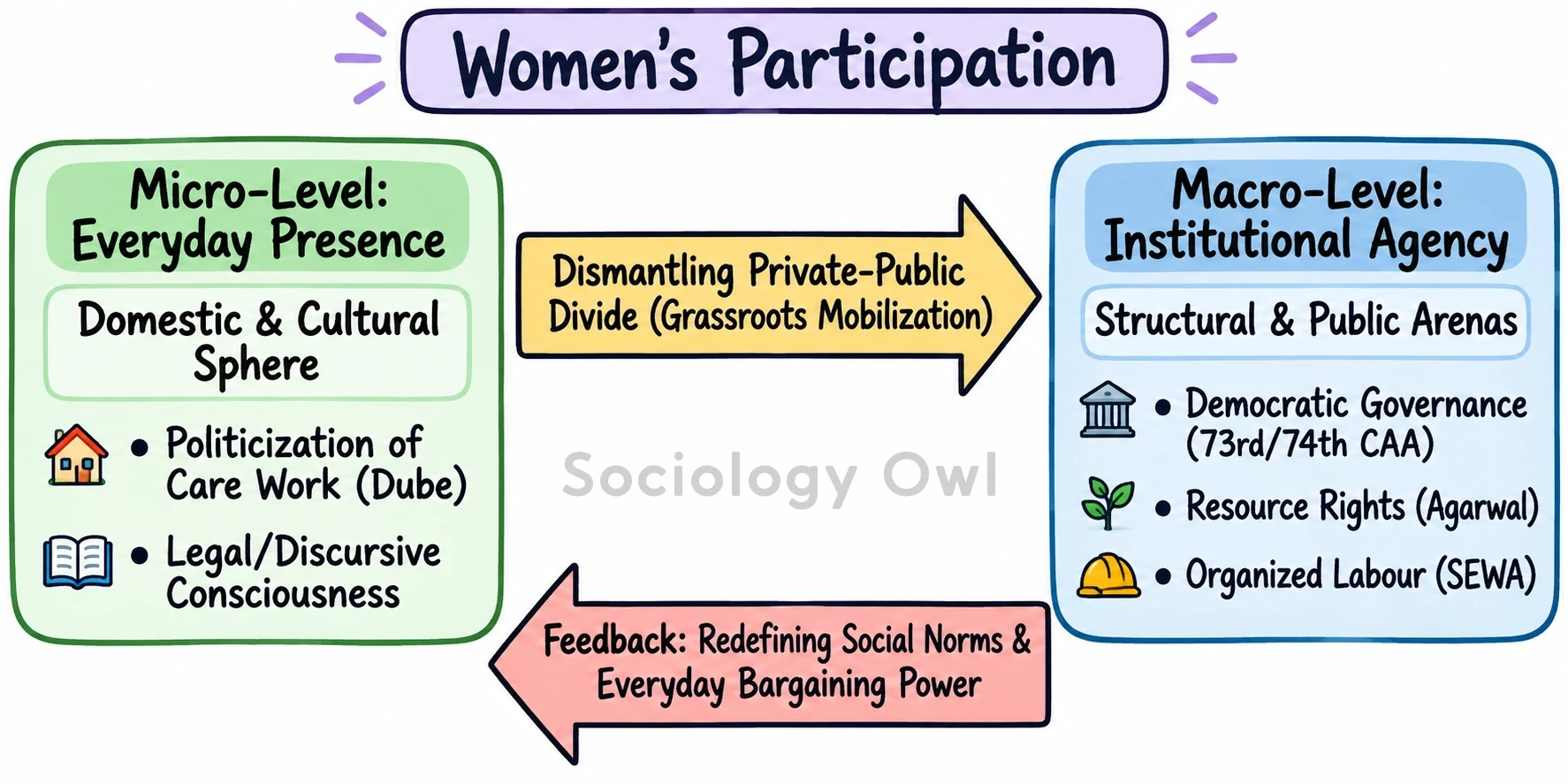
Indian women’s movements have evolved from colonial-era reformism to autonomous, intersectional mobilizations, dismantling the traditional private-public divide and establishing women as conscious, proactive agents in restructuring everyday social life.
Making Presence Felt: Subverting Everyday Spaces and Discourse
- Politicizing the Domestic Realm: As Leela Dube highlighted in her studies on gender socialization, domestic subordination was historically naturalized; feminist campaigns around domestic violence, unpaid care work, and reproductive autonomy directly challenged this private patriarchy.
- Transforming Legal Consciousness: Grassroots agitations—from the anti-rape agitations post-Mathura case to campaigns against dowry—radically reoriented jurisprudence, culminating in legislations like the Protection of Women from Domestic Violence Act (PWDVA) and the POSH Act.
- Cultural and Linguistic Assertion: Counter-hegemonic cultural practices, through protest poetry, street theatre, and Dalit feminist literature, disrupted Brahminical and patriarchal vocabularies, making feminine lived experiences central to public debate.
Expanding Substantive Agency Across Institutional Fields
- Local Democratic Governance: Sustained political advocacy paved the way for the 73rd and 74th Constitutional Amendments, propelling over a million women into formal politics through Panchayati Raj and challenging village-level patriarchal hegemonies.
- Agrarian and Resource Struggles: From Chipko to anti-mining resistance, women positioned themselves at the vanguard of environmental movements. As Bina Agarwal notes, mobilizing for collective rights over land, common property resources, and forests redefined women’s economic bargaining power.
- Unionizing the Informal Economy: Collectives like the Self-Employed Women’s Association (SEWA) and state-level collectives like Kudumbashree transformed vulnerable informal workers into organized, credit-worthy economic agents capable of institutional bargaining.
- Intersectional Subaltern Mobilization: Autonomous Dalit and Adivasi women’s forums challenged monolithic upper-caste feminist narratives, ensuring that margins of caste, class, and ethnicity drive mainstream civil society and academic discourse.
By dismantling the private-public divide, women’s movements have structurally reconfigured Indian democracy, transforming marginality into decisive socio-political agency.