Model Answer:
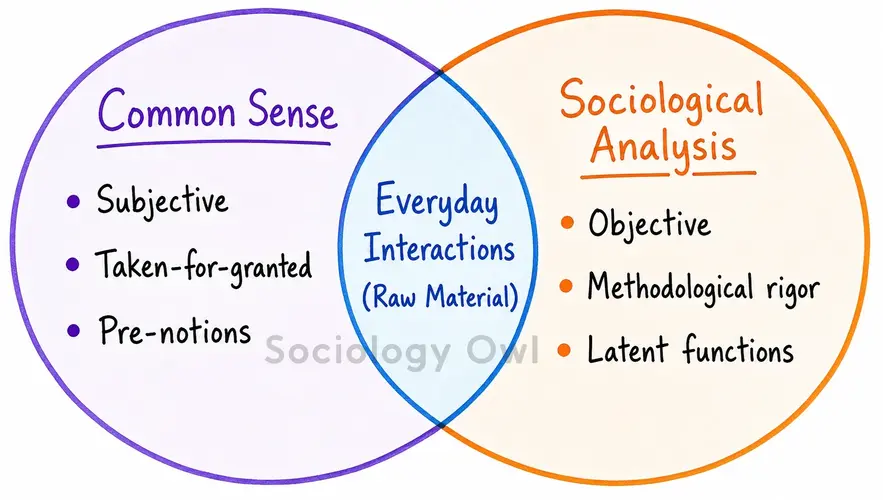
Common sense is the routine, “taken-for-granted” knowledge of everyday life. While it provides the raw material and starting point for social inquiry, sociology differentiates itself through rigorous methodology, empirical evidence, and critical questioning.
Common Sense as the Bedrock of Social Inquiry
Certain sociological traditions value common sense as the fundamental starting point of research:
- Alfred Schutz: In Phenomenology, sociology begins with the “Life-world” (Lebenswelt). Common sense provides the “Typifications” and recipes humans use to navigate reality, forming the raw data for sociologists.
- Harold Garfinkel: Ethnomethodology studies how ordinary people construct common-sense reality. He utilized “Breaching experiments” to expose the fragile, taken-for-granted assumptions guiding social order.
- Clifford Geertz: In anthropology, he famously analyzed “Common sense as a cultural system”, which is essential for researchers to gain deep ethnographic insights.
- Antonio Gramsci: Argued that common sense contains fragments of “Good sense” (practical wisdom), serving as a starting point for understanding the lived realities of subaltern classes.
Limitations and the Need for Scientific Rigor
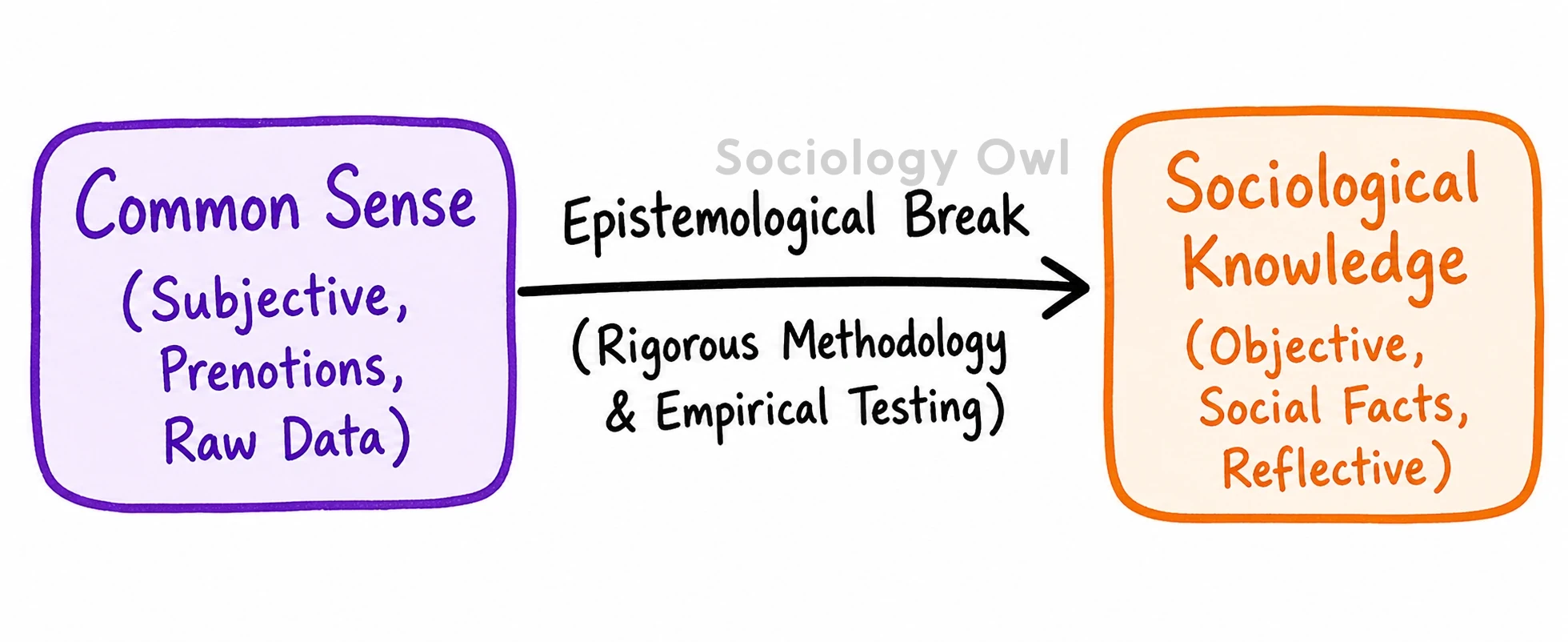
Despite its utility, common sense is highly subjective and culturally relative, necessitating a scientific departure:
- Emile Durkheim: Warned against common sense, terming it “Prenotions”. In Suicide, he deliberately debunked common-sense explanations (like climate or individual psychology) to establish objective Social Facts.
- Gaston Bachelard & Pierre Bourdieu: Argued that sociology must make an “Epistemological break” from everyday assumptions to become a true, objective science.
- Marxist Perspective: Common sense often internalized ruling-class ideology, manifesting as “False consciousness”. For example, it dictates that poverty is caused by laziness, obscuring structural exploitation.
During the COVID-19 pandemic, “common sense” often blamed the rapid spread of the virus on the individual carelessness of specific communities. However, sociological research broke past this to reveal structural inequalities: overcrowded housing, gig-economy vulnerabilities, and unequal healthcare access.
Conclusion
Common sense provides the ‘what’ of human behavior, while sociology uncovers the ‘why’ and ‘how’. As Andre Beteille observed, sociological research requires common sense, but it must be an informed, rigorous, and “Reflective common sense” to accurately capture complex social realities.