Model Answer:
Louis Dumont Binary Opposition in Indian Caste System
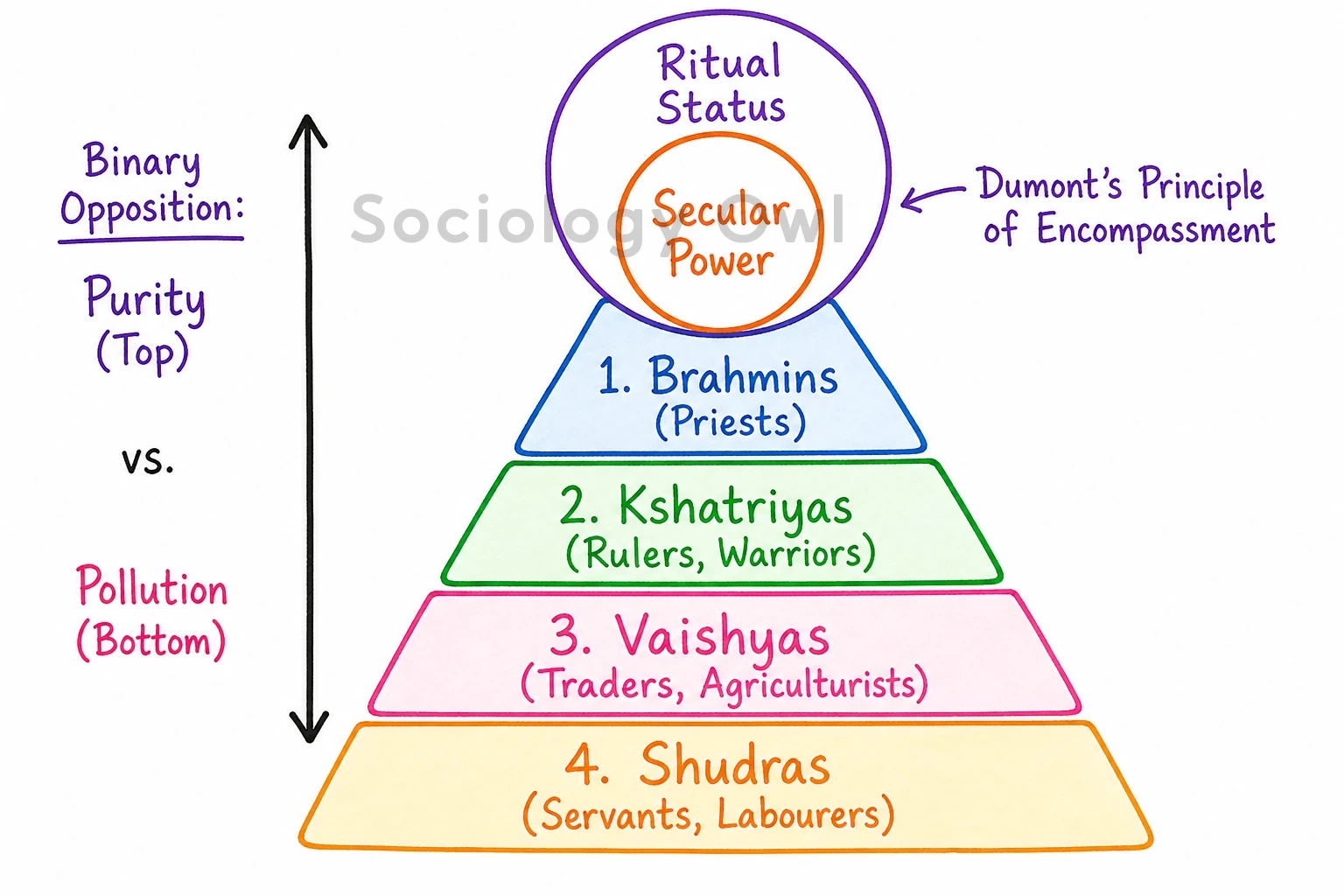
Applying a Structuralist-Indological approach inspired by Claude Levi-Strauss, Louis Dumont in Homo Hierarchicus argues the Indian caste system is driven by the cognitive principle of ‘binary opposition’, contrasting the hierarchical Indian mind (Homo Hierarchicus) with Western egalitarianism (Homo Aequalis).
Dumont’s Theory of Binary Opposition
- Purity vs. Pollution: The foundational dichotomy forming the caste hierarchy, where Brahmins embody extreme purity and untouchables represent extreme pollution.
- Principle of Encompassment: In this hierarchy, the pure not only opposes the impure but encompasses it. Ritual status encompasses secular power, meaning religious authority (Brahmins) supersedes political power (Kshatriyas).
- Repulsion and Interdependence: The binary dictates physical separation (endogamy, untouchability) while necessitating functional economic interdependence, as seen in the traditional Jajmani system.
Sociological Debates and Critiques
- Dipankar Gupta: Rejects Dumont’s universal binary, arguing instead for “Multiple Hierarchies” where individual castes possess distinct origin myths claiming superiority.
- Andre B0e9teille: His Sripuram study demonstrates that Caste, Class, and Power are now disassociated, challenging Dumont’s assertion that status always encompasses power.
- B.R. Ambedkar: Dismissed the harmonious ideological binary, analyzing caste as a system of “graded inequality” maintained through violent exploitation.
- M.N. Srinivas: His concept of the Dominant Caste proves that secular land ownership often dictates local ritual status, defying a fixed textual hierarchy.
Today, the strict purity-pollution binary is diluting in the public sphere due to urbanization, yet it persists privately in endogamy. As Rajni Kothari observes, the binary has shifted from ritual “pure vs. impure” to political “us vs. them,” driving secularized vote-bank mobilizations.
Conclusion
While Dumont offers a profound “Book View” of traditional caste ideology, he neglects the dynamic “Field View”. Today, caste has transitioned from a rigid ritualistic hierarchy into a horizontal, secularized identity utilized for modern socio-political assertion.