UPSC Mains 2024 GS4 Model Answer

Q. “The concept of Just and Unjust is contextual. What was just a year back, may turn out to be unjust in today’s context. Changing context should be constantly under scrutiny to prevent miscarriage of justice.” Examine the above statement with suitable examples.

Q. “The concept of Just and Unjust is contextual. What was just a year back, may turn out to be unjust in today’s context. Changing context should be constantly under scrutiny to prevent miscarriage of justice.” Examine the above statement with suitable examples.

UPSC Mains 2024 GS4 Ethics Paper

Model Answer:

Justice is a dynamic, evolving ideal driven by societal, technological, and moral advancements, making ethical relativism and transformative constitutionalism essential paradigms.

Evolution of Justice: Contextual Relativity

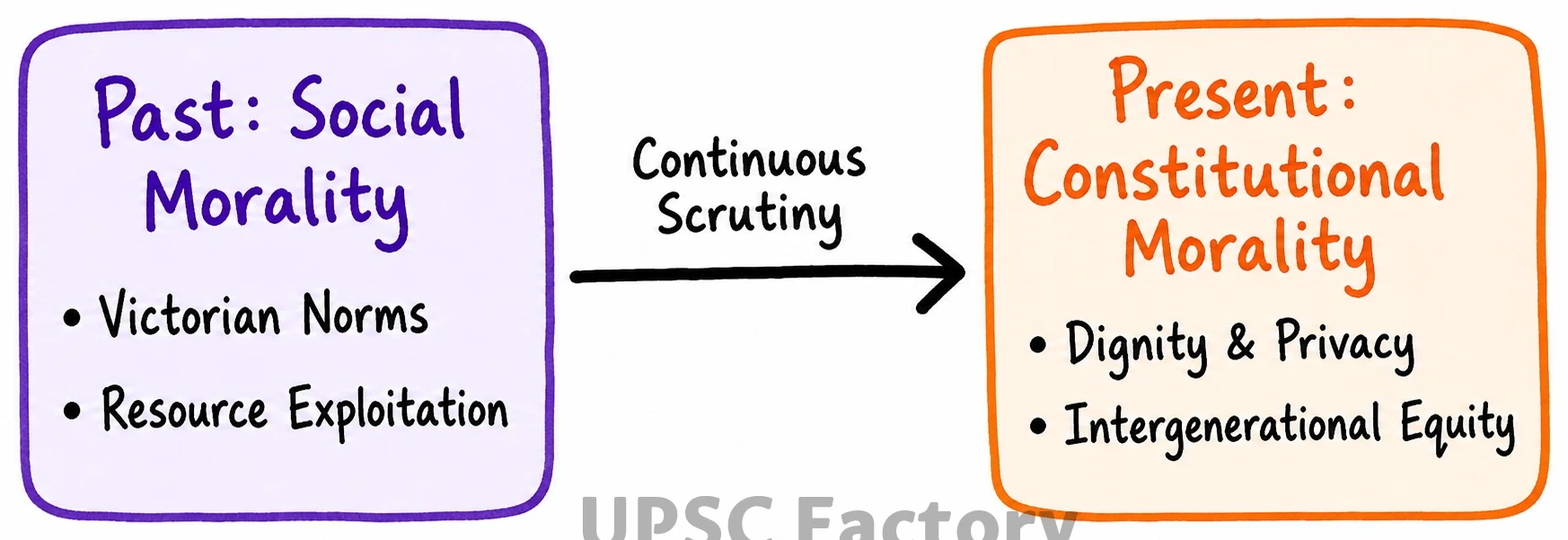
  • Shifting Social Morality: Victorian-era norms justified criminalizing homosexuality, which is now deemed profoundly unjust (Navtej Singh Johar case).
  • Redefining Gender Parity: Adultery laws treating women as male property were once legal norms, now recognized as unconstitutional (Joseph Shine case).
  • Evolving Environmental Ethics: Unfettered resource exploitation was historically viewed as ‘development’, now condemned as intergenerational injustice (Climate Change litigation).
Imperative of Continuous Scrutiny to Prevent Injustice

  • Technological Disruption: The digital age mandates constant legal evolution to protect human dignity (Puttaswamy case – Right to Privacy).
  • Dismantling Systemic Oppression: Outdated frameworks require proactive review to prevent normalized state overreach (Scrutiny of Colonial-era Sedition laws).
  • Progressive Realization of Rights: Institutional vigilance bridges the gap between static legislation and expanding constitutional morality.
  • Addressing Normalized Wrongs: Constant evaluation prevents historical legal exceptions from perpetuating silent injustices (Ongoing scrutiny of marital rape exceptions).

To prevent the miscarriage of justice, ethical and legal frameworks must co-evolve proactively, ensuring that constitutional morality consistently outpaces static societal prejudices.
Q. “The concept of Just and Unjust is contextual. What was just a year back, may turn out to be unjust in today’s context. Changing context should be constantly under scrutiny to prevent miscarriage of justice.” Examine the above statement with suitable examples. Read More »

Q. “In law, a man is guilty when he violates the rights of others. In ethics, he is guilty if he only thinks of doing so.” – Immanuel Kant

Q. “In law, a man is guilty when he violates the rights of others. In ethics, he is guilty if he only thinks of doing so.” – Immanuel Kant

UPSC Mains 2024 GS4 Ethics Paper

Model Answer:

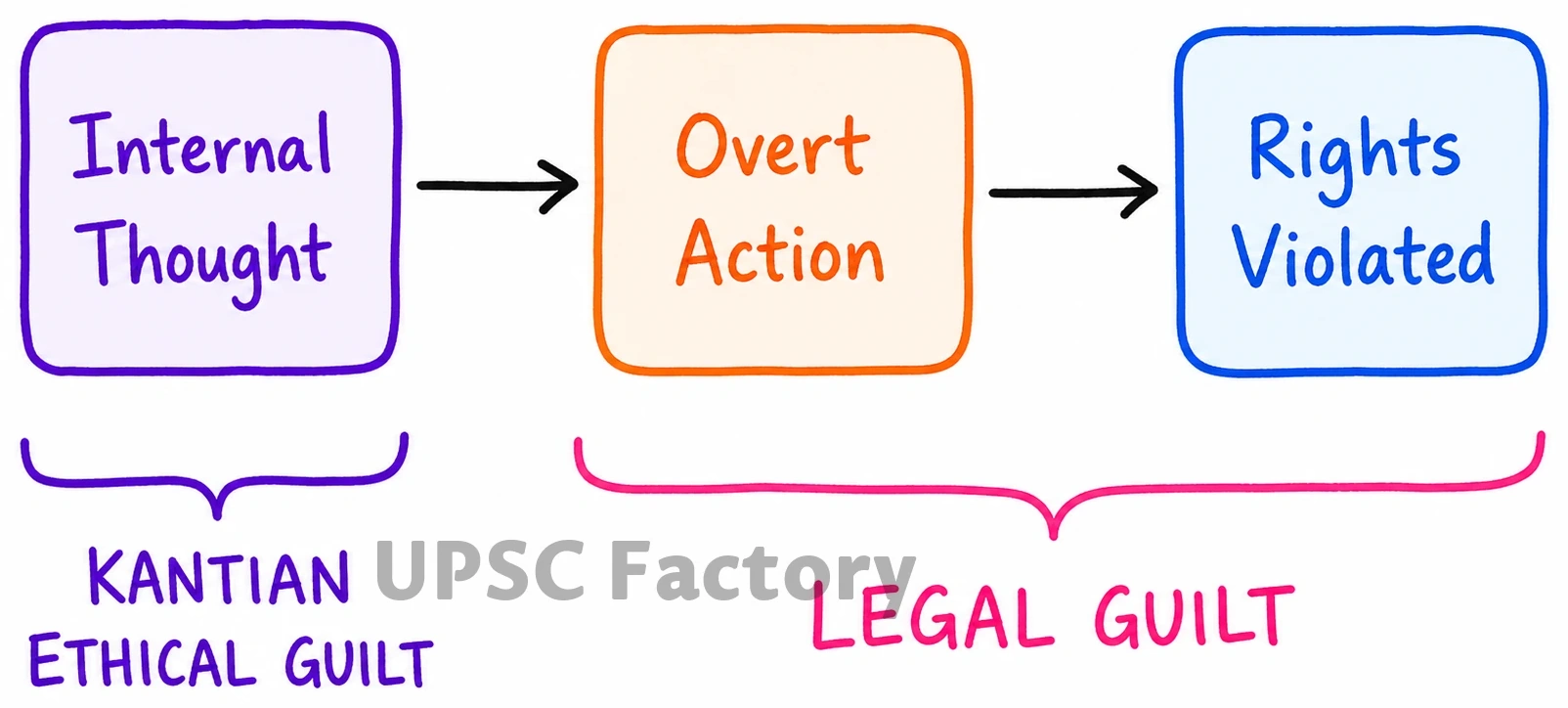
Kant’s quote highlights the dichotomy between legal jurisprudence (focusing on external compliance) and ethical deontology (demanding internal purity of intent).

1. Law: The Realm of External Actions

  • Action-Centric (Actus Reus): Jurisprudence penalizes overt actions and tangible consequences, ignoring unacted thoughts.
  • Objective Violation: Legal guilt requires physical proof of encroaching on another’s rights (e.g., actual physical assault).
  • Coercive Compliance: Legal obedience is frequently driven by the fear of systemic punishment rather than moral conviction.
  • Example: A civil servant deeply desiring a bribe but refraining solely due to CCTV cameras remains legally innocent.

2. Ethics: The Realm of Internal Intent

  • Primacy of ‘Good Will’: Kant argues that true moral worth stems exclusively from pure, duty-bound intentions, irrespective of outcomes.
  • Inherent Culpability: Harboring malice corrupts character; harboring a harmful thought itself constitutes a profound ethical transgression.
  • Categorical Imperative: Intentions must be universalizable; inherently malicious schemes fail this foundational Kantian test.
  • Example: Secretly plotting to sabotage a colleague’s promotion is ethically bankrupt and guilty, even if the plot remains unexecuted.

While law provides a necessary, objective baseline to prevent societal harm, true ethical governance demands the cultivation of an uncorrupted, internally guided conscience.

Q. “In law, a man is guilty when he violates the rights of others. In ethics, he is guilty if he only thinks of doing so.” – Immanuel Kant Read More »

Q. “Faith is of no avail in the absence of strength. Faith and strength, both are essential to accomplish any great work.” – Sardar Patel

Q. “Faith is of no avail in the absence of strength. Faith and strength, both are essential to accomplish any great work.” – Sardar Patel

UPSC Mains 2024 GS4 Ethics Paper

Model Answer:

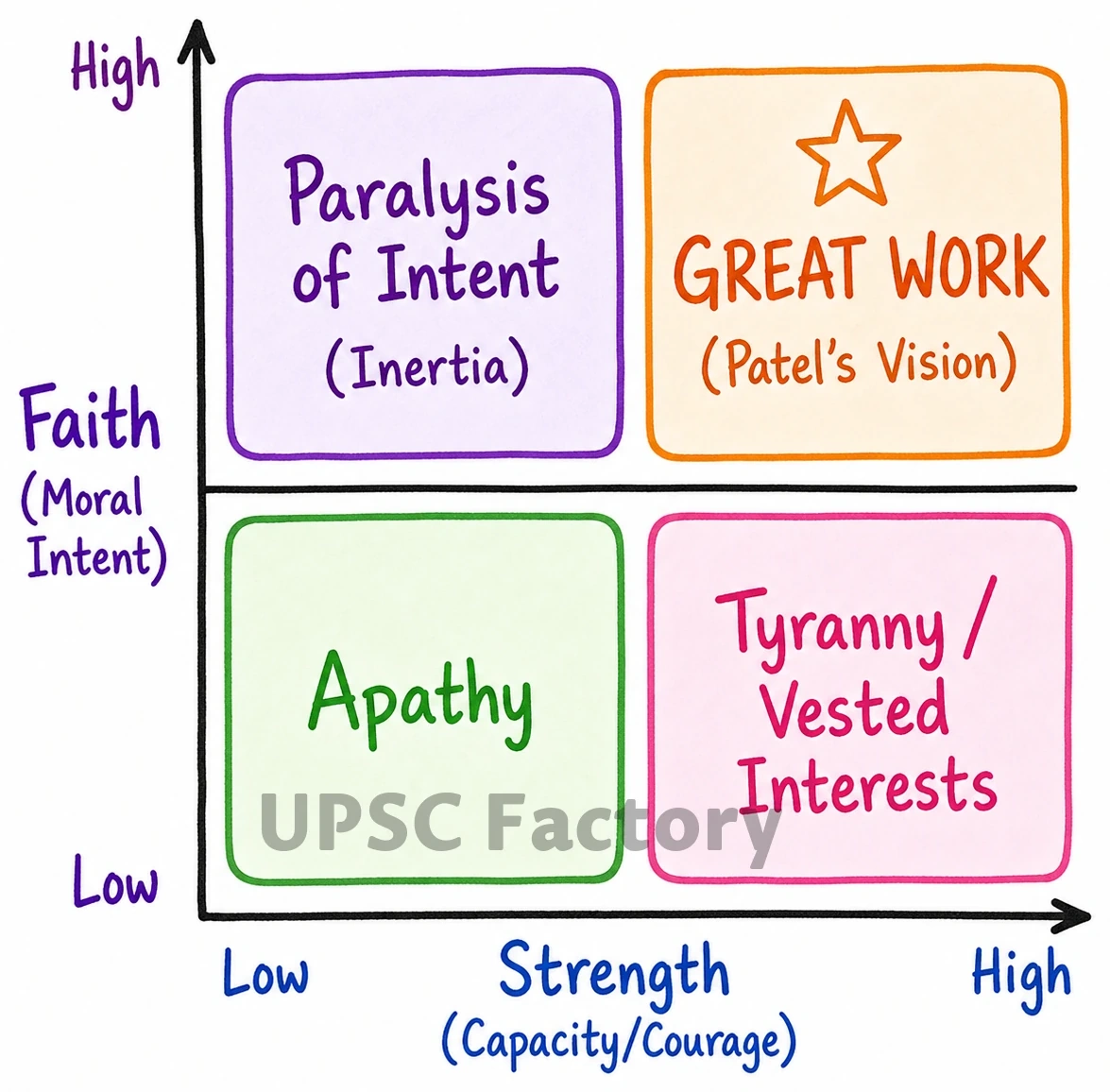
Sardar Patel’s quote underscores that moral conviction (faith) must be coupled with execution capacity and fortitude (strength) to achieve meaningful outcomes.

1. Inadequacy of Faith Without Strength

  • Paralysis of Intent: Good intentions lacking courage (fortitude) fail to translate into action during crises (Virtue Ethics).
  • Vulnerability of Righteousness: High ideals without institutional backing easily succumb to vested interests (e.g., failure of the League of Nations).
  • Execution Deficit: Noble goals remain theoretical unless backed by structural and personal empowerment (Amartya Sen’s Capability Approach).

2. Synergy of Faith and Strength in Administration

  • Diplomacy and Deterrence: Combining patriotic vision with administrative resolve achieves the impossible (e.g., Patel integrating 565 princely states via diplomacy and police action).
  • Vision and Competence: Unwavering belief combined with technological and institutional prowess creates historical milestones (e.g., ISRO’s Chandrayaan missions).
  • Ethical Enforcement: Faith in democratic fairness requires the strict courage to enforce laws impartially (e.g., T.N. Seshan’s sweeping electoral reforms).

To achieve transformative governance, a civil servant must possess both a “soft heart” (faith in constitutional morality) and a “hard head” (administrative strength and fortitude).

Q. “Faith is of no avail in the absence of strength. Faith and strength, both are essential to accomplish any great work.” – Sardar Patel Read More »

Q. “Learn everything that is good from others, but bring it in, and in your own way absorb it, do not become others.” – Swami Vivekananda

Q. “Learn everything that is good from others, but bring it in, and in your own way absorb it, do not become others.” – Swami Vivekananda

UPSC Mains 2024 GS4 Ethics Paper

Model Answer:

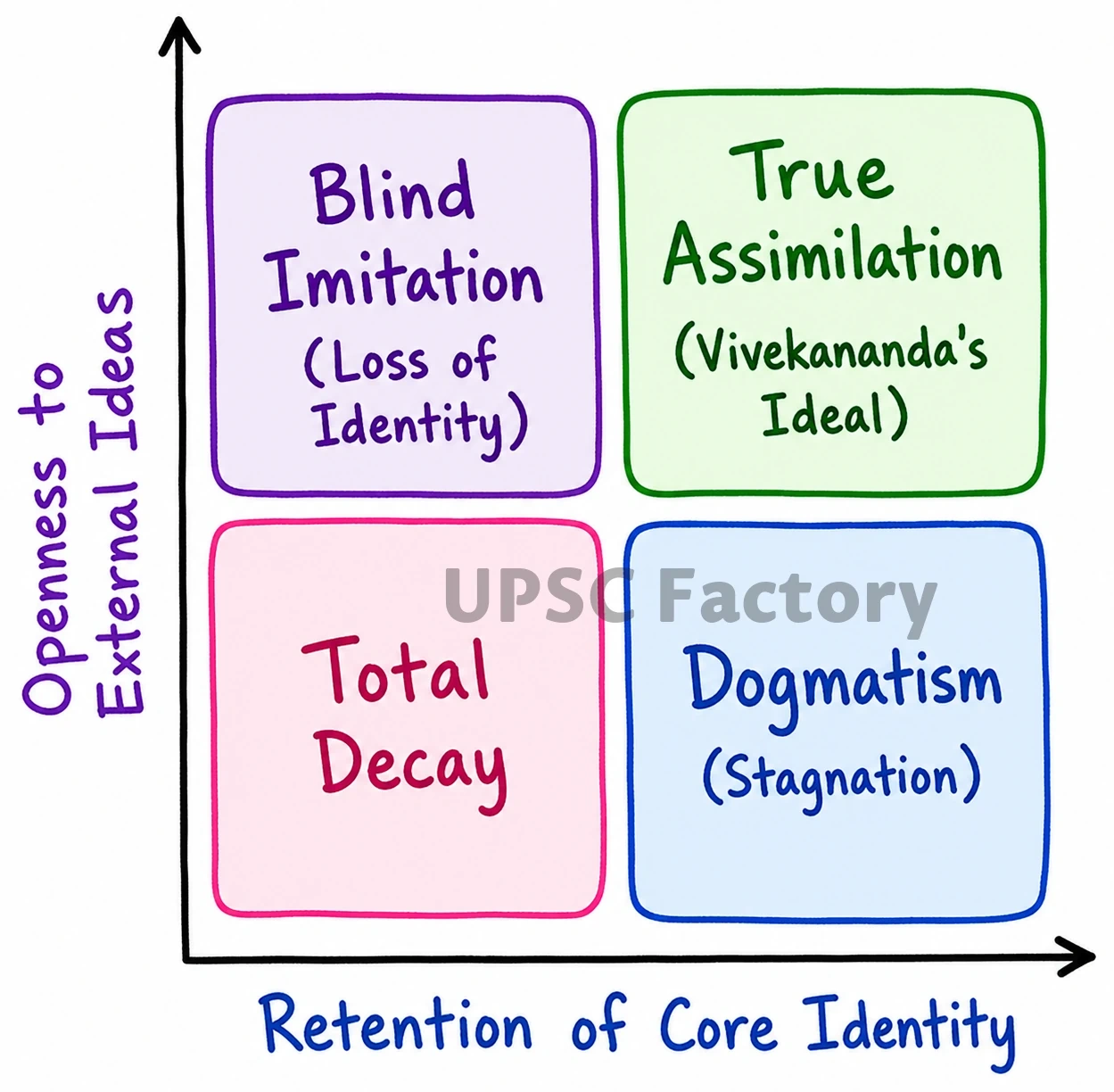
Swami Vivekananda advocates for a dynamic balance between intellectual receptivity and cultural authenticity, promoting constructive assimilation while cautioning against blind imitation.

1. Assimilation of Universal Good (Intellectual Openness)

  • Cosmopolitan Ethos: Eradicates dogmatism by embracing progressive global ideals (Liberty, Equality from the French Revolution).
  • Scientific Temper: Encourages the adoption of universal technological and socio-economic advancements to drive societal progress.
  • Ethical Enrichment: Fosters continuous moral evolution by openly integrating diverse philosophical wisdom without prejudice.

2. Preserving Core Identity (Avoiding Blind Imitation)

  • Contextual Adaptation: Universal concepts must be tailored to local socio-cultural realities to ensure effectiveness and harmony.
  • Safeguarding Autonomy: Blind copying breeds cultural subservience and erodes individual or national self-worth (e.g., Macaulayism).
  • Organic Assimilation: External values must enrich, not replace, indigenous ethos (Indian Constitution adapting global democratic features to local realities).
  • Authentic Progress: Modernization should not equate to Westernization (Meiji Japan modernizing while strictly retaining traditional ethos).

True progress lies in assimilating global virtues—like a seed absorbing external nutrients from soil and water—to grow organically and authentically into one’s true self.

Q. “Learn everything that is good from others, but bring it in, and in your own way absorb it, do not become others.” – Swami Vivekananda Read More »

Q. Global warming and climate change are the outcomes of human greed in the name of development, indicating the direction in which extinction of organisms including human beings is heading towards loss of life on Earth. How do you put an end to this to protect life and bring equilibrium between the society and the environment?

Q. Global warming and climate change are the outcomes of human greed in the name of development, indicating the direction in which extinction of organisms including human beings is heading towards loss of life on Earth. How do you put an end to this to protect life and bring equilibrium between the society and the environment?

UPSC Mains 2024 GS4 Ethics Paper

Model Answer:

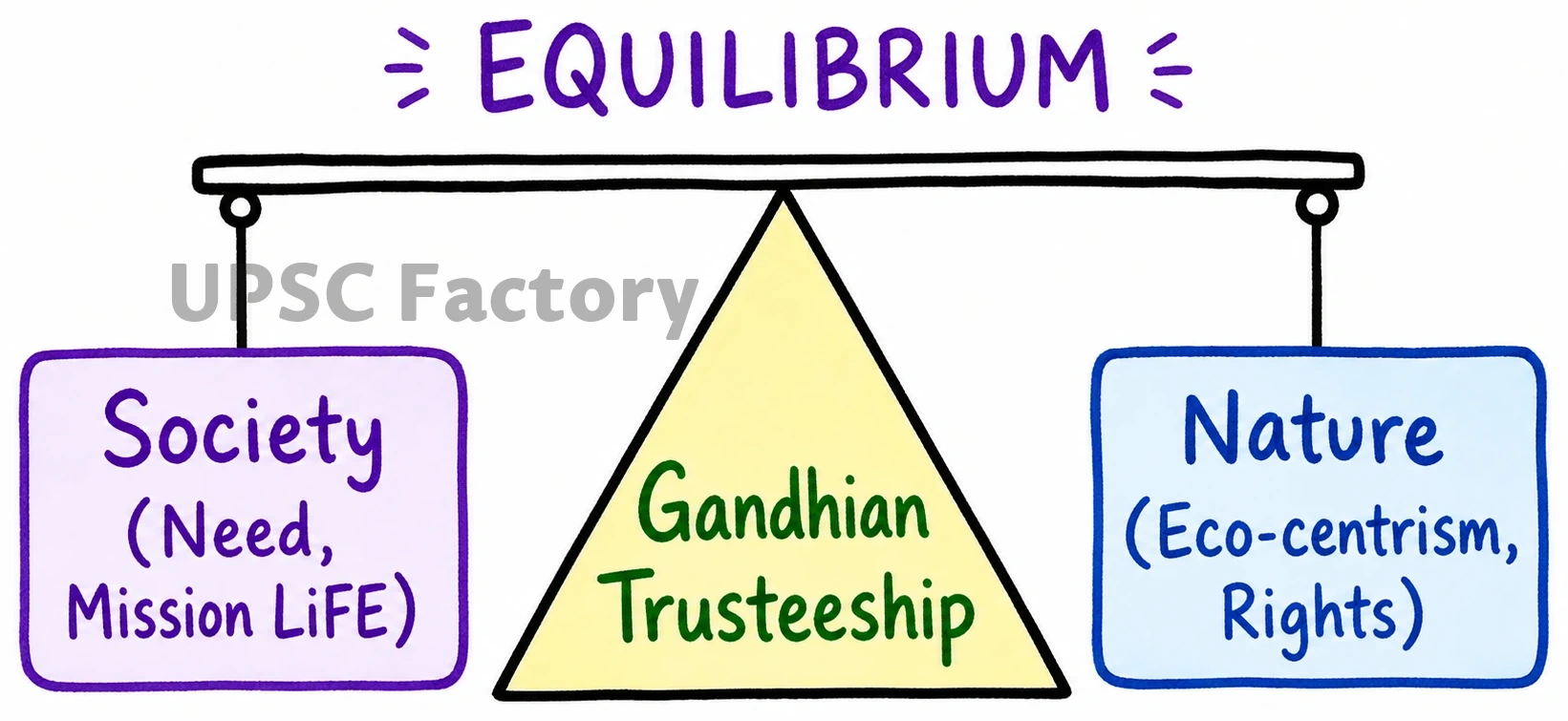
The climate crisis reflects the triumph of anthropocentric greed over ecological need, violating intergenerational equity and pushing Earth towards an irreversible mass extinction.

Ethical Pathways to Restore Socio-Environmental Equilibrium

  • Embracing Eco-centrism: Shift from viewing nature merely as an exploitable human resource to respecting its intrinsic value (Deep Ecology paradigm).
  • Gandhian Trusteeship: Adopt the ethos of being stewards, not absolute owners, of natural resources, guided by “need, not greed.”
  • Earth Jurisprudence: Grant legal personhood to ecological entities to prevent unchecked corporate exploitation and ensure natural justice (e.g., Legal rights for rivers).
  • Mindful Consumption: Implement systemic behavioral nudging to replace materialism with sustainable, low-carbon living (Mission LiFE – Lifestyle for Environment).
  • Corporate Environmental Ethics: Enforce strict deontological duties on industries to internalize ecological costs and prioritize sustainability (Polluter Pays Principle, Green Accounting).
  • Virtue Ethics in Conservation: Mainstream indigenous environmental consciousness into modern development policies (Bishnoi community’s ecological sacrifices).

Ultimately, securing life on Earth demands an ethical renaissance—transitioning from a paradigm of reckless capitalist exploitation to one of compassionate, eco-centric harmony.

Q. Global warming and climate change are the outcomes of human greed in the name of development, indicating the direction in which extinction of organisms including human beings is heading towards loss of life on Earth. How do you put an end to this to protect life and bring equilibrium between the society and the environment? Read More »

Q. “It is not enough to talk about peace, one must believe in it; and it is not enough to believe in it, one must act upon it.” In the present context, the major weapon industries of the developed nations are adversely influencing continuation of number of wars for their own self-interest, all around the world. What are the ethical considerations of the powerful nations in today’s international arena to stop continuation of ongoing conflicts?

Q. “It is not enough to talk about peace, one must believe in it; and it is not enough to believe in it, one must act upon it.” In the present context, the major weapon industries of the developed nations are adversely influencing continuation of number of wars for their own self-interest, all around the world. What are the ethical considerations of the powerful nations in today’s international arena to stop continuation of ongoing conflicts?

UPSC Mains 2024 GS4 Ethics Paper

Model Answer:

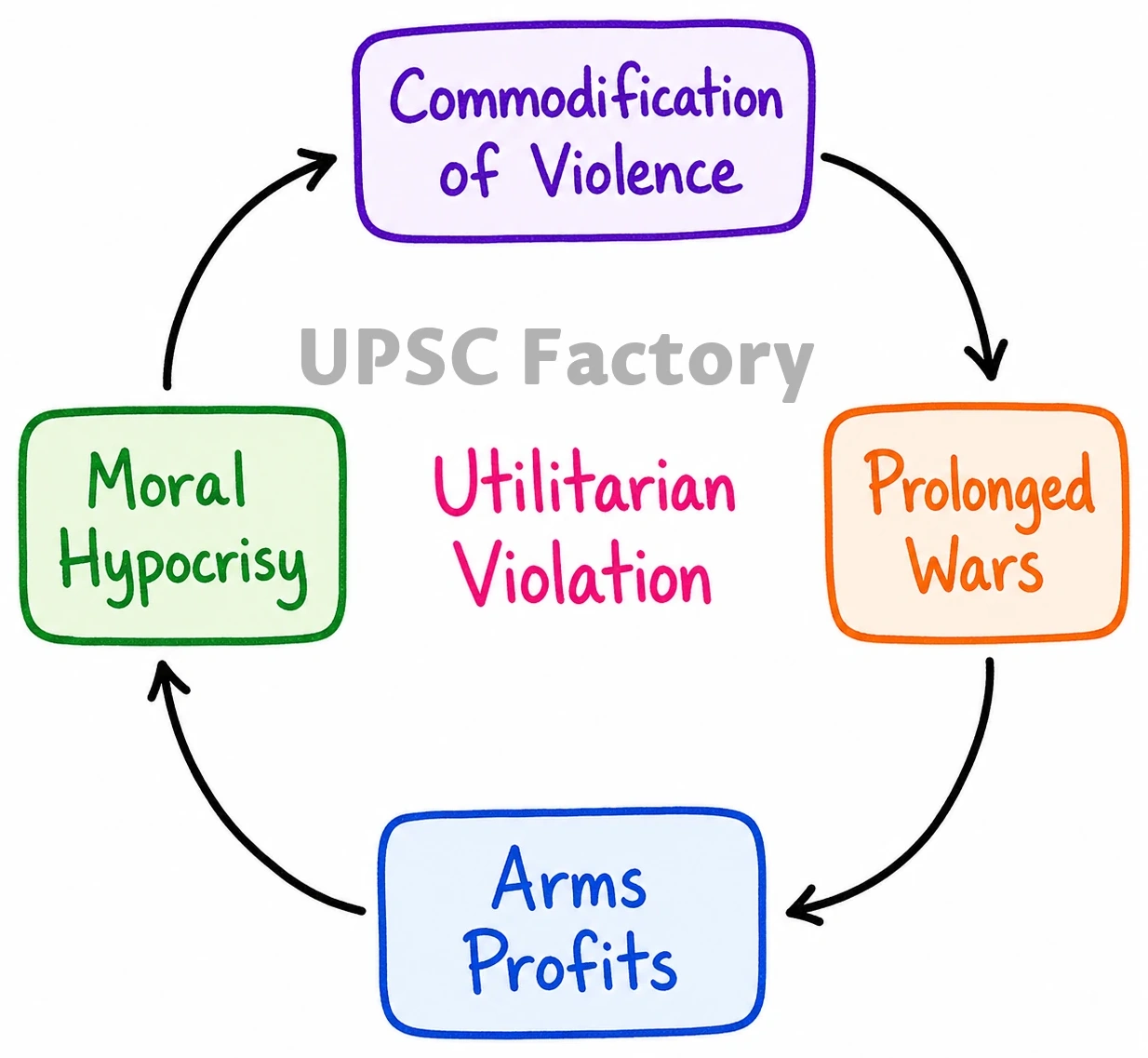
Eleanor Roosevelt’s quote emphasizes that authentic peace requires proactive moral action, contrasting sharply with today’s profit-driven “Military-Industrial Complex” (MIC).

1. Ethical Deficit of the Military-Industrial Complex

  • Profit over Humanity: Prioritizing defense exports over human lives violates the utilitarian principle of maximum global welfare.
  • Moral Hypocrisy: Developed nations advocate human rights while dominating the global arms trade (e.g., SIPRI reports ~70% of arms originate from US/Europe).
  • Commodification of Violence: Using ongoing conflicts (e.g., Gaza, Ukraine) as testing grounds and profit engines uses humans merely as means (violating Kantian ethics).

2. Ethical Considerations to Stop Ongoing Conflicts

  • Global Common Good: Shifting from narrow geopolitical self-interest to universal welfare and collective security (Vasudhaiva Kutumbakam).
  • Responsibility to Protect (R2P): Fulfilling the moral duty to prevent humanitarian crises rather than arming belligerents.
  • Regulatory Integrity: Strictly adhering to and enforcing the Arms Trade Treaty (ATT) to embargo weapon supplies to active conflict zones.
  • Just War Theory: Aligning foreign policy strictly with Jus ad bellum, recognizing that the ultimate objective of any intervention must be enduring peace.

Powerful nations must transition from weaponized capitalism to ethical diplomacy, realizing that sustainable global leadership is built on human development, not arms proliferation.

Q. “It is not enough to talk about peace, one must believe in it; and it is not enough to believe in it, one must act upon it.” In the present context, the major weapon industries of the developed nations are adversely influencing continuation of number of wars for their own self-interest, all around the world. What are the ethical considerations of the powerful nations in today’s international arena to stop continuation of ongoing conflicts? Read More »

Q. “Ethics encompasses several key dimensions that are crucial in guiding individuals and organizations towards morally responsible behaviour.” Explain the key dimensions of ethics that influence human actions. Discuss how these dimensions shape ethical decision-making in the professional context.

Q. “Ethics encompasses several key dimensions that are crucial in guiding individuals and organizations towards morally responsible behaviour.” Explain the key dimensions of ethics that influence human actions. Discuss how these dimensions shape ethical decision-making in the professional context.

UPSC Mains 2024 GS4 Ethics Paper

Model Answer:

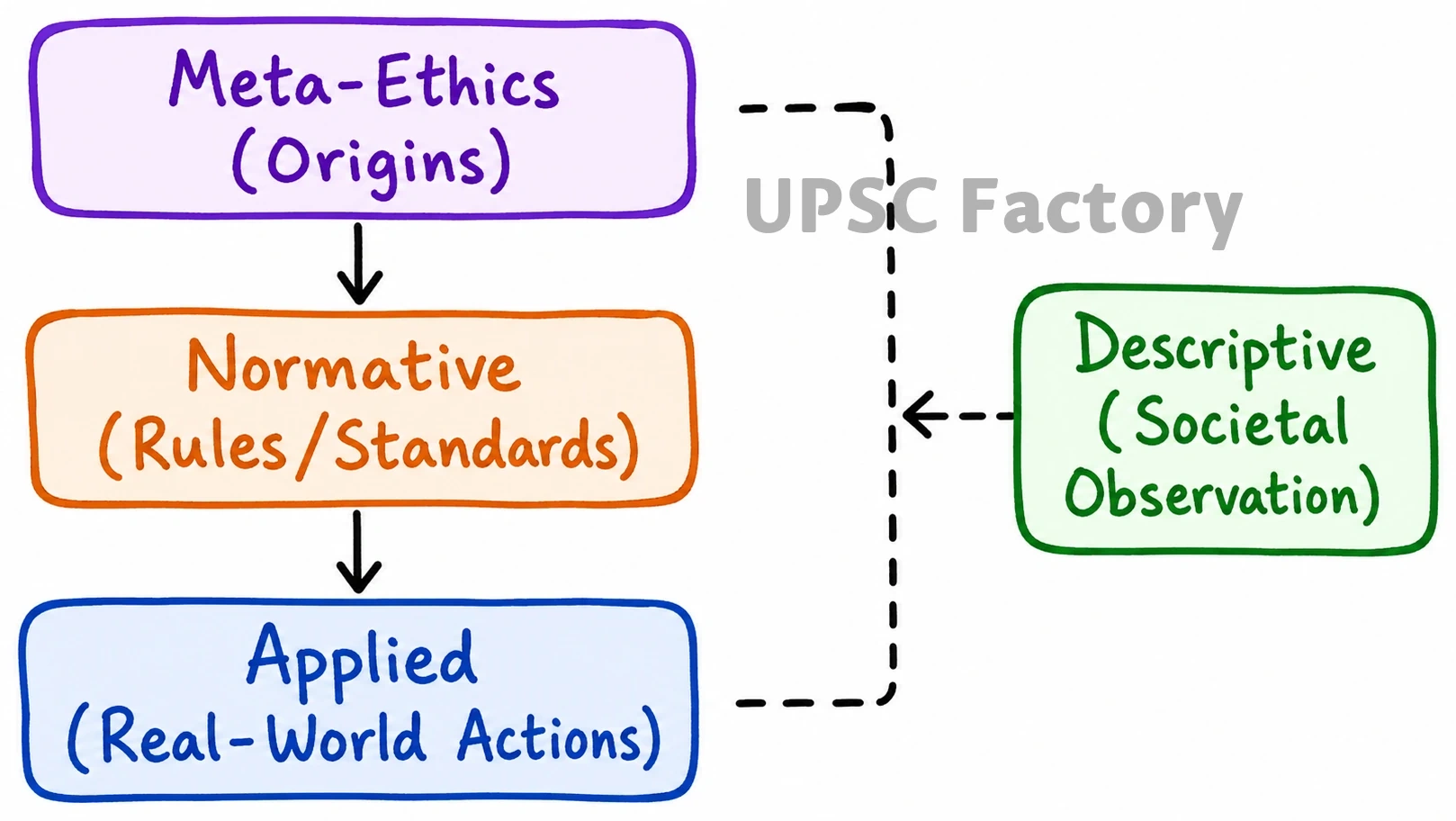
Ethics is a multidimensional framework systematically evaluating right and wrong, guiding human actions and institutional conduct toward moral rectitude.

1. Key Dimensions of Ethics Influencing Actions

  • Normative Ethics: Prescribes moral standards determining what “ought” to be done based on duty or outcomes (Deontology, Utilitarianism).
  • Applied Ethics: Translates theoretical norms into resolving practical, real-world moral dilemmas (bioethics, corporate governance).
  • Meta-Ethics: Explores the foundational origin and meaning of moral concepts (objective truth vs. subjective relativism).
  • Descriptive Ethics: Empirically studies actual societal moral beliefs and behavioral patterns (sociological observation).

2. Shaping Ethical Decision-Making in Professions

  • Structuring Rulebooks: Normative ethics establishes clear, non-negotiable organizational boundaries and rules (Tata Group’s Code of Conduct).
  • Resolving Dilemmas: Applied ethics guides professionals during severe conflicts of interest or whistleblowing (Edward Snowden’s NSA disclosures).
  • Fostering Intrinsic Values: Meta-ethical clarity internalizes core public service values, preventing ethical fading (Nolan Principles: Integrity, Objectivity).
  • Aligning Corporate Culture: Descriptive ethics helps leadership identify actual workforce behavioral realities to recalibrate training and compliance frameworks.

Integrating these ethical dimensions empowers professionals to navigate moral ambiguities, ensuring decisions consistently prioritize transparency, accountability, and the broader public interest.

Q. “Ethics encompasses several key dimensions that are crucial in guiding individuals and organizations towards morally responsible behaviour.” Explain the key dimensions of ethics that influence human actions. Discuss how these dimensions shape ethical decision-making in the professional context. Read More »

Q. The application of Artificial Intelligence as a dependable source of input for administrative rational decision-making is a debatable issue. Critically examine the statement from the ethical point of view.

Q. The application of Artificial Intelligence as a dependable source of input for administrative rational decision-making is a debatable issue. Critically examine the statement from the ethical point of view.

UPSC Mains 2024 GS4 Ethics Paper

Model Answer:

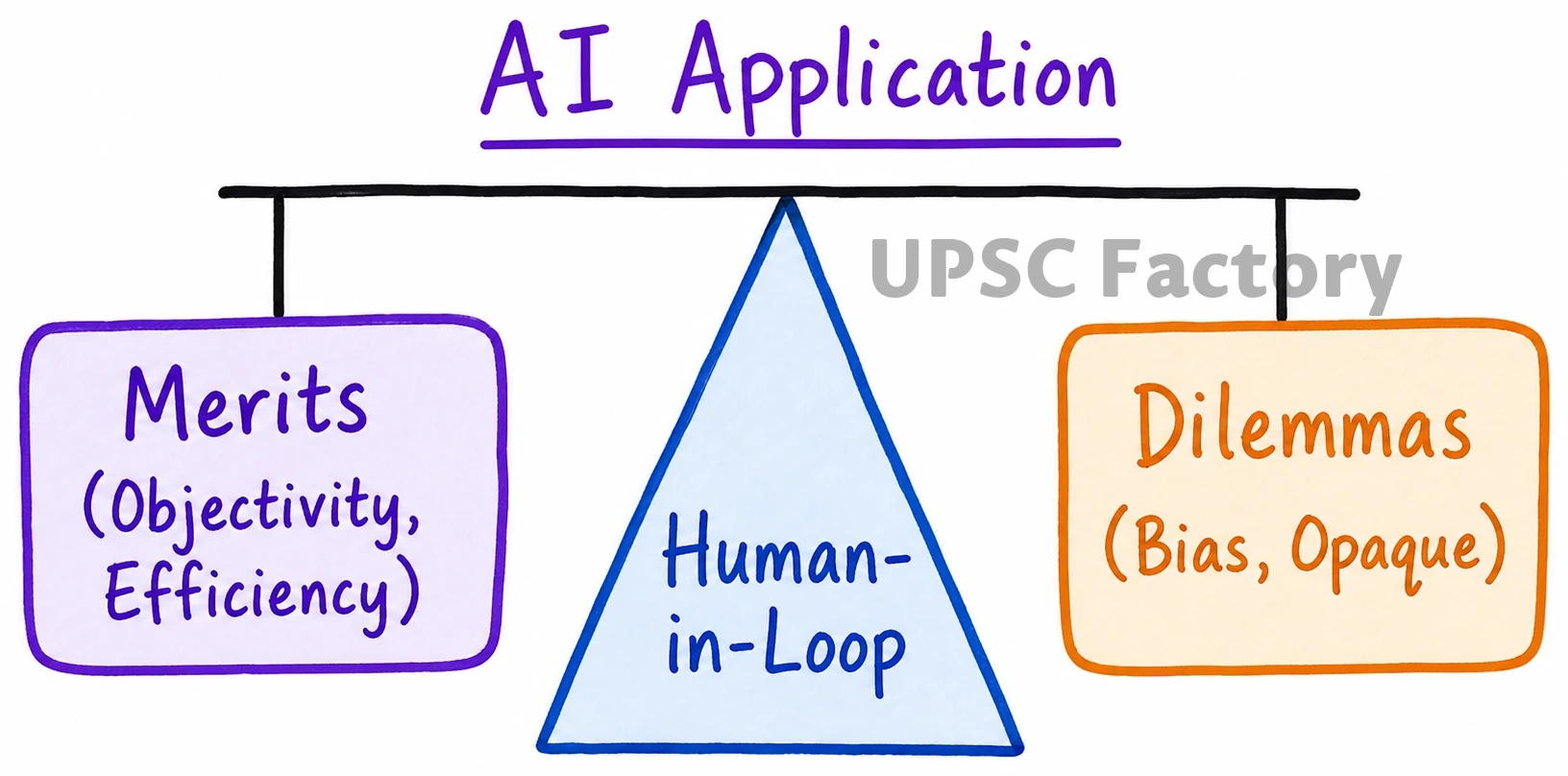
AI promises data-driven rationality in public administration, but its dependability is debated due to inherent conflicts between algorithmic efficiency and foundational administrative ethics.

1. Ethical Merits of AI Inputs

  • Procedural Fairness: Minimizes cognitive human prejudices, promoting objective and impartial administrative actions.
  • Utilitarian Welfare: Maximizes resource allocation efficiency for the greater good (e.g., precise beneficiary targeting in PDS).
  • Transparency: Digitally traceable AI inputs reduce opaque bureaucratic discretion and rent-seeking behavior.
  • Proactive Governance: Predictive analytics enable anticipatory public service delivery, fulfilling the administrative duty of care (e.g., disaster forecasting).

2. Ethical Dilemmas & Debatability

  • Algorithmic Bias: AI learns from historical data, potentially perpetuating systemic discrimination (e.g., racial/caste bias in COMPAS sentencing).
  • ‘Black-Box’ Accountability: Opaque machine learning logic obscures decision rationales, violating the core principle of administrative answerability.
  • Empathy Deficit: AI lacks compassion, applying rules rigidly without contextual understanding for vulnerable populations.
  • Privacy Intrusions: Aggressive data harvesting compromises informed consent and fundamental human dignity (Puttaswamy Judgement).

AI must be an enabler, not an arbiter. Upholding NITI Aayog’s ‘AI for All’ strategy requires strict “Human-in-the-Loop” governance to balance rational efficiency with ethical compassion and justice.

Q. The application of Artificial Intelligence as a dependable source of input for administrative rational decision-making is a debatable issue. Critically examine the statement from the ethical point of view. Read More »

Q. Dr. Srinivasan is a senior scientist working for a reputed biotechnology company known for its cutting-edge research in pharmaceuticals.

Q. Dr. Srinivasan is a senior scientist working for a reputed biotechnology company known for its cutting-edge research in pharmaceuticals.

Dr. Srinivasan is heading a research team working on a new drug aimed at treating a rapidly spreading variant of a new viral infectious disease. The disease has been rapidly spreading across the world and the cases reported in the country are increasing.
There is huge pressure on Dr. Srinivasan’s team to expedite the trials for the drug as there is significant market for it, and the company wants to get the first-mover advantage in the market.
During a team meeting, some senior team members suggest some shortcut for expediting the clinical trials for the drug and for getting the requisite approvals. These include manipulating data to exclude some negative outcomes and selectively reporting positive results, foregoing the process of informed onsent and using compounds already patented by a rival company, rather than developing one’s own component. Dr. Srinivasan is not comfortable taking such shortcuts, at the same time he realises meeting the targets is impossible without using these means.

a) What would you do in such a situation?
b) Examine your options and consequences in the light of the ethical questions involved.
c) How can data ethics and drug ethics save humanity at large in such a scenario?

UPSC Mains 2024 GS4 Ethics Paper

Model Answer:

a) In this situation, as Dr. Srinivasan, I would:

• Refuse to compromise ethical standards, emphasizing the importance of scientific integrity.
• Propose alternative methods to expedite the process ethically:
  – Increasing resources and manpower for the trials
  – Collaborating with other research institutions to share data and resources
  – Requesting emergency fast-track approval from regulatory bodies while maintaining all safety protocols
• Communicate clearly with company leadership about the risks of unethical shortcuts and their potential long-term consequences.
 

b) Options and consequences:

1. Following suggested shortcuts:
• Consequences: Potential public health risks, legal liabilities, loss of scientific credibility, and long-term damage to company reputation.
• Ethical issues: Violates principles of scientific integrity, informed consent, and intellectual property rights.
2. Refusing to compromise:
• Consequences: Delayed drug release, potential loss of market advantage, possible professional repercussions.
• Ethical standpoint: Upholds scientific integrity and prioritizes public safety over profit.
3. Seeking a middle ground:
• Approach: Streamline processes without compromising on ethics or safety.
• Ethical consideration: Balances urgency of the situation with maintaining ethical standards.
 

c) Data ethics and drug ethics can save humanity by:

• Ensuring the safety and efficacy of new drugs through rigorous, unbiased testing.
• Maintaining public trust in scientific institutions and pharmaceutical companies.
• Promoting transparency in research, allowing for peer review and validation.
• Protecting vulnerable populations from exploitation in clinical trials.
• Fostering a culture of responsibility and integrity in scientific research.
• Encouraging the development of truly effective treatments rather than rushed, potentially harmful solutions.
• Safeguarding long-term public health by preventing the release of inadequately tested drugs.
 
Conclusion: Upholding ethical standards in pharmaceutical research is crucial for public safety, scientific progress, and maintaining trust in healthcare systems.

Q. Dr. Srinivasan is a senior scientist working for a reputed biotechnology company known for its cutting-edge research in pharmaceuticals. Read More »