UPSC Mains 2025 GS2 Model Answer

Q. “With the waning of globalization, post-Cold War world is becoming a site of sovereign nationalism.” Elucidate.

Q. “With the waning of globalization, post-Cold War world is becoming a site of sovereign nationalism.” Elucidate.

UPSC Mains 2025 GS2 Paper

Model Answer:

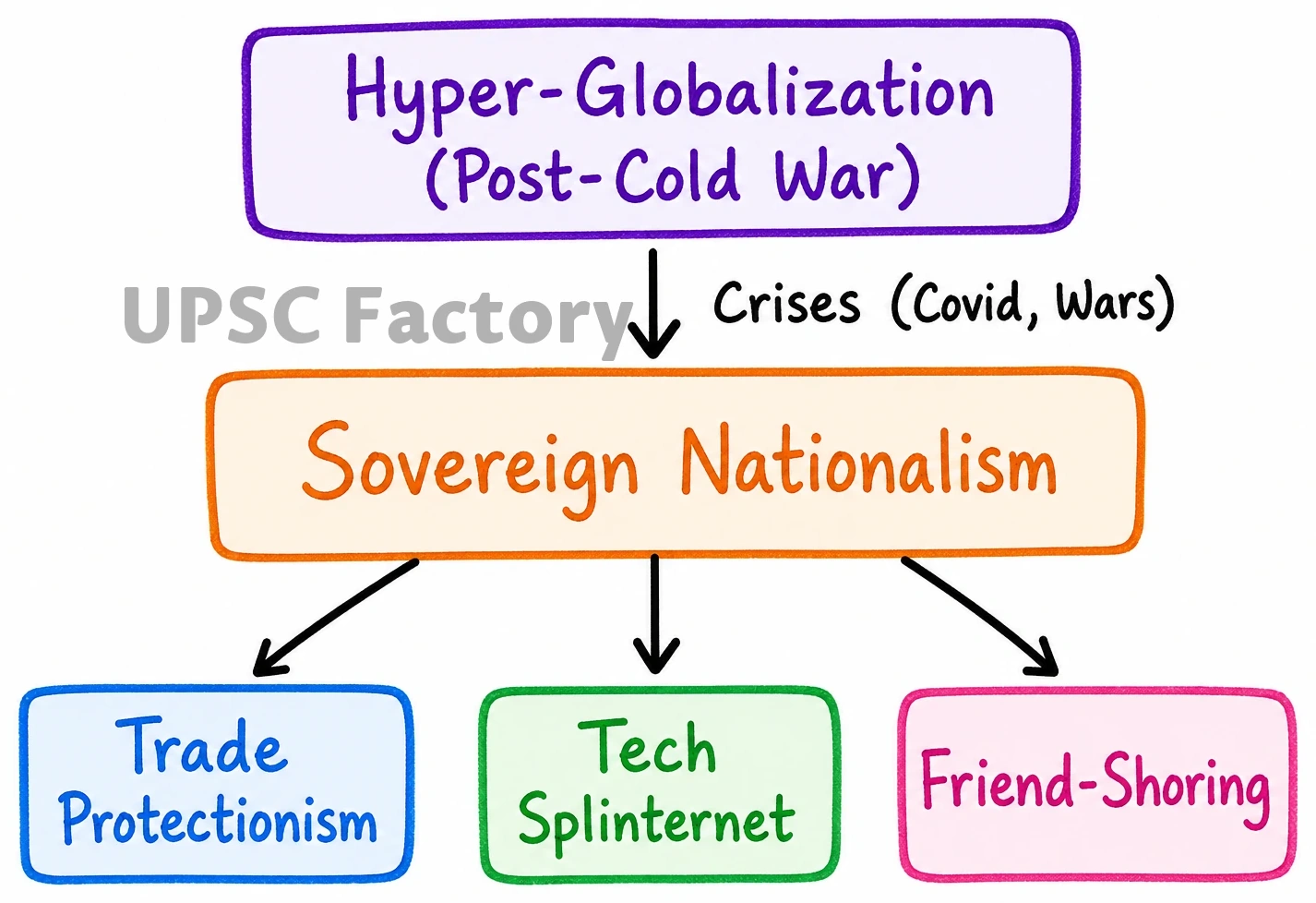
The post-Cold War era of hyper-globalization is giving way to a fragmented world order driven by protectionism, where states prioritize “sovereign nationalism” and self-interest over deep integration.
Indicators of Waning Globalization

  • Economic Protectionism: Free trade is being replaced by tariff walls and localized industrial policies (US-China trade war, WTO appellate paralysis).
  • Weaponization of Supply Chains: Vulnerabilities in critical dependencies have triggered structural decoupling (EU reducing reliance on Russian energy).
  • Technological Fragmentation: The global commons is dividing into a “Splinternet” with stringent tech-export controls (US CHIPS and Science Act).
  • Border Fortification: Retrogression of free movement in favor of strict immigration controls (Brexit, US border policies).

Manifestations of Sovereign Nationalism

  • Drive for Strategic Autonomy: States are actively pursuing domestic self-reliance in critical sectors (India’s Atmanirbhar Bharat, EU’s Strategic Compass).
  • Friend-Shoring & Minilateralism: Aligning trade exclusively with geopolitical allies rather than global markets (Quad’s supply chain resilience initiatives).
  • Resource Nationalism: Hoarding of essential goods during crises (Covid-19 vaccine nationalism, Indonesia’s ban on nickel exports).
  • Geopolitical Assertiveness: Unilateral prioritization of territorial and historical claims over international rules (China in the South China Sea).

While sovereign nationalism ensures domestic resilience, transnational challenges like climate change and AI require a balanced “re-globalization” rooted in equitable, diversified, and human-centric multilateralism.
Q. “With the waning of globalization, post-Cold War world is becoming a site of sovereign nationalism.” Elucidate. Read More »

Q. India-Africa digital partnership is achieving mutual respect, co-development and long-term institutional partnerships. Elaborate.

Q. India-Africa digital partnership is achieving mutual respect, co-development and long-term institutional partnerships. Elaborate.

UPSC Mains 2025 GS2 Paper

Model Answer:

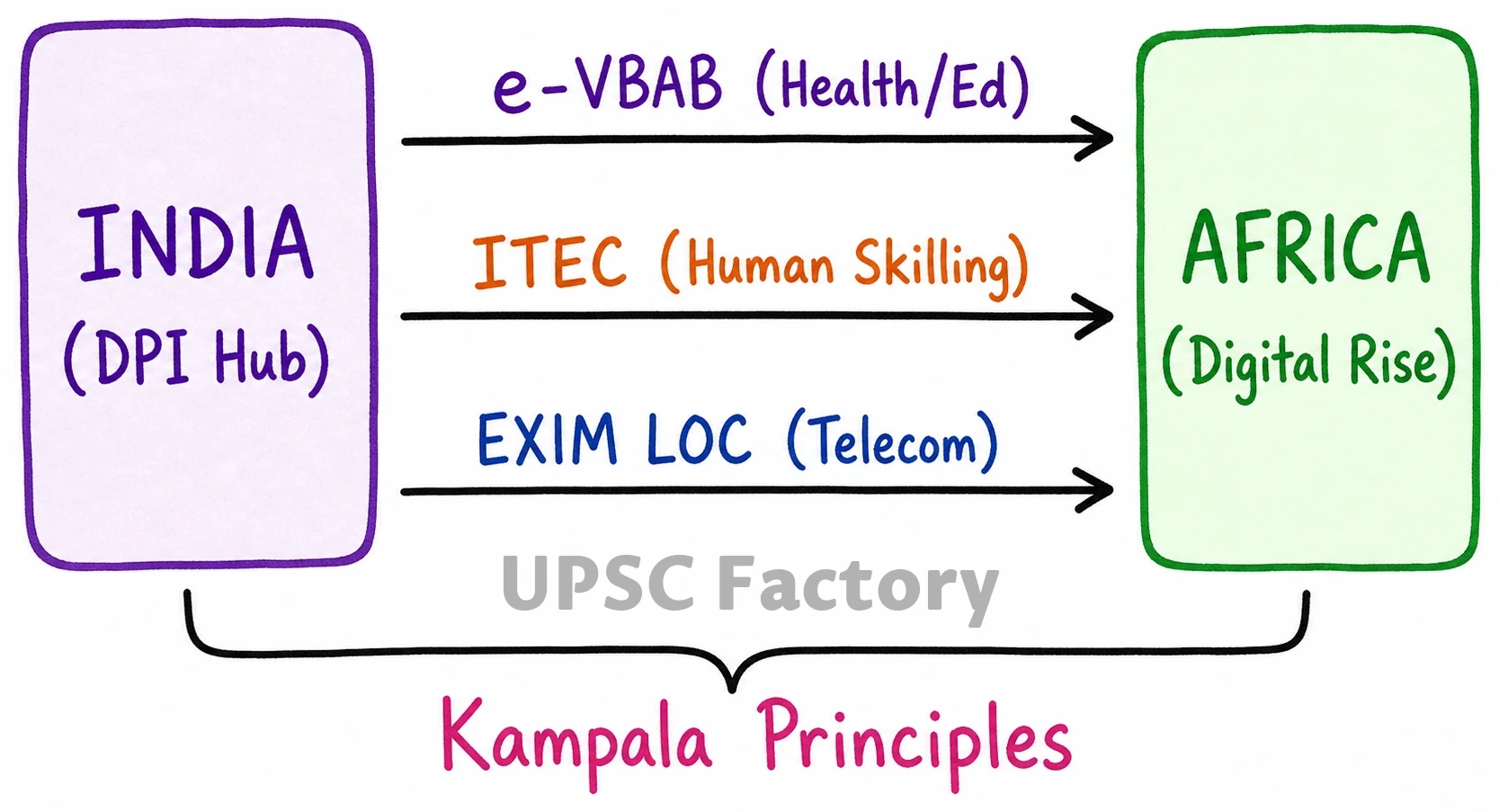
Guided by the Kampala Principles, India’s digital outreach to Africa shifts away from neo-colonial extraction towards equitable capacity-building, leveraging scalable Digital Public Infrastructure (DPI)

1. Driving Mutual Respect and Co-Development

  • Demand-Driven Tech: Deploying adaptable, open-source DPI to leapfrog digital divides without imposing exploitative debt traps (UPI in Mauritius/Namibia).
  • Human Capital Empowerment: Fostering African self-reliance through extensive technological skilling instead of creating vendor dependency (ITEC digital training modules).
  • Socio-Economic Inclusion: Democratizing access to essential cross-border services via inclusive digital connectivity (e-VidyaBharti and e-ArogyaBharti [e-VBAB] network).

2. Establishing Long-Term Institutional Partnerships

  • Permanent Innovation Hubs: Building localized infrastructure for sustainable research, development, and indigenous tech growth (Centres of Excellence in IT [CEITs]).
  • Strategic Multilateral Forums: Anchoring policy synergy and continuous digital engagement through formalized institutional frameworks (India-Africa Forum Summit [IAFS]).
  • Transparent Financing: Institutionalizing structural connectivity projects through sustainable, non-coercive financial mechanisms (EXIM Bank Lines of Credit for regional fiber-optics).

By championing a human-centric, mutually beneficial digital ecosystem, this partnership sets a resilient and formidable template for Global South cooperation and collective self-reliance.

Q. India-Africa digital partnership is achieving mutual respect, co-development and long-term institutional partnerships. Elaborate. Read More »

Q. Civil Society Organizations are often perceived as being anti-State actors than non-State actors. Do you agree? Justify.

Q. Civil Society Organizations are often perceived as being anti-State actors than non-State actors. Do you agree? Justify.

UPSC Mains 2025 GS2 Paper

Model Answer:

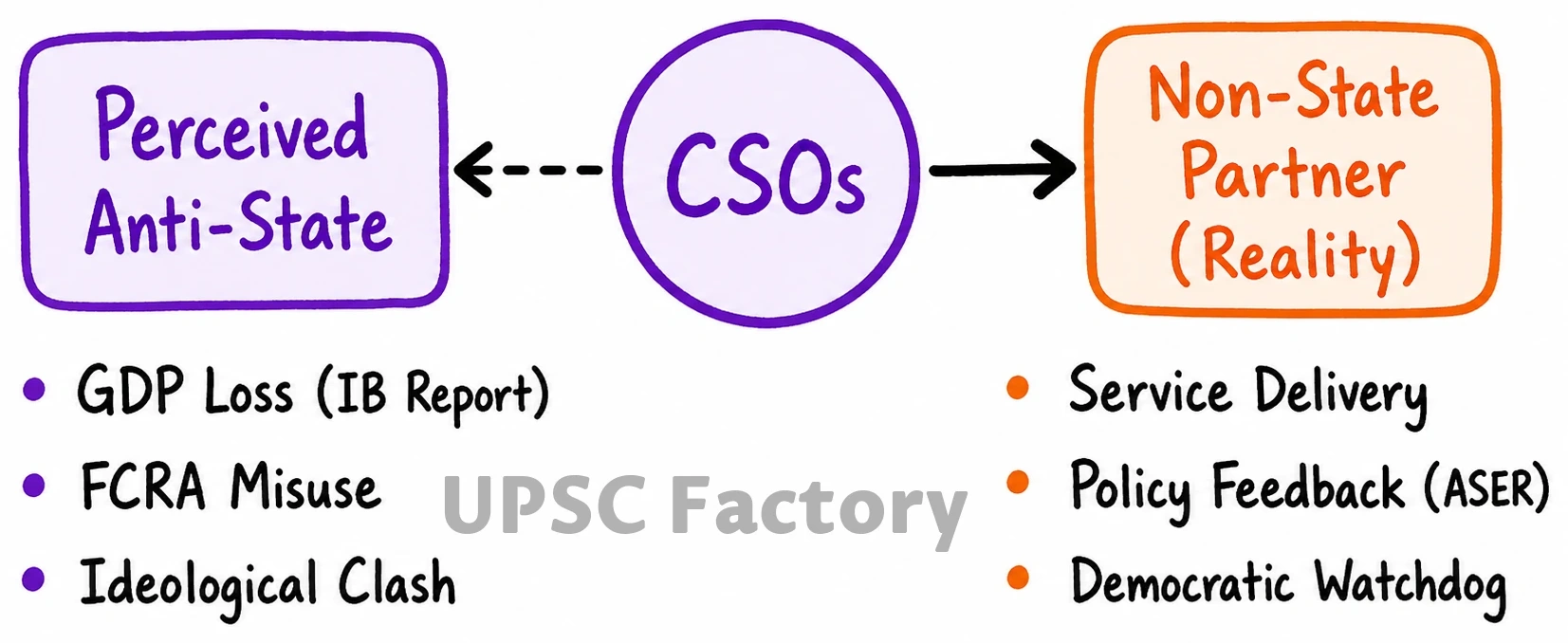
Civil Society Organizations (CSOs) act as the crucial “third sector” of governance. While primarily non-State developmental partners, friction sometimes generates an “anti-State” perception.

1. Factors Driving the “Anti-State” Perception

  • Economic Stalling: Activism delaying critical infrastructure; a 2014 IB Report claimed such protests cause a 2-3% GDP loss.
  • Foreign Interference: Alleged misuse of foreign funds for vested political interests, prompting the stringent FCRA Amendments 2020.
  • Ideological Friction: Direct resistance to State-led development paradigms (e.g., Greenpeace, Narmada Bachao Andolan).
  • Reputational Critiques: Critical human rights advocacy occasionally embarrassing the State internationally (e.g., Amnesty International).

2. CSOs as True “Non-State” Developmental Partners

  • Service Delivery: Filling vast State welfare gaps through grassroots action (e.g., Akshaya Patra managing Mid-Day Meals).
  • Policy Feedback: Providing empirical data to improve developmental outcomes (e.g., Pratham’s ASER reports guiding education).
  • Democratic Watchdogs: Expanding citizen rights and systemic transparency (e.g., MKSS’s foundational role in the RTI Act).
  • Last-Mile Connectivity: Acting as the State’s extended arm during emergencies (e.g., vital NGO relief during COVID-19).

CSOs are not inherently anti-State but act as vital democratic watchdogs. Fostering a symbiotic partnership under the National Policy on Voluntary Sector (2007) is essential for inclusive governance.

Q. Civil Society Organizations are often perceived as being anti-State actors than non-State actors. Do you agree? Justify. Read More »

Q. e-governance projects have a built-in bias towards technology and back-end integration than user-centric designs. Examine.

Q. e-governance projects have a built-in bias towards technology and back-end integration than user-centric designs. Examine.

UPSC Mains 2025 GS2 Paper

Model Answer:

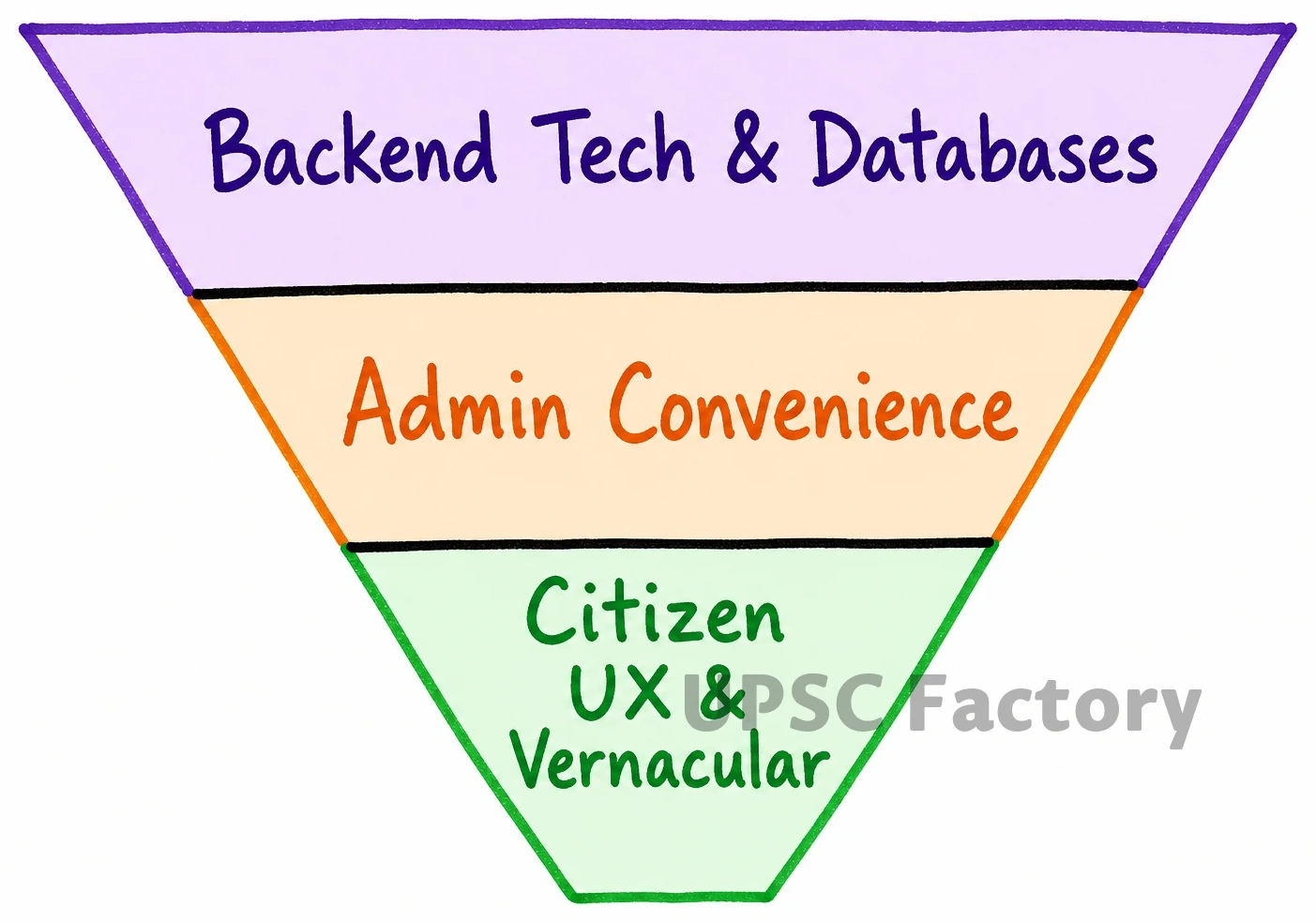
While e-governance enhances efficiency, it often prioritizes administrative convenience and back-end data architecture over seamless, accessible citizen experiences, limiting digital equity.

1. Manifestations & Reasons for Tech Bias

  • Vendor-driven models: Outsourced IT firms prioritize complex backend database architecture over grassroots UX/UI testing.
  • Administrative convenience: Focus remains on inter-departmental data integration and monitoring rather than simplifying citizen interfaces.
  • Language & interface barriers: Systems frequently lack vernacular or voice-assisted support (e.g., initial CoWIN portal’s English/smartphone barrier).
  • Compliance over usability: Government portals are often cluttered and bureaucratic, frequently ignoring the Guidelines for Indian Government Websites (GIGW).

2. Impacts & Need for Citizen-Centric Shift

  • Exclusion errors: Marginalized users struggle to navigate complex portals, leading to welfare denial (e.g., Aadhaar authentication/OTP failures).
  • Widening digital divide: Tech-heavy platforms inadvertently favor urban, tech-savvy, and digitally literate populations.
  • Design solutions: E-governance requires a proactive shift towards omnichannel accessibility, integrating tools like Bhashini for AI-led local language support.
  • Unified ecosystems: Transitioning toward intuitive, user-friendly, single-window platforms (e.g., UMANG app) simplifies citizen interactions.

As highlighted by the 2nd ARC (11th Report), e-governance must transition from a “technology-first” mindset to a “citizen-first” design to ensure truly inclusive and empathetic digital administration.

Q. e-governance projects have a built-in bias towards technology and back-end integration than user-centric designs. Examine. Read More »

Q. Women’s social capital complements in advancing empowerment and gender equity. Explain.

Q. Women’s social capital complements in advancing empowerment and gender equity. Explain.

UPSC Mains 2025 GS2 Paper

Model Answer:

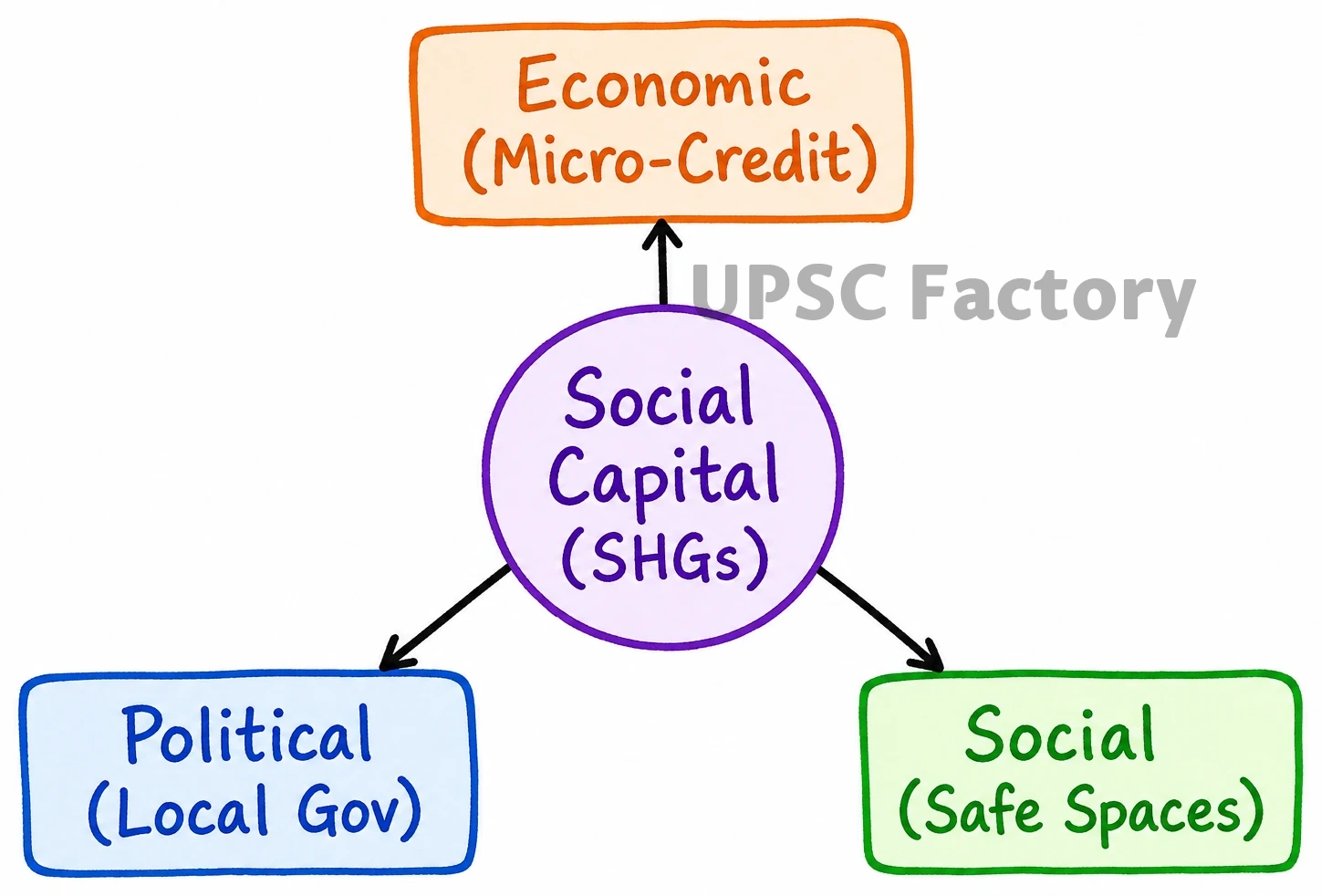
Women’s social capital—fostered through collectives and Self-Help Groups (SHGs)—acts as a structural catalyst for multi-dimensional empowerment and gender equity.

Advancing Multi-Dimensional Empowerment

  • Economic Independence: Pools resources to facilitate micro-credit access and scale female entrepreneurship (DAY-NRLM, ‘Lakhpati Didi’ scheme).
  • Political Agency: Transitions women from domestic confines to active grassroots leadership and local governance (Panchayati Raj networks).
  • Social Solidarity (Bonding Capital): Creates community safe spaces to challenge regressive patriarchal norms and combat gender-based violence (Kudumbashree, Kerala).

Bridging the Gender Divide

  • Collective Bargaining: Amplifies negotiation power for wage parity, property rights, and labor protections in the unorganized sector (SEWA, Gujarat).
  • Institutional Integration (Linking Capital): Bridges systemic gaps by connecting marginalized women directly with formal banking and state development frameworks.
  • Crisis Resilience: Provides decentralized safety nets during socio-economic shocks, preventing the disproportionate regression of female livelihoods into extreme poverty.

Leveraging women’s social capital transforms them from passive welfare beneficiaries into active development agents, accelerating India’s trajectory toward achieving SDG 5 (Gender Equality).

Q. Women’s social capital complements in advancing empowerment and gender equity. Explain. Read More »

Q. “The Attorney General of India plays a crucial role in guiding the legal framework of the Union Government and ensuring sound governance through legal counsel.” Discuss his responsibilities, rights and limitations in this regard.

Q. “The Attorney General of India plays a crucial role in guiding the legal framework of the Union Government and ensuring sound governance through legal counsel.” Discuss his responsibilities, rights and limitations in this regard.

UPSC Mains 2025 GS2 Paper

Model Answer:

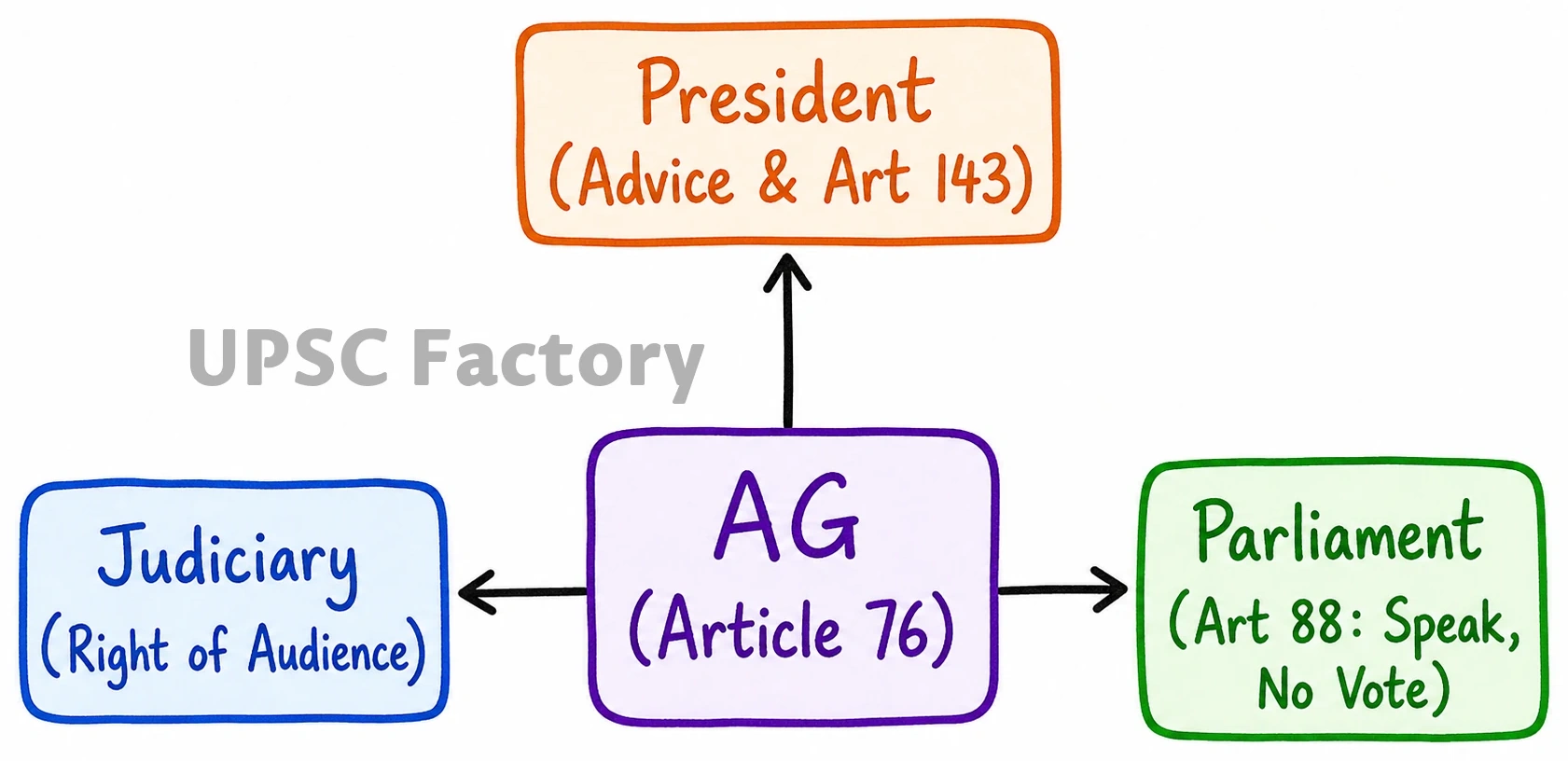
Under Article 76, the Attorney General (AG) is India’s highest law officer, serving as the chief legal advisor to the Union Government and ensuring constitutionally sound governance.

Responsibilities and Rights of the AG

  • Advisory Mandate: Advises the Union on complex legal matters referred by the President.
  • Judicial Representation: Appears for the Government in the Supreme Court and High Courts (e.g., Electoral Bonds case).
  • Presidential References: Represents the Union under Article 143 advisory jurisdiction (e.g., 2G Spectrum case).
  • Right of Audience: Holds the absolute right to appear in all Indian courts.
  • Parliamentary Privileges: Can address and participate in Parliamentary proceedings and committees without voting rights (Article 88).

Limitations on the AG

  • Conflict of Interest: Strictly barred from advising or holding a brief against the Union Government.
  • Criminal Defense: Cannot defend accused persons in criminal prosecutions without explicit government permission.
  • Corporate Roles: Prohibited from accepting corporate directorships without prior government consent.
  • Employment Status: Retains private practice rights since they are not classified as full-time government servants.

Balancing independent legal expertise with state duties, the AG acts as a vital institutional bridge between the executive and the judiciary, upholding the rule of law.

Q. “The Attorney General of India plays a crucial role in guiding the legal framework of the Union Government and ensuring sound governance through legal counsel.” Discuss his responsibilities, rights and limitations in this regard. Read More »

Q. Discuss the nature of Jammu and Kashmir Legislative Assembly after the Jammu and Kashmir Reorganization Act, 2019. Briefly describe the powers and functions of the Assembly of the Union Territory of Jammu and Kashmir.

Q. Discuss the nature of Jammu and Kashmir Legislative Assembly after the Jammu and Kashmir Reorganization Act, 2019. Briefly describe the powers and functions of the Assembly of the Union Territory of Jammu and Kashmir.

UPSC Mains 2025 GS2 Paper

Model Answer:

The J&K Reorganization Act, 2019 transformed Jammu and Kashmir into a Union Territory (UT) with a legislature, functioning under the Article 239A model (similar to Puducherry).

1. Nature of the Post-2019 Legislative Assembly

  • Unicameral Structure: Transitioned from a bicameral legislature to a strictly unicameral Assembly (Legislative Council abolished).
  • Reduced Autonomy: Functions without Article 370’s special status, heavily subordinate to Union oversight.
  • Statutory Devolution: Governed by the 2019 Act’s statutory provisions rather than explicit constitutional entrenchment (unlike Delhi’s Article 239AA).
  • Delimited Representation: Reorganized to 114 seats (including 24 reserved for PoJK), enhancing representation for STs and specific regions.

2. Powers, Functions, and Limitations

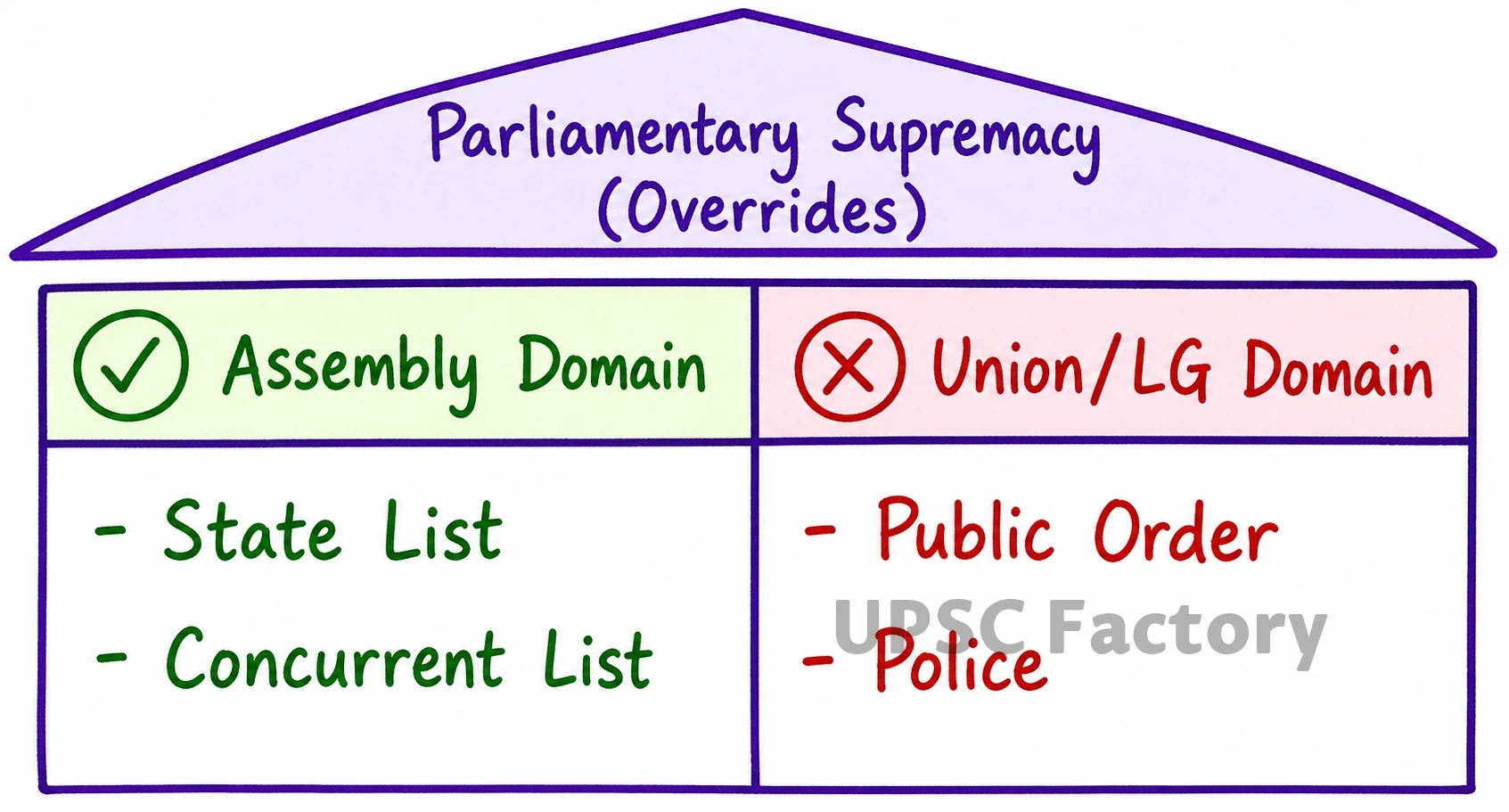
  • Legislative Domain: Empowered to legislate on subjects in the State and Concurrent Lists (Section 32 of the 2019 Act).
  • Explicit Exclusions: Strictly barred from legislating on ‘Public Order’ and ‘Police’ (retained by the Centre).
  • Executive Oversight: A Council of Ministers (capped at 10% of Assembly strength) is formed to aid and advise the Lieutenant Governor (LG).
  • Overriding Discretion: The LG holds expansive veto powers and direct administrative control over All-India Services and the Anti-Corruption Bureau.
  • Parliamentary Supremacy: Parliament retains concurrent legislative jurisdiction; Union laws definitively override Assembly laws in any repugnancy.

Though structurally constrained and possessing reduced legislative competence compared to its former Statehood, the Assembly remains a crucial institutional mechanism for ensuring localized democratic representation and grassroots governance.

Q. Discuss the nature of Jammu and Kashmir Legislative Assembly after the Jammu and Kashmir Reorganization Act, 2019. Briefly describe the powers and functions of the Assembly of the Union Territory of Jammu and Kashmir. Read More »

Q. Compare and contrast the President’s power to pardon in India and in the USA. Are there any limits to it in both the countries? What are preemptive pardons?

Q. Compare and contrast the President’s power to pardon in India and in the USA. Are there any limits to it in both the countries? What are preemptive pardons?

UPSC Mains 2025 GS2 Paper

Model Answer:

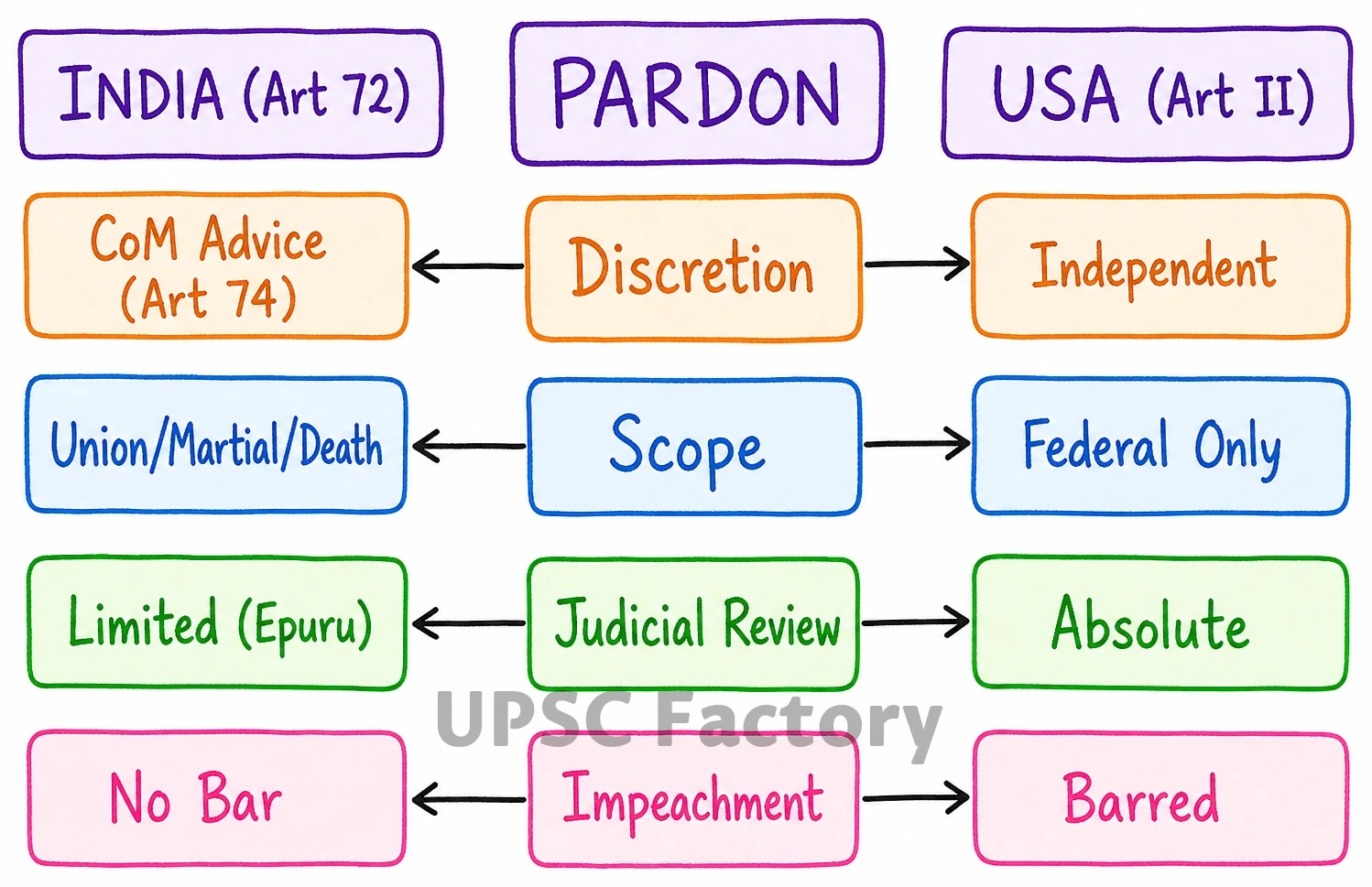
Article 72 (India) and Article II, Section 2 (USA) empower their respective Presidents to grant pardons, acting as a constitutional safeguard against judicial fallibility and harshness.

1. Comparison & Limitations: India vs. USA

  • Executive Discretion: The US President acts independently; the Indian President mandates the binding advice of the Council of Ministers (Article 74).
  • Jurisdictional Scope: US pardons apply strictly to federal offences; Indian pardons cover Union laws, court-martials, and all death sentences.
  • Impeachment Limits: The US President is explicitly barred from granting pardons in cases of impeachment; India lacks this specific restriction.
  • Judicial Review (Limitations): US pardoning power is virtually absolute; Indian pardons are subject to limited judicial review on grounds of arbitrariness or mala fide intent (Epuru Sudhakar v. Govt of AP).

2. Preemptive Pardons

  • Definition: Clemency granted before any formal charges are filed or convictions occur, fully shielding the individual from future prosecution.
  • Applicability: Exists exclusively in the USA (e.g., Gerald Ford pardoning Richard Nixon). India prohibits preemptive pardons; the power operates only after an offence is legally established.

While the US framework grants sweeping, independent executive discretion, India’s system successfully prevents arbitrary misuse through mandatory cabinet advice and judicial review, reflecting a robust separation of powers.

Q. Compare and contrast the President’s power to pardon in India and in the USA. Are there any limits to it in both the countries? What are preemptive pardons? Read More »

Q. Comment on the need of administrative tribunals as compared to the court system. Assess the impact of the recent tribunal reforms through rationalization of tribunals made in 2021.

Q. Comment on the need of administrative tribunals as compared to the court system. Assess the impact of the recent tribunal reforms through rationalization of tribunals made in 2021.

UPSC Mains 2025 GS2 Paper

Model Answer:

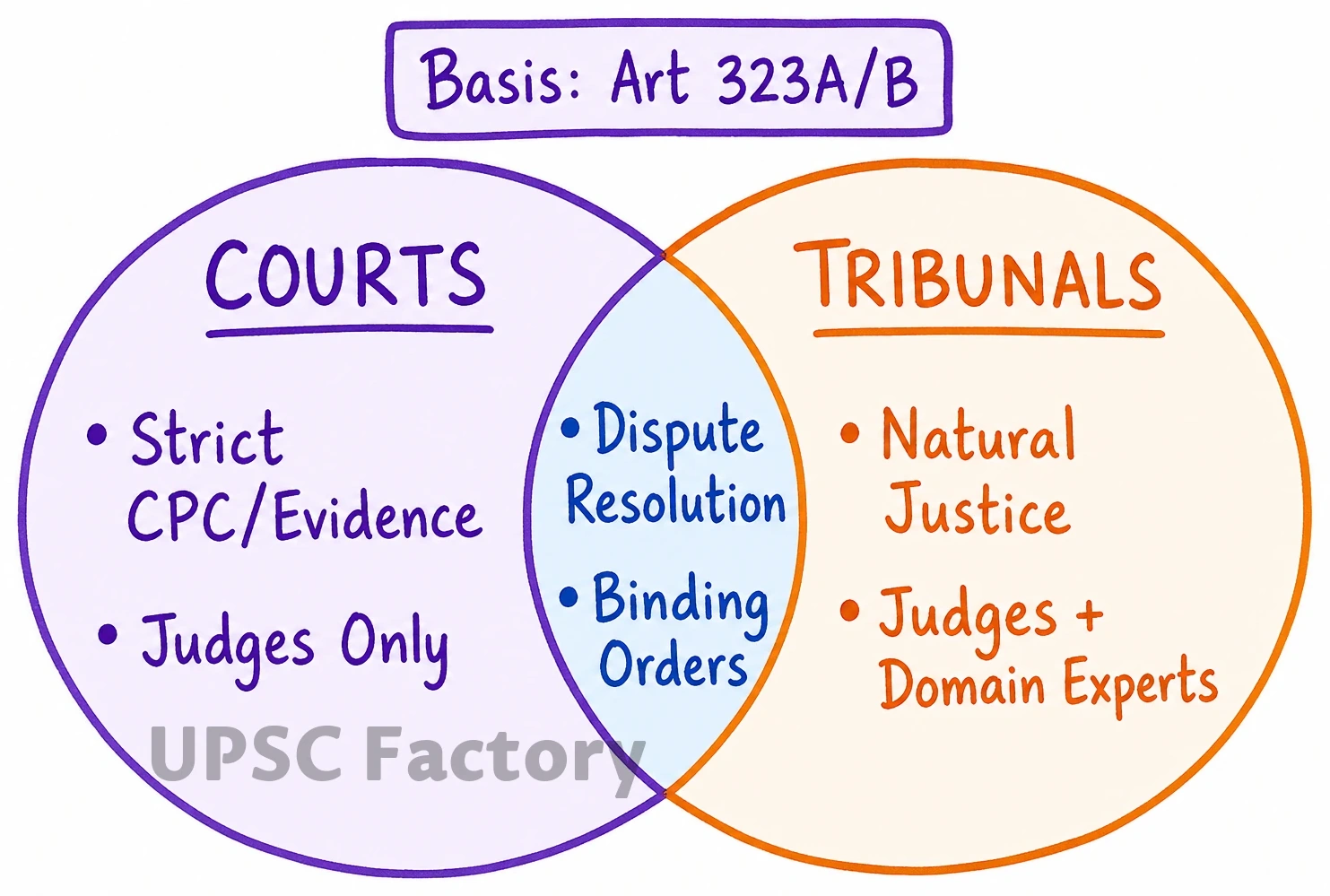
Inserted under Articles 323A and 323B (42nd Amendment, Swaran Singh Committee), tribunals provide specialized, parallel dispute resolution to bypass traditional judicial bottlenecks.

Need for Administrative Tribunals vs. Court System

  • Domain Expertise: Integrates subject-matter experts alongside judicial members for technical disputes (e.g., NGT for environment).
  • Procedural Flexibility: Guided by principles of natural justice, remaining unburdened by strict CPC or Evidence Act codes.
  • Decongesting Judiciary: Diverts specialized litigation, alleviating the massive backlog of regular courts.
  • Cost and Speed: Ensures rapid, economically accessible, and simplified dispute resolution for citizens and administration.

Impact of Tribunal Reforms Act, 2021

  • Forum Consolidation: Abolished non-essential appellate bodies (FCAT, IPAB), transferring their jurisdiction to High Courts and Commercial Courts.
  • Resource Efficiency: Reduced the public exchequer’s financial burden by streamlining overlapping and underperforming jurisdictions.
  • Risk of Overburdening: Re-transferring cases risks re-choking High Courts that currently lack specialized benches (e.g., Intellectual Property).
  • Independence Concerns: Executive dominance in Search-cum-Selection Committees and shorter tenures raised judicial independence issues (Madras Bar Association case).

While rationalization streamlines administrative adjudication, establishing an independent National Tribunals Commission is essential to ensure infrastructural autonomy and preserve specialized justice delivery.

Q. Comment on the need of administrative tribunals as compared to the court system. Assess the impact of the recent tribunal reforms through rationalization of tribunals made in 2021. Read More »

Q. Discuss the ‘corrupt practices’ for the purpose of the Representation of the People Act, 1951.

Q. Discuss the ‘corrupt practices’ for the purpose of the Representation of the People Act, 1951. Analyze whether the increase in the assets of the legislators and/or their associates, disproportionate to their known sources of income, would constitute ‘undue influence’ and consequently a corrupt practice.

UPSC Mains 2025 GS2 Paper

Model Answer:

Section 123 of the Representation of the People Act (RPA), 1951 defines “corrupt practices” that can void an election, safeguarding democratic integrity.

1. Corrupt Practices under RPA 1951 (Section 123)

  • Bribery: Offering or accepting gratification to influence voting or contesting.
  • Undue Influence: Direct/indirect interference with the free exercise of electoral rights (Section 123(2)).
  • Identity Appeals: Soliciting votes on grounds of religion, race, caste, or language.
  • Malpractices: Publishing false statements, booth capturing, or exceeding prescribed campaign expenditure limits.

2. Disproportionate Assets (DA) as ‘Undue Influence’

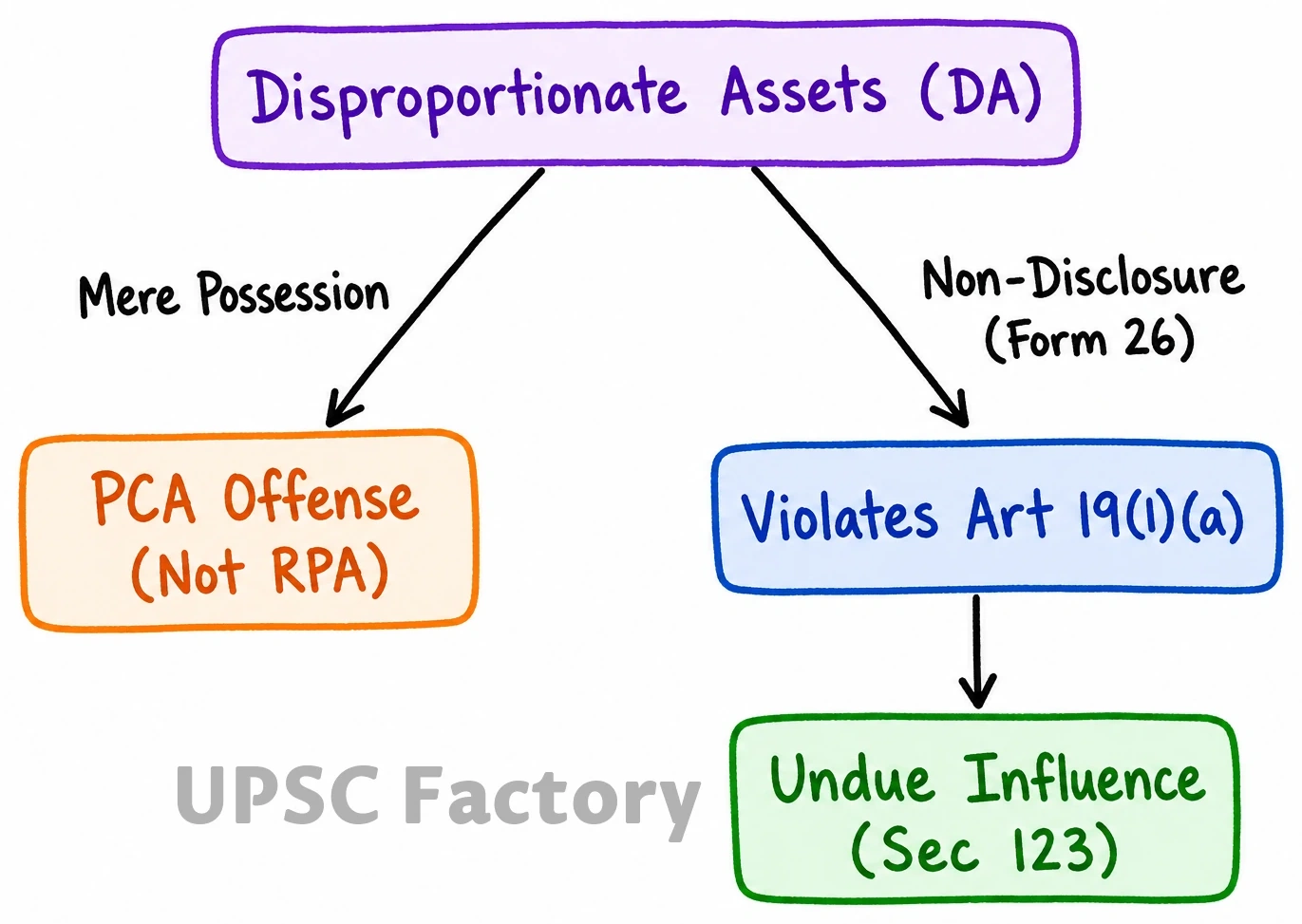
  • Distinct Statutory Offense: Mere possession of DA is penalized under the Prevention of Corruption Act, but is not inherently “undue influence” under RPA.
  • The Lok Prahari Ruling (2018): The Supreme Court clarified that the non-disclosure of DA sources, rather than mere possession, constitutes undue influence.
  • Infringing Voter Rights: Concealing DA in Form 26 (Conduct of Election Rules) violates voters’ Right to Know (Article 19(1)(a)), impeding informed choice.
  • Electoral Nullification: Failure to disclose income sources for candidates or dependents is a corrupt practice under Section 123(2), rendering the election liable to be voided.

Classifying asset non-disclosure as undue influence strengthens electoral probity, necessitating proactive verification of candidate affidavits by the Election Commission to ensure transparency.

Q. Discuss the ‘corrupt practices’ for the purpose of the Representation of the People Act, 1951. Read More »