UPSC Mains 2025 GS2 Model Answer

Q. “The reform process in the United Nations remains unresolved, because of the delicate imbalance of East and West and entanglement of the USA vs. Russo-Chinese alliance.” Examine and critically evaluate the East-West policy confrontations in this regard.

Q. “The reform process in the United Nations remains unresolved, because of the delicate imbalance of East and West and entanglement of the USA vs. Russo-Chinese alliance.” Examine and critically evaluate the East-West policy confrontations in this regard.

UPSC Mains 2025 GS2 Paper

Model Answer:

UN Reform Deadlock: East-West Policy Confrontations

The United Nations, conceived in 1945’s post-war architecture, faces an existential reform crisis amid the contemporary geopolitical schism between the US-led Western bloc and the Russo-Chinese strategic alignment.

Core East-West Confrontations

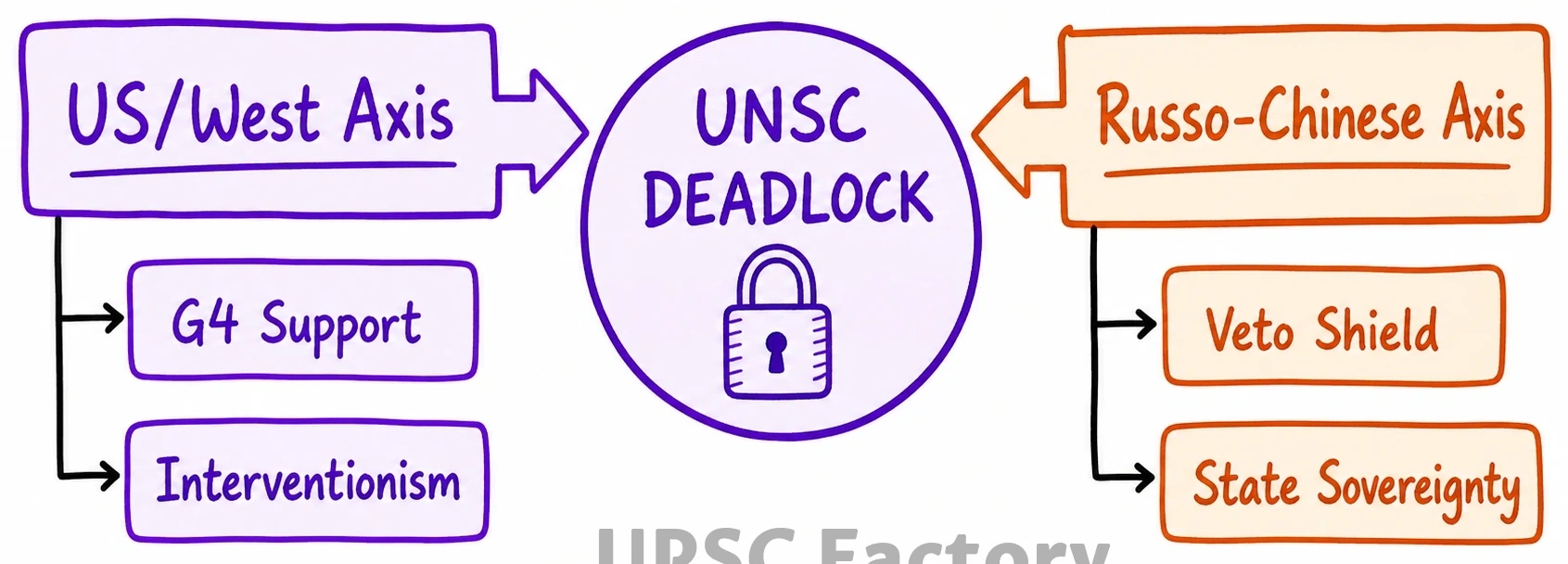
The ideological divergence manifests in fundamental disagreements over UN’s operational philosophy. Western powers champion humanitarian intervention through ‘Responsibility to Protect’ (R2P), viewing it as moral imperative in crises like Libya, Kosovo intervention. Conversely, Russia and China invoke state sovereignty and non-interference principles, dismissing R2P as neo-colonial pretext for regime change operations.

Security Council expansion remains deadlocked through strategic obstruction:
• China blocks Japan (historical grievances, regional rivalry) and resists India’s permanent membership despite bilateral engagement
• Russia supports India but opposes Japan, creating selective vetoes that prevent G4 consensus
• Western powers endorse G4 (India, Japan, Germany, Brazil) but lack unified strategy against Russo-Chinese resistance
• Veto usage intensifies – Syria paralysis, Ukraine deadlock demonstrate P5’s weaponization of procedural privilege

The veto power impasse epitomizes this confrontation. Recent crises witnessed unprecedented veto frequency – Russia’s 17 vetoes on Syria, US-China standoffs on Myanmar, creating institutional paralysis on mass atrocities.

Beyond Binary Confrontation: Critical Assessment

However, attributing reform stalemate solely to East-West tensions oversimplifies complex dynamics:

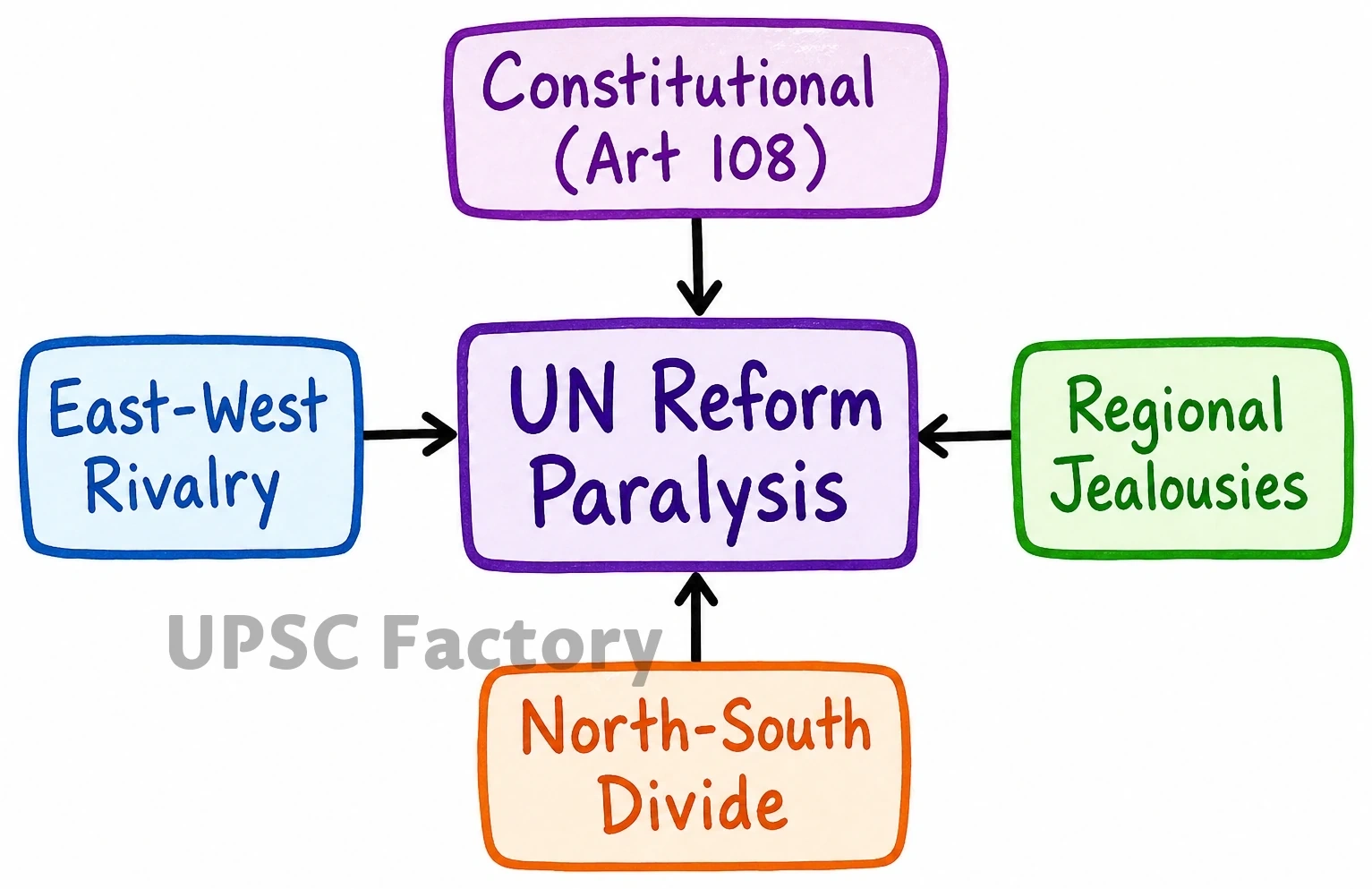
P5’s collective self-preservation transcends ideological divides. Despite confrontations, all permanent members resist diluting their exclusive club’s privileges. France and UK, though supporting expansion rhetorically, maneuver cautiously to preserve influence.

Regional rivalries compound deadlock. The “Uniting for Consensus” coalition – Pakistan against India, Italy opposing Germany, Argentina blocking Brazil – exploits East-West tensions while pursuing parochial agendas. These cross-cutting cleavages create multiple veto points beyond great power competition.

Middle powers’ emergence (India’s non-alignment 2.0, Brazil’s strategic autonomy, African Union’s collective voice) challenges binary frameworks, demanding accommodation beyond East-West paradigms.

Conclusion:

UN reform remains hostage to East-West confrontations, P5 self-interest, and regional rivalries – threatening multilateralism’s future credibility.

Q. “The reform process in the United Nations remains unresolved, because of the delicate imbalance of East and West and entanglement of the USA vs. Russo-Chinese alliance.” Examine and critically evaluate the East-West policy confrontations in this regard. Read More »

Q. “Energy security constitutes the dominant kingpin of India’s foreign policy, and is linked with India’s overarching influence in Middle Eastern countries.” How would you integrate energy security with India’s foreign policy trajectories in the coming years?

Q. “Energy security constitutes the dominant kingpin of India’s foreign policy, and is linked with India’s overarching influence in Middle Eastern countries.” How would you integrate energy security with India’s foreign policy trajectories in the coming years?

UPSC Mains 2025 GS2 Paper

Model Answer:

Energy Security and India’s Foreign Policy Integration

India’s overwhelming energy import dependency—85% crude oil, 55% natural gas—makes energy security central to foreign policy, necessitating multi-dimensional diplomatic strategies beyond traditional Middle Eastern partnerships.

Current Energy-Foreign Policy Nexus

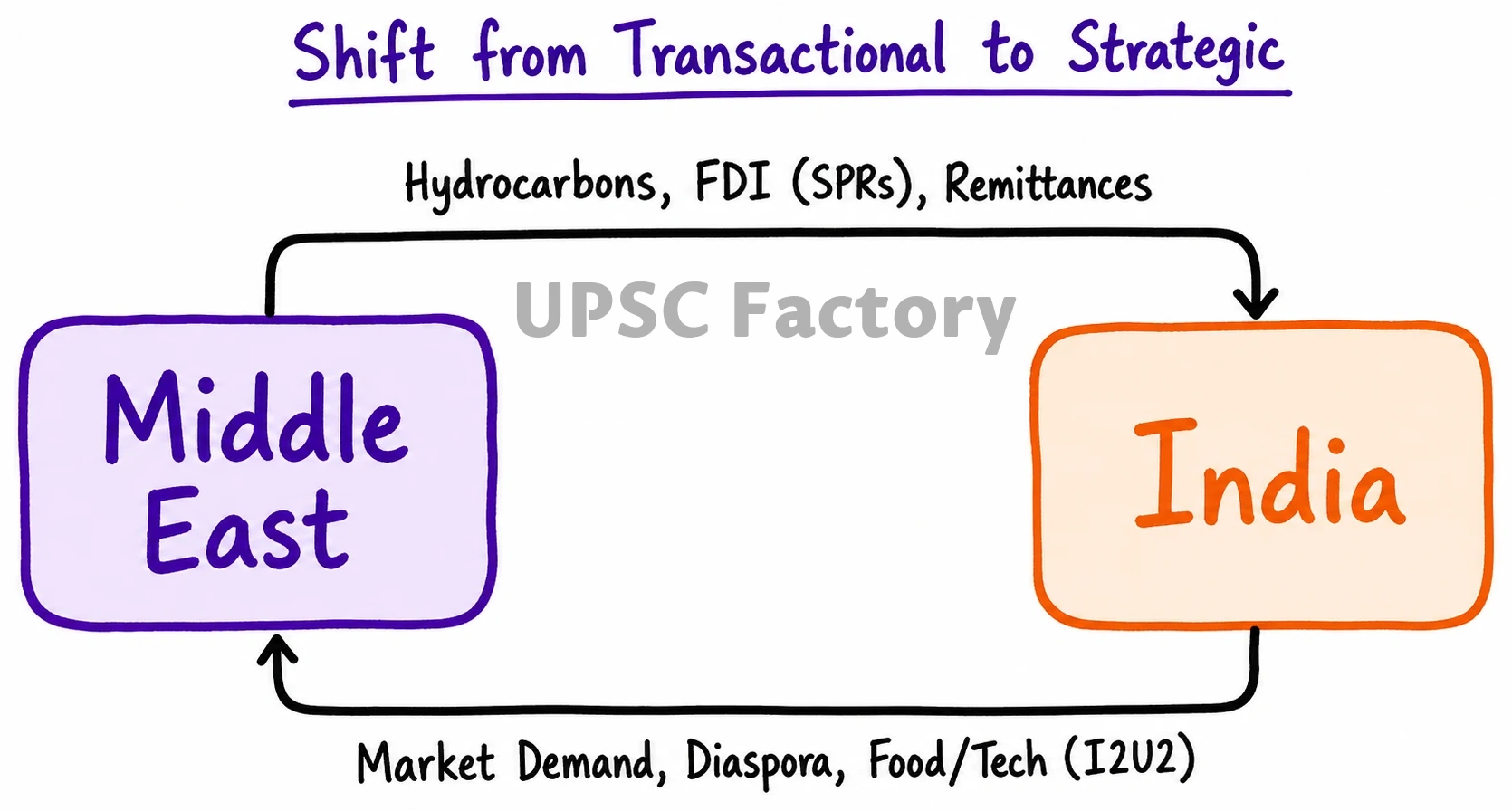
• Middle East Dominance: Supplies 60% of hydrocarbon imports, shaping India’s “Look West Policy” and requiring sustained diplomatic engagement with Gulf nations

• Diplomatic Balancing: India maintains simultaneous partnerships with regional rivals Saudi Arabia, UAE, and Iran, navigating sectarian tensions to protect energy interests

• Strategic Investments: ONGC Videsh’s overseas acquisitions and joint ventures like Ratnagiri Refinery transform buyer-seller dynamics into comprehensive partnerships

Future Integration Trajectories

1. Geographic and Source Diversification

• Expanding supplier base: India now sources crude from 39 countries, with Russia becoming top supplier post-Ukraine crisis, while exploring Nigerian oil, Mozambique gas, and Venezuelan heavy crude

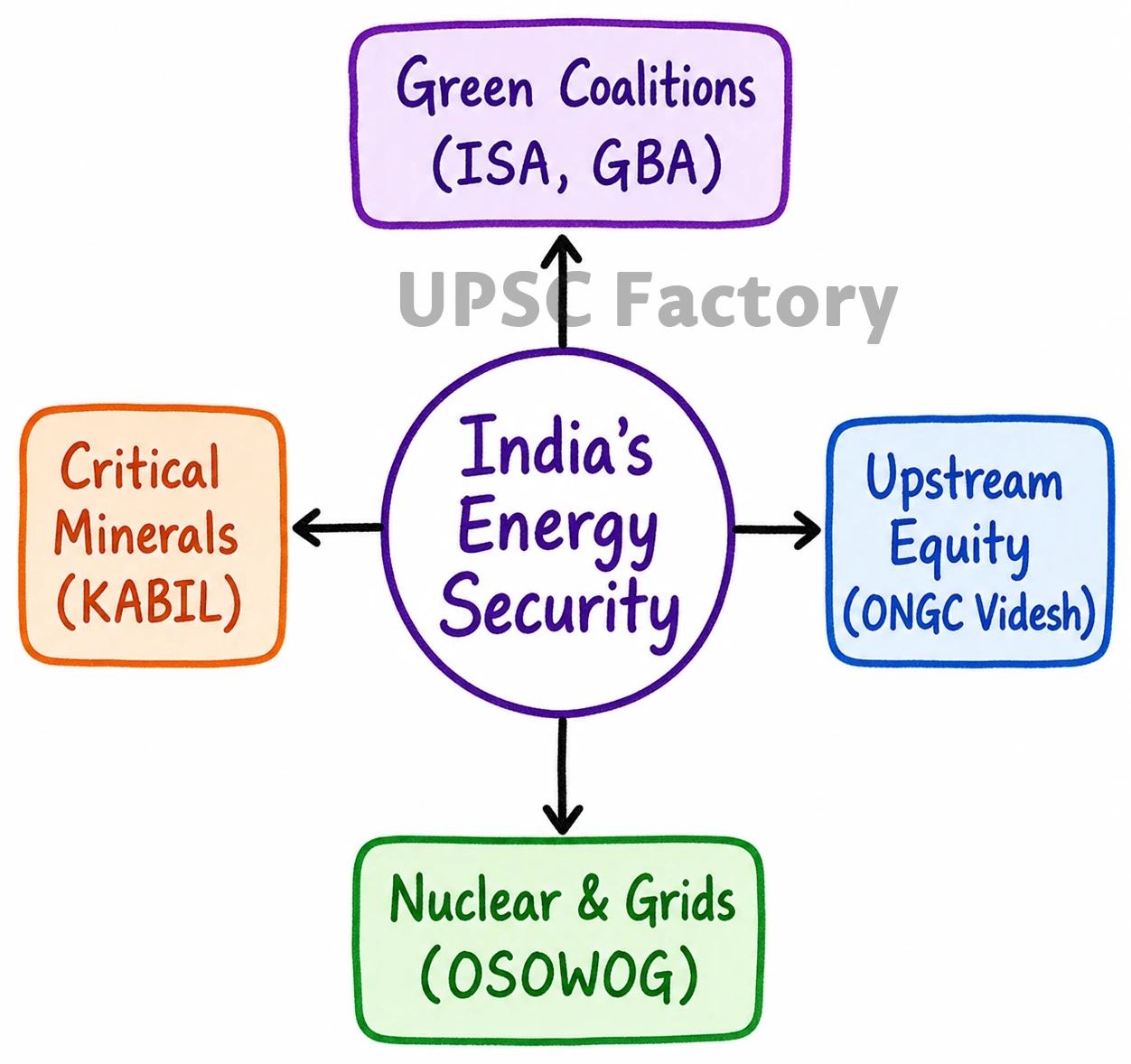
• Clean energy partnerships: Pursuing solar technology with Germany-Japan, green hydrogen cooperation with Australia-EU, and critical minerals diplomacy for lithium in Argentina

2. Strategic Partnership Evolution

• IMEC corridor: This India-Middle East-Europe initiative integrates energy infrastructure with transportation corridors, enhancing connectivity and supply security

• I2U2 Forum: India-Israel-UAE-USA collaboration creates opportunities for renewable investments and technology transfer

• Equity participation: Indian PSUs acquire overseas field stakes, ensuring long-term security through ownership rather than purchase agreements

3. Renewable Energy Leadership

• International Solar Alliance: Leading this 121-member initiative positions India as clean energy leader while attracting technology and investments

• Net Zero 2070 alignment: Climate commitments create diplomatic opportunities for green financing and enhanced global stature

4. Maritime Security Integration

• SLOC protection: With 85% crude via sea routes, India strengthens naval capabilities through QUAD cooperation and SAGAR doctrine

• Chokepoint diplomacy: Engaging nations controlling Strait of Hormuz and Malacca Strait ensures uninterrupted energy flows

5. Domestic Resilience

• Strategic reserves: Expanding from 9.5 to 90 days coverage

• Renewable targets: 500GW capacity by 2030 requires diplomatic efforts for investments and technology

Conclusion: Balancing traditional partnerships with diversification and sustainability determines India’s energy security and global influence.

Q. “Energy security constitutes the dominant kingpin of India’s foreign policy, and is linked with India’s overarching influence in Middle Eastern countries.” How would you integrate energy security with India’s foreign policy trajectories in the coming years? Read More »

Q. The National Commission for Protection of Child Rights has to address the challenges faced by children in the digital era. Examine the existing policies and suggest measures the Commission can initiate to tackle the issue.

Q. The National Commission for Protection of Child Rights has to address the challenges faced by children in the digital era. Examine the existing policies and suggest measures the Commission can initiate to tackle the issue.

UPSC Mains 2025 GS2 Paper

Model Answer:

NCPCR’s Role in Addressing Digital Era Challenges for Children

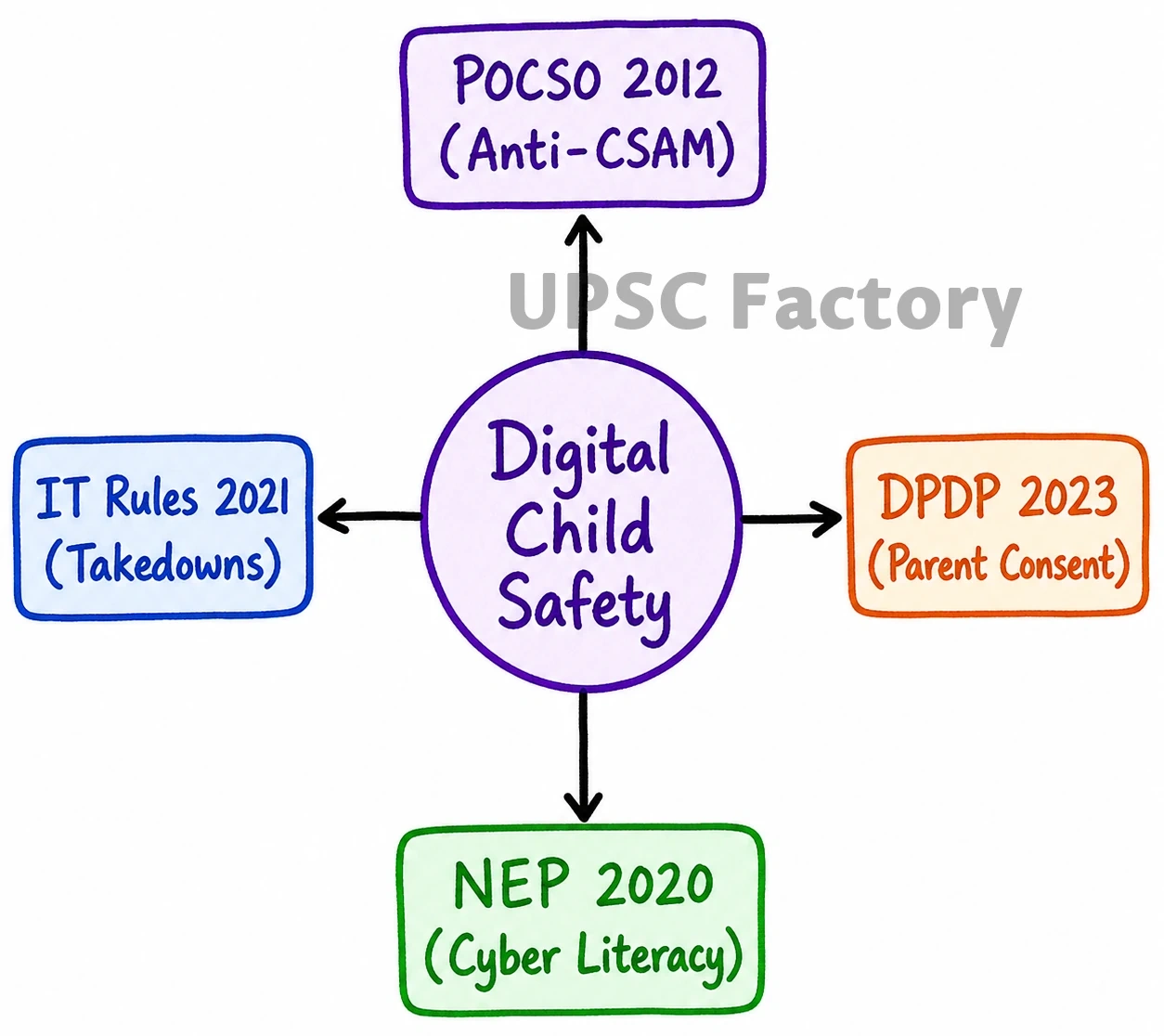
The digital revolution has created unprecedented opportunities alongside significant risks for children. While offering educational resources and connectivity, it exposes them to cyberbullying, online predation, and inappropriate content. The National Commission for Protection of Child Rights (NCPCR), established under the CPCR Act 2005, must evolve its approach to safeguard children’s rights in this complex digital ecosystem.

Existing Policy Framework and Gaps:

India has developed several legislative measures addressing online child safety:

• Information Technology Act, 2000 and IT Rules, 2021 – Mandate social media intermediaries to exercise due diligence and establish grievance redressal mechanisms. However, enforcement remains inconsistent, particularly for smaller platforms.

• POCSO Act, 2012 – Covers online sexual offences including child pornography and grooming (like Instagram predator cases), but struggles with cross-border jurisdiction issues.

• Juvenile Justice Act, 2015 – Addresses child exploitation but lacks specific provisions for emerging threats like deepfakes and AI-generated content.

Critical gaps persist in implementation, with low digital literacy among stakeholders and rapidly evolving technology outpacing regulatory frameworks. The absence of comprehensive data protection laws specifically for children remains a significant vulnerability.

Suggested Measures for NCPCR:

Regulatory Interventions:
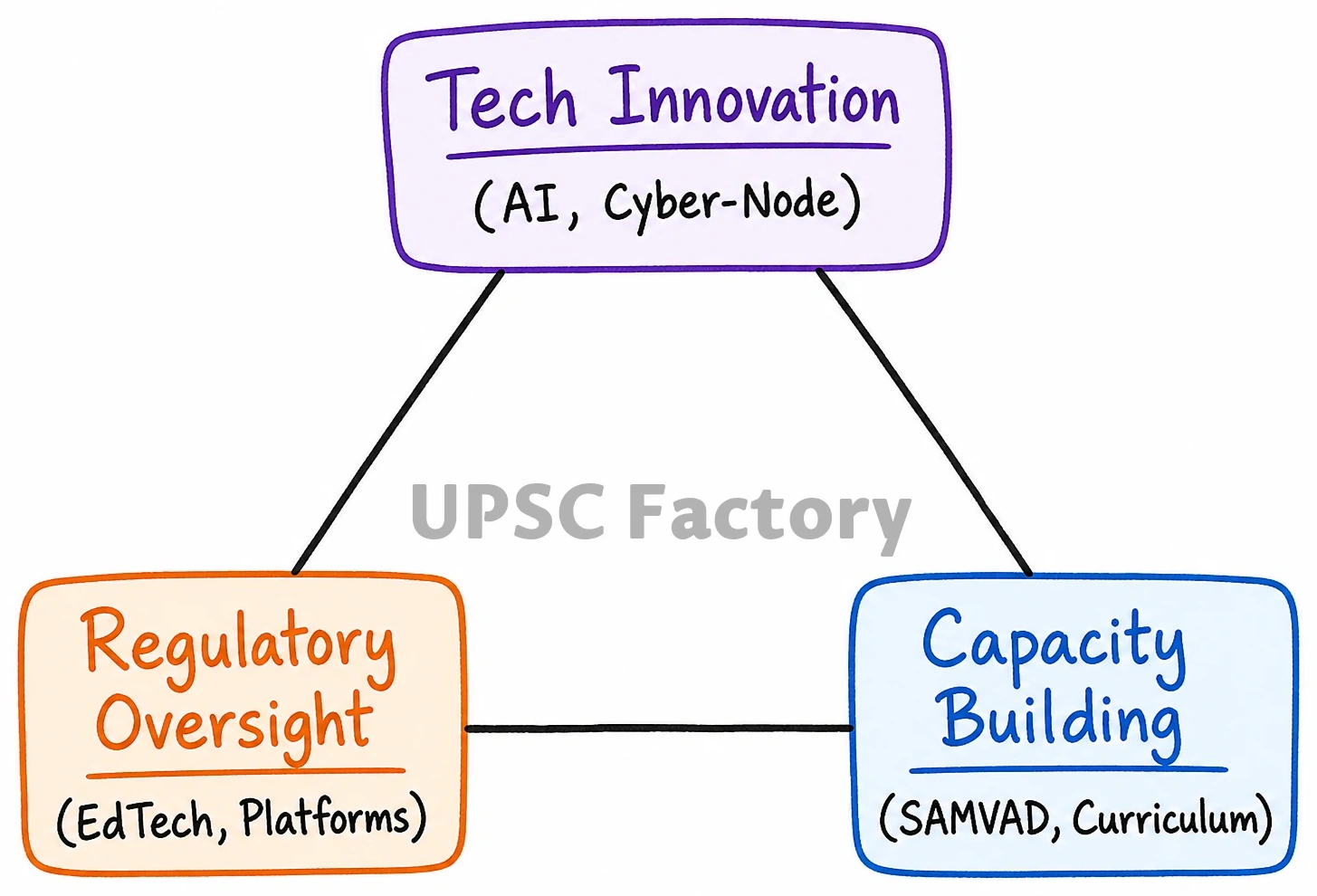
• Develop mandatory age-appropriate design codes for digital platforms targeting children (like YouTube Kids standards)
• Establish stringent compliance mechanisms for ed-tech platforms regarding data collection
• Create specialized guidelines for online gaming platforms addressing addiction concerns (PUBG, Free Fire issues)

Preventive and Support Systems:
• Launch nationwide digital literacy campaigns integrating cyber safety in school curricula from primary level
• Establish 24×7 child-friendly helpline for reporting online abuse with multilingual support
• Develop partnerships with tech companies for implementing parental control features
• Create district-level cyber safety cells for rapid response

Research and Monitoring:
• Commission periodic studies on emerging digital threats
• Maintain centralized database on online crimes against children
• Regular social media audits for child safety compliance

Conclusion: A multi-stakeholder approach combining robust regulation, education, and technology solutions is essential for comprehensive child protection online.

Q. The National Commission for Protection of Child Rights has to address the challenges faced by children in the digital era. Examine the existing policies and suggest measures the Commission can initiate to tackle the issue. Read More »

Q. “In contemporary development models, decision-making and problem-solving responsibilities are not located close to the source of information and execution defeating the objectives of development.” Critically evaluate.

Q. “In contemporary development models, decision-making and problem-solving responsibilities are not located close to the source of information and execution defeating the objectives of development.” Critically evaluate.

UPSC Mains 2025 GS2 Paper

Model Answer:

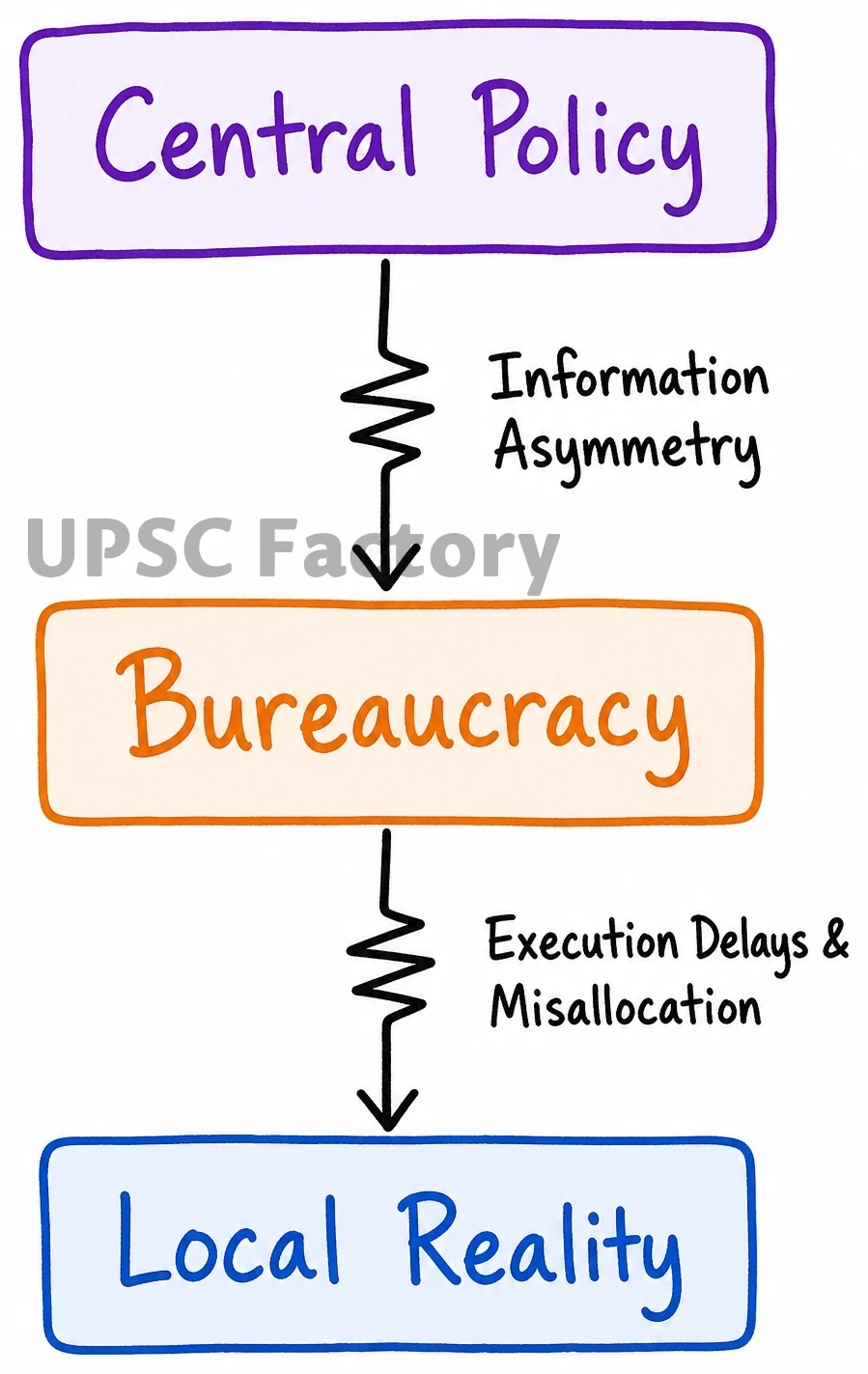
The persistence of centralized decision-making in development administration creates a fundamental disconnect between policy design and ground-level implementation, often undermining the very objectives these models seek to achieve.

Problem with Centralized Models:

Contemporary development frequently suffers from information asymmetry, where distant decision-makers lack understanding of local contexts. This manifests in:

• One-size-fits-all approaches that ignore cultural and geographical specificities – like uniform crop patterns ignoring local soil conditions, or standardized housing schemes disregarding climatic variations

• Resource wastage through misaligned projects – rural roads without connectivity, schools without teachers, or health centers without equipment demonstrate how top-down planning leads to infrastructure falling into disuse

• Absence of community ownership, treating beneficiaries as passive recipients rather than active stakeholders, resulting in poor maintenance and project abandonment post-funding

Shift Towards Decentralization:

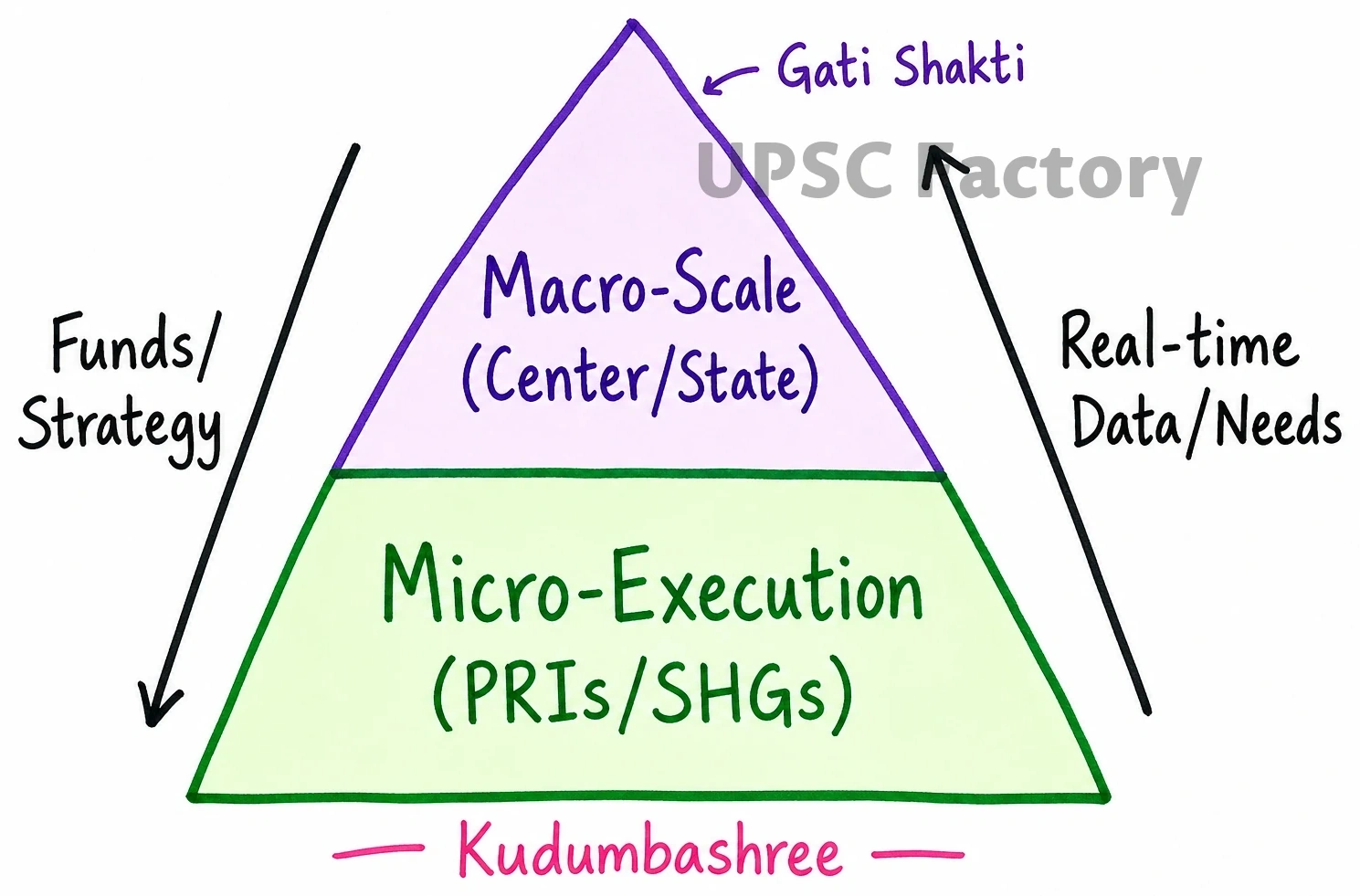
However, contemporary models increasingly recognize these limitations. The 73rd and 74th Constitutional Amendments represent India’s structural commitment to grassroots governance. Programs like MGNREGA empower Gram Sabhas to identify and approve local works, ensuring demand-driven development. The localization of SDGs further emphasizes contextual solutions over imported blueprints. Participatory Development approaches now engage communities throughout project cycles, from planning to evaluation.

Persistent Challenges:

Despite progressive frameworks, implementation gaps persist. Local bodies face the ‘3 Fs’ problem – inadequate devolution of Funds, Functions, and Functionaries. Capacity constraints limit technical expertise at grassroots levels. Elite capture diverts benefits from intended beneficiaries, particularly affecting marginalized communities.

Way Forward:

Effective development requires strengthening local institutions through sustained capacity building, ensuring genuine fiscal devolution with untied funds, institutionalizing social audits for accountability, and leveraging technology for real-time feedback loops between implementation and policy levels.

Q. “In contemporary development models, decision-making and problem-solving responsibilities are not located close to the source of information and execution defeating the objectives of development.” Critically evaluate. Read More »

Q. Inequality in the ownership pattern of resources is one of the major causes of poverty. Discuss in the context of ‘paradox of poverty’.

Q. Inequality in the ownership pattern of resources is one of the major causes of poverty. Discuss in the context of ‘paradox of poverty’.

UPSC Mains 2025 GS2 Paper

Model Answer:

Inequality in Resource Ownership and the Paradox of Poverty

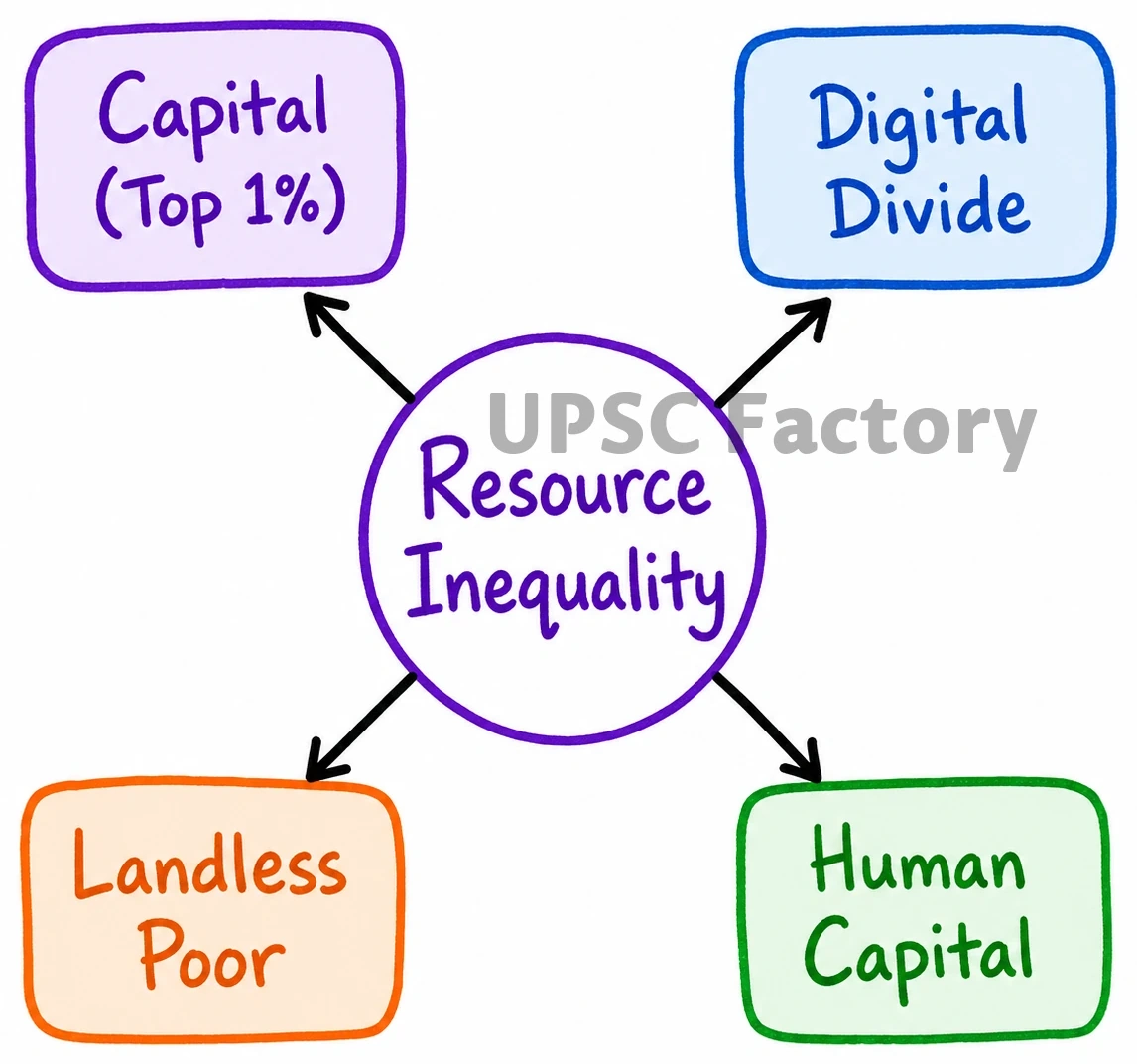
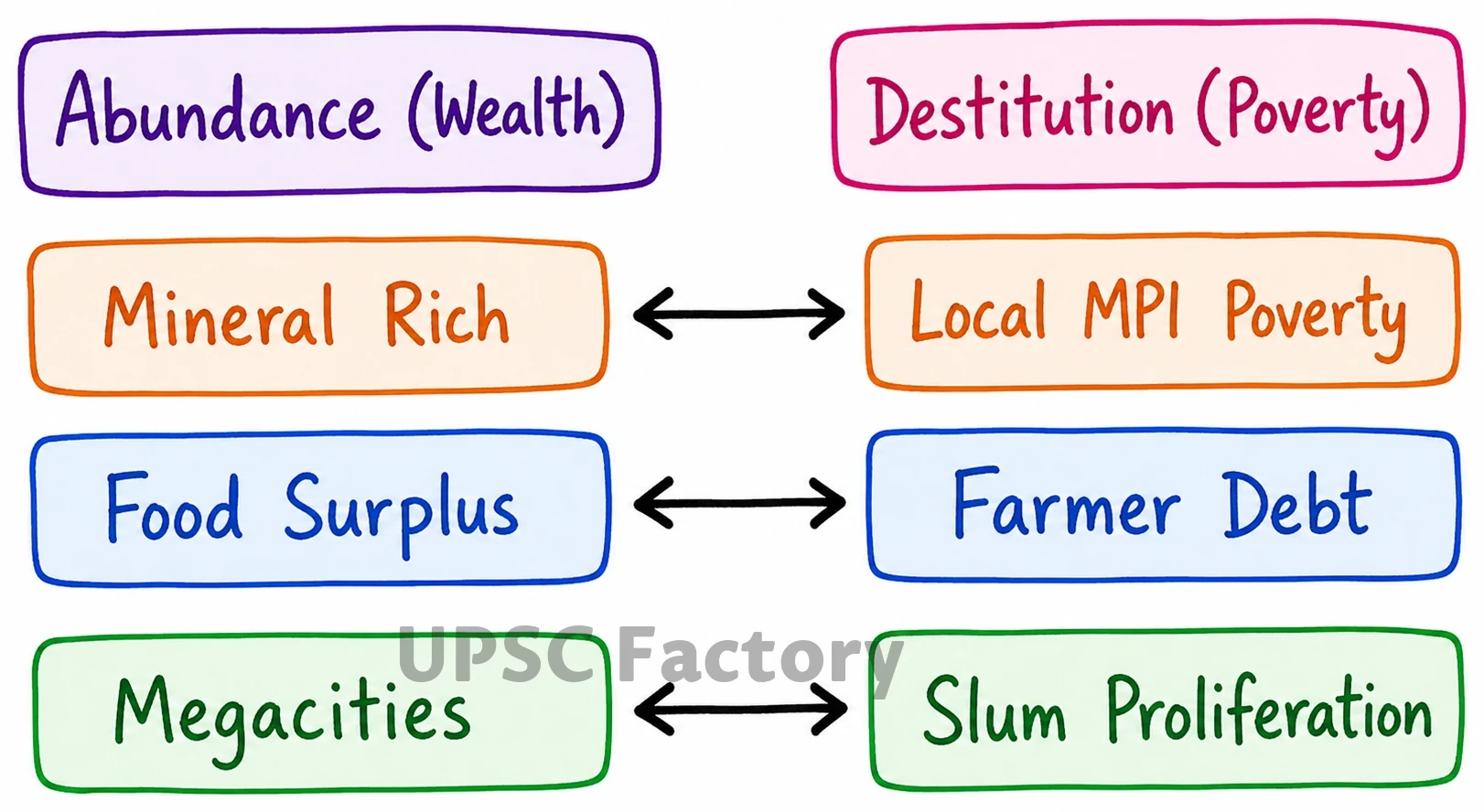
The ‘paradox of poverty’ refers to the contradictory coexistence of abundant resources with widespread poverty. This paradox stems not from resource scarcity but from structural inequalities in ownership and distribution patterns that prevent economic benefits from reaching the majority population.

Manifestations of Unequal Resource Ownership:

Natural Resources
• Land concentration: Small rural elite owns majority agricultural land while large populations remain landless, limiting agricultural livelihoods. Example: Bihar’s zamindari legacy.
• Mineral wealth paradox: Resource-rich states like Jharkhand, Chhattisgarh, and Odisha house India’s poorest communities, particularly tribals. Wealth from coal and iron ore extraction benefits corporations while local communities face displacement and environmental degradation. Example: Niyamgiri hills conflict.

Economic and Financial Resources
• Capital access disparity: Poor lack affordable credit for entrepreneurship while wealthy accumulate more through easy capital access. Financial exclusion traps marginalized in poverty cycles. Example: informal sector workers.
• Industrial concentration: Benefits concentrate among few industrialists while the informal sector, employing majority workforce, remains characterized by low wages and absent social security.

Human Capital Inequality
As Amartya Sen argues, poverty represents capability deprivation. Unequal access to quality education and healthcare perpetuates intergenerational poverty. The affluent secure premier services ensuring better opportunities, while poor depend on underfunded public systems. Example: digital divide during COVID-19.

Institutional Barriers
Elite capture of state resources through political influence ensures policies favor vested interests, undermining welfare schemes’ effectiveness. Historical injustices like caste-based exclusion systematically prevent resource ownership, particularly land, across generations. Example: manual scavenging communities.

Way Forward requires:
– Effective land reforms with tenure security
– Community stakeholdership in resource extraction
– Enhanced public expenditure on education and healthcare
– Expanded financial inclusion through affordable credit
– Robust benefit-sharing mechanisms for local communities

Conclusion:
Addressing structural inequality through redistributive reforms remains fundamental to converting national wealth into inclusive prosperity for all citizens.

Q. Inequality in the ownership pattern of resources is one of the major causes of poverty. Discuss in the context of ‘paradox of poverty’. Read More »

Q. What are environmental pressure groups? Discuss their role in raising awareness, influencing policies and advocating for environmental protection in India.

Q. What are environmental pressure groups? Discuss their role in raising awareness, influencing policies and advocating for environmental protection in India.

UPSC Mains 2025 GS2 Paper

Model Answer:

Environmental Pressure Groups in India

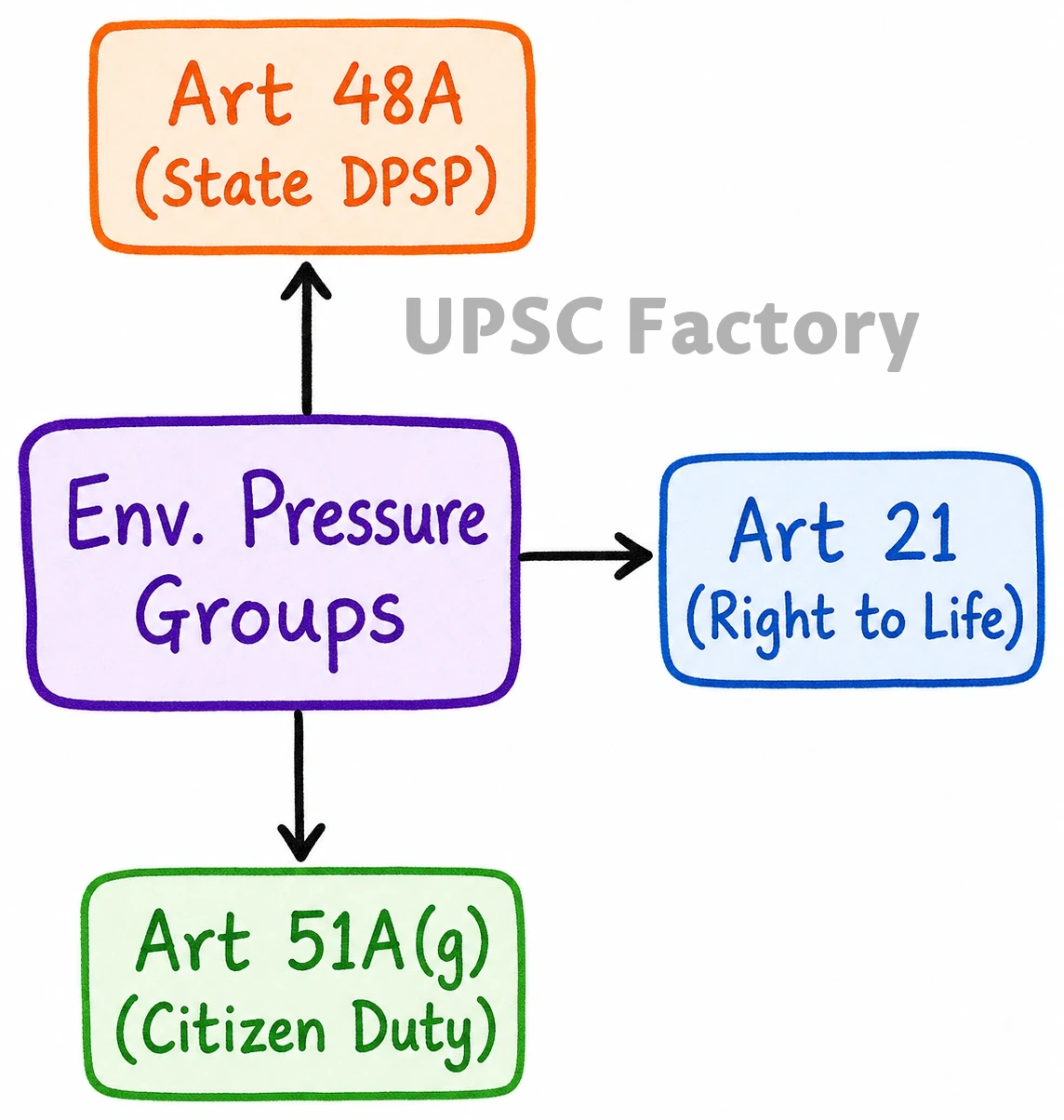
Environmental pressure groups are organized voluntary associations that seek to influence government policies and societal practices concerning environmental issues without seeking political power themselves. In India’s diverse ecological landscape, these non-state actors have emerged as crucial catalysts for environmental governance and sustainable development.

Role in Raising Awareness:

Environmental pressure groups have effectively mobilized public consciousness through multiple strategies:

• Grassroots Mobilization: Historic movements like Chipko Movement (hugging trees), Appiko Movement (Karnataka’s forest protection), and recent campaigns like Fridays for Future India have successfully engaged local communities and youth in environmental discourse.

• Media and Research Dissemination: Organizations like Centre for Science and Environment publish accessible reports on air pollution and water contamination, transforming complex scientific data into public knowledge. Social media campaigns amplify their reach exponentially.

• Highlighting Development Costs: Narmada Bachao Andolan brought international attention to displacement issues and ecological damage from large dams, fundamentally changing the discourse on development projects.

Influencing Policies:

These groups employ sophisticated strategies to shape environmental legislation:

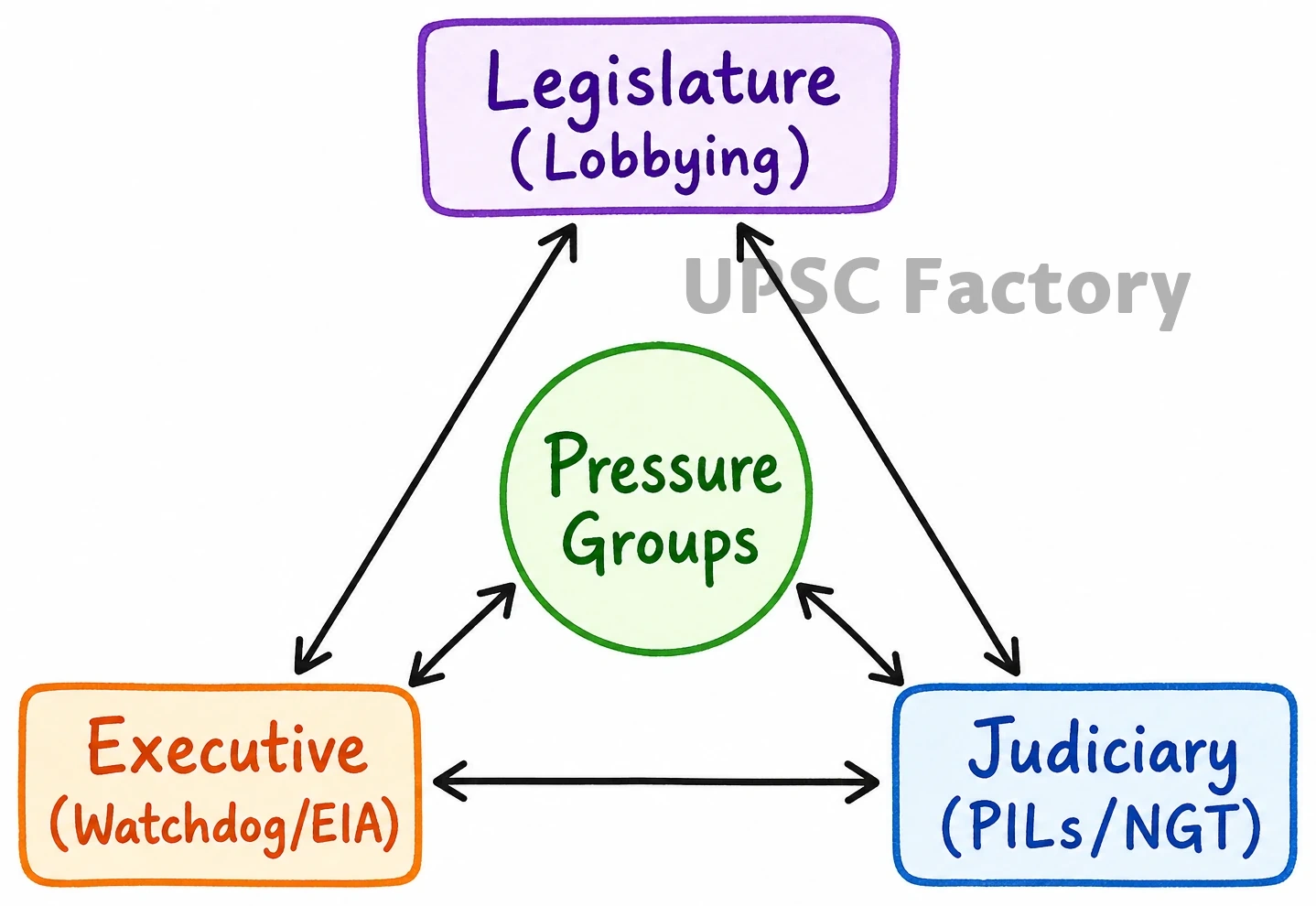
• Legislative Advocacy: Active participation in policy consultations contributed to formulating the Biological Diversity Act, 2002, and strengthening environmental impact assessment procedures.

• Judicial Intervention: M.C. Mehta’s PILs resulted in landmark judgments including CNG mandate (Delhi transport) and Ganga pollution control. The Save Silent Valley Movement prevented hydroelectric project construction, creating Silent Valley National Park.

• Project Opposition: Recent movements like Save Aarey (Mumbai’s green space) have successfully challenged unsustainable infrastructure projects through sustained advocacy.

Advocating for Environmental Protection:

• Direct Conservation Action: Greenpeace India campaigns against coal mining, while Wildlife Protection Society combats poaching and illegal wildlife trade.

• Sustainable Alternatives: Kerala Sastra Sahitya Parishad promotes eco-friendly development models, demonstrating viable alternatives to destructive practices.

• Corporate Accountability: Groups monitor industrial compliance, report violations, and advocate for stricter enforcement mechanisms.

Conclusion: Environmental pressure groups strengthen India’s democracy by bridging citizens and government, ensuring sustainable development through persistent advocacy and accountability.

Q. What are environmental pressure groups? Discuss their role in raising awareness, influencing policies and advocating for environmental protection in India. Read More »

Q. Examine the evolving pattern of Centre-State financial relations in the context of planned development in India. How far have the recent reforms impacted the fiscal federalism in India?

Q. Examine the evolving pattern of Centre-State financial relations in the context of planned development in India. How far have the recent reforms impacted the fiscal federalism in India?

UPSC Mains 2025 GS2 Paper

Model Answer:

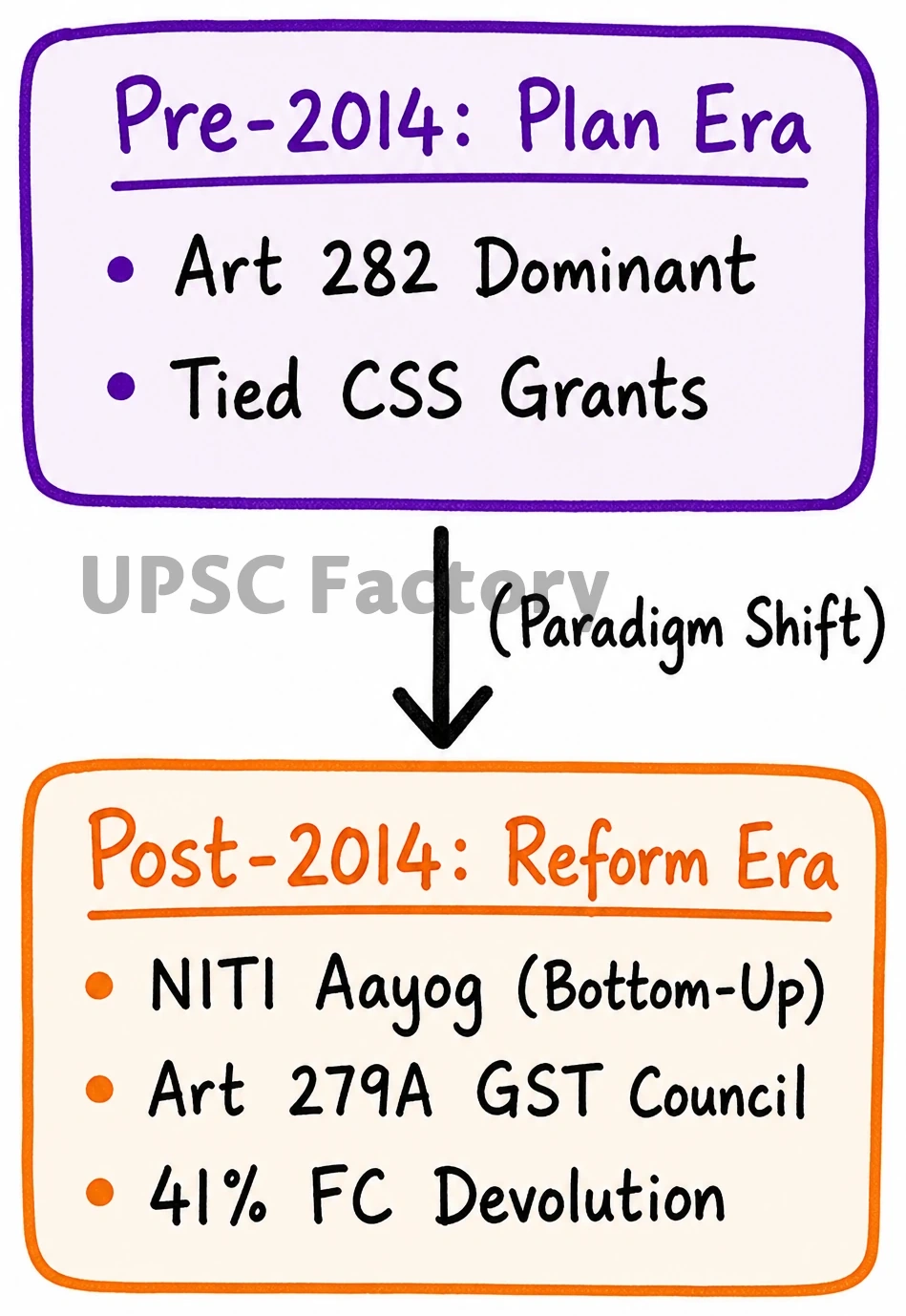
India’s fiscal federalism has transformed from centralized planning to cooperative federalism, fundamentally reshaping Centre-State financial dynamics post-2014.

Evolution During Planned Development Era (1951-2014)

The Planning Commission era epitomized fiscal centralization through discretionary resource allocation. The dual transfer mechanism created structural dependencies:

• Plan Grants: Conditional transfers by Planning Commission tied states to national priorities, limiting autonomous decision-making (e.g., MGNREGA, SSA implementation).

• Non-Plan Grants: Finance Commission’s formula-based transfers addressed revenue gaps but remained insufficient for developmental needs.

• Centrally Sponsored Schemes: One-size-fits-all approach dominated state budgets, with states contributing matching shares despite varying fiscal capacities (ICDS, Mid-Day Meal Scheme).

This architecture fostered “transfer dependency syndrome” where states aligned development priorities with central schemes to access funds, undermining federal principles.

Impact of Recent Reforms on Fiscal Federalism

Institutional Transformation:
The abolition of Planning Commission (2014) and establishment of NITI Aayog marked a shift from “command-and-control” to “collaborate-and-compete” federalism. This ended discretionary plan grants, enhancing predictability in transfers.

Finance Commission Recommendations:
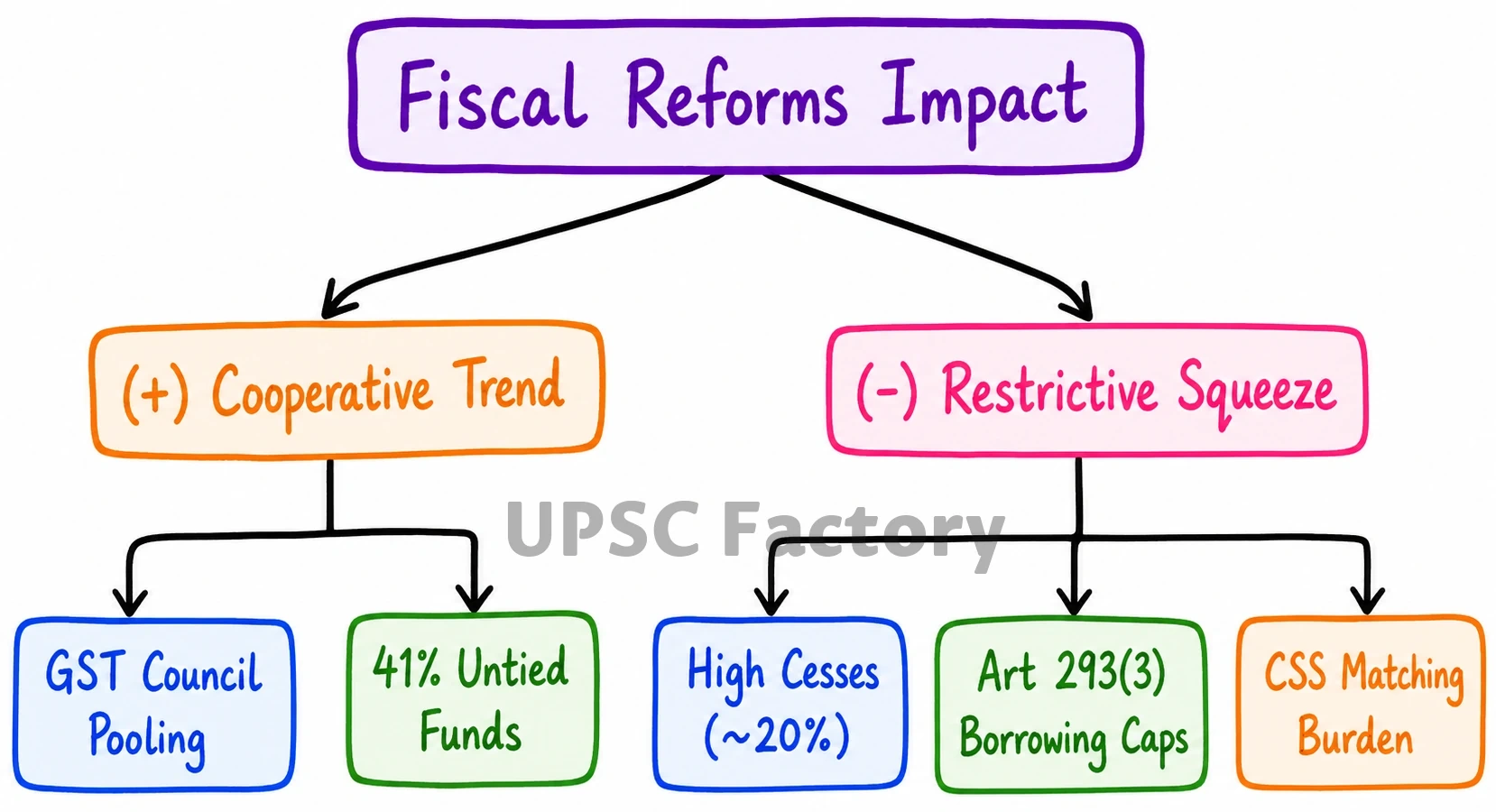
• The 14th FC’s unprecedented increase in tax devolution from 32% to 42% provided states with untied resources, strengthening fiscal autonomy.
• The 15th FC maintained 41% share while introducing performance-based incentives for health, education outcomes.

GST Implementation (2017):
The GST Council exemplifies cooperative federalism with consensual decision-making. However, states surrendered taxation autonomy, creating revenue dependencies. Compensation mechanism disputes (Kerala, Punjab cases) exposed structural tensions.

Emerging Challenges:
• Cesses and surcharges bypass divisible pool—from 10.4% (2010-11) to 20.7% (2020-21) of gross tax revenue.
• CSS continues at 28 schemes, maintaining conditional transfers.
• Borrowing restrictions under FRBM limit state fiscal flexibility during crises (COVID-19 demonstrated).

Conclusion: While reforms enhanced fiscal autonomy through increased devolution, structural issues persist, necessitating balanced cooperative-competitive federalism framework.

Q. Examine the evolving pattern of Centre-State financial relations in the context of planned development in India. How far have the recent reforms impacted the fiscal federalism in India? Read More »

Q. Discuss the evolution of collegium system in India. Critically examine the advantages and disadvantages of the system of appointment of the Judges of the Supreme Court of India and that of the USA.

Q. Discuss the evolution of collegium system in India. Critically examine the advantages and disadvantages of the system of appointment of the Judges of the Supreme Court of India and that of the USA.

UPSC Mains 2025 GS2 Paper

Model Answer:

Evolution of Collegium System in India

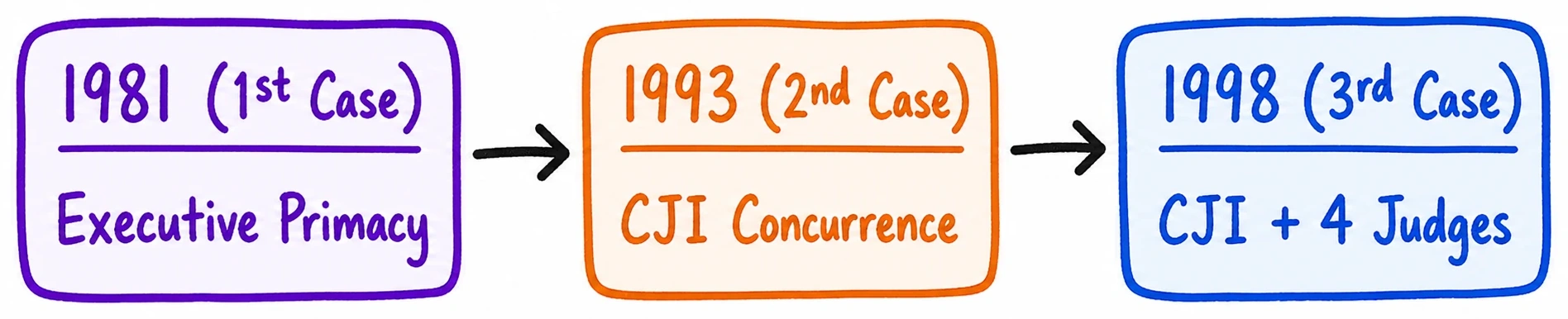
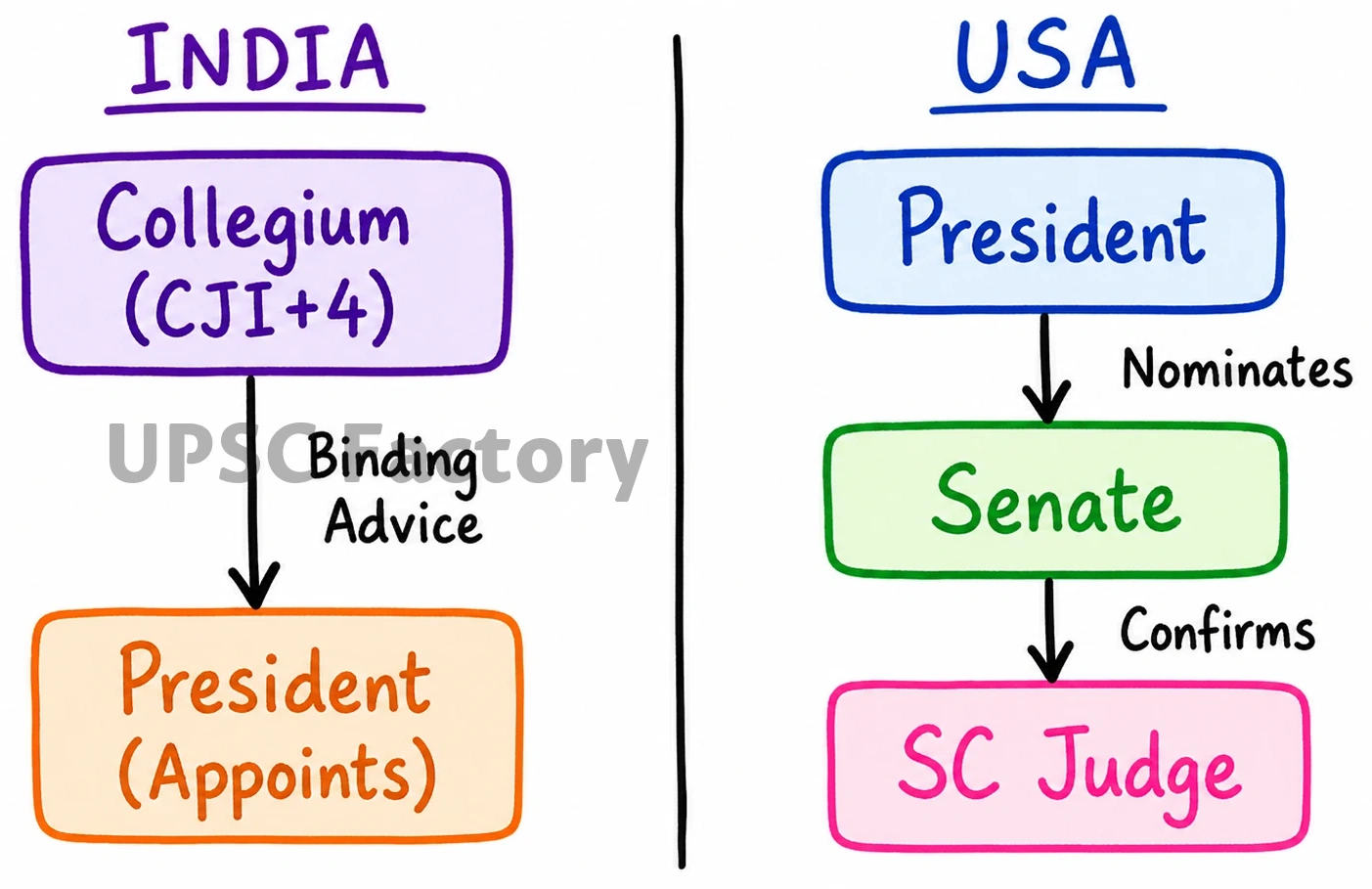
The collegium system in India emerged through judicial interpretation rather than constitutional design. Articles 124 and 217 mandated Presidential appointment of judges after “consultation” with the Chief Justice of India (CJI). The system evolved through landmark judgments:

• First Judges Case (S.P. Gupta, 1981) – interpreted “consultation” as non-binding, granting executive primacy in appointments
• Second Judges Case (1993) – reversed earlier position; held “consultation” meant “concurrence,” birthing collegium system with CJI and two senior-most judges
• Third Judges Case (1998) – expanded collegium to five judges for Supreme Court, three for High Courts
• NJAC attempt (2014) – 99th Amendment sought replacement with National Judicial Appointments Commission
• NJAC struck down (2015) – Supreme Court declared it violated Constitution’s basic structure

Critical Analysis of Indian Collegium System:

Advantages:
• Preserves judicial independence – shields judiciary from political pressure, preventing situations like ADM Jabalpur during Emergency
• Merit-based assessment – judges better understand judicial competence, integrity requirements for effective adjudication
• Maintains separation of powers – prevents executive dominance over judicial branch, protecting constitutional democracy
• Protects from electoral politics – insulates appointments from changing political equations

Disadvantages:
• Opaque functioning – closed-door decisions breed suspicion, allegations of “uncle-judge syndrome” persist
• Absence of accountability – no formal selection criteria, public scrutiny, or grievance redressal mechanism
• Limited representation – women constitute less than 15% of higher judiciary; marginalized communities underrepresented
• Self-perpetuating system – “judges appointing judges” creates insularity

US System Analysis:

Advantages:
• Democratic legitimacy – Senate confirmation ensures people’s voice through elected representatives
• Transparent proceedings – public hearings allow scrutiny (Justice Barrett’s confirmation)
• Comprehensive vetting – FBI background checks, judiciary committee examination
• Checks and balances – inter-branch cooperation required

Disadvantages:
• Extreme politicization – partisan battles overshadow merit (Bork rejection, Garland blockade)
• Ideological considerations – Presidents seek philosophical alignment over pure competence
• Lengthy confirmation battles – political gridlock delays appointments
• Public spectacle – character assassination attempts during hearings

Conclusion: India needs transparent selection criteria with judicial primacy intact, avoiding both opacity and politicization for optimal justice delivery.

Q. Discuss the evolution of collegium system in India. Critically examine the advantages and disadvantages of the system of appointment of the Judges of the Supreme Court of India and that of the USA. Read More »

Q. Indian Constitution has conferred the amending power on the ordinary legislative institutions with a few procedural hurdles.

Q. Indian Constitution has conferred the amending power on the ordinary legislative institutions with a few procedural hurdles. In view of this statement, examine the procedural and substantive limitations on the amending power of the Parliament to change the Constitution.

UPSC Mains 2025 GS2 Paper

Model Answer:

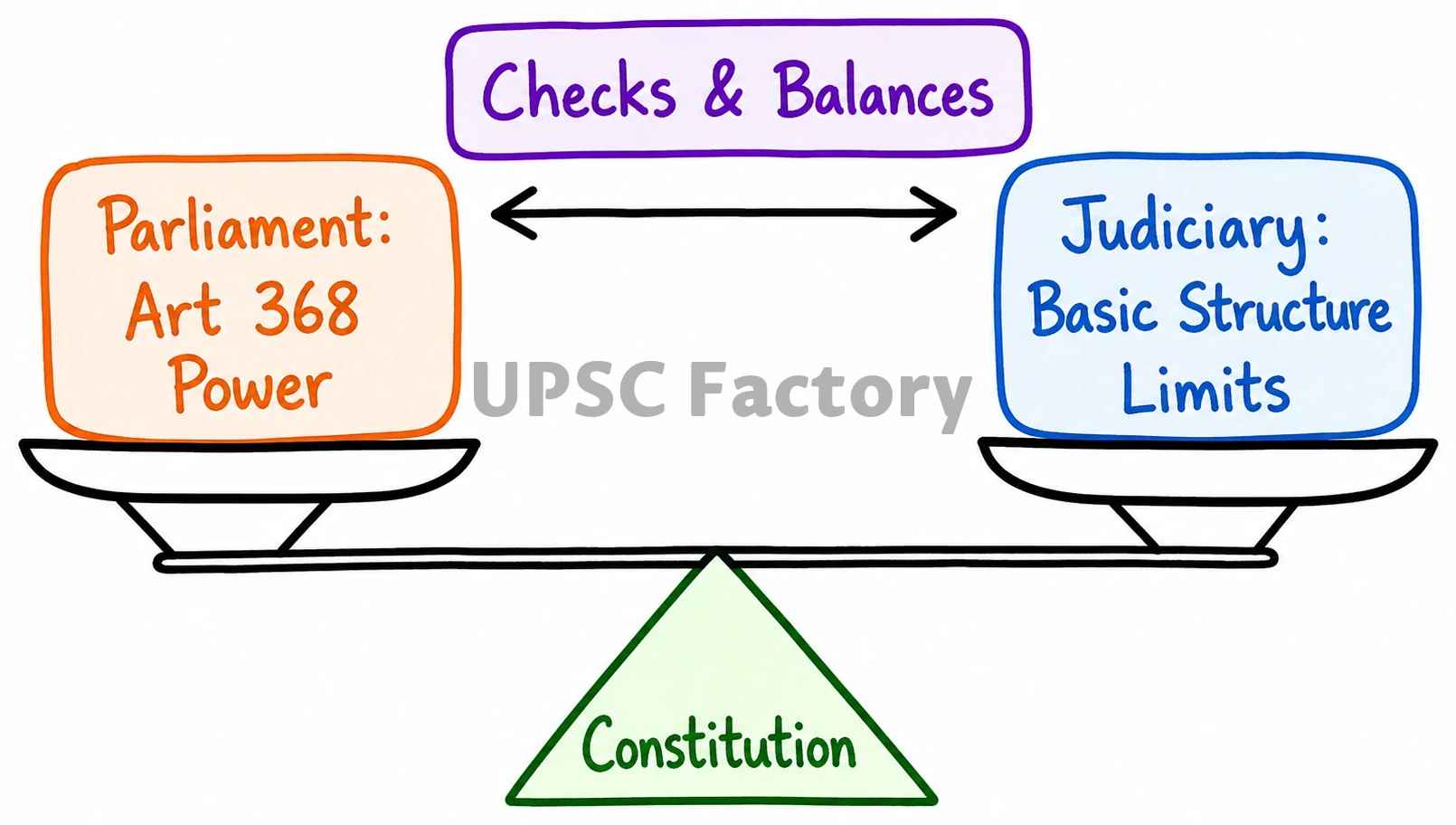
The Indian Constitution empowers Parliament to amend it through Article 368, but this power operates within carefully designed procedural requirements and judicially-evolved substantive boundaries. The framers rejected both extreme rigidity and flexibility, creating a nuanced multi-tiered amendment process that balances adaptability with constitutional sanctity.

Procedural Limitations: A Graduated Approach

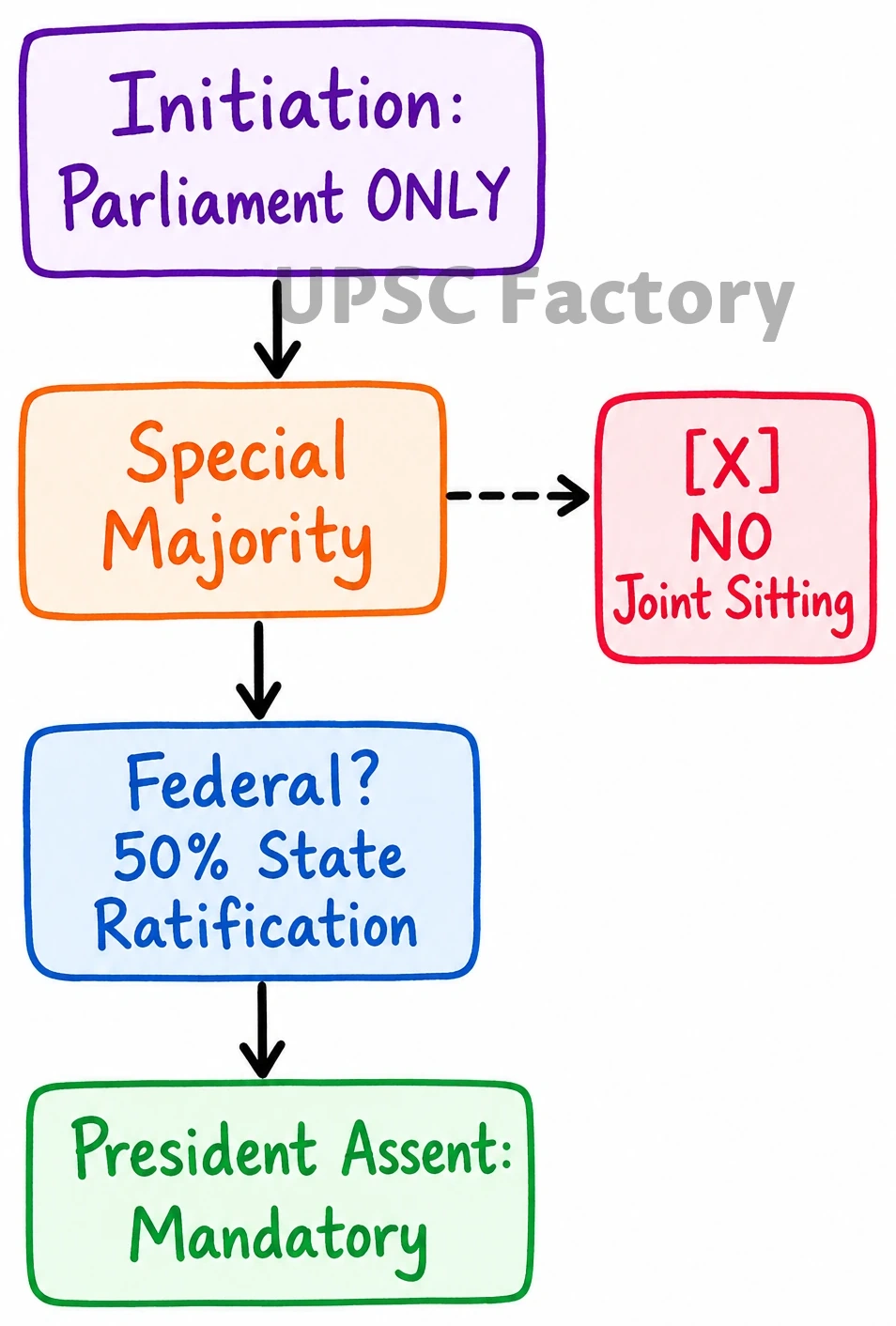
The Constitution prescribes three distinct amendment procedures based on the provisions being modified:

Simple Majority: Certain provisions like citizenship laws, state boundaries (Telangana formation, 2014), and administrative matters require only ordinary legislative majority, though these aren’t formally constitutional amendments under Article 368.

Special Majority: Most constitutional provisions demand a stringent special majority requiring:
• Majority of total membership of each House
• Two-thirds majority of members present and voting
• No provision for joint sitting in case of deadlock

Special Majority with State Ratification: Federal provisions necessitate additional ratification by at least half of state legislatures through simple majority. These include:
• Distribution of legislative powers (Seventh Schedule)
• Representation of states in Parliament
• Supreme Court and High Courts jurisdiction
• Article 368 itself

This ensures federal consensus on matters affecting Centre-State relations. Additionally, constitutional amendment bills cannot originate in state legislatures, and President’s assent, though mandatory, cannot be withheld.

Substantive Limitations: Basic Structure Doctrine

The judiciary has evolved substantive limits through the Basic Structure doctrine, crystallized in Kesavananda Bharati case (1973). Parliament cannot destroy the Constitution’s essential features, including:
• Supremacy of Constitution
• Democratic and republican character
• Secularism and federalism
• Judicial review and rule of law
• Separation of powers

The Minerva Mills case (1980) struck down the 42nd Amendment’s attempt to override this doctrine, reaffirming that Parliament’s amending power itself is limited. This prevents constitutional democracy from being undermined through amendments (NJAC struck down, 2015).

Conclusion: These procedural hurdles and substantive boundaries ensure constitutional amendments reflect deliberative consensus while preserving democracy’s foundational principles.

Q. Indian Constitution has conferred the amending power on the ordinary legislative institutions with a few procedural hurdles. Read More »

Q. “Constitutional morality is the fulcrum which acts as an essential check upon the high functionaries and citizens alike….”

Q. “Constitutional morality is the fulcrum which acts as an essential check upon the high functionaries and citizens alike….”

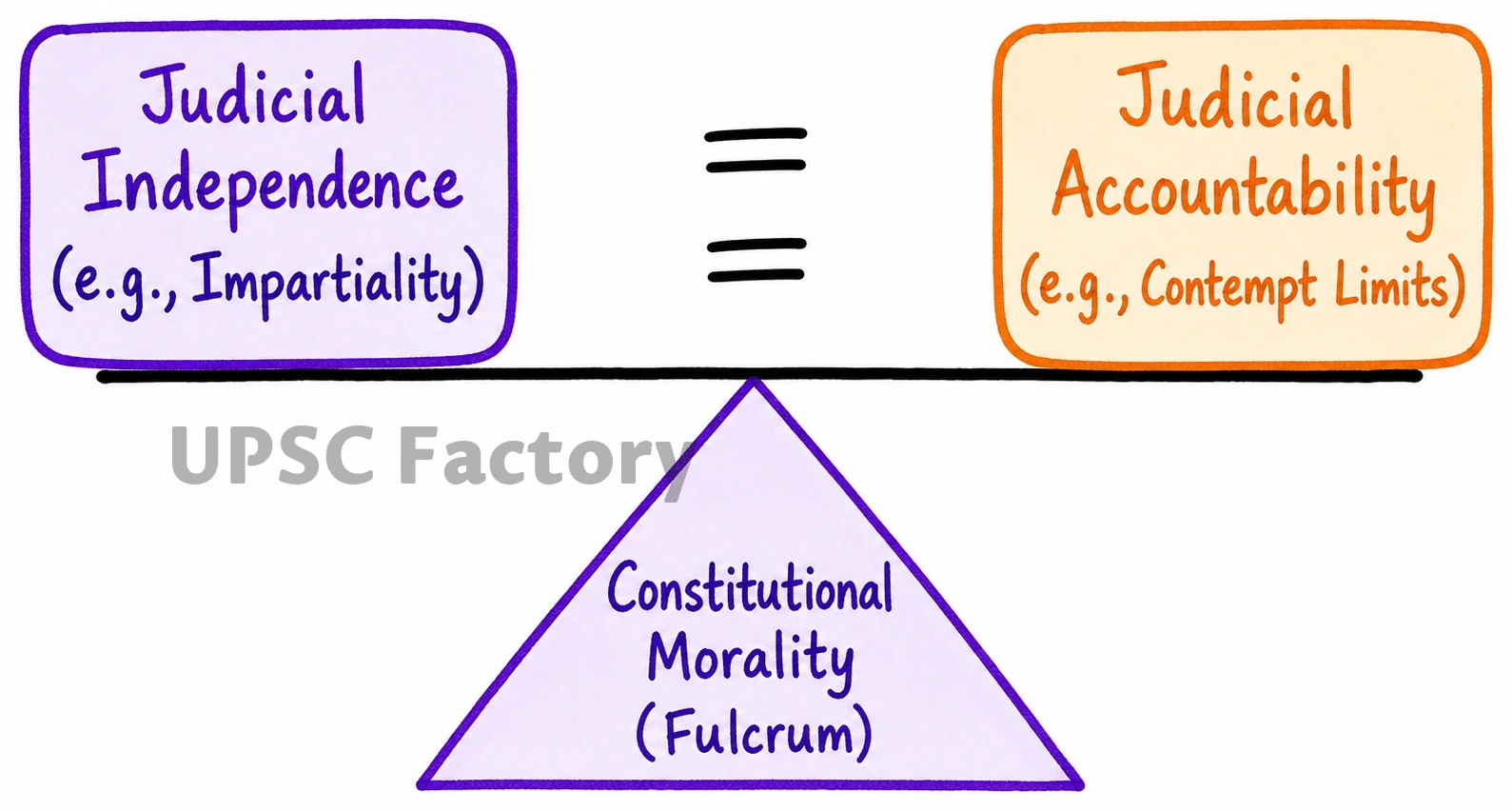
In view of the above observation of the Supreme Court, explain the concept of constitutional morality and its application to ensure balance between judicial independence and judicial accountability in India.

UPSC Mains 2025 GS2 Paper

Model Answer:

Constitutional Morality: Balancing Judicial Independence and Accountability

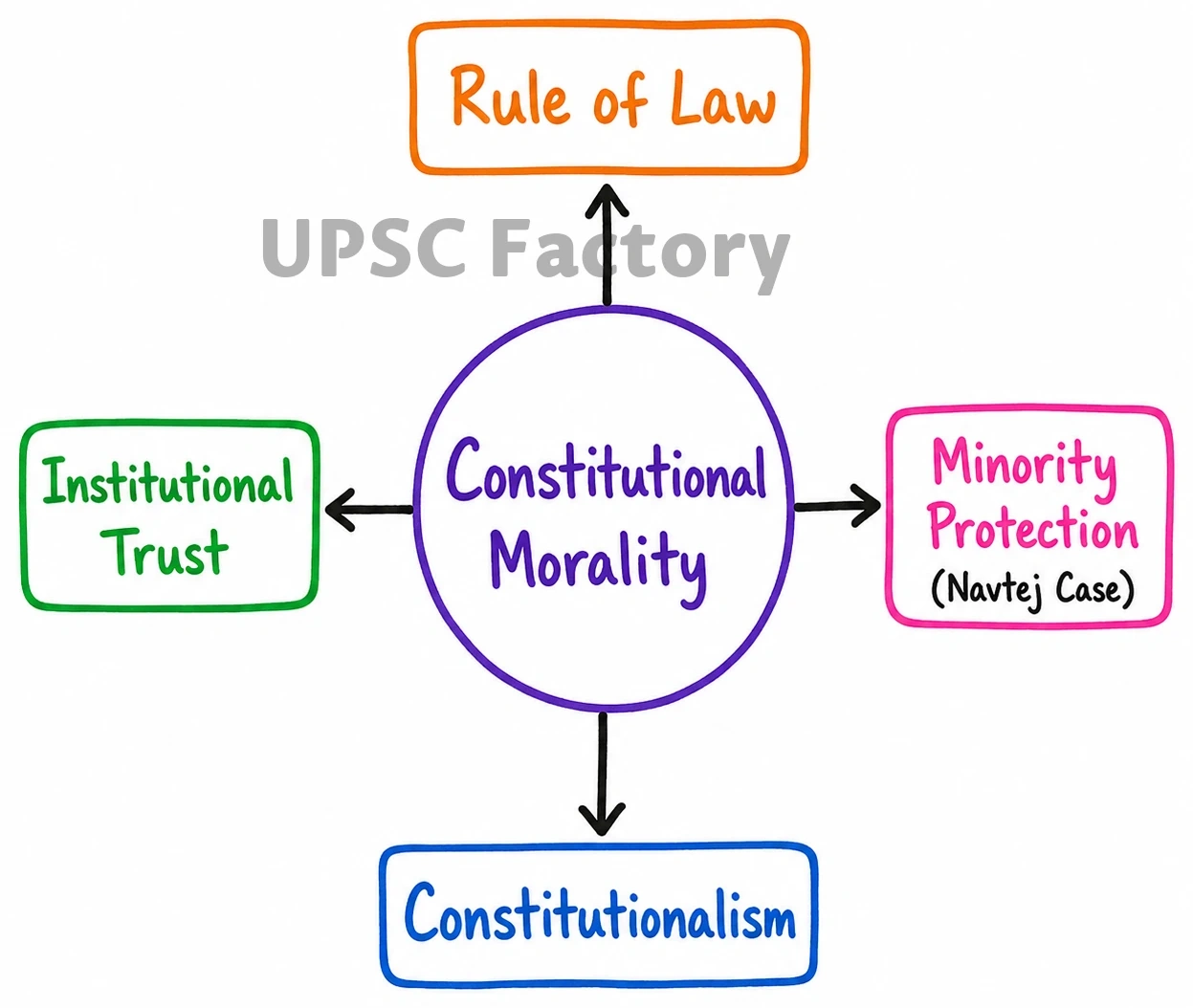
Constitutional morality, though not explicitly mentioned in our Constitution, is inherent in its foundational principles of justice, liberty, equality, and fraternity. Dr. B.R. Ambedkar emphasized it as essential for democratic functioning, describing it as “paramount reverence for constitutional forms.” The Supreme Court in Government of NCT of Delhi vs. Union of India (2018) equated it with the Constitution’s spirit itself.

Core Tenets of Constitutional Morality:

• Supremacy of Constitution – It upholds rule of law above all institutions and ensures constitutional values prevail over popular morality
• Protection of fundamental rights – Even against majoritarian impulses, as seen in Navtej Singh Johar (decriminalizing homosexuality) and Sabarimala (women’s entry)
• Democratic principles – Mandates institutional discipline and restraint by all constitutional functionaries
• Transformative vision – Goes beyond societal prejudices to realize constitutional ideals of equality and dignity

Application to Judicial Independence:

Constitutional morality mandates an independent judiciary free from executive-legislative influence. This principle manifested when the Supreme Court struck down the NJAC Act, reasoning that executive involvement in judicial appointments compromises independence – a basic structure element. It protects judges’ security of tenure, fixed service conditions, and maintains the collegium’s primacy. The judiciary’s role as final interpreter of the Constitution requires this independence to check governmental excesses.

Ensuring Judicial Accountability:

Simultaneously, constitutional morality ensures judges aren’t above accountability. It acts as an “ethical compass” preventing:
• Judicial overreach – Limits PIL jurisdiction, Master of Roster powers
• Arbitrary actions – Through review/curative petitions, in-house mechanisms
• Abuse of contempt powers – As public trust, not personal privilege
• Lack of transparency – Collegium resolutions now public

The impeachment proceedings against Justice Ramaswami (though unsuccessful) underscored that even highest functionaries face accountability.

Conclusion: Constitutional morality creates the “Lakshman Rekha” ensuring judiciary remains independent yet accountable, sustaining democracy’s delicate balance.

Q. “Constitutional morality is the fulcrum which acts as an essential check upon the high functionaries and citizens alike….” Read More »