Model Answer:
Under Article 124(2), Indian Supreme Court judges are appointed by the President. However, judicial interpretation birthed the unique Collegium system, starkly contrasting with the USA’s executive-legislative model.
1. Evolution of the Collegium System in India
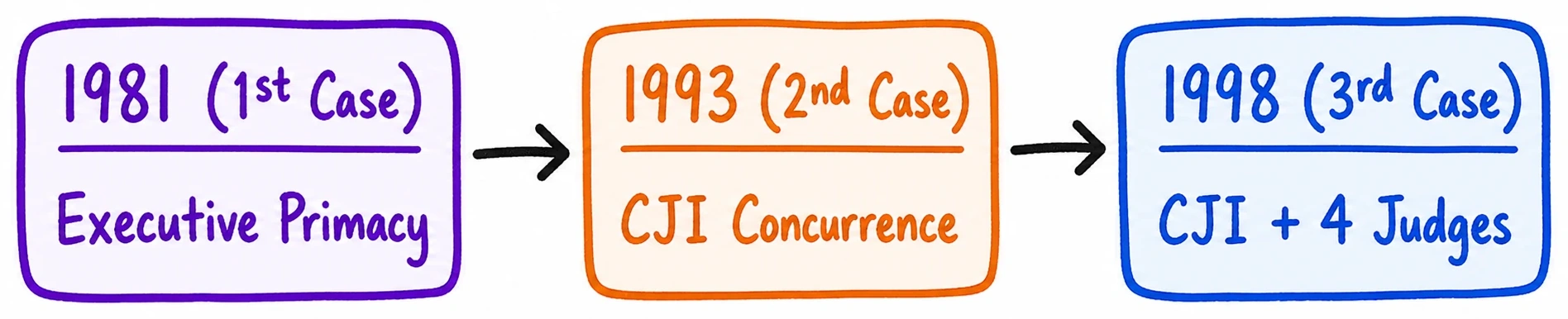
- First Judges Case (1981): Established executive primacy; ruled that “consultation” with the CJI does not mean “concurrence” (S.P. Gupta case).
- Second Judges Case (1993): Birthed the Collegium system; overruled the 1981 verdict by making the CJI’s advice binding (“concurrence”).
- Third Judges Case (1998): Expanded the Collegium to include the CJI and the four senior-most SC judges, emphasizing plural judicial consensus.
2. Indian System (The Collegium): Advantages & Disadvantages
- Advantage – Judicial Independence: Shields appointments from executive overreach and political interference, preserving the Basic Structure.
- Advantage – Peer Expertise: Judges are uniquely positioned to assess a candidate’s legal acumen, constitutional morality, and judicial temperament.
- Disadvantage – Opaqueness: Functions secretly with no formalized criteria, leading to the “judges appointing judges” critique.
- Disadvantage – Democratic Deficit: Lacks executive checks and public accountability (the 99th Amendment/NJAC Act was struck down in 2015).
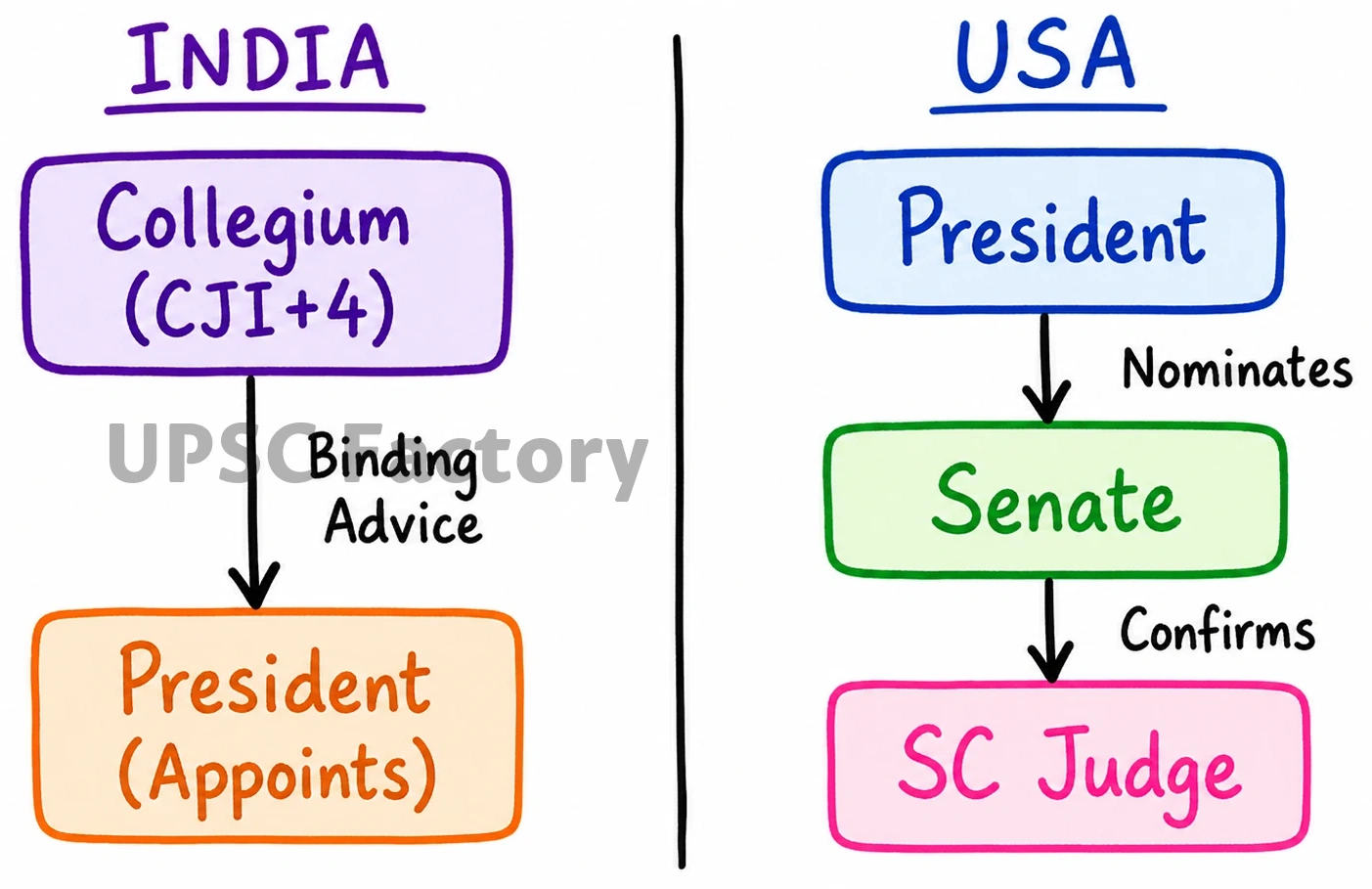
3. US System (Presidential Nomination & Senate Confirmation): Advantages & Disadvantages
- Advantage – Democratic Legitimacy: Involves both the Executive and Legislature, ensuring robust constitutional checks and balances.
- Advantage – Public Transparency: Rigorous Senate Judiciary Committee hearings ensure thorough background checks and high public scrutiny.
- Disadvantage – Severe Politicization: Appointments often devolve into ideological battles, prioritizing partisan affiliations over pure legal merit.
- Disadvantage – Compromised Perception: Intense political lobbying can erode public trust in the ultimate neutrality and independence of the bench.
While the US model risks hyper-partisanship, India’s collegium struggles with opacity. India must finalize a revised Memorandum of Procedure (MoP) to institutionalize transparency while safeguarding judicial independence.