Model Answer:
India’s fiscal federalism has transitioned from centralized planned development under the Planning Commission to a modern paradigm emphasizing cooperative federalism and greater statutory devolution.
Evolving Pattern of Financial Relations
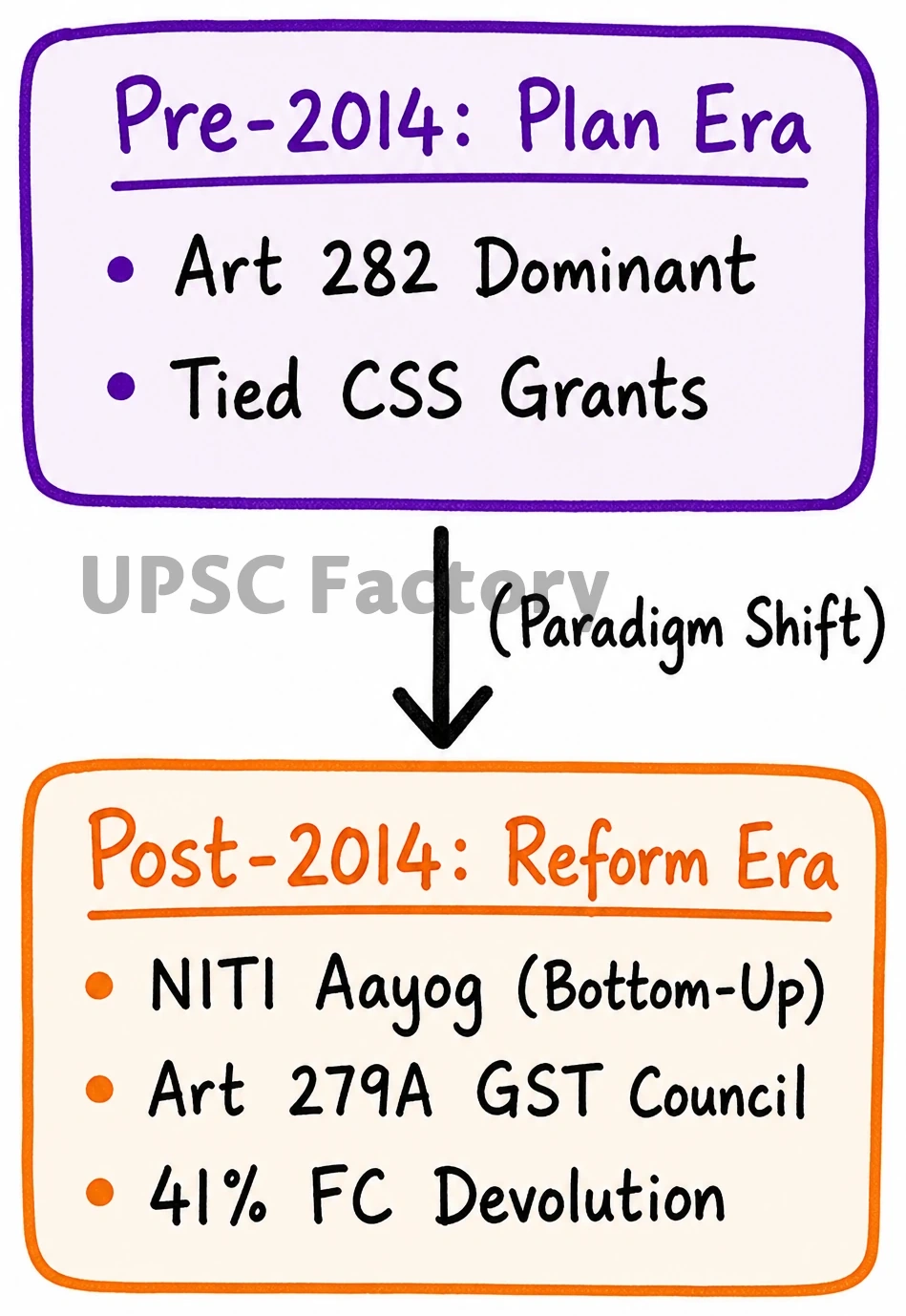
- Domination of Discretionary Grants: Historically, the Planning Commission’s discretionary grants (Article 282) severely overshadowed the Finance Commission’s statutory transfers (Article 275).
- Centralized Plan Assistance: Mechanisms like the Gadgil-Mukherjee formula tied funds to strict Central mandates, heavily restricting States’ expenditure autonomy.
- Institutional Paradigm Shift: The abolition of the Planning Commission and creation of NITI Aayog shifted the governance model towards bottom-up, cooperative federalism.
- Enhanced Statutory Devolution: The 14th and 15th Finance Commissions dramatically increased untied tax devolution (from 32% to 41%), providing unconditional fiscal space.
- Restructuring of Transfers: The consolidation of Centrally Sponsored Schemes (CSS) into core and optional categories aimed to grant States greater developmental flexibility.
Impact of Recent Reforms on Fiscal Federalism
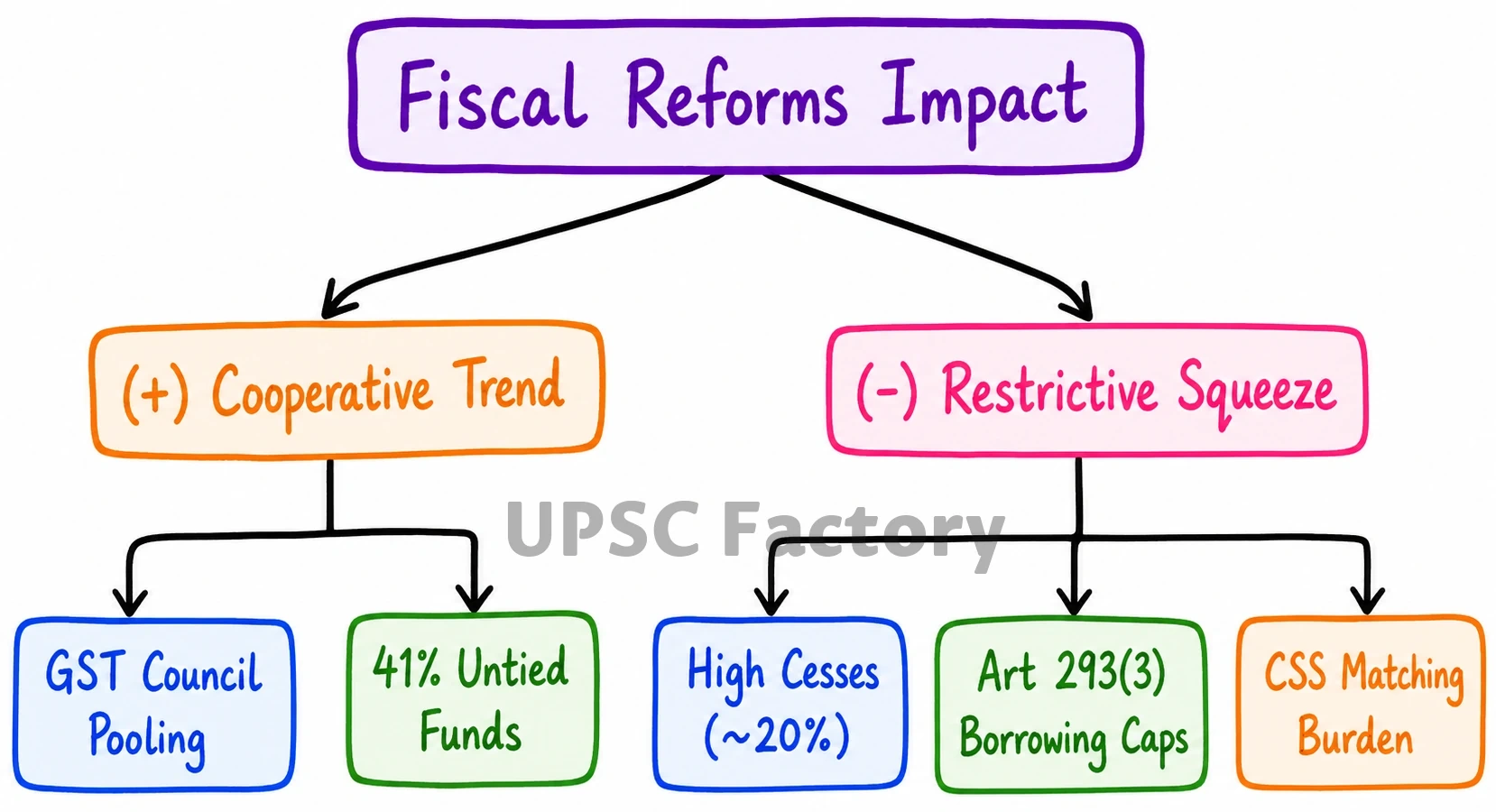
- Democratic Fiscal Governance: The GST Council (Article 279A) established an unprecedented Centre-State pooling of fiscal sovereignty and consensus-based taxation.
- Revenue Autonomy Squeeze: Surging non-shareable cesses and surcharges (reaching ~20% of Gross Tax Revenue) effectively shrink the constitutional divisible pool.
- Asymmetric CSS Burden: Despite rationalization, increased matching-fund requirements in major CSS severely strain State treasuries, diverting funds from local priorities.
- Stringent Borrowing Limits: Conditional borrowing caps strictly enforced by the Centre (Article 293(3)) restrict States’ capital expenditure capacities during fiscal crises.
- Post-GST Revenue Stress: The cessation of the 5-year GST compensation guarantee has exposed structural vulnerabilities in State revenue generation mechanisms.
- Performance-Based Incentives: Reforms now link additional borrowing allowances to State-level sectoral reforms (e.g., power sector, municipal finances), enforcing macro-fiscal discipline.
Achieving equitable fiscal federalism requires capping non-shareable cesses, institutionalizing dispute resolution mechanisms, and utilizing the Inter-State Council to balance macroeconomic stability with State financial autonomy.