Model Answer:
With the UN warning that 2 billion people lack safe drinking water and NITI Aayog projecting severe water stress, alternative technologies are crucial for global water security.
1. Emerging Alternative Technologies for Freshwater
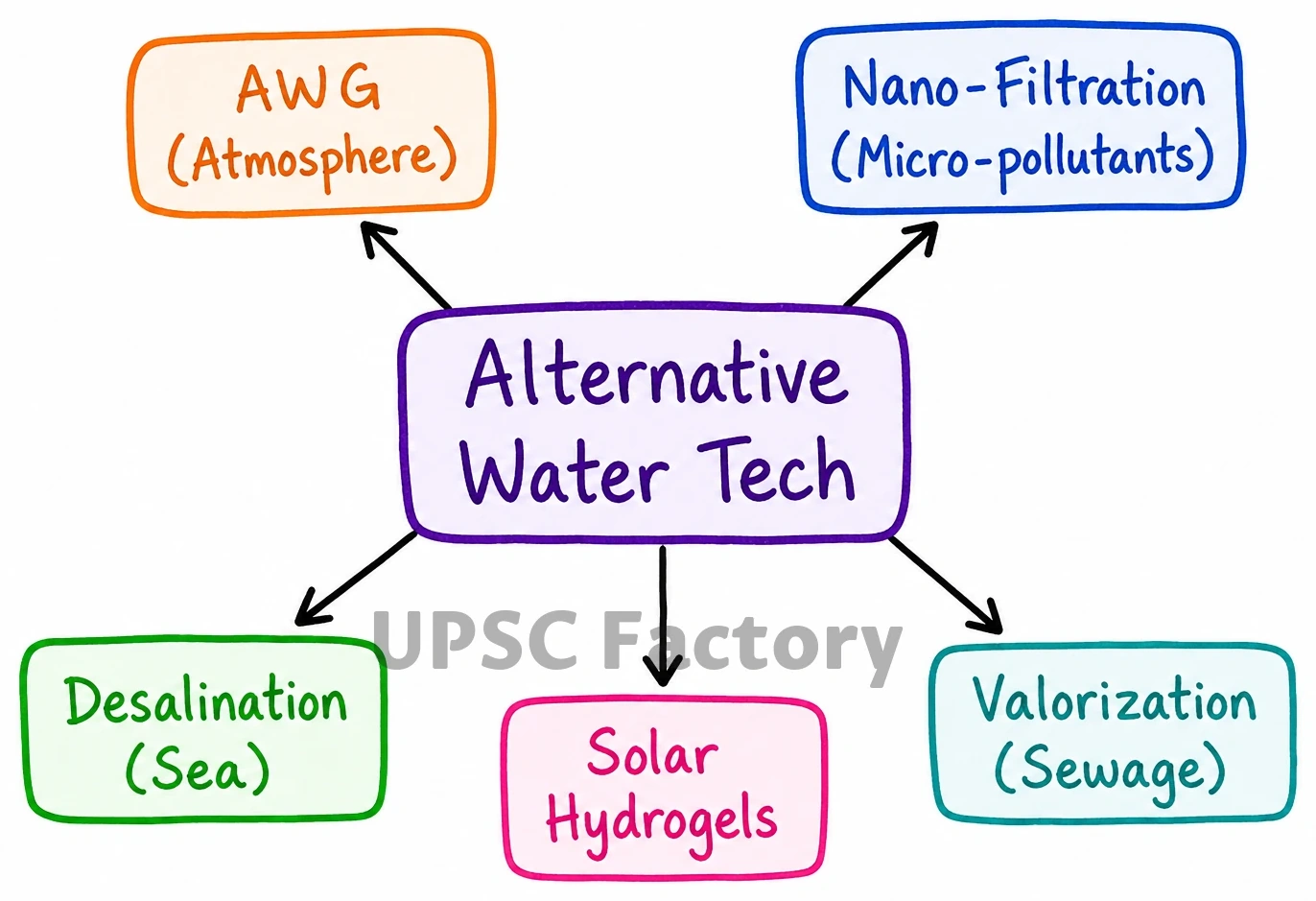
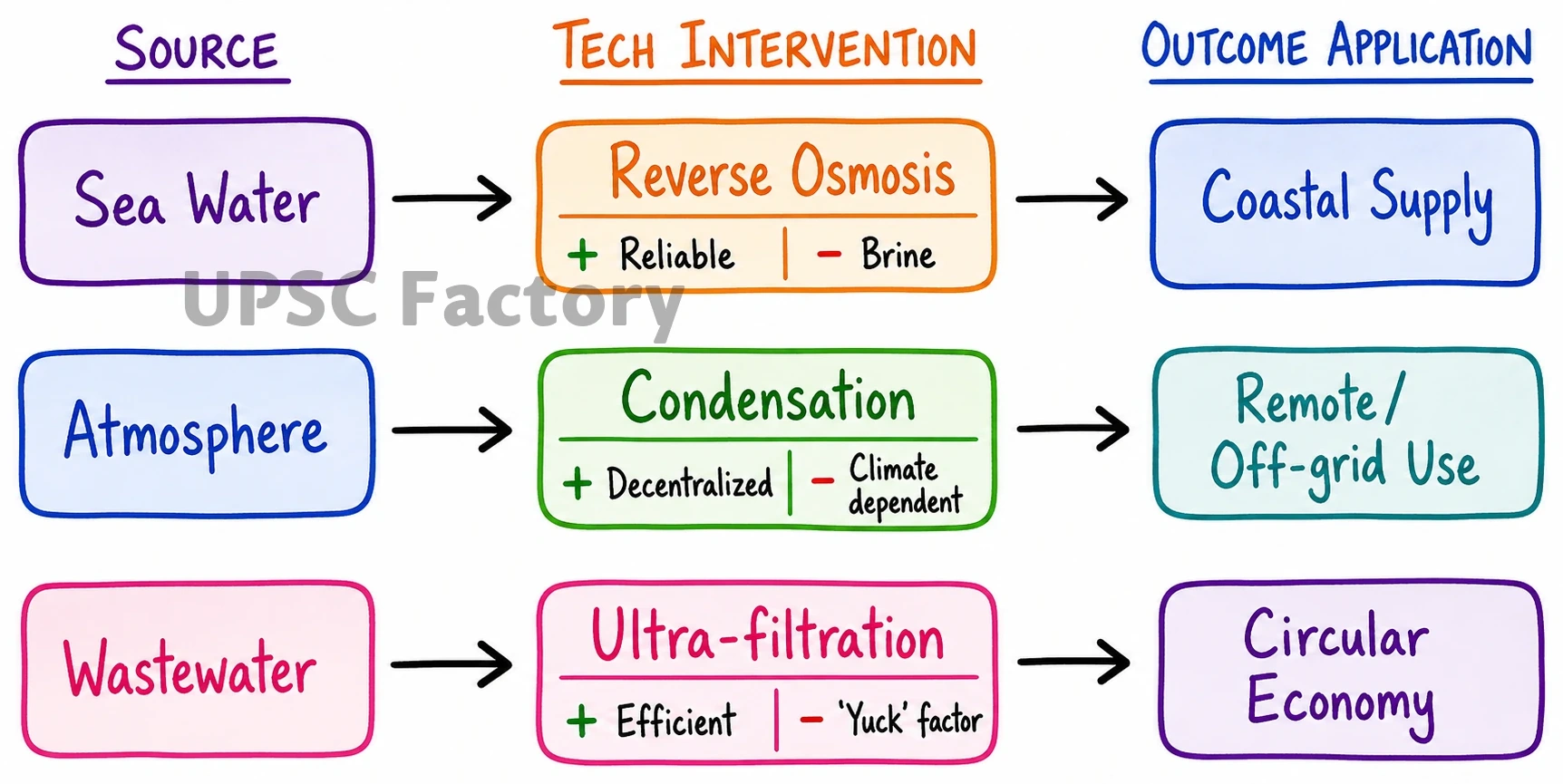
- Desalination: Membrane-based (Reverse Osmosis) and thermal processes converting seawater to potable water.
- Wastewater Valorization: Ultra-filtration and reverse osmosis recycling sewage into pure drinking water.
- Atmospheric Water Generation (AWG): Condensing atmospheric humidity directly into purified water.
- Nanotechnology Filtration: Utilizing carbon nanotubes and graphene oxide to eliminate micro-pollutants and heavy metals.
- Solar Hydrogels: Employing sunlight-driven evaporation to extract clean water from contaminated or saline sources.
2. Analysis of Three Key Technologies
- Desalination Technology: (Example: Nemmeli Plant, Chennai)
- Merits: Provides an inexhaustible, climate-resilient freshwater source, guaranteeing supply security for rapidly growing coastal megacities.
- Demerits: Extremely energy-intensive (large carbon footprint), high setup costs, and toxic hypersaline brine discharge threatens marine ecosystems.
- Advanced Wastewater Recycling: (Example: NEWater, Singapore)
- Merits: Drives a circular economy, mitigates sewage discharge into rivers, and ensures high resource-efficiency for industrial and domestic use.
- Demerits: High initial capital requirement, continuous complex monitoring needs, and a strong psychological “yuck factor” hindering mass public acceptance.
- Atmospheric Water Generators (AWG): (Example: ‘Meghdoot’ systems across Indian Railways)
- Merits: Offers a decentralized, plug-and-play solution requiring no ground or surface water source, making it highly effective in humid, remote geographies.
- Demerits: Yield remains heavily climate-dependent (fails in arid regions below 30% humidity) and incurs high per-liter electricity costs.
Achieving SDG 6 (Clean Water and Sanitation) requires transitioning from linear extraction to a circular water economy by integrating these technologies with robust conservation and Integrated Water Resources Management (IWRM).