Model Answer

Suggest measures to minimize the influence of the researchers in process of collecting data through focus group discussion.

Model Answers

Q: Suggest measures to minimize the influence of the researchers in process of collecting data through focus group discussion.

Question asked in UPSC Sociology 2022 Paper 1. Download our app for last 20 year question with model answers.

Model Answer:

Pioneered by Robert K. Merton, Focus Group Discussions (FGDs) capture collective meaning-making within the Interpretivist tradition. To prevent the “Hawthorne Effect” and interviewer bias, researchers must minimize their influence to ensure data validity.

Measures to Minimize Researcher Influence

  • Standardization of Stimulus: Following Merton, using carefully structured, open-ended discussion guides prevents leading questions and participant priming.
  • Epistemic Reflexivity: Drawing on Pierre Bourdieu, researchers must continuously analyze how their own social location (class, gender) impacts group dynamics and objectively document it.
  • Democratizing Research: Applying Ann Oakley’s Feminist Methodology, researchers should flatten power hierarchies by treating participants as “co-producers of knowledge” rather than mere subjects.
  • Structural Distancing: Approximating Max Weber’s Value Neutrality, reducing physical intrusion (e.g., one-way mirrors, participant moderators) minimizes researcher-induced behavioral shifts.

When researching marginalized groups like gig workers, an elite researcher might intimidate subjects. Employing “insider” facilitators—central to Participatory Action Research—curbs alienating power dynamics.

Conclusion

While Michel Foucault notes that zero influence is an illusion due to omnipresent power relations, these measures enable genuine Symbolic Interactionism (Herbert Blumer) and help achieve “Strong Objectivity” (Sandra Harding) through maximum methodological transparency.

Suggest measures to minimize the influence of the researchers in process of collecting data through focus group discussion. Read More »

Q. What are the major problems faced by the labour migrants while working in informal sectors of Indian States? Discuss.

Q. What are the major problems faced by the labour migrants while working in informal sectors of Indian States? Discuss.

UPSC Sociology 2025 Paper 2

Model Answer:

Internal migration supplies India’s informal sector with “footloose labour” (Jan Breman). This phenomenon is deeply embedded in the caste-class nexus, resulting in multifaceted vulnerabilities.

Dimensions of Migrant Precarity

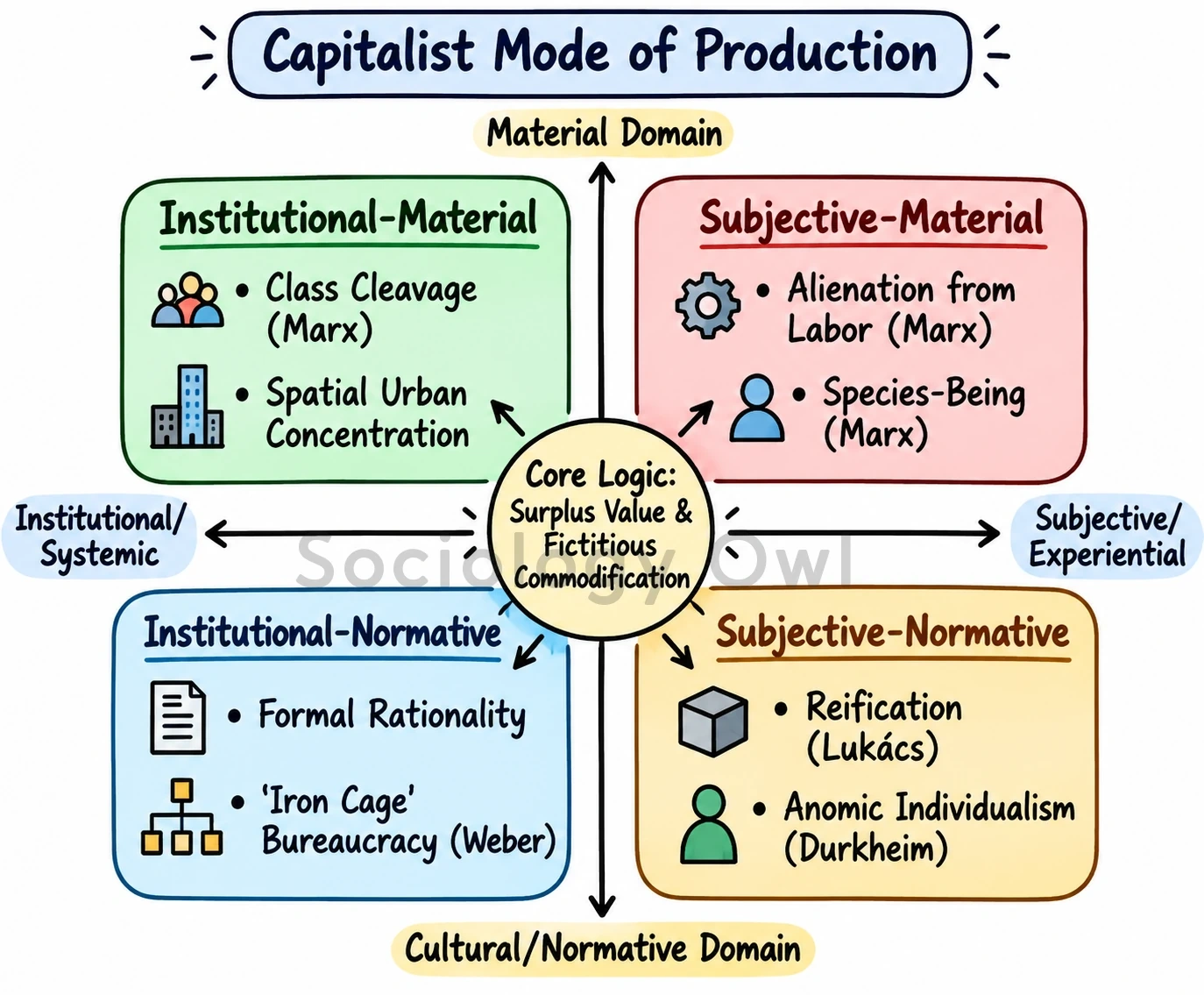
  • Economic Exploitation: Migrants face irregular wages and debt-driven neo-bondage. They function as a highly disposable reserve army of labour.
  • Caste-Class Overlap: Gail Omvedt notes that traditional hierarchies reproduce occupationally; the majority of informal migrants belong to marginalized SCs/STs.
  • Nativism and Spatial Segregation: Migrants endure “Sons of the Soil” hostility (Myron Weiner) in host states and inhabit overcrowded slums mirroring rural residential segregation.
  • Gendered Precarity: Neetha N. highlights the invisibility and “double burden” of female migrant workers who face severe wage disparities and exploitation.

Post-pandemic initiatives like the e-Shram Portal and One Nation One Ration Card (ONORC) attempt to address migrants’ institutional invisibility and historic denial of entitlements.

Conclusion

While urbanization promises social mobility, migrants remain trapped in informal precarity. Enforcing portable social rights is vital to transition the migrant subaltern from systemic marginalization to inclusive citizenship.

Q. What are the major problems faced by the labour migrants while working in informal sectors of Indian States? Discuss. Read More »

How has the idea of Work From Home’ forced us to redefine the formal and informal organisation of work ?

Model Answers

Q: How has the idea of Work From Home' forced us to redefine the formal and informal organisation of work ?

Question asked in UPSC Sociology 2021 Paper 1. Download our app for last 20 year question with model answers.

Model Answer:

Historically, the Industrial Revolution separated the home and factory. Work From Home (WFH) reverses this spatial fixity, actualizing Alvin Toffler’s vision of the “Electronic Cottage” (The Third Wave). Sociologically, it profoundly problematises the classic boundaries between formal (bureaucratic, regulated) and informal (unwritten norms, networks) work structures.

Redefining the Organisation of Work

Formal Structures

From Spatial to Algorithmic Control: The Weberian office is evolving into a “Digital Iron Cage.” Supervision shifts from shop-floor Taylorism to datafied control via productivity dashboards and log-ins.

Digital Surveillance: Extending Braverman’s labour process theory, management deepens through Michel Foucault’s “Panopticism.” Monitoring software creates a Digital Panopticon, ensuring continuous worker visibility.

Contractual Blurring & Moonlighting: Formal boundaries blur as firms externalize production costs (electricity, space) onto households. Conversely, spatial freedom enables workers to manipulate formal time through Moonlighting, forcing organizations to redefine employment exclusivity.

Informal Structures

Decline of Workplace Rituals: The loss of the physical office replaces Erving Goffman’s “front-stage” interactions with highly curated camera performances. This erodes Emile Durkheim’s Collective Effervescence and Organic Solidarity, leading to workplace atomisation and a new form of Marxist Alienation.

Exclusionary Networks: While backchannel chats (WhatsApp) sustain informal ties, they often exclude new or marginal workers who subsequently fail to acquire “insider” Social Capital (Pierre Bourdieu).

Gendered Emotional Labour: Drawing on Arlie Hochschild, homes become contested sites. WFH exacerbates the “double burden” for women, entangling formal paid work with informal, domestic care work.

WFH creates new stratifications. Applying Guy Standing’s framework, WFH is largely a privilege of the knowledge “salariat,” inaccessible to the manual “precariat.” Furthermore, rising WFH burnout has triggered phenomena like “Quiet Quitting,” prompting countries like France and Portugal to legally mandate a formal “Right to Disconnect.”

Conclusion

WFH marks a paradigm shift from spatial-bureaucratic control to digital-algorithmic governance. While offering flexibility, it demands updated labour regulations to prevent WFH from becoming an exploitative digital cage that deepens class polarization while eroding the organic social fabric of work.

How has the idea of Work From Home’ forced us to redefine the formal and informal organisation of work ? Read More »

Q. Despite the efforts of the government, bonded labour still continues in India. Discuss.

Q. Despite the efforts of the government, bonded labour still continues in India. Discuss.

UPSC Sociology 2024 Paper 2

Model Answer:

Despite the 1976 Abolition Act, unfree labour (Begar, Hali) persists in India. Sociologically, it reflects the enduring resilience of the caste-class nexus rather than mere administrative failure.

Structural Resilience of Bondage

Caste-Class Hegemony

Dominant Castes (M.N. Srinivas) utilize debt bondage to maintain economic surplus and social dominance over marginalized Dalits and Adivasis (Gail Omvedt).

Interlocking Markets: Amit Bhaduri highlights the interlocking of labour and credit markets, where collateral-less poor must pledge their future labour for survival credit.

Capitalism and “Neo-Bondage”

Neo-Bondage

Jan Breman notes traditional bondage has been replaced by capitalist “neo-bondage”, where advances are used to extract cheap, hyper-exploitative, migrant “footloose labour”.

De-proletarianization: Tom Brass argues capitalists intentionally use debt to convert free labourers into unfree bonded labourers to suppress wages and prevent unionization.

Modern bondage thrives in informal sectors like brick kilns. Subaltern scholars like David Hardiman note state-elite collusion often renders rehabilitation efforts, like the 2016 Central Sector Scheme, structurally ineffective.

Conclusion

Eradicating bonded labour requires moving beyond legal abolition toward dismantling systemic landlessness, echoing Dr. B.R. Ambedkar’s vision in Annihilation of Caste for true socio-economic emancipation.

Q. Despite the efforts of the government, bonded labour still continues in India. Discuss. Read More »

Are traditional social institutions getting weakend as agents of social change in the contemporary society ? Substantiate.

Model Answers

Q: Are traditional social institutions getting weakend as agents of social change in the contemporary society ? Substantiate.

Question asked in UPSC Sociology 2022 Paper 1. Download our app for last 20 year question with model answers.

Model Answer:

According to Talcott Parsons, Social Institutions are established normative patterns. Kingsley Davis defines Social Change as alterations in social structure. Historically, traditional institutions (family, religion, kinship) were primary change agents, but their dominance is increasingly contested by formal modern agencies like the State and mass media.

Traditional Institutions and Social Change

Weakening of Traditional Institutions

  • Structural Differentiation: Parsons argues modern specialization strips traditional institutions of multi-functional roles. The State now initiates educational and welfare changes, diminishing the family’s structural influence.
  • Secularization & Liquid Modernity: Unlike Max Weber’s thesis in The Protestant Ethic and the Spirit of Capitalism, Bryan Wilson’s Secularization theory posits religion has lost its macro-social power. Furthermore, Zygmunt Bauman’s “Liquid Modernity” asserts that rigid traditional structures are melting, unable to anchor modern shifts.
  • Individualization: Ulrich Beck in Risk Society and Anthony Giddens argue individuals increasingly carve “do-it-yourself” biographies, rejecting traditional institutional dictates.
  • Colonization of the Lifeworld: Jürgen Habermas notes bureaucratic and market forces have intruded into private spheres, stifling autonomous grassroots change originating from traditional communities.

Adaptation and Persistence of Tradition

Despite the rise of Manuel Castells’ “Network Society”, traditional institutions remain potent:

  • Religious Revivalism: Religion continues to act as a radical change agent. The influence of religious fundamentalism in overturning Roe v. Wade in the USA proves its capacity to drive macro-legal shifts.
  • Family as a Catalyst: The traditional family is changing, but structural debates surrounding it (e.g., LGBTQ+ rights and same-sex marriage) remain powerful catalysts for contemporary legal and social transformation.

Decentralized digital movements like the Arab Spring or #MeToo demonstrate how modern platforms bypass traditional community gatherings to incubate rapid change. However, tradition adapts to modernity, as seen when caste and kinship networks mobilize to drive change in modern democratic politics.

Conclusion

Traditional institutions are no longer the exclusive initiators of social change. They have transitioned from proactive, monopolistic agents to “reactive arenas,” continuously negotiating their transformative influence alongside the State and globalized digital media.

Are traditional social institutions getting weakend as agents of social change in the contemporary society ? Substantiate. Read More »

Q. What is the nature of relationship between science and religion in modern society? Analyze with suitable examples.

Q. What is the nature of relationship between science and religion in modern society? Analyze with suitable examples.

UPSC Sociology 2025 Paper 1

Model Answer:

Introduction

Science (Karl Popper’s focus on empiricism) and religion (Emile Durkheim’s focus on the sacred) interact not as a zero-sum game, but through a complex modern spectrum.

Conflict and Coexistence

Disenchantment: Max Weber argued scientific rationality would inevitably replace faith, causing a “disenchantment of the world.”

Conflict: This friction remains visible in evolution-creationism debates and bioethical disputes (e.g., stem-cell research).

Dual Needs: Bronislaw Malinowski noted that humans inherently require both practical science and religious comfort.

Compartmentalization: Milton Singer explains how modern individuals separate cognitive domains. For instance, ISRO scientists seamlessly perform traditional religious rituals before deploying advanced space technology.

Synergy and Risk: Robert Merton noted historical synergies (Puritan Ethos). Today, Ulrich Beck argues that science-induced crises (“Risk Society”) trigger religious revivalism as people seek secure anchors.

Global Example: Pope Francis’s encyclical Laudato Si successfully integrates climate science with theological moral stewardship.

Conclusion

Science and religion remain complementary frameworks in modern society. While science explains the empirical ‘how’ of the universe, religion continues to provide the existential ‘why’ and fundamental moral anchoring.

Q. What is the nature of relationship between science and religion in modern society? Analyze with suitable examples. Read More »

Q. Does the structural-functionalist perspective on social stratification promote a status quo? Give reasons for your answer.

Q. Does the structural-functionalist perspective on social stratification promote a status quo? Give reasons for your answer.

UPSC Sociology 2025 Paper 1

Model Answer:

The Davis-Moore thesis (structural-functionalism) posits that stratification is a universal necessity to fill critical societal roles via differential rewards. Critics, however, argue it functions as a conservative ideology promoting the status quo.

Mechanisms Defending the Status Quo

  • Value Consensus: Talcott Parsons argues stratification reflects shared societal values, naturally legitimizing existing elite dominance.
  • “Myth of Meritocracy”: Michael Young and Melvin Tumin argue functionalism ignores ascribed statuses—like inherited wealth or India’s traditional Caste System—falsely assuming equal opportunity.
  • Ideological Shield: Marxists dismiss functionalism as a “bourgeois ideology” manufacturing “false consciousness” to mask exploitation.

Functionalist logic is often weaponized to justify extreme wealth concentration (e.g., tech billionaires in the Oxfam Inequality Report) as mere rewards for “functional importance,” deliberately ignoring structural monopolies.

Conclusion

As Alvin Gouldner critiqued, while functionalism highlights motivational needs in complex societies, its blindness to power dynamics and unequal starting lines makes it an apologist tool perpetuating existing hierarchies.

Q. Does the structural-functionalist perspective on social stratification promote a status quo? Give reasons for your answer. Read More »

Q. Justify that the Indian traditions are modernizing. Also discuss its contributing factors.

Q. Justify that the Indian traditions are modernizing. Also discuss its contributing factors.

UPSC Sociology 2025 Paper 2

Model Answer:

Indian traditions exhibit dynamic continuity through what Yogendra Singh calls a complex synthesis. Lloyd and Susanne Rudolph’s The Modernity of Tradition explains how India adapts modern forms while retaining its core identity.

Evidence, Contributing Factors, and Critiques

  • Caste Transformation: Secularization occurs via political mobilization, transforming caste into modern interest groups (Rajni Kothari’s politicization of caste).
  • Family Structure: Nuclear households retain deep kinship obligations, reflecting “functional jointness” (A.M. Shah).

  • Colonial Legacies: British jurisprudence and modern education initiated M.N. Srinivas’s Westernization.
  • Techno-Legal Shifts: Post-independence constitutional equality and economic liberalization necessitated adaptive changes.
  • Critique: Modernization remains uneven. Dipankar Gupta warns of “Mistaken Modernity,” where superficial modern elements are adopted but traditional prejudices (like casteism) persist.

The booming industry of online matrimonial websites perfectly illustrates this—using modern, globalized technology to facilitate traditional caste endogamy and arranged marriages.

Conclusion

Indian traditions are inherently not static. This ongoing synthesis proves that modernization in India is an adaptive evolution, seamlessly blending structural change with deep-rooted cultural continuity.

Q. Justify that the Indian traditions are modernizing. Also discuss its contributing factors. Read More »

Q. Analyse the changing nature of caste as a status group.

Q. Analyse the changing nature of caste as a status group.

UPSC Sociology 2024 Paper 1

Model Answer:

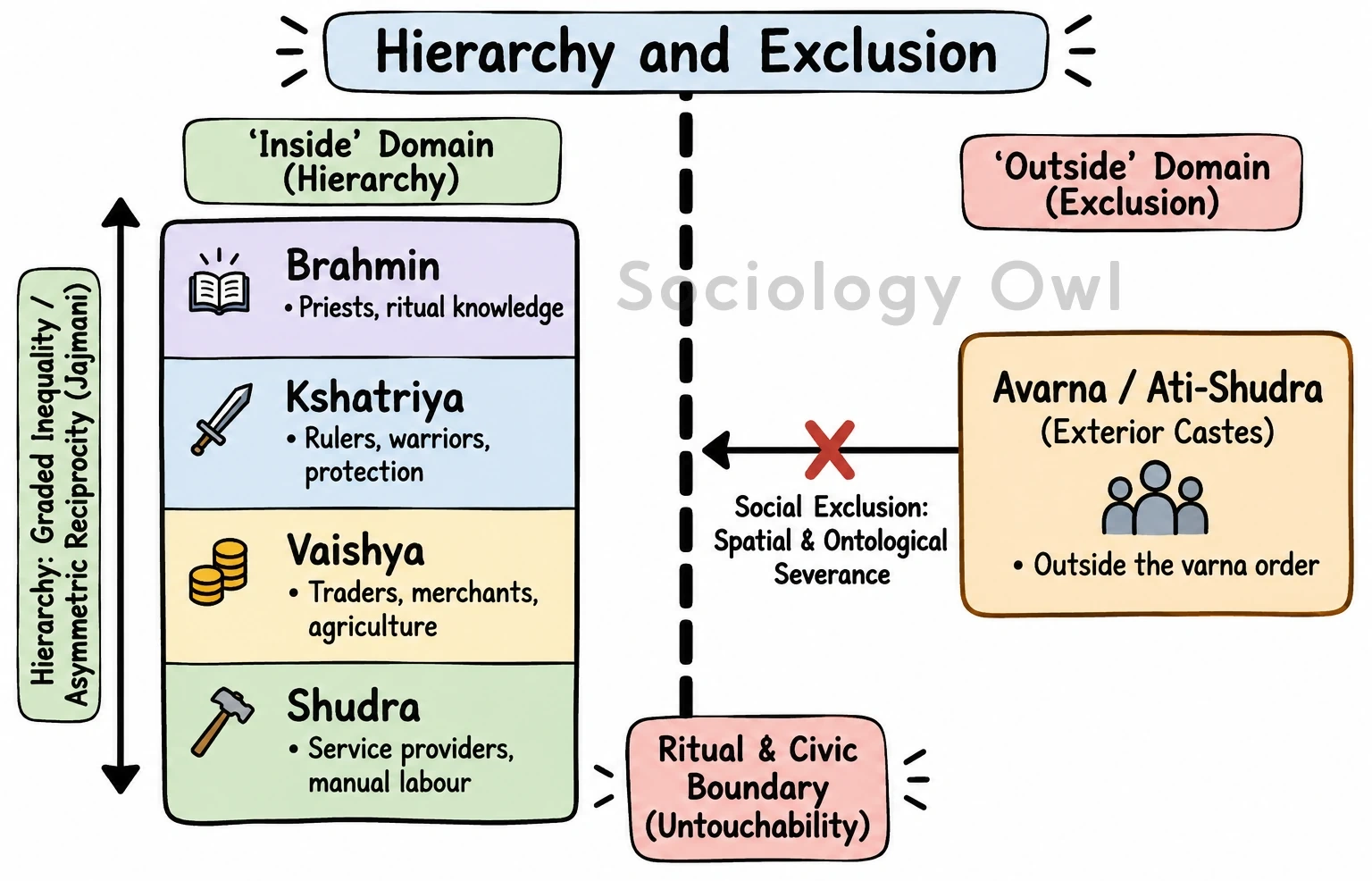
Max Weber defines a Status Group by shared social honor and a “style of life.” Traditionally, caste was a closed status group rooted in ritual purity.

Transformations in Caste Status

  • Identity over Hierarchy: Dipankar Gupta notes a shift from a “continuous hierarchy” to “discrete categories,” where status is horizontally contested rather than passively accepted.
  • Status to Party: Weberian status groups have mutated into Parties. Rajni Kothari’s “politicization of caste” demonstrates identities mobilizing for political power.
  • Capital Conversion: Moving beyond Louis Dumont’s ritual purity model (Homo Hierarchicus), upper castes preserve honor today by converting historical advantage into modern “cultural capital” (Pierre Bourdieu).
  • Status Inconsistency: Class mobility decouples caste from traditional occupations, leading to modern status incongruence.


The globalization of caste (e.g., Seattle’s caste ban, Silicon Valley’s Cisco case) proves its resilience as a status group within modern capitalist workspaces.

Conclusion

Caste has transitioned from a ritual hierarchy to competing socio-political identities. While traditional occupational linkages fade, it survives via endogamy and modern capital as a dynamic stratification system.

Q. Analyse the changing nature of caste as a status group. Read More »

Discuss recent trends in the structure of migration .

Model Answers

Q: Discuss recent trends in the structure of migration .

Question asked in UPSC Sociology 2022 Paper 2. Download our app for last 20 year question with model answers.

Model Answer:

Migration in India is not merely geographic movement but a spatial manifestation of structural inequalities and a tool for social mobility. Driven by uneven capitalist development and agrarian shifts, migration profoundly reshapes India’s traditional socio-economic fabric.

Sociological Trends in Migration Structure

  • Caste-Class Nexus: Migration remains deeply stratified. Upper-castes dominate white-collar professions and the international “Brain Drain” (Binod Khadria), while Dalits and Adivasis predominantly constitute the distress-driven “Brawn Drain” in informal sectors.
  • Circular and Seasonal Migration: Jan Breman, in his book Footloose Labour, conceptualizes informal rural migrants as “Wage Hunters and Gatherers”. Marginalized groups are forced into precarious, perpetual transit without achieving true social integration in urban centers.
  • Fluid Spatial Boundaries: Dipankar Gupta identifies a growing “Rural-Urban Nexus”. Villages are no longer isolated entities; migrants maintain active socio-economic ties to their native villages while working in cities, blurring traditional spatial boundaries.
  • Feminization of Migration: While patrilocal exogamy (marriage) remains the primary demographic driver for female mobility, Neetha N. highlights a rising trend of independent female migration into domestic work and manufacturing, challenging traditional patriarchal roles.
  • Role of Social Networks: Caste and kinship ties function as “Social Capital” (Pierre Bourdieu). These networks dictate migrant destinations, housing, and occupational clustering within specific urban informal trades.

The COVID-19 Reverse Migration crisis exposed the severe structural alienation of migrants. It demonstrated how urban capitalism relies on a “reserve army of cheap labor” lacking social security, prompting state interventions like the e-Shram portal to formalize worker identity and provide portable welfare.

Conclusion

Migration presents a distinct sociological paradox. While it serves as an emancipatory escape from oppressive village hierarchies—echoing B.R. Ambedkar’s critique of the Indian village—it simultaneously reproduces new structural inequalities in urban slums. A dynamic synthesis of modernization requires inclusive policies that bridge the rural-urban divide and dismantle migrant precarity.

Discuss recent trends in the structure of migration . Read More »