Model Answer

Q. How do ‘Civil Society Organizations’ such as NGOs’ and ‘Self-Help Groups’ contribute to grassroot level social changes? Discuss.

Q. How do ‘Civil Society Organizations’ such as NGOs’ and ‘Self-Help Groups’ contribute to grassroot level social changes? Discuss.

UPSC Sociology 2025 Paper 1

Model Answer:

Civil Society Organizations (CSOs) like NGOs and Self-Help Groups (SHGs) operate beyond the state and market as vital catalysts for bottom-up social change. Alexis de Tocqueville, in Democracy in America, identified such “voluntary associations” as foundational to preventing tyranny. In modern contexts, Rajni Kothari terms them “Non-Party Political Formations”, empowering marginalized communities outside traditional political structures.

Mechanisms of Grassroots Transformation

  • Empowerment and Capacity Building: SHGs foster collective action and micro-credit, building what Robert Putnam calls social capital—networks of trust and reciprocity that enhance economic independence and challenge local patriarchies.
  • Advocacy and Policy Influence: NGOs expand Jürgen Habermas’s “public sphere” by facilitating democratic debate. They act as pressure groups, exemplifying Antonio Gramsci’s counter-hegemonic action (e.g., grassroots movements spearheading India’s RTI Act).
  • Mobilization and Conscientization: Utilizing Paulo Freire’s conscientization approach, CSOs raise rights awareness. They institutionalize New Social Movements (Alain Touraine), shifting the focus of change toward identity, environment, and human rights.

Critiques and Limitations of CSOs

  • Marxist Critique: Scholars like David Harvey argue CSOs lead to the NGO-ization of resistance. They act as “safety valves” that pacify revolutionary potential and make neoliberal capitalism tolerable without altering fundamental class structures.
  • Feminist Critique: Thinkers like Naila Kabeer warn of the feminization of debt. SHGs often burden women with micro-loan repayments without dismantling deeply entrenched domestic patriarchal structures.
  • State Retrenchment and Elite Capture: Over-reliance on NGOs allows the neoliberal state to abdicate core welfare duties. Furthermore, grassroots groups are frequently hijacked by dominant local classes, reproducing inequalities.

Globally, CSOs connect local grievances to transnational change. The Grameen Bank in Bangladesh pioneered the SHG micro-credit model worldwide, while international grassroots networks like La Vía Campesina champion peasant rights against globalized agribusiness.

Conclusion

While NGOs and SHGs are indispensable for participatory development, they are not structural panaceas. As Peter Evans argues, sustainable social change requires “State-Society Synergy”—where CSOs do not replace the state but collaborate with an accountable public machinery to ensure equitable, lasting transformation from below.

Q. How do ‘Civil Society Organizations’ such as NGOs’ and ‘Self-Help Groups’ contribute to grassroot level social changes? Discuss. Read More »

Elaborate the salient features and the role of middle class in India’s democracy and development.

Model Answers

Q: Elaborate the salient features and the role of middle class in India’s democracy and development.

Question asked in UPSC Sociology 2023 Paper 2. Download our app for last 20 year question with model answers. 

Model Answer:

The Indian middle class has evolved from a colonial, state-dependent group to the post-1991 LPG-driven “New Middle Class.” Sociologically, it is a complex socio-cultural formation pivotal to India’s trajectory, moving beyond mere economic categorization.

Salient Features of the Indian Middle Class

  • Caste-Class Nexus: Andre Beteille notes that this class remains disproportionately dominated by upper castes, though globalization and reservation policies are gradually fracturing this dominance.
  • Cultural Capital: It is defined by its possession of Cultural Capital, notably English-language proficiency and elite education.
  • Consumerism: Pawan Varma in The Great Indian Middle Class highlights its shift from Nehruvian frugality to aggressive neoliberal consumerism.

Role in Democracy

  • Civil Society vs. Anti-Politics: While historically driving nationalism (A.R. Desai), the contemporary middle class often prefers technocratic governance over grassroots politics. Partha Chatterjee notes their dominance in elite “civil society” versus subaltern “political society.”
  • The Democratic Paradox: Christophe Jaffrelot highlights the “secession of the successful”—where the upper-middle class retreats into gated communities, increasingly apathetic to systemic inequalities.

Role in Development

  • Engines of Neoliberal Growth: As drivers of the tertiary IT/service sector, they emulate global consumerist lifestyles, reflecting Embourgeoisement and M.N. Srinivas’s concept of Westernization.
  • Hegemony over Narratives: Amartya Sen argues they dictate national agendas (e.g., smart cities, bullet trains), often at the expense of subaltern developmental needs like primary healthcare.

Middle-class civil society intervention is evident in the India Against Corruption movement and urban Resident Welfare Associations (RWAs), which demand accountability but frequently exhibit exclusionary spatial politics.

Conclusion

The Indian middle class acts as a “double-edged sword” (Satish Deshpande). While it is the primary engine of macroeconomic integration and governance reform, its inherent caste-privilege and technocratic elitism pose continuous challenges to substantive democratization.

Elaborate the salient features and the role of middle class in India’s democracy and development. Read More »

Q. Do modernization and secularization necessarily go together? Give your views.

Q. Do modernization and secularization necessarily go together? Give your views.

UPSC Sociology 2024 Paper 1

Model Answer:

Modernization & Secularization

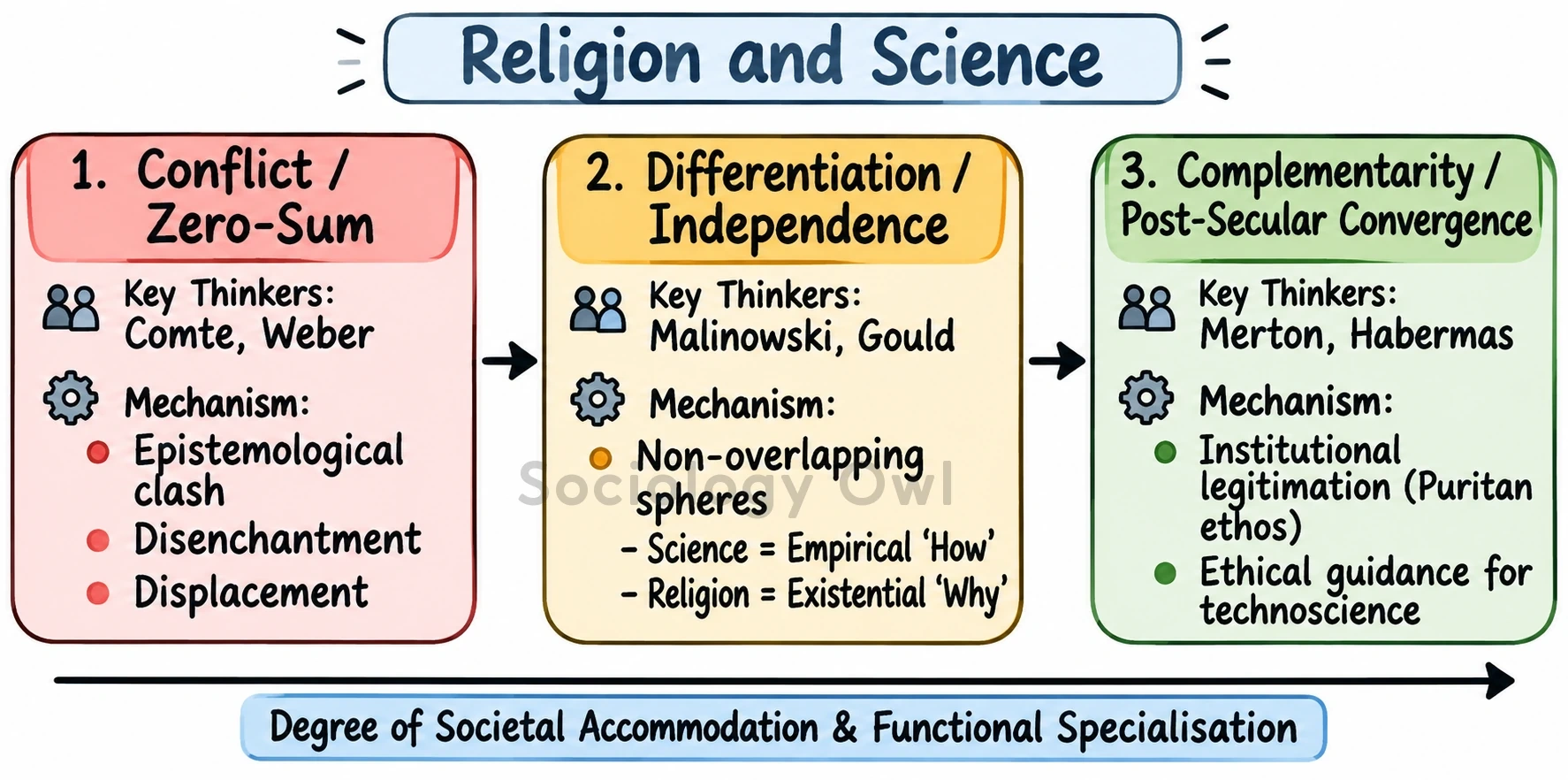
The “Orthodox Secularization Thesis” posited a zero-sum relationship between modernization and religion. Bryan Wilson defines secularization as religion losing its social significance, while modernization involves Talcott Parsons’ concept of “structural differentiation”, where institutions specialize, stripping religious authority.

The Orthodox Secularization Thesis

Early classical sociologists believed modernization inevitably brings secularization:

  • Max Weber: Argued modernization brings Rationalization and the “Disenchantment of the World”, replacing religious worldviews with scientific reasoning.
  • Karl Marx: Viewed religion as an obsolete opiate that would organically vanish as industrial modernity advanced.

Critiques: Desecularization and Transformation

Modern sociology views the universal linkage as highly contested:

  • Multidimensionality: Karel Dobbelaere notes modernity causes macro-secularization (state-church separation) but not necessarily micro-secularization (individual faith often remains intact).
  • The U-Turn: Initially a secularization proponent, Peter Berger famously retracted his stance in The Desecularization of the World, arguing the modern world is “furiously religious.”
  • Rational Choice: Rodney Stark and William Bainbridge propose Religious Market Theory, arguing that a lack of state monopoly in modern societies creates a competitive religious economy, increasing participation (e.g., the United States).
  • New Forms of Faith: Modernity alters religious expression. Grace Davie identifies a shift to “Believing without belonging”, while Thomas Luckmann argues faith becomes a highly privatized “Invisible Religion”.
  • Public Resurgence: Jose Casanova highlights the Deprivatization of Religion, where faith refuses marginalization and aggressively re-enters the political sphere.

Shmuel Eisenstadt’s theory of Multiple Modernities explains why modernization avoids a singular Western blueprint. Pentecostalism is exploding in the rapidly modernizing Global South, while Jürgen Habermas notes even Western Europe is evolving into a “post-secular society” that must negotiate with vibrant, immigrant religious identities.

Conclusion

Modernization and secularization do not necessarily go together. Rather than destroying faith, modernity transforms it. Religion dynamically adapts through individualization, deprivatization, or fundamentalist reactions against modernity, proving its enduring sociological vitality.

Q. Do modernization and secularization necessarily go together? Give your views. Read More »

Q. Define the concept of ‘gig’ economy and discuss its impact on labour market and workers’ social security net.

Q. Define the concept of ‘gig’ economy and discuss its impact on labour market and workers’ social security net.

UPSC Sociology 2024 Paper 1

Model Answer:

The ‘gig economy’ signifies a structural transition from Fordism (lifelong, standardized employment) to Post-Fordism (flexible, decentralized work). Rooted in Manuel Castells’ concept of the Network Society, it utilizes digital platforms as the new infrastructure for economic relations, fundamentally altering traditional employer-employee dynamics.

Impact of the Gig Economy

Impact on the Labour Market

  • The Rise of the Precariat: Guy Standing argues that gig work fosters a new global class, the “Precariat”, characterized by chronic employment insecurity, fluctuating incomes, and a lack of occupational identity.
  • Algorithmic Management: Platforms exert strict control through algorithms. Sociologically, this operates as a modern digital Panopticon (Michel Foucault) or a new “Iron Cage” of rationality (Max Weber), creating an “illusion of entrepreneurship” while restricting genuine worker autonomy.
  • Disguised Wage-Labour and Alienation: From a Marxist perspective, platforms extract surplus value while avoiding labour reproduction costs. Workers face Digital Alienation, physically isolated from peers and controlled by an app, which hinders the formation of Marxian class consciousness (class-in-itself to class-for-itself).

Impact on Workers’ Social Security Net

  • Individualization of Risk: Echoing Ulrich Beck’s Risk Society, the gig economy forces individuals to bear structural economic risks (healthcare, accidents, retirement) that were previously absorbed by employers or the state.
  • Structural Anomie: The absence of institutional safety nets and the fragmentation of collective bargaining mechanisms lead to a state of Anomie (Emile Durkheim), leaving workers socially disconnected and vulnerable to market volatility.

The ILO consistently warns about the deficit of “Decent Work” in platform economies globally. In India, grassroots mobilization like the All India Gig Workers Union (AIGWU) and state interventions like the Rajasthan Gig Workers (Registration and Welfare) Act, 2023 reflect systemic attempts to institutionalize a safety net.

Conclusion

The gig economy presents a paradox of late capitalism: offering digital flexibility while reviving 19th-century labour precarity. Mitigating this requires a “new social contract” that divorces social security from standard employment models, ensuring equitable welfare and protection in the digital age.

Q. Define the concept of ‘gig’ economy and discuss its impact on labour market and workers’ social security net. Read More »

How do you assess the changing patterns in kinship relations in societies today?

Model Answers

Q: How do you assess the changing patterns in kinship relations in societies today?

Question asked in UPSC Sociology 2023 Paper 1. Download our app for last 20 year question with model answers. 

Model Answer:

Sociologically, Robin Fox defines kinship as the study of what man does with the basic facts of life—mating, gestation, and parenthood. Historically society’s primary organizing principle, kinship has transitioned from rigid lineage structures to dynamic, individualized networks in contemporary society.

Structural and Economic Transformations

  • Functionalist Shift: Talcott Parsons linked industrialization to the rise of the Isolated Nuclear Family. Expanding on this, William Goode (World Revolution and Family Patterns) observed a global trend toward the Conjugal Family system.
  • Persistence of Kinship: Countering theories of kinship decline, Eugene Litwak proposed the Modified Extended Family. He argued that despite geographic mobility, emotional and financial kinship networks endure and adapt across distances.

Shift Towards Individualization and ‘Chosen’ Kinship

  • Late-Modernity: Anthony Giddens highlights the rise of the Pure Relationship, sustained by mutual Confluent Love rather than structural obligations. Ulrich Beck attributes diverse family forms to broader societal Individualization.
  • New Kinship Studies: Janet Carsten’s concept of Relatedness emphasizes that modern kinship is actively built through everyday care, transcending mere biology. This is highly visible in LGBTQ+ networks, which Kath Weston terms Families We Choose.

Technological Redefinitions: Marilyn Strathern observes that New Reproductive Technologies (NRTs) like IVF and surrogacy radically alter lineage by divorcing biological descent from social parenthood.

Globalization: Arlie Hochschild highlights Transnational Care Chains, where migrant women fundamentally reshape kinship and intergenerational caregiving across borders.

Conclusion

Contemporary kinship has transitioned from being strictly ‘given’ via blood and descent to being fluidly ‘constructed’ through choice, technology, and mutual care. While its structural functions have evolved, kinship remains a highly resilient institution providing indispensable emotional security and social capital.

How do you assess the changing patterns in kinship relations in societies today? Read More »

Discuss the nature of regional variations in sex ratio in India, stating reasons thereof.

Model Answers

Q: Discuss the nature of regional variations in sex ratio in India, stating reasons thereof.

Question asked in UPSC Sociology 2023 Paper 2. Download our app for last 20 year question with model answers.

Model Answer:

India’s sex ratio mirrors structural inequalities. Barbara Miller (The Endangered Sex) maps a stark regional dichotomy: the culturally masculine North-West (adverse ratio) versus the egalitarian South/North-East. While NFHS-5 indicates overall progress (1020/1000), the Child Sex Ratio remains skewed.

Sociological Reasons for Variations

  • Kinship Zones: Irawati Karve links northern patrilocal kinship to deep “daughter aversion.” Leela Dube’s “Seed and Earth” metaphor explains how northern patriarchy devalues women as mere receptacles, contrasting with southern endogamy and female autonomy.
  • Agrarian Economy: Prem Chowdhry attributes Haryana’s adverse ratios to hyper-masculinity and patriarchal land-ownership. Conversely, Bina Agarwal connects better Southern/Eastern ratios to female property rights.
  • The Prosperity Paradox: Mary E. John argues declining ratios reflect modernity, not backwardness. Capitalist medical nexuses make sex-selective abortions highly accessible among urban, prosperous classes.

Strict enforcement of the PCPNDT Act and behavioral campaigns like Beti Bachao Beti Padhao have yielded marginal improvements in Sex Ratio at Birth in traditionally skewed states like Haryana, demonstrating state-led demographic correction.

Conclusion

Regional variations in sex ratios are not merely demographic statistics; they are vivid reflections of the deeply entrenched caste-class-gender nexus operating within a rapidly modernizing India.

Discuss the nature of regional variations in sex ratio in India, stating reasons thereof. Read More »

In the face of rising global climatic concerns, how do you contextualize the relevance of Chipko Movement and its Gandhian tone? Answer analytically.

Model Answers

Q: In the face of rising global climatic concerns, how do you contextualize the relevance of Chipko Movement and its Gandhian tone? Answer analytically.

Question asked in UPSC Sociology 2023 Paper 2. Download our app for last 20 year question with model answers.

Model Answer:

The Chipko movement, an early New Social Movement, exemplifies what Ramachandra Guha terms the “Environmentalism of the Poor.” Rooted in the Gandhian ethics of Ahimsa and Sarvodaya, it provides a critical sociological framework to critique modern global climate crises.

The Gandhian Tone and Sociological Debates

Satyagraha as a Subaltern Tool: Mobilized by leaders like Sunderlal Bahuguna, peaceful resistance challenged state-corporate logging nexuses. In The Unquiet Woods, Guha debates the movement’s nature, arguing Chipko was fundamentally a peasant struggle for economic survival and resource rights, contrasting sharply with Western “empty-stomach” (leisure-based) environmentalism.

Gram Swaraj (Decentralization): Chipko was a protest against top-down colonial forestry models. It demanded indigenous control over local resources, an ethos crucial today against centralized global climate governance.

Gender Dynamics in Ecology

Eco-Feminism vs. Feminist Environmentalism: Vandana Shiva analyzes Chipko through Eco-Feminism, positing that women share a spiritual connection with nature (Prakriti) and resisted patriarchal “maldevelopment.” Conversely, Bina Agarwal offers a materialist critique via “Feminist Environmentalism,” arguing that women’s participation stemmed from their lived realities, as deforestation disproportionately increased their daily labor for fuel and fodder.

Chipko’s fight for local rights prefigures modern Climate Justice debates, mirroring the Global South’s demands against the industrialized Global North. Domestically, its Gandhian continuum is visible in the recent Hasdeo Arand protests, where indigenous communities utilized Satyagraha against corporate coal mining to protect their habitat.

Conclusion

In an era dominated by top-down, technocratic climate solutions like carbon credits, Chipko’s Gandhian legacy serves as a potent reminder. It asserts that sustainable ecology is impossible without sociological equity, Gram Swaraj, and justice for marginalized communities.

In the face of rising global climatic concerns, how do you contextualize the relevance of Chipko Movement and its Gandhian tone? Answer analytically. Read More »

Explain how the pattern of patriarchy is being altered in a family and at the workplace in the present context.

Model Answers

Q: Explain how the pattern of patriarchy is being altered in a family and at the workplace in the present context.

Question asked in UPSC Sociology 2021 Paper 1. Download our app for last 20 year question with model answers.

Model Answer:

Sylvia Walby defines patriarchy as a system where men dominate, oppress, and exploit women. She notes a historical shift from “Private Patriarchy” (exclusion from public life, household-based control) to “Public Patriarchy” (subordinated inclusion in public spheres), framing its modern alteration across institutions.

Alterations of Patriarchy

Family and Workplace Dynamics

  • Symmetrical Roles: Moving away from traditional male-breadwinner models, Young and Willmott observe the rise of the “Symmetrical Family”, characterized by joint conjugal roles and shared decision-making.
  • Legal Empowerment: Equal inheritance and anti-domestic violence laws have fractured absolute male authority over household assets.
  • Critical Persistence: However, Arlie Hochschild argues patriarchy merely adapted. Working women now face a “Second Shift” (dual burden of paid labor and unpaid domestic work), while Duncombe and Marsden highlight the “Triple Shift” (adding emotional labor).
  • Workforce Participation: Liberal feminists like Betty Friedan championed education, driving female labor participation and cracking the “Glass Ceiling”. Institutional biases are increasingly challenged by equal pay and anti-harassment policies.
  • Critical Persistence: Despite progress, patriarchy mutates through “Pink-Collarization” (segregating women into low-paying care jobs) and the “Motherhood Penalty”. Concurrently, Christine Williams identifies the “Glass Escalator”, where men in female-dominated sectors get promoted faster, while women face the “Glass Cliff” (promoted only during corporate crises).

Globally, the #MeToo movement has radically challenged entrenched workplace patriarchy. Conversely, the COVID-19 pandemic triggered a global “She-cession,” forcing women out of the workforce due to childcare demands, proving patriarchal family norms still dictate economic participation. Countering this, the Nordic model’s “use-it-or-lose-it” paternity leaves actively aim to equalize domestic roles.

Conclusion

While socio-economic shifts have successfully weakened classical private patriarchy, it has mutated into resilient forms of public patriarchy. As Catherine Hakim’s Preference Theory suggests, achieving true egalitarianism requires not just institutional reforms, but a fundamental restructuring of societal attitudes toward caregiving and labor.

Explain how the pattern of patriarchy is being altered in a family and at the workplace in the present context. Read More »

Q. Underline the role of social media in contemporary social movements and describe its challenges.

Q. Underline the role of social media in contemporary social movements and describe its challenges.

UPSC Sociology 2024 Paper 1

Model Answer:

Contemporary collective action, characterizing New Social Movements (NSMs), has shifted from traditional class struggles to identity and rights-based claims. Social media acts as the primary vehicle for these “networked social movements”, extending Jurgen Habermas’s concept into a vast “Digital Public Sphere”.

Role of Social Media in Social Movements

  • Resource Mobilization: Expanding on McCarthy and Zald’s theory, digital platforms drastically reduce the structural costs (time, capital, infrastructure) required for mobilizing collective resources.
  • Frame Alignment: Utilizing David Snow and Robert Benford’s Framing Theory, activists bypass traditional media gatekeepers, enabling direct narrative building and ideological resonance (e.g., #BlackLivesMatter).
  • Network Society: Manuel Castells observes that platforms forge decentralized, “rhizomatic” (leaderless) “networks of outrage and hope,” enabling rapid transnational solidarity without formal hierarchies.

Challenges of Digital Mobilization

  • Weak Ties and Slacktivism: Malcolm Gladwell critiques that high-risk activism requires strong social ties. Social media primarily fosters weak ties, leading to what Evgeny Morozov terms “Slacktivism”—superficial, low-risk participation.
  • Tactical Freeze: In Twitter and Tear Gas, Zeynep Tufekci argues digital movements scale so rapidly that they fail to build the offline organizational infrastructure necessary for long-term policy negotiation, resulting in a “tactical freeze.”
  • Digital Panopticism: Applying Michel Foucault’s concept, the internet functions as a modern “Panopticon.” States utilize algorithmic surveillance and internet blackouts to exercise biopower and suppress dissent.

During the Indian Farmers’ Protest (2020-21), digital platforms served as a critical tool to build transnational solidarity, successfully bypassing local media constraints and internationalizing agrarian grievances.

Conclusion

While social media provides a powerful technological catalyst for modern mobilization, the underlying drivers remain rooted in structural inequalities. As emphasized by Neil Smelser’s Value-Added Theory and W.G. Runciman’s Relative Deprivation, offline systemic strain remains the true root cause and ultimate battleground for sustained social change.

Q. Underline the role of social media in contemporary social movements and describe its challenges. Read More »

Q. What are the Private and Public network and support systems operative in Indian society for the aged? Suggest measures to curb down the challenges before care givers of the aged.

Q. What are the Private and Public network and support systems operative in Indian society for the aged? Suggest measures to curb down the challenges before care givers of the aged.

UPSC Sociology 2025 Paper 2

Model Answer:

The UNFPA India Ageing Report 2023 projects that the elderly will constitute 20% of India’s population by 2050. This rapid “demographic shift” is fundamentally altering traditional kinship and family structures, necessitating a robust evolution in both private and public care mechanisms.

Support Networks and Systems

Private Support Networks:

  • Family and Kinship: Despite residential nuclearization, A.M. Shah argues that “functional jointness” (financial and emotional ties) persists. However, Sarah Lamb observes a shift from traditional Seva (unquestioned duty) to “negotiated care,” especially alongside diaspora migration.
  • Market and Civil Society: There is a growing “commodification of care” (paid care workers, premium retirement communities) serving the urban upper-middle class, contrasting starkly with the severe destitution faced by the rural poor, where NGOs attempt to bridge the gap.

Public Support Systems:

  • State Interventions: The Maintenance and Welfare of Parents and Senior Citizens Act (2007) and schemes like IGNOAPS provide the formal framework.
  • Sociological Critique: Demographer S. Irudaya Rajan critiques these systems, noting that state pensions are meager and systematically exclude the vast informal sector workforce. Additionally, the state often frames the elderly as “dependents” requiring charity rather than citizens with rights.

Challenges for Caregivers

  • Feminization of Caregiving: In India’s patriarchal setup, elder care falls disproportionately on women, specifically the daughter-in-law.
  • Intersectionality and Stress: The “sandwich generation” faces immense “emotional labour” (Arlie Hochschild). These challenges vary across class and caste: urban middle-class caregivers face psychological stress (time poverty), while landless Dalit households face extreme material deprivation.
  • Structural Lag: Increased longevity has resulted in what Matilda White Riley terms “structural lag”—where demographic changes have outpaced the evolution of supportive social institutions.

Addressing caregiver challenges requires multifaceted measures:

  • Formalizing the Care Economy: Recognizing unpaid female labor through state caregiver allowances and subsidized geriatric healthcare.
  • Rebuilding Social Capital: Establishing state-supported respite care, day-care centers, and neighborhood support groups to relieve isolated caregivers.
  • Workplace Flexibility: Introducing paid elder-care leave and flexible hours to prevent caregiver drop-out from the labor force.

Conclusion

Addressing India’s aging population requires shifting the narrative from viewing the elderly as a “demographic burden” to recognizing them as a vital social resource. Bridging traditional Dharma with modern, rights-based state welfare is essential for fostering “intergenerational solidarity” and ensuring dignified aging in a transitioning society.

Q. What are the Private and Public network and support systems operative in Indian society for the aged? Suggest measures to curb down the challenges before care givers of the aged. Read More »