Model Answer

Discuss the material basis of patriarchy as an ideological system.

Model Answers

Q: Discuss the material basis of patriarchy as an ideological system.

Question asked in UPSC Sociology 2022 Paper 2. Download our app for last 20 year question with model answers.

Model Answer:

Patriarchy is not merely a cultural belief system but is deeply anchored in structural realities. Friedrich Engels historically linked women’s subordination to the emergence of private property. In the Indian context, feminist sociologist Kamla Bhasin defines patriarchy as an ideology of male superiority fundamentally sustained by a material system where men control property, resources, and women’s labor.

Material Foundations of Patriarchal Ideology in India

  • Land and Property Ownership: Bina Agarwal, in A Field of One’s Own, argues that the systematic exclusion of women from arable land ownership is the strongest material basis of South Asian patriarchy, fostering ideologies of female dependency and male superiority.
  • Kinship, Patriliny, and Patrilocality: Leela Dube highlights the “Seed and Earth” metaphor in Indian kinship. The ideology positions men as the “seed” (owners of lineage) and women as the “earth” (mere vessels), legitimizing the material reality of passing property only to sons. Furthermore, the material reality of village exogamy (loss of female labor) births the ideology of daughters as “Paraya Dhan” (another’s wealth).
  • Caste-Property Nexus: Uma Chakravarti’s concept of “Brahmanical Patriarchy” explains that strict ideological control over women’s sexuality is materially driven by the need to maintain caste purity and keep property within the endogamous caste group.
  • Control over Labor: Maria Mies, studying the Lacemakers of Narsapur, demonstrates how capitalist patriarchy extracts cheap female labor through the ideology of “housewifization”, treating their economic output as mere leisure.

Debates on Kinship and Materiality

  • The Matrilineal Paradox: Contrasting North Indian kinship, Khasi matrilineal societies pass property through women. Yet, Tiplut Nongbri notes that ideological and political control remains with men (maternal uncles), proving patriarchal ideology’s complex entrenchment despite material variances.
  • Unpaid Labor: The NSSO’s Time Use Survey (TUS) reveals Indian women perform nearly 10 times more unpaid care labor than men, forming the hidden material base of the patriarchal economy.
  • Legal vs. Ideological Reality: Despite the Hindu Succession (Amendment) Act, 2005 granting equal coparcenary rights, patriarchal ideology (dowry as substitute inheritance, fear of severing sibling ties) prevents women from claiming these material rights.

Conclusion

The material and ideological bases of patriarchy are dialectically linked. Dismantling it requires a dual approach: securing the material base through actualized property rights and financial inclusion, alongside ideological transformation through intersectional feminist movements, as advocated by Sharmila Rege.

Discuss the material basis of patriarchy as an ideological system. Read More »

Q. What do you understand by sustainable development? Discuss the elements of sustainable development as proposed in the UNDP’s Sustainable Development Goals Report-2015.

Q. What do you understand by sustainable development? Discuss the elements of sustainable development as proposed in the UNDP’s Sustainable Development Goals Report-2015.

UPSC Sociology 2025 Paper 1

Model Answer:

Sustainable Development: A Sociological Gaze

Sustainable development, defined by the Brundtland Commission as meeting present needs without compromising future generations, emerged as a sociological critique of Modernization Theory. As capitalist growth generated profound ecological “manufactured risks,” Ulrich Beck noted our shift into a “Risk Society”, necessitating a paradigm shift toward multidimensional sustainability.

The 2015 UNDP report operationalized the 17 SDGs through the “5 Ps”:

  • People & Prosperity: Aims to end poverty and ensure fulfilling lives. Sociologically, this aligns with Amartya Sen’s “Capability Approach”, which conceptualizes development as expanding substantive human freedoms rather than merely increasing GDP.
  • Planet: Focuses on sustainable natural resource management. However, Allan Schnaiberg’s “Treadmill of Production” theory highlights an inherent contradiction: capitalism requires infinite growth (Prosperity), which inherently degrades finite ecological boundaries (Planet).
  • Peace & Partnership: Fosters inclusive societies and global solidarity. Analyzed through Immanuel Wallerstein’s World Systems Theory, true partnership remains elusive. The developed “Core” often dictates environmental terms to the developing “Periphery” under the guise of global governance.

Sociological Critiques of the SDG Framework

  • Post-Development Theory: In Encountering Development, Arturo Escobar argues that sustainable development is a Western hegemonic oxymoron. It promotes “green capitalism” instead of questioning Western hyper-consumption.
  • Eco-Feminism: Vandana Shiva asserts that dominant development paradigms inherently marginalize women and nature, overriding indigenous ecological knowledge.
  • Dependency Theory: Critics highlight Eco-Imperialism, where the Global South is pressured to sacrifice its industrialization to meet climate goals set by the Global North.

The inherent contradictions within the SDGs are visible through Environmental Racism, where the Global North dumps toxic e-waste in African nations like Ghana. Furthermore, “green” lithium mining often displaces indigenous tribes, demonstrating the stark tension between global “Prosperity” and marginalized “People.”

Conclusion

The SDG framework risks remaining “Shallow Ecology” (superficial tech-fixes) without addressing power dynamics. Genuine sustainable development demands Reflexive Modernization—a systemic restructuring of global capitalist inequalities—to achieve “Deep Ecology” and truly ensure no one is left behind.

Q. What do you understand by sustainable development? Discuss the elements of sustainable development as proposed in the UNDP’s Sustainable Development Goals Report-2015. Read More »

What actionable measures would you suggest to curb the recurrent child labour menace in India ?

Model Answers

Q: What actionable measures would you suggest to curb the recurrent child labour menace in India ?

Question asked in UPSC Sociology 2023 Paper 2. Download our app for last 20 year question with model answers.

Model Answer:

Child labour in India reflects a deeply entrenched caste-class nexus. Myron Weiner, in The Child and the State in India, argues its recurrence fundamentally stems from elite apathy towards educating the marginalized strata.

Actionable Structural Measures

  • Legal Reform: The Child Labour Amendment Act, 2016 allows work in “family enterprises,” which inadvertently reproduces traditional caste-based occupational continuity. This loophole requires stringent state auditing to prevent exploitation.
  • Economic Restructuring: To combat the hyper-exploitation of informal, migrant “footloose labour” (Jan Breman), stabilizing adult wages through schemes like MGNREGA structurally destroys the familial dependency on “cheap” child labour.
  • Socio-Cultural and Gender Interventions: Leela Dube highlights the “invisible” domestic labour of the girl child. Expanding state-sponsored Anganwadi crèches frees girls for schooling, alongside targeted interventions for vulnerable SC/ST groups (A.R. Desai).

Fostering digital community-state synergy via the PENCIL Portal enables robust tracking, reporting, and rehabilitation in hazardous informal sectors like the Sivakasi fireworks industry.

Conclusion

Eradicating child labour requires moving beyond purely legal bans to structurally dismantling the socio-economic inequalities and caste-based hierarchies that make children’s labour necessary for family survival.

What actionable measures would you suggest to curb the recurrent child labour menace in India ? Read More »

What role do co-operatives plays in poverty alleviation in rural India ?

Model Answers

Q: What role do co-operatives plays in poverty alleviation in rural India ?

Question asked in UPSC Sociology 2022 Paper 2. Download our app for last 20 year question with model answers.

Model Answer:

Agrarian Relations

In rural India, co-operatives act as vital institutions of collective action and social capital, aimed at dismantling traditional feudal and moneylender hegemonies to alleviate poverty.

  • Breaking Feudal Ties: Credit co-operatives liberate marginal farmers from exploitative patron-client dependencies.
  • Intersectional Empowerment: Women-led co-operatives foster female social capital, challenging localized patriarchal bargaining and economic dependency.

Elite Capture and Constraints

  • Dominant Caste Hegemony: B.S. Baviskar, studying Maharashtra’s sugar co-operatives, highlighted how they are often monopolized by the Dominant Caste (e.g., Marathas), reinforcing rural power hierarchies.
  • Exclusion: Elite capture by wealthy land-owning classes often marginalizes landless Dalits, turning co-operatives into tools for political patronage rather than egalitarian upliftment.

The AMUL model successfully bypassed upper-caste middlemen to economically empower marginal dairy farmers. Similarly, SEWA models female collective action against poverty.

Conclusion

While co-operatives hold immense potential for egalitarian rural transformation, realizing genuine poverty alleviation requires addressing entrenched caste-class inequalities through inclusive grassroots democratization.

What role do co-operatives plays in poverty alleviation in rural India ? Read More »

Q. Education is a key to social development. Elucidate.

Q. Education is a key to social development. Elucidate.

UPSC Sociology 2024 Paper 2

Model Answer:

Social development entails structural transformation and equity. Following Amartya Sen, education expands human capabilities, acting as India’s primary catalyst for development.

Emancipation and Modernization

  • Modernization: Yogendra Singh notes education fosters universalistic values. M.N. Srinivas saw English education as a secular tool for Westernization and mobility.
  • Emancipation: B.R. Ambedkar used education to dismantle caste monopolies; André Béteille notes affirmative action bridges historical divides.

Critique: Reproducing Inequality

  • Caste-Class Nexus: In Political Agenda of Education, Krishna Kumar argues the English-vernacular divide reproduces inequalities. Elite schooling becomes Cultural Capital, alienating rural masses (A.R. Desai).

The ASER Report reveals “learning poverty,” showing mere access is insufficient. The National Education Policy (NEP) 2020 targets qualitative equity to address this barrier.

Conclusion

While theoretically an equalizer, Indian education remains contested. Moving from structural access to qualitative equity is vital to prevent reproducing the hierarchies it seeks to dismantle.

Q. Education is a key to social development. Elucidate. Read More »

Q. How Dalit movements in India have facilitated their Identity formation? Analyze.

Q. How Dalit movements in India have facilitated their Identity formation? Analyze.

UPSC Sociology 2025 Paper 2

Model Answer:

Dalit movements transformed a stigmatized identity rooted in Louis Dumont’s purity-pollution ideology into an assertive political consciousness. Gail Omvedt categorizes them as New Social Movements seeking human dignity.

Dialectics of Dalit Identity Formation

  • Subaltern Assertion: Movements explicitly rejected M.N. Srinivas’s Sanskritization and Gandhi’s patronizing ‘Harijan’ label, forging independent political agency via B.R. Ambedkar’s Annihilation of Caste.
  • Political Shift: Eleanor Zelliot highlights the transition from ritual pleading to militant political mobilization (e.g., Dalit Panthers), which culminated in Kanshi Ram’s broader Bahujan identity.
  • Structural Critiques: The identity is not monolithic. Anand Teltumbde notes class-based fragmentation (emergence of a Dalit middle-class elite), while Sharmila Rege emphasizes Dalit Feminism to counter internal Brahmanical patriarchy.

The Rohith Vemula movement forged new “Dalit-student-minority” solidarities, while digital platforms have enabled the Bhim Army to cultivate a modern Techno-Dalit assertion.

Conclusion

As Gopal Guru observes, Dalits have evolved from passive objects to active subjects of history. Despite internal intersections of class and gender, this identity formation remains a dynamic force in democratizing India’s socio-political landscape.

Q. How Dalit movements in India have facilitated their Identity formation? Analyze. Read More »

Examine the factors responsible for the rural unrest in contemporary India.

Model Answers

Q: Examine the factors responsible for the rural unrest in contemporary India.

Question asked in UPSC Sociology 2021 Paper 2. Download our app for last 20 year question with model answers.

Model Answer:

As A.R. Desai argued, the agrarian question lies at the core of India’s wider class struggles. However, contemporary rural unrest has shifted from historical anti-feudal movements to anti-state and anti-market conflicts. Sharad Joshi conceptualized this as the “India vs. Bharat” divide, highlighting the structural alienation felt by the rural populace against urban-biased macroeconomic policies.

Structural and Economic Transformations

  • Andre Beteille & the “Caste-Class Nexus”: In Caste, Class and Power, Beteille notes the breakdown of traditional caste-class congruence creates structural friction. This nexus often manifests as violence between landowning dominant OBCs and landless Dalit laborers.
  • D.N. Dhanagare on Peasant Classes: Unlike historical struggles, contemporary unrest is heavily driven by middle and rich peasants (surplus producers) facing neoliberal market volatility, corporatization, and shrinking state procurement.
  • Jan Breman & “Footloose Labour”: The informalization of rural labor and the breakdown of traditional patronage (Jajmani) drive precarity, displacement, and everyday resistance among marginalized, landless groups.

Socio-Cultural and Ecological Dispossession

  • Dipankar Gupta & Surinder Jodhka: Gupta’s “vanishing village” meets Jodhka’s “blocked mobility.” Rural youth reject unviable farming but face jobless urban growth, fueling volatile identity-based reservation agitations (e.g., Jats, Marathas).
  • Subaltern Perspective: Ranajit Guha and David Hardiman view Adivasi unrest (e.g., Niyamgiri, Pathalgadi) against resource extraction as continued subaltern resistance against the hegemony of the modern developmental state.
  • Bina Agarwal & Gender: The feminization of agriculture entails structural patriarchal violence, leaving women managing distressed farms without land titles or state credit amidst male out-migration.

The 2020-21 Farm Law protests showcased agrarian classes utilizing kinship, Khaps, and religious institutions (Langars) to sustain economic resistance against agricultural corporatization. Conversely, state interventions like PM-KISAN are sociologically critiqued as superficial “band-aid solutions” that ignore entrenched land inequities.

Conclusion

Contemporary rural unrest is symptomatic of India’s painful transition from a traditional agrarian society to a capitalist market economy. As Dipankar Gupta notes, the village is no longer an idyllic community but an arena of competing interests. Sustainable peace requires moving beyond welfarism to structurally democratizing market access, resolving landlessness, and ensuring grassroots social justice.

Examine the factors responsible for the rural unrest in contemporary India. Read More »

Q. Do you think that the formal workspaces are free of gender bias? Argue your case.

Q. Do you think that the formal workspaces are free of gender bias? Argue your case.

UPSC Sociology 2025 Paper 1

Model Answer:

While Liberal feminists highlight diversity policies reducing overt bias, formal workspaces remain structurally gendered beneath an illusion of bureaucratic neutrality.

Structures of Persistent Bias

  • Joan Acker’s theory of Gendered Organizations argues the “ideal worker” norm is structurally modeled on a male life-cycle without caregiving responsibilities, inherently penalizing women.
  • Rosabeth Moss Kanter, in Men and Women of the Corporation, highlights “Tokenism” in boardrooms and “Homosocial Reproduction” (male elites promoting similar men), denying women crucial Social Capital (Pierre Bourdieu).
  • Marxist-feminists like Sylvia Walby note capitalist workspaces rely on women carrying the unpaid “Second Shift” (Arlie Hochschild), perpetuating structural pay gaps.

Counter-Perspective: Catherine Hakim’s “Preference Theory” controversially attributes disparities to women’s varied lifestyle choices rather than employer bias, though feminists critique these as constrained choices heavily shaped by patriarchal socialization.

The recent “She-cession” during COVID-19 and unequal pay scandals in progressive tech sectors expose how covert biases persist despite modern diversity mandates.

Conclusion

Formal workspaces have merely transitioned from overt discrimination to covert structural patriarchy. Substantive equality requires dismantling entrenched male-centric organizational norms rather than relying on superficial inclusion.

Q. Do you think that the formal workspaces are free of gender bias? Argue your case. Read More »

Q. Do you think that new economic reforms of British rule have disrupted the old economic system of India? Substantiate your answer with suitable examples.

Q. Do you think that new economic reforms of British rule have disrupted the old economic system of India? Substantiate your answer with suitable examples.

UPSC Sociology 2025 Paper 2

Model Answer:

The pre-colonial Indian economy, famously termed “self-sufficient village republics” by Charles Metcalfe and analyzed through Karl Marx’s concept of the “Asiatic Mode of Production”, rested on a synthesis of agriculture and handicrafts. British economic reforms deeply disrupted this by forcefully integrating India into global capitalism.

Transformation of Social and Agrarian Structures

  • New Agrarian Classes: Colonial land settlements (Zamindari/Ryotwari) commodified land. A.R. Desai highlighted the emergence of new exploitative classes. Daniel Thorner sociologically classified this new stratification into Malik (landlords/moneylenders), Kisan (working peasants), and Mazdoor (landless laborers).
  • Emergence of Dominant Castes: Bestowing private property rights upon specific middle-peasant castes laid the historical foundation for what M.N. Srinivas later identified as the Dominant Caste in rural India.
  • Collapse of Reciprocity: William Wiser observed that the shift to a cash-based legal economy dismantled the Jajmani system, transforming caste interdependency from a status-based reciprocal exchange into contract-based exploitation.
  • Occupational Disruption: Deindustrialization ruined traditional artisanal guilds. As Andre Beteille noted, the forced migration of ruined artisans into agricultural labor began to detach economic ‘class’ from traditional ritual ‘caste’ hierarchies, causing immense pauperization.

Sociological Debates on Economic Disruption

  • The Myth of Isolation: Sociologists like A.M. Shah challenge the premise of “perfect self-sufficiency.” Indian villages were always integrated into regional trade; the British merely reoriented these networks toward global extraction.
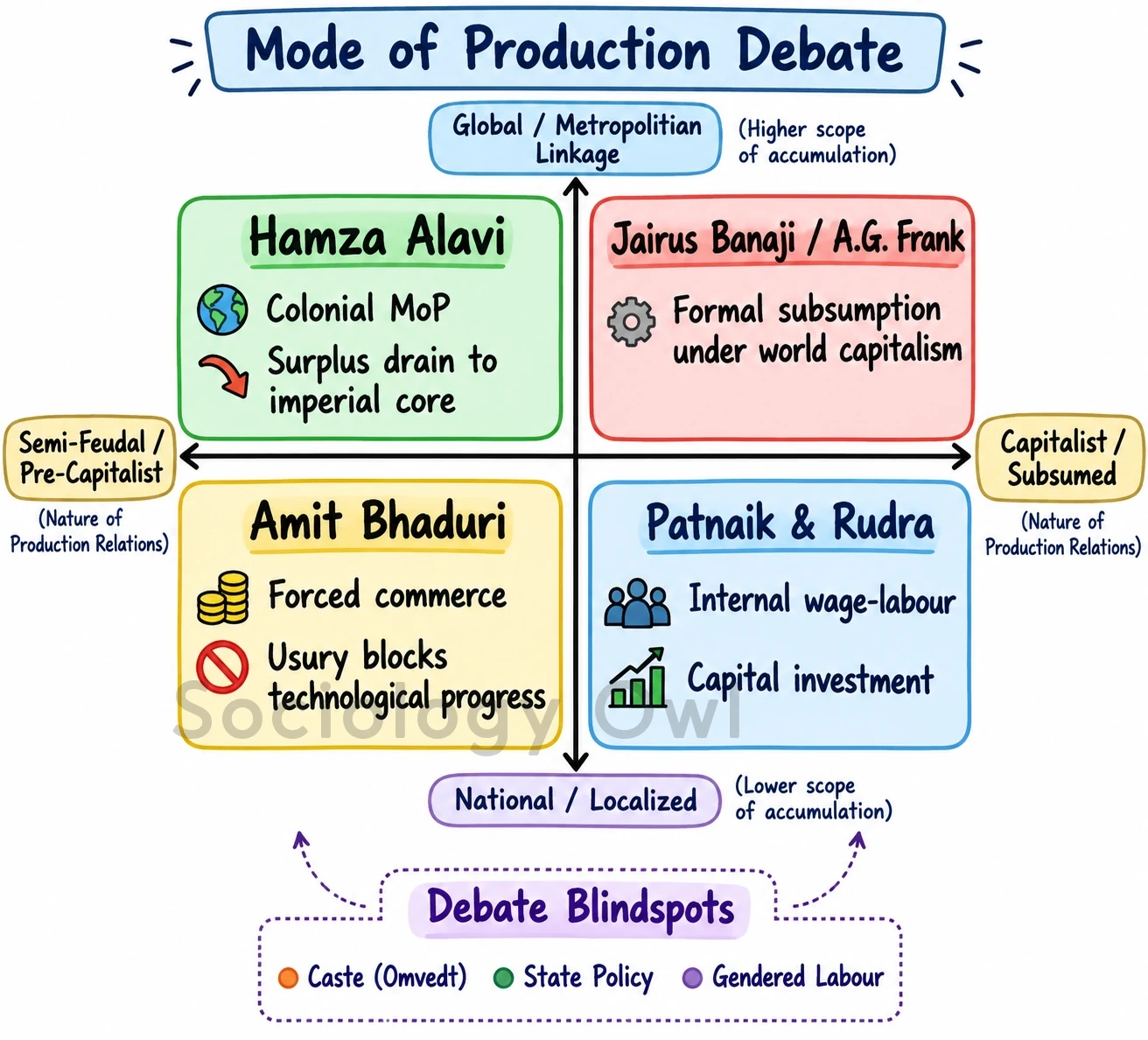
  • Deformed Capitalism: Rather than true modernization, Hamza Alavi argues the reforms created a “Colonial Mode of Production,” where India experienced a peripheral, distorted capitalism.

The structural vulnerability introduced by colonial commercialization persists today. The forced shift to cash-crop agriculture established the roots of India’s contemporary agrarian crisis, manifesting tragically in ongoing farmer suicides among cotton growers in Vidarbha.

Conclusion

British economic reforms did not merely drain wealth; they fundamentally restructured Indian social stratification. By dismantling traditional occupational purities and forging a complex caste-class nexus, colonial policies catalyzed a permanent shift from a ritualistic hierarchy to the politico-economic stratification defining modern India.

Q. Do you think that new economic reforms of British rule have disrupted the old economic system of India? Substantiate your answer with suitable examples. Read More »

Discuss the role of pressure groups in strengthening democracy.

Model Answers

Q: Discuss the role of pressure groups in strengthening democracy.

Question asked in UPSC Sociology 2022 Paper 2. Download our app for last 20 year question with model answers.

Model Answer:

Pressure groups are interest-based collectives bridging civil society and the State. Sociologically, they articulate structural interests, making Indian democracy substantive rather than merely procedural.

Role in Strengthening Democracy

  • Subaltern Empowerment: Rajni Kothari argues that traditional identities adapt to modern politics. Caste associations (e.g., Nadar Mahajana Sangam) act as pressure groups, deepening pluralism for marginalized groups.
  • “Demand Groups”: Lloyd and Susanne Rudolph observe that unorganized sectors form “demand groups” to negotiate effectively with the State.
  • Civic Mobilization: Ghanshyam Shah notes they function as non-party political formations, articulating grassroots issues beyond party politics.

The grassroots mobilization by the Mazdoor Kisan Shakti Sangathan (MKSS) directly influenced the enactment of the RTI Act. Similarly, the Bharatiya Kisan Union (BKU) actively shapes agrarian class policies.

Sociological Critique

  • Marxist Lens: A.R. Desai asserts capitalist lobbying groups (FICCI, CII) wield disproportionate state influence compared to proletarian collectives.
  • Elite Capture: Dipankar Gupta highlights that civil society pressure groups are often dominated by the educated urban elite.

Conclusion

Despite structural inequalities, pressure groups remain essential catalysts in transforming Indian society from a rigid representative democracy to a vibrant participatory democracy.

Discuss the role of pressure groups in strengthening democracy. Read More »