2025 Sociology Paper 2

Q. Do you think that law has been able to abolish child labour in India? Comment.

Q. Do you think that law has been able to abolish child labour in India? Comment.

UPSC Sociology 2025 Paper 2

Model Answer:

Despite legal frameworks (Article 24, RTE Act), child labour persists. Sociologically, law acts merely as a superstructure attempting to regulate a structural necessity of India’s urban informalization and capitalist development.

Structural Limitations of Law

  • Caste-Class Nexus: A.R. Desai links child labour to structural poverty among marginalized SCs/STs, which superficial legal bans ignore.
  • Reproduction of Caste: Neera Burra heavily critiques the 2016 “family enterprise” exemption, arguing it legally sanctions the reproduction of caste-based occupations and blocks social mobility.
  • Informal Exploitation: Following Jan Breman’s concept of “footloose labour”, informal urban sectors prefer children as cheap, docile workers who evade legal scrutiny.

Socio-Cultural Endorsement

  • Middle-Class Apathy: In The Child and the State in India, Myron Weiner argues that entrenched elite beliefs against educating lower-castes culturally normalize child labour.

The post-COVID-19 surge in child labour, particularly in informal sub-contracting like Jharkhand’s mica mines, exposes the limits of mere legal prohibition.

Conclusion

As Upendra Baxi suggests, law often functions as a symbol rather than an instrument of change. Abolition demands dismantling the deeply entrenched caste-class inequalities feeding India’s informal economy.

Q. Do you think that law has been able to abolish child labour in India? Comment. Read More »

Q. What are the Indian government’s schemes launched for poverty alleviation after the United Nation’s Declaration of ‘Sustainable Development Goals – 2015’? Briefly describe.

Q. What are the Indian government’s schemes launched for poverty alleviation after the United Nation’s Declaration of ‘Sustainable Development Goals – 2015’? Briefly describe.

UPSC Sociology 2025 Paper 2

Model Answer:

Post-2015 schemes align with SDGs, moving beyond mere income generation to Amartya Sen’s capability approach. They target poverty not just as economic deprivation, but as a structural phenomenon deeply entrenched in India’s caste-class nexus.

Societal Impact of Post-2015 Schemes

Feminization of Poverty

PM Ujjwala (LPG) and Jal Jeevan Mission (water) address the patriarchal burden of care work, enhancing women’s capabilities by restructuring gendered resource distribution.

Informalization of Labor

PM Shram Yogi Maandhan offers pensions to unorganized workers, acting as a safety net for those Jan Breman characterizes as precarious “wage-hunters and gatherers.”

Institutional Integration

The expanded PM Jan Dhan Yojana helps emancipate the rural poor from traditional, exploitative patron-client dependencies (remnants of the Jajmani system).

Despite successes like PM-KISAN, structural issues remain. Jean Drèze argues these schemes provide relief but bypass fundamental agrarian inequalities like land ownership. Furthermore, Reetika Khera notes that techno-utopian delivery often creates “exclusion errors,” disproportionately impacting marginalized Dalits and Adivasis.

Conclusion

Post-2015 poverty alleviation represents a shift towards “New Welfarism.” Rather than relying on broad rights-based frameworks, the Indian state focuses on the targeted provision of essential private goods, striving to build human capital and mitigate historical multidimensional inequalities.

Q. What are the Indian government’s schemes launched for poverty alleviation after the United Nation’s Declaration of ‘Sustainable Development Goals – 2015’? Briefly describe. Read More »

Q. Describe the main features of Indian new middle class. How is it different from the old middle class?

Q. Describe the main features of Indian new middle class. How is it different from the old middle class?

UPSC Sociology 2025 Paper 2

Model Answer:

While the Old Middle Class (OMC) was a product of colonial education and state administration (B.B. Misra), the New Middle Class (NMC) emerged post-1991, driven by neoliberal globalization and a market-led economy.

Features of the New Middle Class

  • Consumerist Identity: As Pavan Varma explores in The Great Indian Middle Class, the NMC is defined more by its aspirational consumption than production (Leela Fernandes).
  • Caste-Class Nexus: Satish Deshpande argues the NMC masquerades upper-caste privilege as “merit,” having successfully converted traditional caste capital into modern educational capital.
  • Secession of the Successful: Dipankar Gupta notes their tendency to bypass public utilities in favor of privatized global standards (e.g., gated communities).

Distinctions from the Old Middle Class

  • Economic Ethos: The OMC valued frugality and public-sector job security; the NMC embraces risk-taking and MNC employment.
  • Political Ideology: The OMC focused on Nehruvian nation-building and welfarism. The NMC engages in issue-based activism and “Bourgeois Environmentalism” (Amita Baviskar), prioritizing urban beautification over subaltern rights.

Recent massive layoffs in IT and Ed-Tech expose the NMC’s underlying vulnerabilities, revealing a rising, insecure “Precariat” class that completely lacks the systemic job security of the OMC.

Conclusion

While the OMC was state-created, the NMC is market-produced. Despite being a demographic minority, the NMC holds disproportionate hegemony in shaping the cultural and economic aspirations of a globalized India.

Q. Describe the main features of Indian new middle class. How is it different from the old middle class? Read More »

Q. Do you think that forced displacement of labourers has caused their deprivation and resultant inequalities during the recent past years? Elaborate.

Q. Do you think that forced displacement of labourers has caused their deprivation and resultant inequalities during the recent past years? Elaborate.

UPSC Sociology 2025 Paper 2

Model Answer:

Forced displacement of labourers in India encompasses both crisis-induced shocks (like COVID-19 reverse migration) and Development-Induced Displacement (DID). This dual phenomenon severely deepens deprivation and exacerbates structural socio-economic inequalities.

Mechanisms of Deprivation and Inequalities

  • Capitalist Development and Dispossession: A.R. Desai argues that India’s capitalist path of development structurally marginalizes the rural poor. Walter Fernandes highlights that Adivasis constitute over 40% of all displaced persons despite being just 8.6% of the population, showcasing acute structural inequality.
  • Socio-Cultural Alienation: Virginius Xaxa emphasizes that DID severs Adivasis from their land (Jal, Jungle, Zameen), destroying their traditional economies and cultural identities.
  • Capability Deprivation: Crisis-induced displacement transforms workers into “footloose labour” (Jan Breman), trapped in a vulnerable precariat class (Guy Standing). Through Amartya Sen’s Capability Approach, this represents profound capability deprivation—the loss of health, education, and basic social security, not just wages.

Nuances and Internal Debates

Escape vs. Distress: While Utsa Patnaik frames forced rural out-migration as a squeeze on the peasantry caused by agrarian distress, Dipankar Gupta offers a counter-narrative. For Dalits, forced displacement from villages is sometimes an attempt to escape traditional caste hierarchies, although they often encounter new class-based exploitation in urban slums.

Citizenship Deficit and State Response: The pandemic exodus exposed the failure of the Inter-State Migrant Workmen Act, 1979. Millions survive in what Partha Chatterjee terms “political society”—lacking substantive citizenship rights. Recent policies like the e-Shram Portal and One Nation One Ration Card (ONORC) attempt to rectify this by formalizing the informal workforce and ensuring welfare portability.

Conclusion

Forced displacement is not merely a temporary economic shock but an institutionalized process of social exclusion. Addressing resultant inequalities requires a rights-based development framework, ensuring marginalized labourers transition from precarious subjects into empowered, rights-bearing citizens.

Q. Do you think that forced displacement of labourers has caused their deprivation and resultant inequalities during the recent past years? Elaborate. Read More »

Q. How Dalit movements in India have facilitated their Identity formation? Analyze.

Q. How Dalit movements in India have facilitated their Identity formation? Analyze.

UPSC Sociology 2025 Paper 2

Model Answer:

Dalit movements transformed a stigmatized identity rooted in Louis Dumont’s purity-pollution ideology into an assertive political consciousness. Gail Omvedt categorizes them as New Social Movements seeking human dignity.

Dialectics of Dalit Identity Formation

  • Subaltern Assertion: Movements explicitly rejected M.N. Srinivas’s Sanskritization and Gandhi’s patronizing ‘Harijan’ label, forging independent political agency via B.R. Ambedkar’s Annihilation of Caste.
  • Political Shift: Eleanor Zelliot highlights the transition from ritual pleading to militant political mobilization (e.g., Dalit Panthers), which culminated in Kanshi Ram’s broader Bahujan identity.
  • Structural Critiques: The identity is not monolithic. Anand Teltumbde notes class-based fragmentation (emergence of a Dalit middle-class elite), while Sharmila Rege emphasizes Dalit Feminism to counter internal Brahmanical patriarchy.

The Rohith Vemula movement forged new “Dalit-student-minority” solidarities, while digital platforms have enabled the Bhim Army to cultivate a modern Techno-Dalit assertion.

Conclusion

As Gopal Guru observes, Dalits have evolved from passive objects to active subjects of history. Despite internal intersections of class and gender, this identity formation remains a dynamic force in democratizing India’s socio-political landscape.

Q. How Dalit movements in India have facilitated their Identity formation? Analyze. Read More »

Q. Do you think that new economic reforms of British rule have disrupted the old economic system of India? Substantiate your answer with suitable examples.

Q. Do you think that new economic reforms of British rule have disrupted the old economic system of India? Substantiate your answer with suitable examples.

UPSC Sociology 2025 Paper 2

Model Answer:

The pre-colonial Indian economy, famously termed “self-sufficient village republics” by Charles Metcalfe and analyzed through Karl Marx’s concept of the “Asiatic Mode of Production”, rested on a synthesis of agriculture and handicrafts. British economic reforms deeply disrupted this by forcefully integrating India into global capitalism.

Transformation of Social and Agrarian Structures

  • New Agrarian Classes: Colonial land settlements (Zamindari/Ryotwari) commodified land. A.R. Desai highlighted the emergence of new exploitative classes. Daniel Thorner sociologically classified this new stratification into Malik (landlords/moneylenders), Kisan (working peasants), and Mazdoor (landless laborers).
  • Emergence of Dominant Castes: Bestowing private property rights upon specific middle-peasant castes laid the historical foundation for what M.N. Srinivas later identified as the Dominant Caste in rural India.
  • Collapse of Reciprocity: William Wiser observed that the shift to a cash-based legal economy dismantled the Jajmani system, transforming caste interdependency from a status-based reciprocal exchange into contract-based exploitation.
  • Occupational Disruption: Deindustrialization ruined traditional artisanal guilds. As Andre Beteille noted, the forced migration of ruined artisans into agricultural labor began to detach economic ‘class’ from traditional ritual ‘caste’ hierarchies, causing immense pauperization.

Sociological Debates on Economic Disruption

  • The Myth of Isolation: Sociologists like A.M. Shah challenge the premise of “perfect self-sufficiency.” Indian villages were always integrated into regional trade; the British merely reoriented these networks toward global extraction.
  • Deformed Capitalism: Rather than true modernization, Hamza Alavi argues the reforms created a “Colonial Mode of Production,” where India experienced a peripheral, distorted capitalism.

The structural vulnerability introduced by colonial commercialization persists today. The forced shift to cash-crop agriculture established the roots of India’s contemporary agrarian crisis, manifesting tragically in ongoing farmer suicides among cotton growers in Vidarbha.

Conclusion

British economic reforms did not merely drain wealth; they fundamentally restructured Indian social stratification. By dismantling traditional occupational purities and forging a complex caste-class nexus, colonial policies catalyzed a permanent shift from a ritualistic hierarchy to the politico-economic stratification defining modern India.

Q. Do you think that new economic reforms of British rule have disrupted the old economic system of India? Substantiate your answer with suitable examples. Read More »

Q. What are the Private and Public network and support systems operative in Indian society for the aged? Suggest measures to curb down the challenges before care givers of the aged.

Q. What are the Private and Public network and support systems operative in Indian society for the aged? Suggest measures to curb down the challenges before care givers of the aged.

UPSC Sociology 2025 Paper 2

Model Answer:

The UNFPA India Ageing Report 2023 projects that the elderly will constitute 20% of India’s population by 2050. This rapid “demographic shift” is fundamentally altering traditional kinship and family structures, necessitating a robust evolution in both private and public care mechanisms.

Support Networks and Systems

Private Support Networks:

  • Family and Kinship: Despite residential nuclearization, A.M. Shah argues that “functional jointness” (financial and emotional ties) persists. However, Sarah Lamb observes a shift from traditional Seva (unquestioned duty) to “negotiated care,” especially alongside diaspora migration.
  • Market and Civil Society: There is a growing “commodification of care” (paid care workers, premium retirement communities) serving the urban upper-middle class, contrasting starkly with the severe destitution faced by the rural poor, where NGOs attempt to bridge the gap.

Public Support Systems:

  • State Interventions: The Maintenance and Welfare of Parents and Senior Citizens Act (2007) and schemes like IGNOAPS provide the formal framework.
  • Sociological Critique: Demographer S. Irudaya Rajan critiques these systems, noting that state pensions are meager and systematically exclude the vast informal sector workforce. Additionally, the state often frames the elderly as “dependents” requiring charity rather than citizens with rights.

Challenges for Caregivers

  • Feminization of Caregiving: In India’s patriarchal setup, elder care falls disproportionately on women, specifically the daughter-in-law.
  • Intersectionality and Stress: The “sandwich generation” faces immense “emotional labour” (Arlie Hochschild). These challenges vary across class and caste: urban middle-class caregivers face psychological stress (time poverty), while landless Dalit households face extreme material deprivation.
  • Structural Lag: Increased longevity has resulted in what Matilda White Riley terms “structural lag”—where demographic changes have outpaced the evolution of supportive social institutions.

Addressing caregiver challenges requires multifaceted measures:

  • Formalizing the Care Economy: Recognizing unpaid female labor through state caregiver allowances and subsidized geriatric healthcare.
  • Rebuilding Social Capital: Establishing state-supported respite care, day-care centers, and neighborhood support groups to relieve isolated caregivers.
  • Workplace Flexibility: Introducing paid elder-care leave and flexible hours to prevent caregiver drop-out from the labor force.

Conclusion

Addressing India’s aging population requires shifting the narrative from viewing the elderly as a “demographic burden” to recognizing them as a vital social resource. Bridging traditional Dharma with modern, rights-based state welfare is essential for fostering “intergenerational solidarity” and ensuring dignified aging in a transitioning society.

Q. What are the Private and Public network and support systems operative in Indian society for the aged? Suggest measures to curb down the challenges before care givers of the aged. Read More »

Q. What are the major problems faced by the labour migrants while working in informal sectors of Indian States? Discuss.

Q. What are the major problems faced by the labour migrants while working in informal sectors of Indian States? Discuss.

UPSC Sociology 2025 Paper 2

Model Answer:

Internal migration supplies India’s informal sector with “footloose labour” (Jan Breman). This phenomenon is deeply embedded in the caste-class nexus, resulting in multifaceted vulnerabilities.

Dimensions of Migrant Precarity

  • Economic Exploitation: Migrants face irregular wages and debt-driven neo-bondage. They function as a highly disposable reserve army of labour.
  • Caste-Class Overlap: Gail Omvedt notes that traditional hierarchies reproduce occupationally; the majority of informal migrants belong to marginalized SCs/STs.
  • Nativism and Spatial Segregation: Migrants endure “Sons of the Soil” hostility (Myron Weiner) in host states and inhabit overcrowded slums mirroring rural residential segregation.
  • Gendered Precarity: Neetha N. highlights the invisibility and “double burden” of female migrant workers who face severe wage disparities and exploitation.

Post-pandemic initiatives like the e-Shram Portal and One Nation One Ration Card (ONORC) attempt to address migrants’ institutional invisibility and historic denial of entitlements.

Conclusion

While urbanization promises social mobility, migrants remain trapped in informal precarity. Enforcing portable social rights is vital to transition the migrant subaltern from systemic marginalization to inclusive citizenship.

Q. What are the major problems faced by the labour migrants while working in informal sectors of Indian States? Discuss. Read More »

Q. Justify that the Indian traditions are modernizing. Also discuss its contributing factors.

Q. Justify that the Indian traditions are modernizing. Also discuss its contributing factors.

UPSC Sociology 2025 Paper 2

Model Answer:

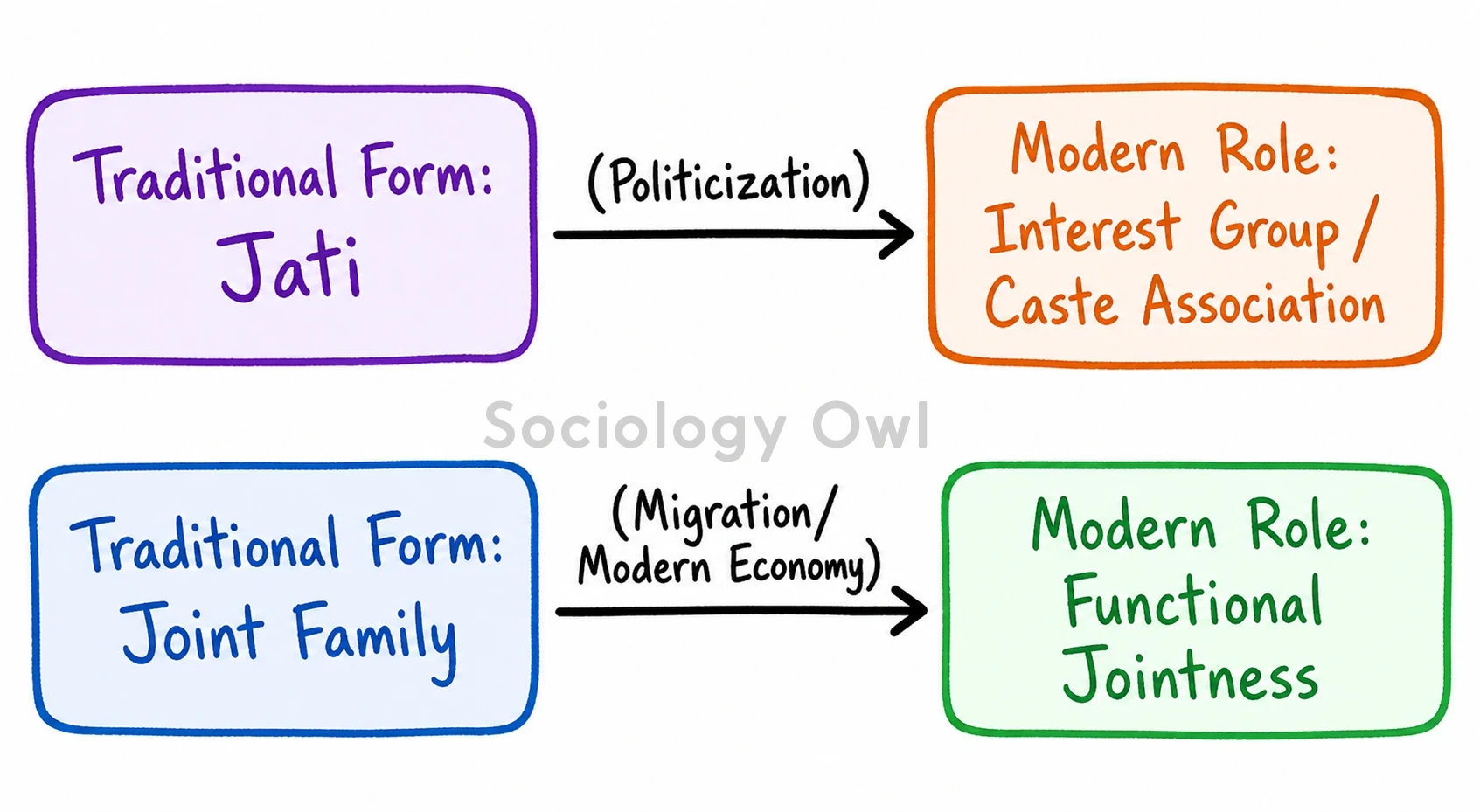
Indian traditions exhibit dynamic continuity through what Yogendra Singh calls a complex synthesis. Lloyd and Susanne Rudolph’s The Modernity of Tradition explains how India adapts modern forms while retaining its core identity.
Evidence, Contributing Factors, and Critiques

  • Caste Transformation: Secularization occurs via political mobilization, transforming caste into modern interest groups (Rajni Kothari’s politicization of caste).
  • Family Structure: Nuclear households retain deep kinship obligations, reflecting “functional jointness” (A.M. Shah).

  • Colonial Legacies: British jurisprudence and modern education initiated M.N. Srinivas’s Westernization.
  • Techno-Legal Shifts: Post-independence constitutional equality and economic liberalization necessitated adaptive changes.
  • Critique: Modernization remains uneven. Dipankar Gupta warns of “Mistaken Modernity,” where superficial modern elements are adopted but traditional prejudices (like casteism) persist.

The booming industry of online matrimonial websites perfectly illustrates this—using modern, globalized technology to facilitate traditional caste endogamy and arranged marriages.

Conclusion

Indian traditions are inherently not static. This ongoing synthesis proves that modernization in India is an adaptive evolution, seamlessly blending structural change with deep-rooted cultural continuity.

Q. Justify that the Indian traditions are modernizing. Also discuss its contributing factors. Read More »

Q. Which measures would you suggest for preventing caste conflicts in India? Justify your argument.

Q. Which measures would you suggest for preventing caste conflicts in India? Justify your argument.

UPSC Sociology 2025 Paper 2

Model Answer:

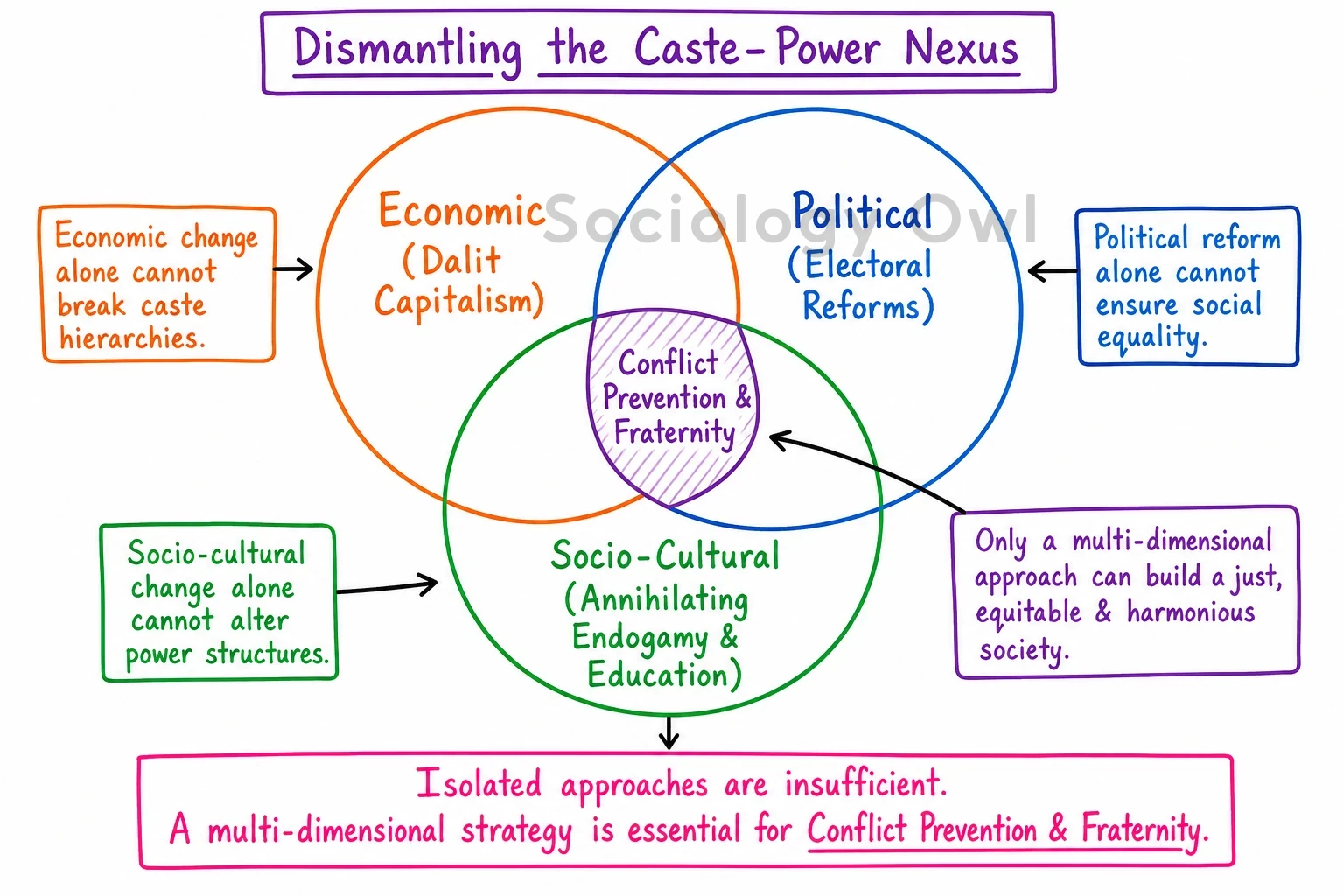
Contemporary caste conflicts stem less from ritual purity (Louis Dumont) and more from secular resource competition (Dipankar Gupta), manifesting as a clash between Dalit Assertion and Dominant Caste backlash (M.N. Srinivas).
Socio-Economic & Political Interventions

  • Dalit Capitalism: Promote entrepreneurship (Chandrabhan Prasad) to break traditional Jajmani dependency. Justification: Economic independence dismantles systemic exploitation.
  • De-politicizing Caste: Check the Politicization of Caste (Rajni Kothari) via electoral reforms. Justification: Curbs violence fueled by targeted vote-bank mobilization.

Legal & Cultural Transformation

  • Combating Institutional Casteism: Strict SC/ST Act enforcement to bypass local Dominant Caste administrative biases. Justification: Dalit upward mobility triggers status anxiety, necessitating strong legal shields.
  • Annihilating Endogamy: Incentivize inter-caste marriages as championed in B.R. Ambedkar’s Annihilation of Caste. Justification: Strikes the structural root of caste reproduction.

Mainstreaming Subaltern educational narratives (Gail Omvedt) builds organic solidarity against contemporary inter-caste violence (e.g., recent clashes over resources in Tamil Nadu).

Conclusion

Preventing conflict requires dismantling the caste-class-power nexus, shifting from mere protective discrimination to substantive equality to realize true constitutional fraternity.

Q. Which measures would you suggest for preventing caste conflicts in India? Justify your argument. Read More »