Q. Discuss the social bases of political mobilization in Independent India. Has some change occurred in these during the last 60-70 years?
UPSC Sociology 2025 Paper 2
Model Answer:
Political mobilization in India has evolved from primordial loyalties to complex democratic negotiations over the last seven decades.
Evolution of Social Bases
Traditional Ties:Lloyd and Susanne Rudolph mapped a shift from vertical mobilization (patron-client dominant castes) to horizontal mobilization (caste associations).
Caste Politics:M.N. Srinivas coined the “Vote Bank”. In Caste in Indian Politics, Rajni Kothari observed the “politicization of caste” as an instrument of secular democratic mobilization.
Class & Tribe:A.R. Desai highlighted agrarian class struggles; Virginius Xaxa noted tribal ethnic assertion against marginalization.
Differential Mobilization:Yogendra Yadav’s“Second Democratic Upsurge” captures the 1990s OBC rise (Christophe Jaffrelot’s“Silent Revolution”), increasingly fragmenting into pragmatic modern caste-alliances (Dipankar Gupta).
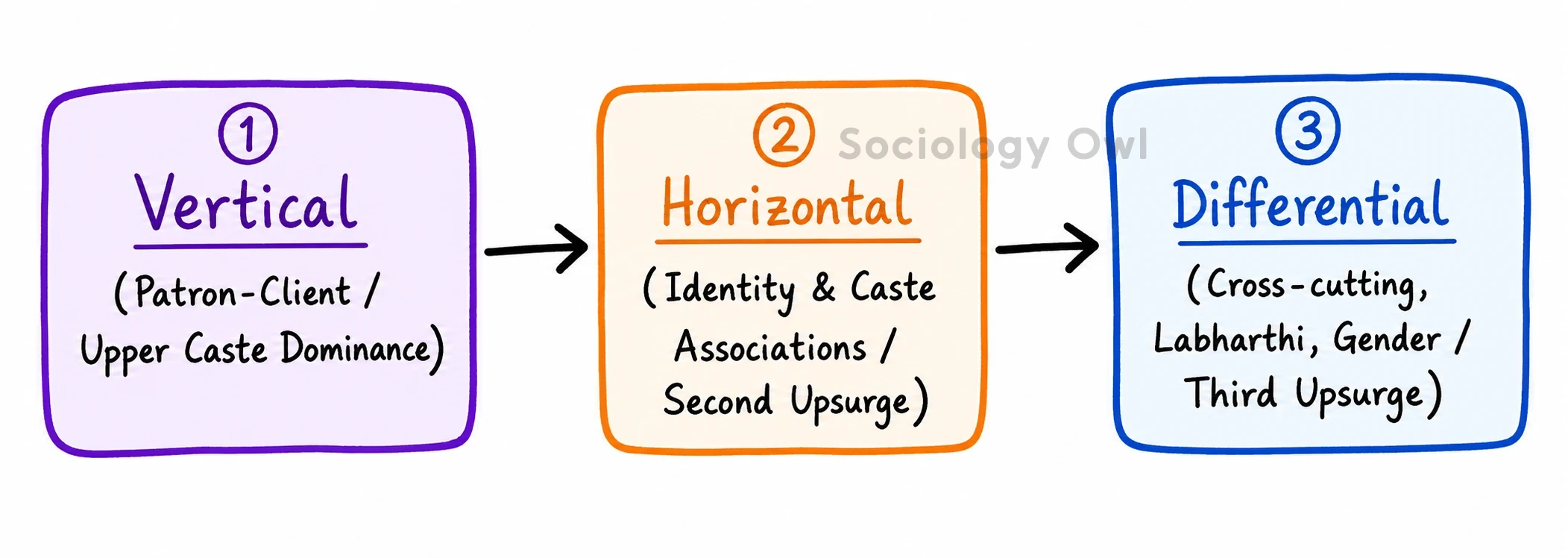
Contemporary politics heavily utilizes “Labharthi” (beneficiary) and gender voting bases. This exemplifies Partha Chatterjee’s“Political Society”, where marginalized masses are mobilized via targeted state welfare.
Conclusion
Shifting from vertical patronage to cross-cutting cleavages, Yogendra Yadav’s“Third Democratic Upsurge”—driven by aspirational youth and women—reflects India’s continuously deepening political sociology beyond traditional loyalties.
Q. What do you mean by nation building? What is the role of religion in nation building? Elaborate your answer.
UPSC Sociology 2025 Paper 2
Model Answer:
Nation-building is the conscious process of integrating diverse populations into a cohesive political community. In India, as Sunil Khilnani notes in The Idea of India, this involved transforming a civilizational entity into a modern “state-nation.” It requires navigating the complex tension between “Civic Nationalism” (constitutional secularism) and “Cultural Nationalism” (shared religious heritage).
Religion as an Integrative Force
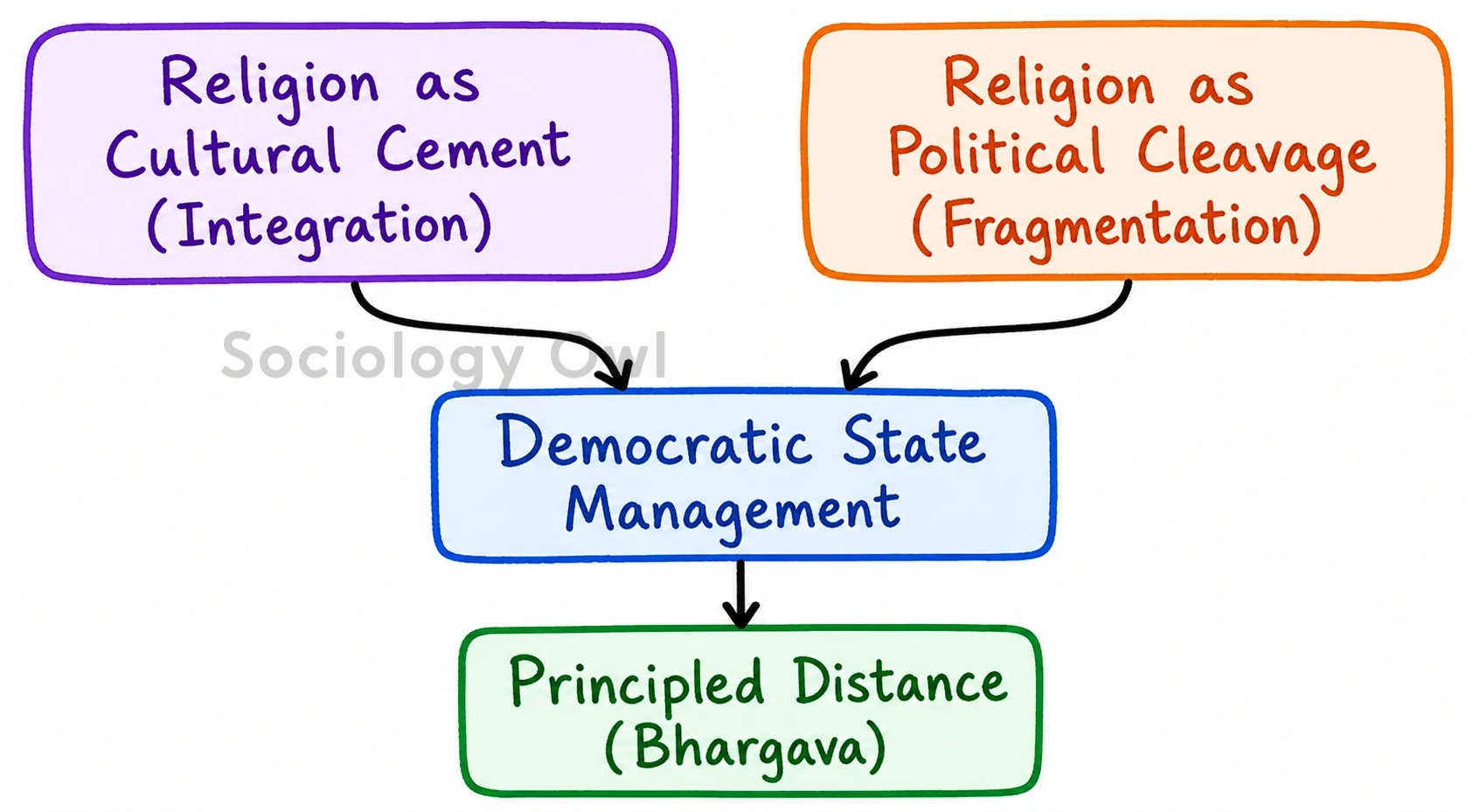
Religion provides shared moral frameworks crucial for collective social solidarity.
Civilizational Unity: Indologist G.S. Ghurye argued that India’s foundational national unity is deeply rooted in its shared Hindu traditions and texts.
Cultural Integration:M.N. Srinivas demonstrated how Sanskritization creates a pan-Indian cultural idiom, facilitating integration and mobility across diverse caste hierarchies.
Mass Mobilization: Gandhi’s strategic synthesis of religious idioms (Ram Rajya, Sarva Dharma Sambhava) united diverse masses against colonialism, creating a “spiritual domain” of nationalism (Partha Chatterjee).
Religion as a Fragmenting Force
Conversely, the politicization of religion poses severe challenges to democratic consolidation.
Subaltern Critique:B.R. Ambedkar and Kancha Ilaiah argue that nation-building based on upper-caste Hindu religious idioms alienates Dalits and religious minorities, fracturing rather than unifying the nation.
Class Fragmentation: Marxist sociologist A.R. Desai posited that the capitalist ruling class intentionally uses religious communalism to fragment working-class solidarity, hindering equitable nation-building.
Ideological Weaponization:Dipankar Gupta distinguishes between religion as faith (fostering harmony) and ideology (creating rigid “us vs. them” boundaries). This manipulation sustains what Paul Brass terms “institutionalized riot systems.”
Recent policy debates highlight religion’s ongoing friction with Indian nation-building. The Citizenship Amendment Act (CAA) sparked intense debates over defining citizenship along religious lines versus constitutional secularism. Similarly, the Uniform Civil Code (UCC) discourse reflects the tension between national legal integration and minority religious rights.
Conclusion
Religion’s role in Indian nation-building is profoundly paradoxical. Resolving this requires embracing Rajeev Bhargava’s model of “Principled Distance”—where the state maintains equal respect and contextual intervention—harmonizing India’s deeply religious society with its secular, democratic aspirations.
Q. “Educational development is the only Panacea for country’s all ills and evils.” Critically examine the above statement with reference to NEP-2020.
UPSC Sociology 2025 Paper 2
Model Answer:
While visionary thinkers like Jyotirao Phule and B.R. Ambedkar championed education as the ultimate weapon for Dalit emancipation, labeling educational development as the sole panacea for India’s societal ills oversimplifies complex structural realities. NEP-2020 offers a progressive framework, but must be critically examined through Indian sociological lenses.
NEP-2020: Education as a Catalyst for Change
NEP-2020 attempts to address historical inequities by positioning education as a tool for modernization and inclusion:
Capability Approach: Aligning with Amartya Sen, NEP-2020’s focus on vocational training and flexible pathways aims to build human capabilities and expand economic freedoms.
Modernization: As S.C. Dube noted, education drives modernization. NEP’s Gender Inclusion Fund and support for Socio-Economically Disadvantaged Groups (SEDGs) aim to democratize traditional power structures.
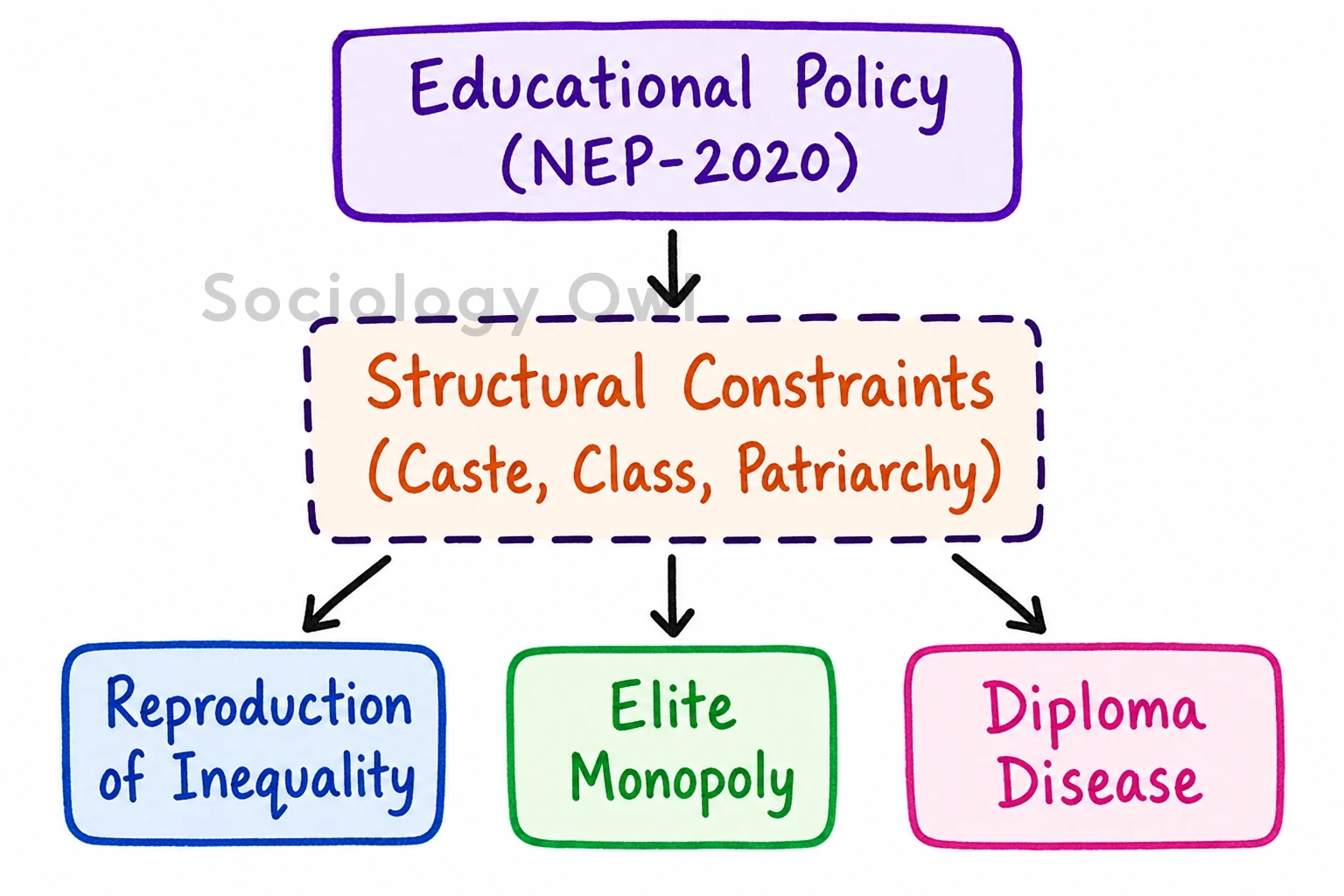
Reproduction of Inequality: From a Marxist perspective, A.R. Desai argued that Indian education primarily benefits the “haves.” Andre Beteille further notes that modern institutions often merely reproduce existing class-caste hierarchies.
Caste-Class Nexus:M.N. Srinivas demonstrated how Dominant Castes historically monopolized higher education to convert traditional status into modern secular power. Thus, educational expansion has not inherently eradicated caste endogamy or exclusionary elite spaces.
Patriarchal Socialization:Leela Dube highlighted that women’s higher education in India is frequently weaponized to secure a “better matrimonial match” rather than female autonomy, perpetuating the “educated housewife” phenomenon.
The Language Debate: While NEP promotes mother-tongue learning, Dalit scholars like Chandra Bhan Prasad view English as the language of Dalit emancipation, arguing that pushing regional languages may inadvertently exclude marginalized groups from global mobility.
The contemporary crisis of the Digital Divide, highlighted by recent ASER Reports, exposes how NEP-2020’s reliance on EdTech creates new axes of inequality for rural students. Furthermore, India’s massive educated youth unemployment illustrates the “Diploma Disease,” proving that without simultaneous structural economic reforms, education guarantees neither employment nor empowerment.
Conclusion
NEP-2020 provides a robust framework, but education is not a magic bullet. As B.R. Ambedkar powerfully synthesized in his slogan “Educate, Agitate, Organize,” education is only the first step. True social transformation requires coupling educational development with the annihilation of caste, dismantling of patriarchy, and genuine economic democratization.
Q. Bring out various factors responsible for declining of village Industries in India.
UPSC Sociology 2025 Paper 2
Model Answer:
Historically romanticized as “little republics,” Indian villages relied on a symbiotic integration of agriculture and artisan crafts. However, structural and cultural transformations have driven their precipitous decline.
Sociological Factors for Decline
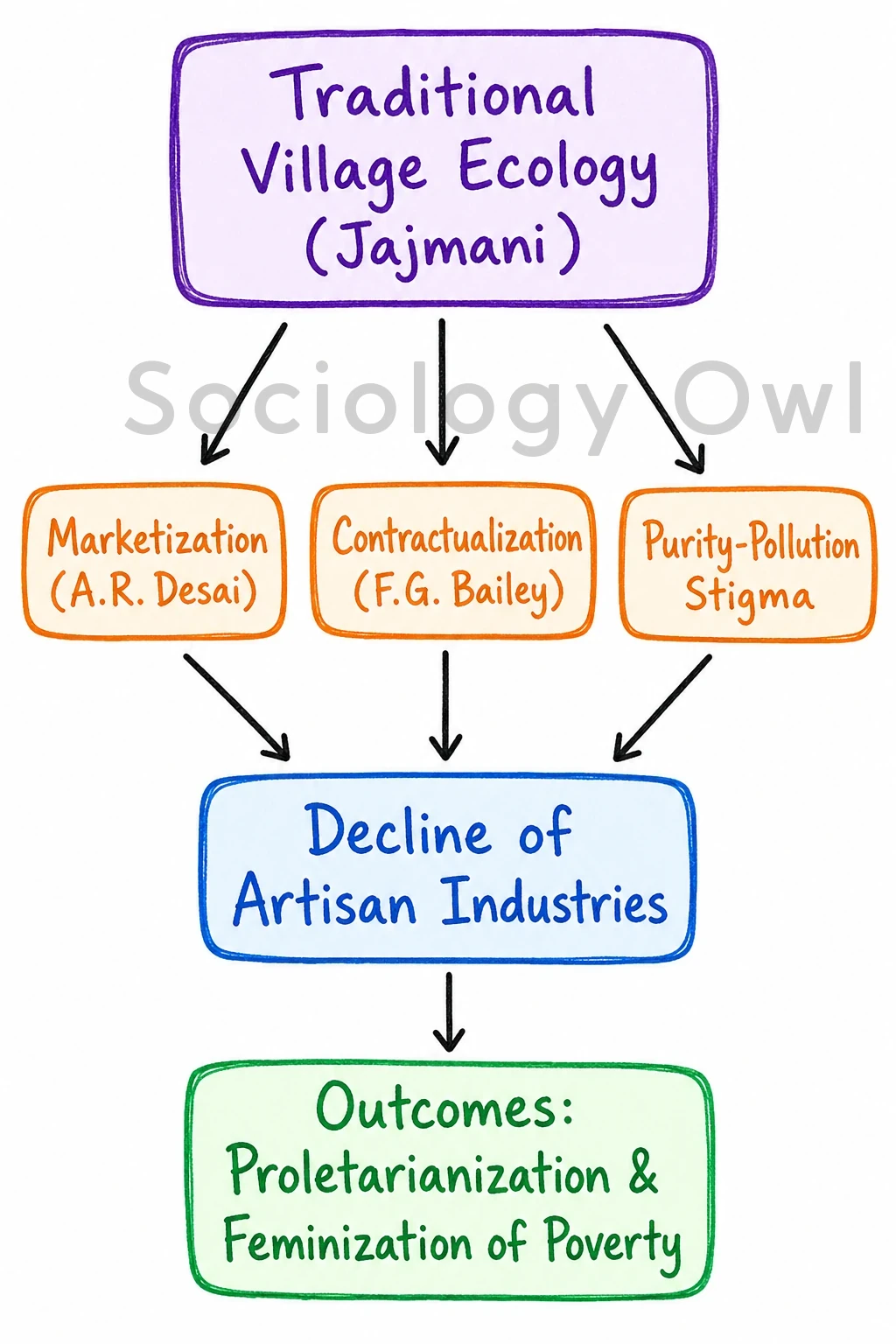
Colonial Capitalism:A.R. Desai notes that colonial market forces destroyed pre-capitalist rural economies, causing the “proletarianization” of artisans into landless laborers.
Jajmani Disintegration:William Wiser documented the collapse of reciprocal caste-based patronage. F.G. Bailey adds that rural monetization replaced hereditary duties with precarious contractual relations.
Caste Stigma & Mobility: Driven by purity-pollution stigmas, youths from lower artisan castes increasingly abandon traditional crafts for secular jobs, seeking upward mobility (Sanskritization).
Gender Marginalization: The collapse of household industries heavily displaced female family labor, worsening the “feminization of agricultural poverty.”
State interventions like the PM Vishwakarma Yojana and civil society cooperatives like SEWA actively counter artisan exploitation by providing modern credit, skills, and market access.
Conclusion
This decline represents the dismantling of traditional social ecology. Reinvigorating rural industries is vital for curbing distress migration, checking economic marginalization, and empowering historically oppressed artisan castes.
Q. Discuss the trend of urbanization in India. Do you think that Industrialization is the only precondition of urbanization? Give you arguments.
UPSC Sociology 2025 Paper 2
Model Answer:
Urbanization in India is not merely a demographic shift but a complex structural and cultural transformation. Ashish Bose characterizes India’s unique demographic trajectory as “Pseudo-urbanization,” where urban growth occurs without commensurate economic development, while M.S.A. Rao views it as a profound shift in the traditional social matrix.
Trends of Urbanization in India
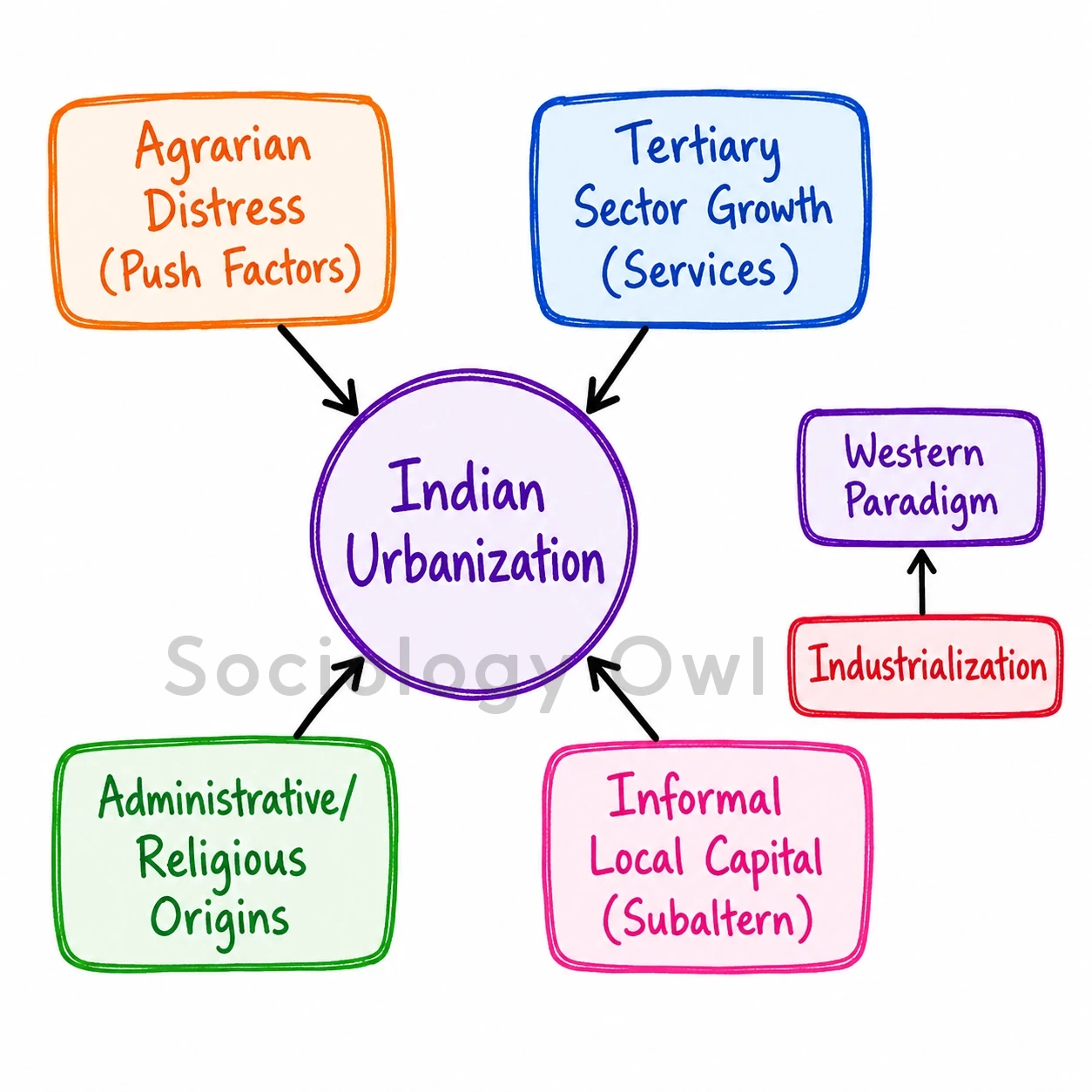
Subaltern Urbanization: Coined by Eric Denis and Partha Mukhopadhyay, the emergence of thousands of new census towns reflects autonomous growth driven by local capital and informal networks, independent of state industrial planning.
Exclusionary Urbanization:Amitabh Kundu argues that top-heavy metropolitan growth pushes the urban poor to the peripheries while gentrifying core city spaces.
Rural-Urban Continuum: Disputing a strict rural-urban dichotomy, G.S. Ghurye and Dipankar Gupta highlight a continuum where mixed migration blurs spatial and cultural boundaries.
Industrialization: Not the Sole Precondition
While the Western paradigm links urbanization directly to the Industrial Revolution, India’s trajectory is multi-causal:
Over-urbanization:Bert F. Hoselitz notes that Indian cities grow demographically without proportionate industrial expansion, heavily driven instead by the tertiary service sector.
Typology of Cities:M.S.A. Rao explicitly identified non-industrial origins for urban centers, including religious (Varanasi), administrative (Chandigarh), and commercial towns.
Agrarian Distress and Informalization:Jan Breman highlights how rural unviability pushes footloose labor into cities. Furthermore, Kalyan Sanyal argues that post-1991 economic reforms bypassed traditional manufacturing, creating vast informal sectors rather than an industrial proletariat.
Policy and Crisis Integration: The government’s Shyama Prasad Mukherji Rurban Mission actively addresses non-industrial rural-urban clusters by providing urban amenities. Additionally, the COVID-19 reverse migration ruthlessly exposed how Indian urbanization heavily relies on an informal, non-industrial workforce, validating Breman’s thesis.
Conclusion
India’s urbanization represents a distinct, multi-causal synthesis of modern economic shifts and traditional structures, proving industrialization is not the sole precondition. Moving forward, urban policy must embrace David Harvey’s framework of the “Right to the City,” shifting from exclusionary enclaves toward inclusive spaces for informal and rural migrant populations.
Q. Is it possible to have sustainable development in India? Cite major environmental issues and suggest a few measures to achieve the sustainability.
UPSC Sociology 2025 Paper 2
Model Answer:
Sustainable development requires meeting present needs without compromising future generations. Sociologically, however, it is a contested struggle over Jal, Jungle, and Zameen. A.R. Desai argues that India’s post-independence capitalist development inherently breeds ecological degradation and inequality, making sustainability fundamentally a question of social justice.
Sociological Debates on Sustainable Development
Achieving sustainability in India requires addressing inherent structural inequalities:
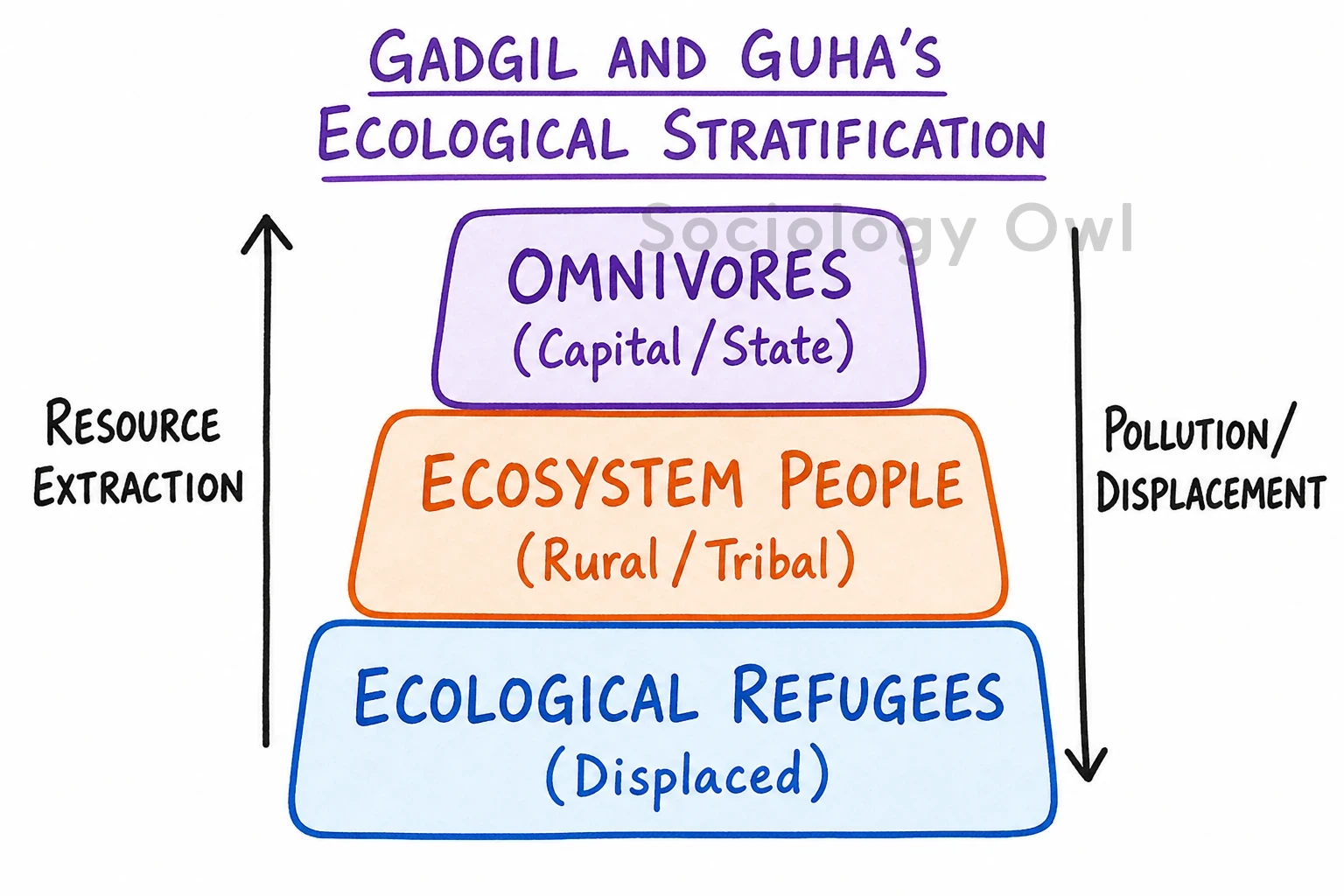
Ecological Stratification: In Ecology and Equity, Madhav Gadgil and Ramachandra Guha argue that sustainable development is impossible unless the unchecked consumption of “Omnivores” (urban capitalists) is curtailed to protect “Ecosystem People” (tribals and rural poor) from becoming ecological refugees.
Feminist Environmentalism:Vandana Shiva, in Staying Alive, highlights “Maldevelopment”, arguing that Western capitalist models are inherently patriarchal and anti-nature, disproportionately harming women.
Major Environmental Issues
Urban Ecology and Class Conflicts:Amita Baviskar introduces “Bourgeois Environmentalism” to explain how middle-class demands for “clean” cities often result in slum demolitions, evicting the urban poor and destroying livelihoods under the guise of beautification.
Development-Induced Displacement: As Walter Fernandes notes, Adivasis constitute over 40% of displaced populations despite being only 8% of the demography. This highlights a severe class-caste nexus in environmental degradation.
Gender and Caste Vulnerability:Bina Agarwal emphasizes that environmental depletion disproportionately increases the labor burden on rural women (collecting fuel and fodder) and pushes marginalized castes into ecologically fragile, disaster-prone zones.
Sustainability requires structural empowerment rather than mere technological fixes:
Decentralization and Rights: Democratizing governance through the Forest Rights Act (FRA, 2006) and PESA shifts power to the Gram Sabha.
Social Movements:Ramachandra Guha identifies the “Environmentalism of the poor”, visible when the Dongria Kondh tribe successfully resisted Vedanta’s mining in Niyamgiri, illustrating grassroots assertion over ecological governance.
Conclusion
In a highly stratified society like India, ecological sustainability is inextricably linked to social equity. As Amartya Sen posits, viewing development as “freedom” dictates that true sustainability is achieved only when marginalized communities transition from passive victims of ecological decay to active decision-makers in resource management.
Q. How same sex marriages are responsible for population dynamics in India? Discuss.
UPSC Sociology 2025 Paper 2
Model Answer:
Same-Sex Marriages and Population Dynamics in India
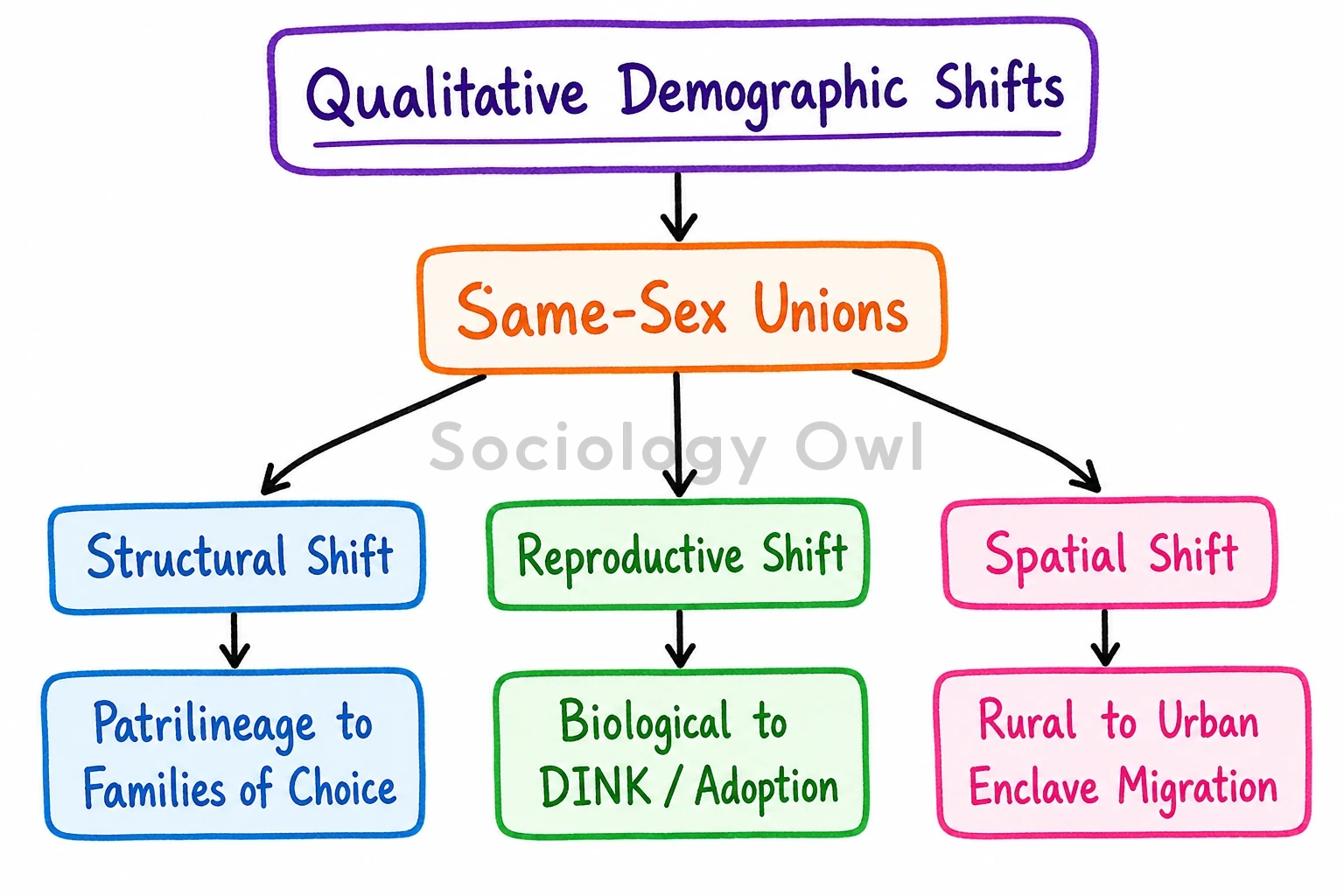
While legally unrecognized (Supriyo v. Union of India, 2023), same-sex marriage impacts India’s social demography normatively rather than statistically, challenging traditional, procreation-centric population models.
Disruption of Traditional Kinship
K.M. Kapadia identifies Praja (progeny) as a core mandate of Hindu marriage. Same-sex unions fundamentally decouple marriage from biological reproduction.
They challenge Leela Dube’s“Seed and Earth” metaphor, disrupting patrilineal reproduction (Vansh) and shifting focus from collective lineage to emotional companionship.
Alternative Parenthood and Policy
The demographic expansion of queer “families of choice” is actively curtailed by the Surrogacy (Regulation) Act, 2021 and CARA guidelines.
This fosters DINK (Double Income, No Kids) households, potentially altering future elderly dependency ratios by increasing reliance on institutional care rather than filial support.
While macro-factors drive India’s fertility decline, same-sex unions mark a qualitative demographic shift. As Patricia Uberoi notes, they reflect modern India’s negotiation between traditional kinship obligations and the emergence of individual constitutional morality.
Q. ‘The transfer of land from cultivating to the non-cultivating owners is bringing about transformation in Indian society.’ Justify your answer by giving suitable illustrations.
UPSC Sociology 2025 Paper 2
Model Answer:
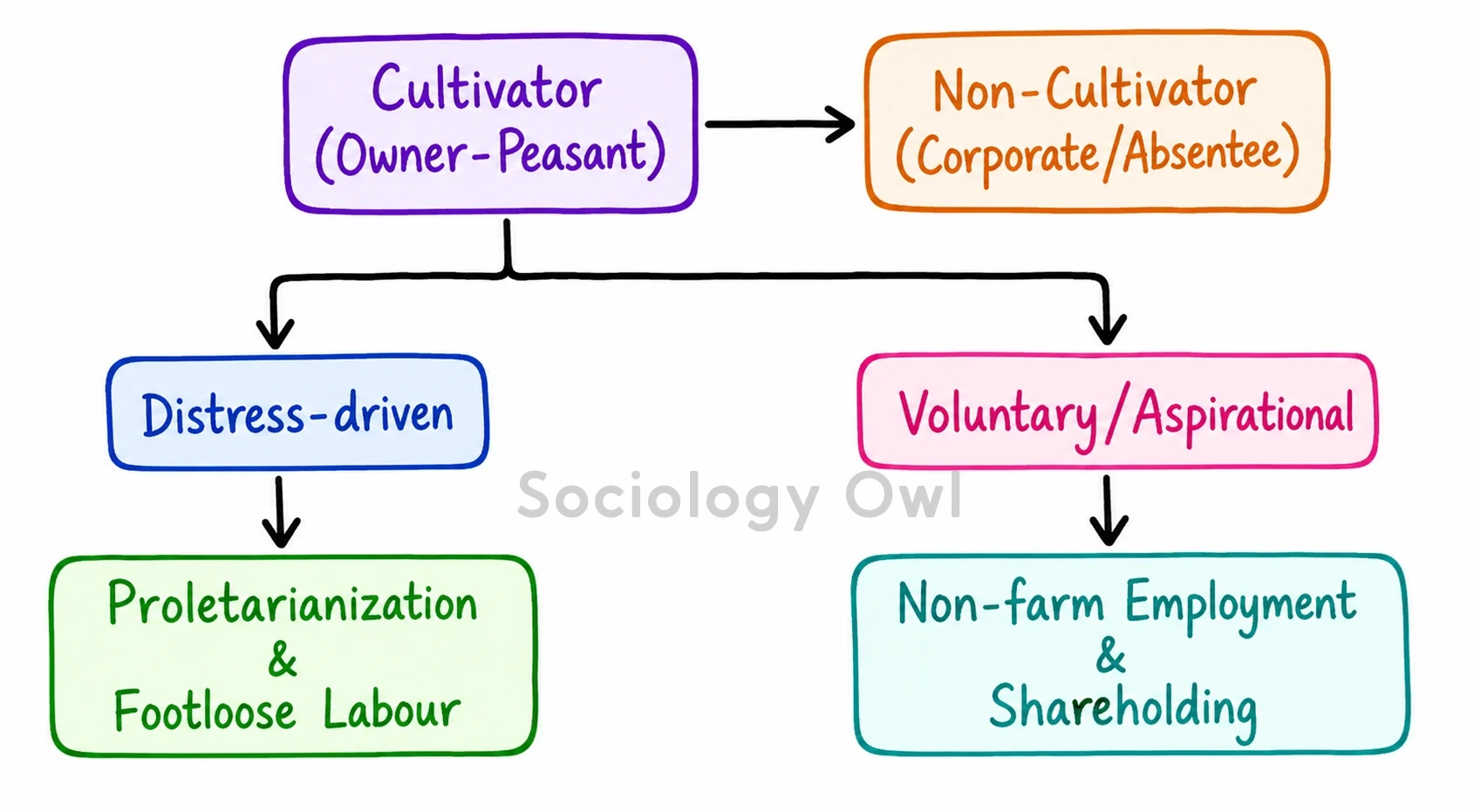
The transfer of land from cultivators to non-cultivators signifies de-peasantization driven by neoliberal agrarian distress. It fundamentally alters the traditional caste-class nexus (Andre Beteille), deeply restructuring rural power dynamics.
Class and Caste Restructuring
Proletarianization:Daniel Thorner highlights the shift from the independent Kisan (owner-cultivator) to the Mazdur (landless laborer).
New Landlordism:Utsa Patnaik identifies rising corporate landownership, while traditional Dominant Castes increasingly transition into urban absentee rent-seekers.
Societal Consequences
Migration and Gender: Dispossessed lower-caste peasants become “footloose labour” (Jan Breman). This triggers the feminization of agriculture (Bina Agarwal), as women are left to toil as laborers on alienated land.
Voluntary Exit: Nuancing this, Surinder S. Jodhka argues that rural youth often willingly sell land to escape the stigma of agriculture for non-farm employment.
The 2020-2021 Farmers’ Protests reflected profound anxieties over corporate land capture. Conversely, Amaravati’s land-pooling illustrates cultivators voluntarily transitioning into commercial shareholders.
Conclusion
This land transfer shifts rural sociology from traditional patronage to modern resource-contestation, dynamically transforming India by intertwining distress-driven proletarianization with emerging capitalist aspirations.
Q. Do you think that in a society like India orthogenetic changes take place through differentiation? Do you observe continuities in the orthogenetic process? Elaborate your answer with suitable examples.
UPSC Sociology 2025 Paper 2
Model Answer:
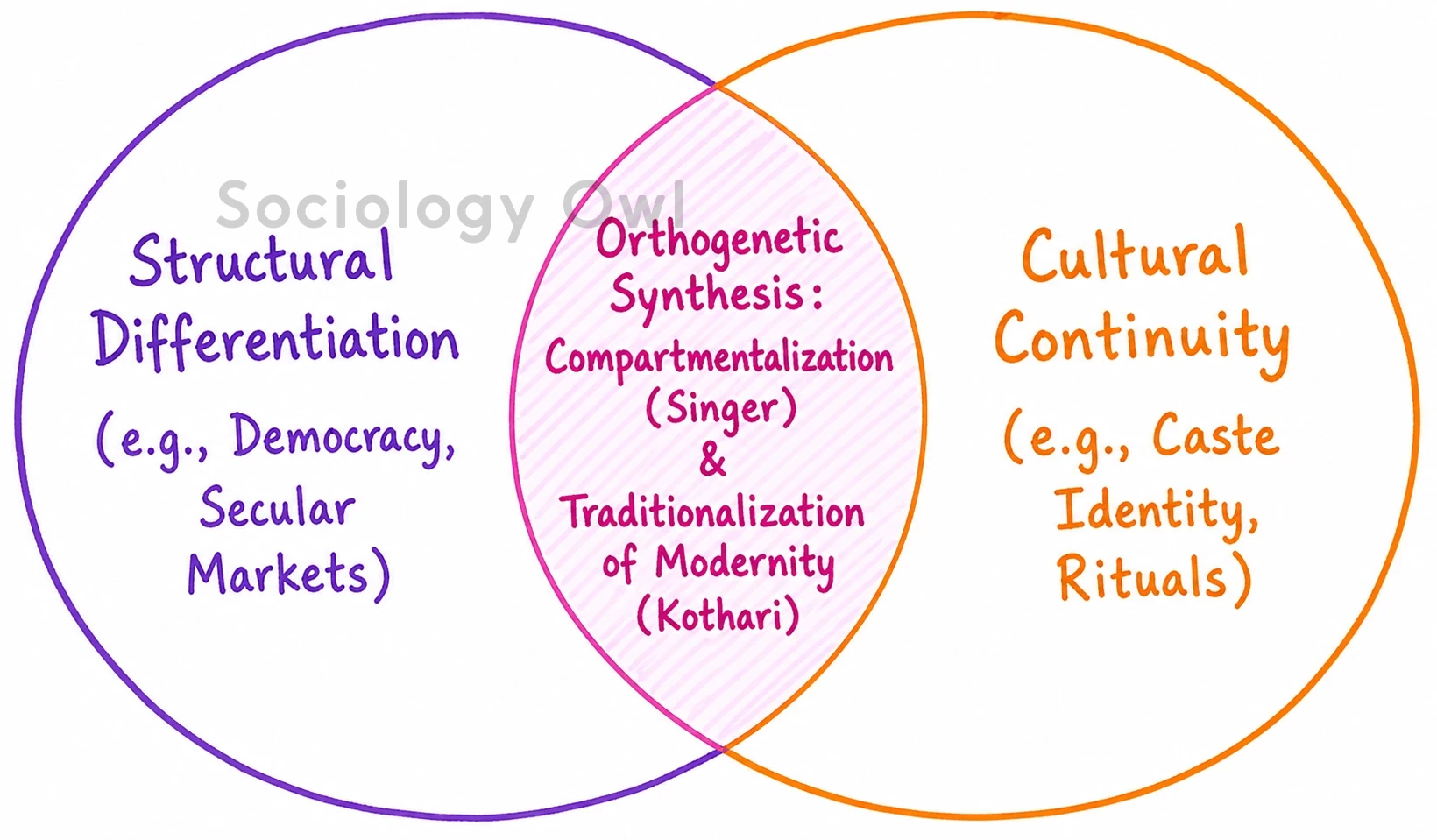
In Modernization of Indian Tradition, Yogendra Singh defines orthogenetic changes as internal cultural transformations (e.g., Buddhism, Sanskritization) that evolve without complete structural breakdown. He argues that Indian society undergoes modernization primarily through structural differentiation while maintaining deep civilizational continuity.
Orthogenetic Change through Differentiation
Social Differentiation:Andre Beteille, in Caste, Class, and Power, demonstrates this in Sripuram, observing that the traditionally overlapping axes of caste, class, and political power have differentiated into distinct, separate spheres.
Cultural Differentiation:M.N. Srinivas’s concept of Sanskritization exemplifies orthogenetic change, where lower castes differentiate their rituals and lifestyles to claim upward mobility within the traditional hierarchy.
Economic Differentiation: The breakdown of the undifferentiated Jajmani system fostered specialized labor markets, enabling phenomena like “Dalit Capitalism” (noted by Chandrabhan Prasad) and disrupting hereditary caste-occupation linkages.
Continuities and Critique of Differentiation
Compartmentalization:Milton Singer observes that Indians separate modern occupational spheres from traditional ritualistic spheres (e.g., scientists performing pujas before space launches), ensuring cultural continuity.
Politicization of Caste:Rajni Kothari notes the “traditionalization of modernity,” wherein modern, differentiated democratic institutions are navigated using traditional caste arithmetic.
From a Marxist Perspective, A.R. Desai argues that differentiation has merely modernized traditional exploitation. The agrarian hierarchy has morphed into an urban Caste-Class Nexus, where differentiation bypasses the marginalized, leaving Dalits trapped in undifferentiated, exploitative roles like manual scavenging.
Modern matrimonial platforms (like Shaadi.com) perfectly illustrate this synthesis. They utilize highly differentiated, modern algorithms solely to enforce strict orthogenetic continuities, such as caste endogamy and Gotra-matching. Similarly, traditional Khap Panchayats have differentiated their functions to demand modern political reservations.
Conclusion
India’s orthogenetic evolution eschews unilinear Western displacement. It creates a unique social fabric where modern forms carry traditional content—a phenomenon Dipankar Gupta terms “Mistaken Modernity.” Ultimately, Indian society demonstrates dynamic structural differentiation intricately interwoven with profound cultural continuity.
Q. “Industrial class structure is a function of social structure of Indian society.” Do you agree with this statement? Analyze.
UPSC Sociology 2025 Paper 2
Model Answer:
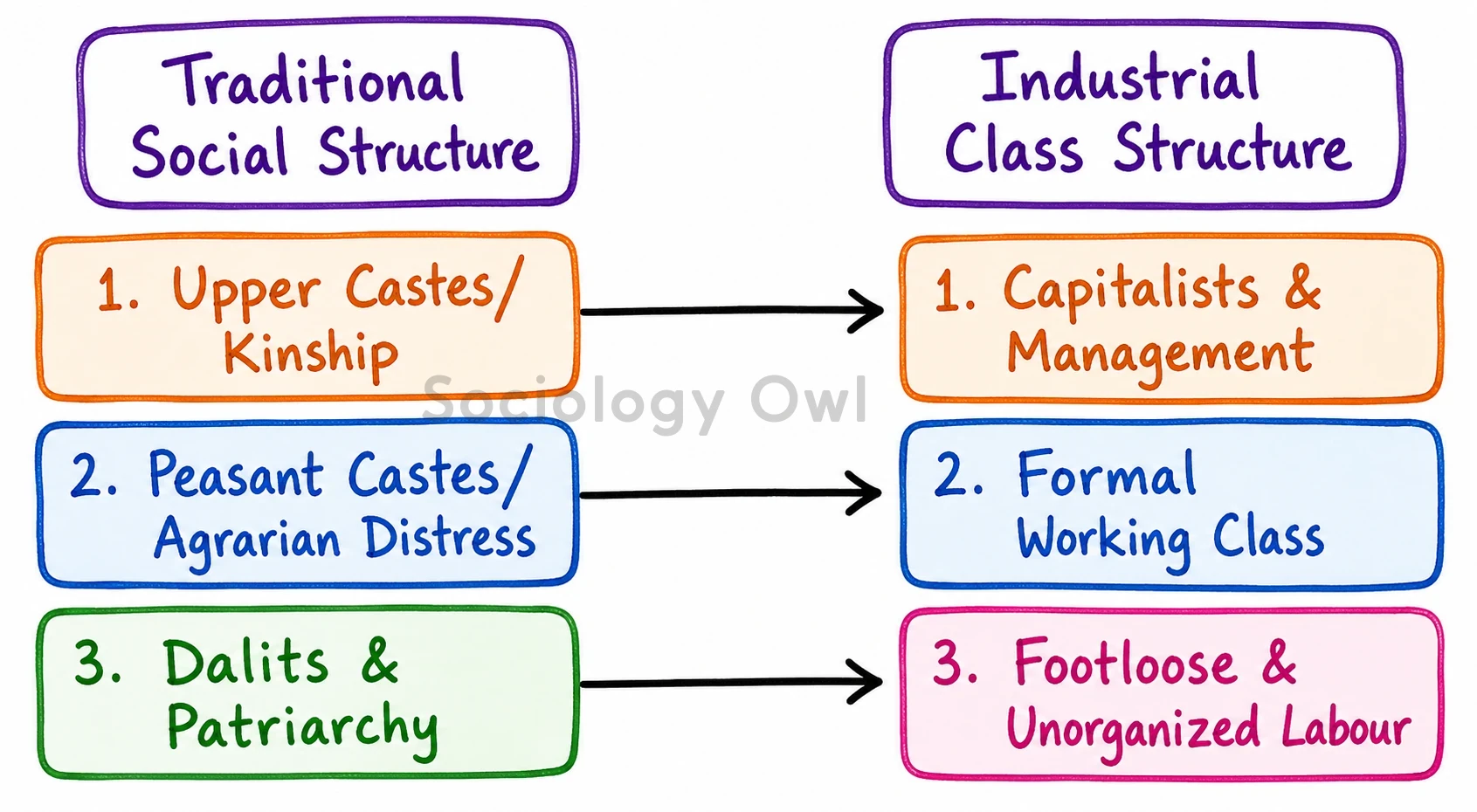
India’s transition to an industrial economy did not obliterate its traditional social structure—comprising caste, kinship, agrarian relations, and patriarchy—but adapted it. As A.R. Desai noted, the emerging capitalist class utilized traditional institutions to consolidate wealth, resulting in a superimposition of modern class lines upon traditional social hierarchies.
Traditional Structures Shaping Industrial Classes
Capital and Kinship:Harish Damodaran in India’s New Capitalists illustrates how traditional mercantile castes monopolized early industrial capital via kinship networks, while upper castes dominated managerial roles through inherited educational capital.
The Division of Labourers:B.R. Ambedkar famously critiqued that caste is not merely a division of labour, but a “division of labourers.” Consequently, Shudras and Dalits disproportionately occupy the unorganized manual workforce.
Agrarian-Industrial Nexus:Jan Breman highlights how agrarian distress within rural structures pushes marginalized castes into the urban industrial reserve army as precarious “footloose labour.”
Patriarchy and Class: Feminist scholars like Neetha N. demonstrate how patriarchal structures funnel women into the most exploitative, low-paid industrial tiers, such as garment manufacturing.
Transformations and Counter-Trends
Secularization of Work: Analyzing counter-trends, G.S. Ghurye observed that industrialization promotes occupational freedom. Richard Lambert, in his classic study of Poona factories, found that the internal shop-floor fostered a secular hierarchy, even if external social relations remained caste-bound.
Dalit Capitalism:Chandra Bhan Prasad highlights the rise of the Dalit Indian Chamber of Commerce and Industry (DICCI), demonstrating how modern capitalism and state support can fracture traditional caste-class monopolies.
In the modern IT sector, Carol Upadhya reveals that subtle caste networking still influences career progression. Furthermore, today’s gig economy often preys on a workforce made vulnerable by traditional agrarian and caste marginality. Acknowledging these structural impediments, state policies like Stand-Up India actively target SC/ST and women entrepreneurs to democratize industrial capital.
Conclusion
India’s industrial class structure remains a dynamic synthesis of modernization and tradition. While democratic capitalism, secular workspaces, and affirmative action challenge historical monopolies, the traditional structures of caste, agrarian ties, and patriarchy fundamentally continue to condition access to capital and labor markets.