2025 Sociology Paper 2

Q. Who is said to be the pioneer of village studies in India? Illustratively describe contributions of some Indian sociologists on village studies. How their approaches are distinct from each other?

Q. Who is said to be the pioneer of village studies in India? Illustratively describe contributions of some Indian sociologists on village studies. How their approaches are distinct from each other?

UPSC Sociology 2025 Paper 2

Model Answer:

Countering Charles Metcalfe’s colonial myth of static “little republics,” the 1950s saw a boom in sociological village studies driven by post-independence nation-building. M.N. Srinivas is widely regarded as the pioneer of the “Field View” via participant observation, though S.C. Dube published the first full-length sociological study, Indian Village (1955).

Contributions to Village Studies

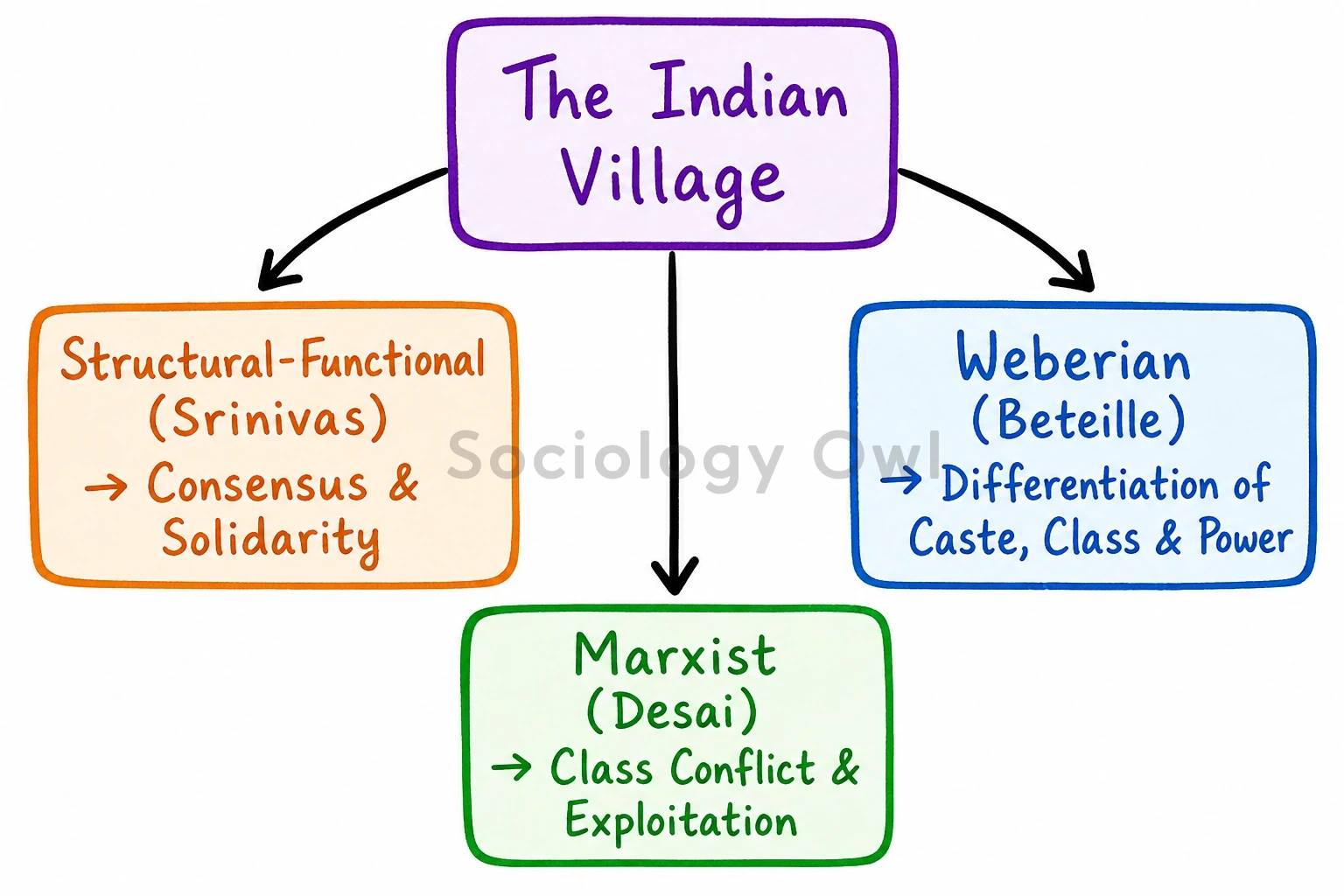
  • M.N. Srinivas: In The Remembered Village (Rampura study), he employed a structural-functionalist lens. He introduced concepts like Sanskritization and Dominant Caste, emphasizing “Village Solidarity” wherein the village acted cohesively despite internal caste hierarchies.
  • A.R. Desai: In Rural Sociology in India, Desai utilized a Marxist historical-dialectical approach. He rejected the harmonious village notion, analyzing it as a site of class conflict, land alienation, and peasant pauperization under colonial capitalism.
  • Andre Beteille: Using a Weberian framework in his Sripuram study, he mapped the shift from a closed to an open stratification system, noting how the traditional overlap between Caste, Class, and Power had fractured.
SociologistTheoretical FrameworkMethod & View of Change
M.N. SrinivasStructural-FunctionalismParticipant observation; cultural mobility and integration.
A.R. DesaiMarxist / Historical-MaterialismMacro-historical analysis; class struggle and capitalist exploitation.
Andre BeteilleWeberian (Trinitarian Model)Empirical observation; differentiation of status, wealth, and power.

Critiques of Village Studies

  • B.R. Ambedkar: Fiercely critiqued the sociological romanticization of the village, terming it a “den of ignorance, narrow-mindedness, and communalism” that perpetuated Dalit oppression.
  • Louis Dumont: Argued that the village is merely an architectural and demographic reality; the true ideological reality of India is Caste.

Today, globalization and migration have fundamentally altered rural realities. Sociologists like Dipankar Gupta conceptualize the “Vanishing Village”, while Surinder S. Jodhka explores how early structural frameworks help decode ongoing agrarian distress and shifting dominant caste politics (e.g., Maratha/Jat reservation demands).

Conclusion

While pioneers like M.N. Srinivas provided the foundational anatomy of the Indian village, their empirical methodologies laid the essential groundwork for contemporary sociologists to study the dynamic, highly political, and globally integrated rural landscapes of 21st-century India.
Q. Who is said to be the pioneer of village studies in India? Illustratively describe contributions of some Indian sociologists on village studies. How their approaches are distinct from each other? Read More »

Q. What is kinship? Briefly explain G. P. Murdock’s contribution to the study of the kinship system.

Q. What is kinship? Briefly explain G. P. Murdock’s contribution to the study of the kinship system.

UPSC Sociology 2025 Paper 2

Model Answer:

Kinship organizes human relationships through networks of rights and obligations based on consanguinity, affinity, and adoption, profoundly shaping social roles.

Murdock’s Contributions and Indian Realities

  • Comparative Methodology: In Social Structure, G.P. Murdock pioneered cross-cultural statistical analysis to establish universal kinship correlations.
  • Kinship Terminologies: He standardized typologies (classificatory vs. descriptive). Contextually, Iravati Karve used similar structural-linguistic approaches to map India’s regional kinship zones.
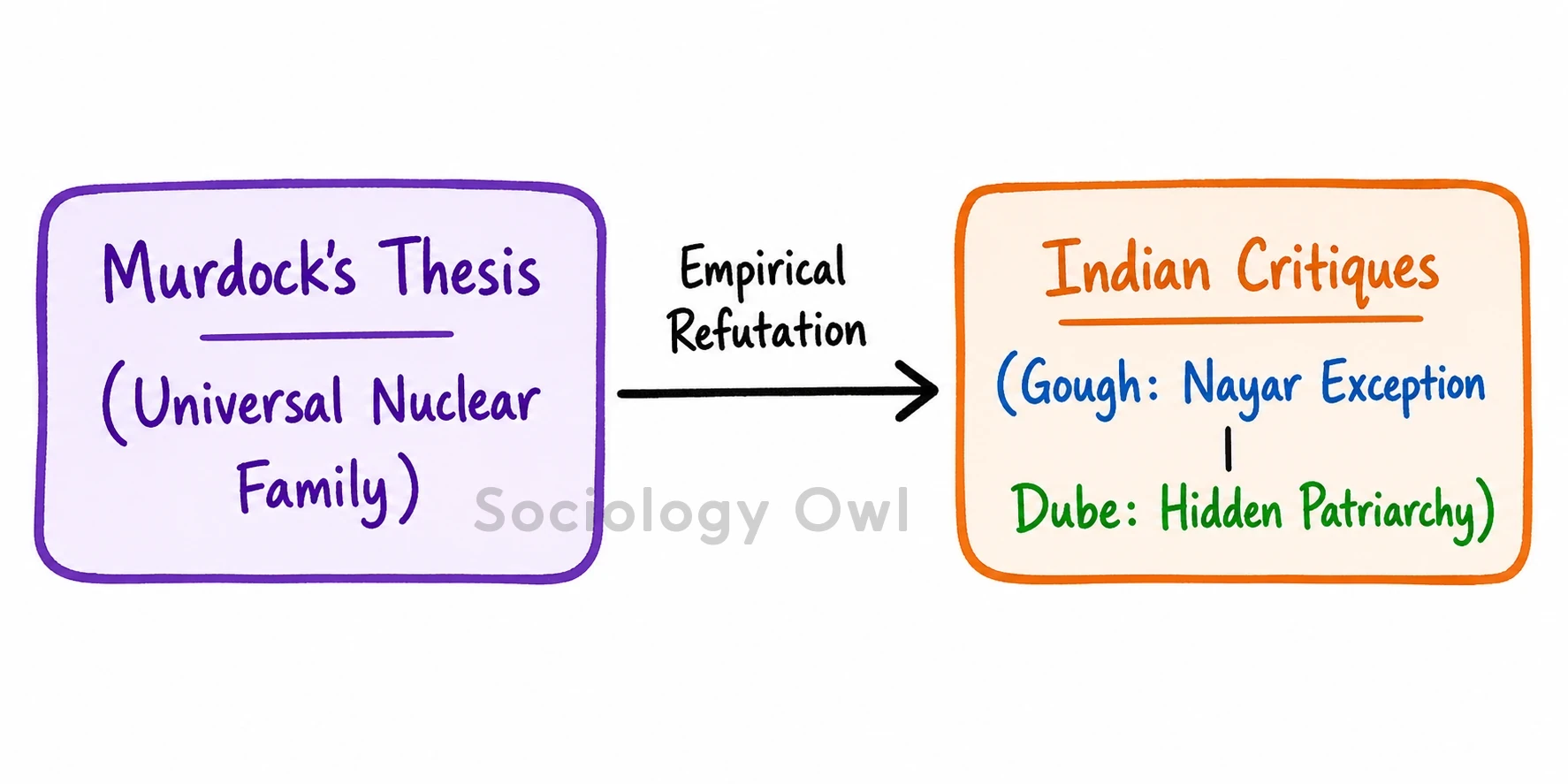
  • Universal Nuclear Family: Murdock deemed the nuclear family a universal functional unit. However, Kathleen Gough’s study of the Nayar Tarawad refuted this universality, demonstrating kinship functioning without traditional husband-father roles. Additionally, Leela Dube critiqued his functionalist ignorance of internal patriarchal subjugation.

Moving beyond Murdock’s structuralism, A.M. Shah’s The Household Dimension of the Family in India distinguishes residential households from functional families, accurately analyzing modern joint-family adaptations in urbanizing India.

Conclusion

While Murdock provided a scientific baseline for global kinship studies, Indian sociologists successfully critiqued and indigenized his taxonomic models to capture India’s diverse, caste-embedded social realities.

Q. What is kinship? Briefly explain G. P. Murdock’s contribution to the study of the kinship system. Read More »

Q. ‘Agrarian class structure has been undergoing changes due to modern forces.’ Critically examine.

Q. ‘Agrarian class structure has been undergoing changes due to modern forces.’ Critically examine.

UPSC Sociology 2025 Paper 2

Model Answer:

Historically, India’s agrarian class structure was rooted in land ownership and intertwined with caste hierarchies, characterized by W.H. Wiser’s Jajmani system. Modern forces—land reforms, the Green Revolution, globalization, and democratic politics—have driven a transition from a status-based to a contract-based agrarian structure, fundamentally reshaping rural relations.

Capitalist Transformation and Class Reconfiguration

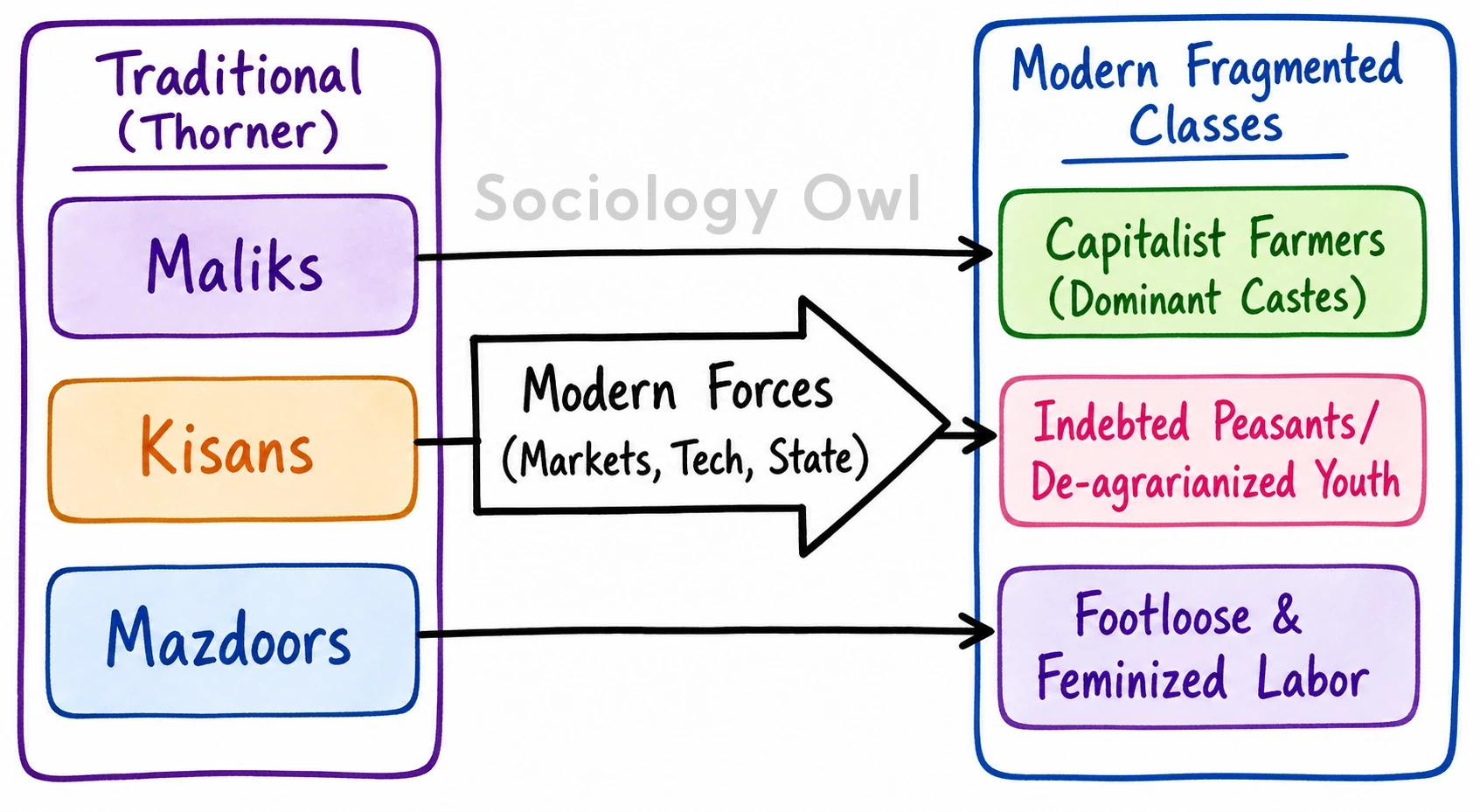
Daniel Thorner categorized traditional agrarian classes into Maliks, Kisans, and Mazdoors. Modern interventions have structurally altered these categories:

  • Mode of Production Debate: Marxist sociologists like Utsa Patnaik, Ashok Rudra, and Alice Thorner debated the nature of this transition. Utsa Patnaik argued that Indian agriculture has seen the emergence of market-oriented capitalism, replacing subsistence farming.
  • Dominant Castes: M.N. Srinivas noted that capitalist farmers who monopolized Green Revolution benefits largely belonged to intermediary Dominant Castes (e.g., Jats, Kammas), thereby consolidating the caste-class nexus.
  • Footloose Labor: Analyzing South Gujarat, Jan Breman documented a shift from traditional “patronage to exploitation.” Commercialization eroded feudal dependencies, creating a massive, unorganized workforce of migrating “footloose labor.”

Critical Examination: Crises and New Inequalities

While modern forces dismantled older feudal ties, they spawned new paradoxes and vulnerabilities:

  • Agrarian Distress: A.R. Vasavi highlights that reliance on cash crops and exposure to global market volatility have pushed the middle Kisan class into severe debt traps, triggering farmer suicides.
  • Feminization of Agriculture: Bina Agarwal argues that male out-migration leaves women as the primary agricultural laborers, yet structural patriarchy continues to deny them land ownership rights.
  • De-peasantization: Surinder S. Jodhka observes that rural youth no longer view farming as a viable primary identity or income source, leading to the “de-agrarianization” of rural spaces.

Erratic weather patterns due to climate change act as modern disrupters, forcing marginal farmers to sell land and swelling the ranks of landless laborers. Additionally, contract farming by multinational corporations shifts agrarian power away from village structures to global agribusiness elites.

Conclusion

The agrarian transition in India remains complex and uneven. It represents what Utsa Patnaik terms an articulation of capitalist and pre-capitalist modes of production, where traditional inequalities of caste and gender are not erased, but continuously reproduced within modern capitalist forms.

Q. ‘Agrarian class structure has been undergoing changes due to modern forces.’ Critically examine. Read More »

Q. ‘Textual perspective is important in understanding of Indian Social System.’ Discuss.

Q. ‘Textual perspective is important in understanding of Indian Social System.’ Discuss.

UPSC Sociology 2025 Paper 2

Model Answer:

The Indological Approach and Textual Perspective

The Indological approach utilizes classical texts to decipher the normative and ideological foundations of the Indian social system.

Significance of Textual Perspective

Ideological Framework: Louis Dumont in Homo Hierarchicus used texts to derive the purity and pollution binary structuring caste.

Institutional Antiquity: G.S. Ghurye utilized Sanskrit literature to trace the evolution of Gotra and kinship.

Civilizational Continuity: Irawati Karve in Yuganta applied textual analysis (The Mahabharata) to understand ancient kinship norms.

Critiques of the Textual Approach

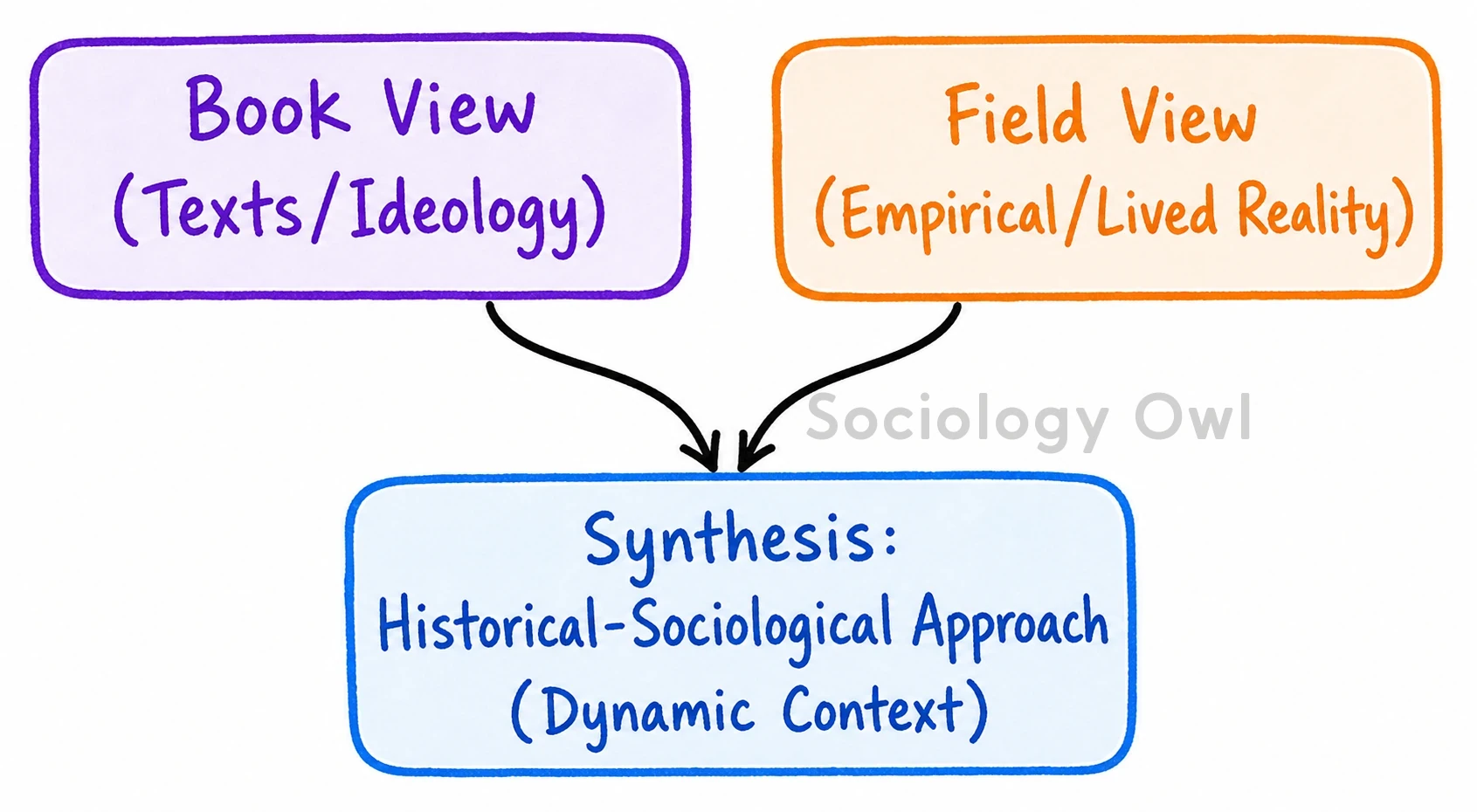
“Book View” vs. “Field View”: M.N. Srinivas argued texts present a static, idealized reality, ignoring dynamic lived realities.

Brahmanical Hegemony: B.R. Ambedkar criticized texts like Manusmriti as active instruments of structural violence against Dalits and women.

Marxist Critique: A.R. Desai argued textual views mask underlying material class conflicts.

Textual analysis remains vital in Indian jurisprudence, evident in Supreme Court referencing ancient texts during the Sabarimala verdict and debates around the Uniform Civil Code (UCC).

Conclusion

While texts provide the ideological grammar of Indian society, they must be synthesized with empirical reality. A historical-sociological approach (e.g., Bernard Cohn), blending the “field view” and “book view,” is vital to capture India’s dynamic reality.

Q. ‘Textual perspective is important in understanding of Indian Social System.’ Discuss. Read More »

Q. In what respects have the constitutional provisions changed the socio-economic and political conditions of Scheduled Castes and Scheduled Tribes in India? Critically examine.

Q. In what respects have the constitutional provisions changed the socio-economic and political conditions of Scheduled Castes and Scheduled Tribes in India? Critically examine.

UPSC Sociology 2025 Paper 2

Model Answer:

The Indian Constitution’s policy of ‘protective discrimination’ has served as an instrument of social engineering for Scheduled Castes and Scheduled Tribes. While catalyzing significant changes, the impact reveals a persistent gap between formal and substantive equality.

Political Empowerment

Constitutional provisions have democratized political space through:
– Reserved constituencies (Articles 330-332) ensuring proportional representation in Parliament and State Assemblies
– Panchayati Raj reservations (73rd/74th Amendments) enabling grassroots participation
– Emergence of assertive Dalit politics exemplified by BSP’s rise, challenging upper-caste hegemony
– Rise of SC/ST leaders to highest offices—K.R. Narayanan as President symbolizing political mainstreaming

However, Christophe Jaffrelot notes this often results in ‘tokenism’, where elected representatives remain dependent on party high commands rather than functioning as autonomous community voices.

Socio-Economic Advancement

Article 16(4) and 15(4) provisions have facilitated:
– Educational mobility: Literacy among SCs increased from 10% (1961) to 66% (2011); scholarships enabling higher education access
– Employment opportunities: Creation of educated middle class through public sector reservations, as observed by Andre Beteille
– Legal protection: Prevention of Atrocities Act (1989) and Protection of Civil Rights Act (1955) providing anti-discrimination framework
– Targeted schemes: Special Component Plan and Tribal Sub-Plan earmarking funds for development

Critical Limitations

Despite constitutional safeguards, structural challenges persist:

Economic Inequality: Benefits largely cornered by urban educated elite—the ‘creamy layer’—while rural majority remains landless and impoverished. Private sector exclusion and declining public employment further limit opportunities.

Social Discrimination: Ghanshyam Shah highlights continued prevalence of untouchability and caste atrocities. Manual scavenging persists despite prohibition; weak implementation undermines legislative intent.

Tribal Marginalization: STs face displacement through development projects, with Fifth and Sixth Schedule protections frequently violated, eroding cultural rights, traditional livelihoods, and forest access.

Conclusion: Constitutional provisions created a rights framework and enabled Dalit-Adivasi political consciousness. However, deep-rooted caste hierarchies persist. The transition from de jure to de facto equality requires comprehensive social reform beyond legal measures.

Q. In what respects have the constitutional provisions changed the socio-economic and political conditions of Scheduled Castes and Scheduled Tribes in India? Critically examine. Read More »

Q. How would you appropriate to characterise G. S. Ghurye as a practitioner of ‘theoretical pluralism’?

Q. How would you appropriate to characterise G. S. Ghurye as a practitioner of ‘theoretical pluralism’?

UPSC Sociology 2025 Paper 2

Model Answer:

G.S. Ghurye, the ‘father of Indian sociology,’ exemplified theoretical pluralism by consciously avoiding any single theoretical dogma, employing diverse perspectives to analyze Indian society’s multifaceted reality.

Integration of Multiple Approaches

Ghurye’s eclectic methodology synthesized:

• Indological-Textual Analysis: Used Sanskrit texts to trace historical origins of social institutions, particularly in “Caste and Race in India” where he analyzed Vedic literature to understand caste origins

• Diffusionist Perspective: Explained how Indo-Aryan cultural traits spread and interacted with local cultures across the subcontinent, blending textual with historical-anthropological methods

• Historical-Comparative Method: Applied to diverse topics including kinship systems, urbanization in “Cities and Civilization”, and religious consciousness in “Indian Sadhus”

Rejection of Theoretical Dogmatism

Unlike contemporaries who adopted single Western frameworks, Ghurye believed Indian civilization’s complexity required a unique synthetic approach:

• Deliberately avoided grand theories like structural-functionalism or Marxism as sole analytical lenses

• His study of tribes as “backward Hindus” used a civilizational-historical framework rather than purely structural analysis, integrating tribes into broader Indian society’s narrative

• Combined empirical fieldwork with classical scholarship, bridging past and present

Conclusion:

Ghurye’s theoretical pluralism created a distinctive Indian sociological perspective. By weaving together Indology, diffusionism, historical comparison, and empirical analysis, he developed a holistic approach tailored to Indian context, demonstrating that complex societies require multiple theoretical lenses for comprehensive understanding.

Q. How would you appropriate to characterise G. S. Ghurye as a practitioner of ‘theoretical pluralism’? Read More »

Q. How did Colonial Policies for the tribes affected their socio-economic conditions in India? Discuss.

Q. How did Colonial Policies for the tribes affected their socio-economic conditions in India? Discuss.

UPSC Sociology 2025 Paper 2

Model Answer:

Colonial rule marked a radical departure from the relative autonomy and symbiotic relationship tribes had with their natural habitat. British policies systematically dismantled traditional socio-economic structures, leading to widespread marginalization.

Forest Policies and Economic Dispossession

The Forest Acts (1865, 1878, 1927) declared forests as state property, criminalizing traditional practices:
• Restricted jhum cultivation, hunting, and gathering of forest produce central to subsistence economy
• Loss of access to Minor Forest Produce forced tribes into exploitative wage labor in plantations and mines
• Severed deep cultural-spiritual connections with forests, causing social disorganization

Land Revenue Systems and Administrative Changes

Introduction of alien administrative structures disrupted tribal ethos:
• Land Alienation: Individual private property replaced communal ownership, facilitating land transfer to non-tribal moneylenders (dikus), particularly in Chotanagpur region
• Erosion of Traditional Authority: Formal centralized administration undermined tribal councils and chiefs, disrupting indigenous justice systems

Market Integration and Exploitation

Forced integration into colonial economy created systematic exploitation:
• Cash taxes and trader influx trapped tribes in debt cycles, creating bonded labor for colonial enterprises
• Detribalization: G.S. Ghurye noted tribes lost cultural identity without proper mainstream integration, resulting in anomie
• Contractor-moneylender-official nexus emerged, establishing “internal colonialism”

Conclusion:

Colonial policies transformed autonomous tribal communities into impoverished, exploited underclass through systematic dispossession and marginalization. This widespread discontent fueled numerous uprisings like the Santhal Rebellion and Birsa Munda’s Ulgulan, reflecting organized resistance against colonial oppression.

Q. How did Colonial Policies for the tribes affected their socio-economic conditions in India? Discuss. Read More »

Q. According to you, which social reform movement has played the most effective role in uplifting the status of women? Explain.

Q. According to you, which social reform movement has played the most effective role in uplifting the status of women? Explain.

UPSC Sociology 2025 Paper 2

Model Answer:

Social Reform Movements and Women’s Upliftment

Among various social reform movements in colonial India, the Satyashodhak Samaj led by Jyotiba and Savitribai Phule stands as the most effective in transforming women’s status through its radical intersectional approach and emphasis on education as liberation.

The Phules pioneered the recognition of interconnected oppression. In Gulamgiri, Jyotiba Phule articulated how Brahmanical patriarchy doubly subjugated lower-caste women, linking gender liberation with caste annihilation—a perspective later echoed by feminist scholars like Uma Chakravarti. This holistic analysis addressed root causes rather than symptoms.

Education as Revolutionary Praxis

Savitribai Phule’s pioneering role as India’s first female teacher and founder of the first girls’ school (Pune, 1848) demonstrated education’s transformative potential. The Phules believed literacy would:
– Foster critical consciousness against oppressive traditions
– Enable economic independence
– Create self-reliant agents of social change

This sustainable model proved more effective than mere legislative reforms.

Comprehensive Grassroots Initiatives

The movement’s practical interventions included:
– Establishing Balhatya Pratibandhak Griha for pregnant widows
– Organizing barbers’ strikes against widow tonsuring
– Promoting widow remarriage
– Campaigning against child marriage

Lasting Impact:

The Phules’ work laid the ideological and practical foundation for subsequent women’s movements. By attacking patriarchy’s structural basis through education and challenging caste-gender intersections, they created a blueprint for genuine social transformation that resonates even today in Dalit feminist movements.

Q. According to you, which social reform movement has played the most effective role in uplifting the status of women? Explain. Read More »