Prelims Solution

Q. Consider the following statements in respect of two natural numbers p and q such that p is a prime number and q is a composite number:

Q. Consider the following statements in respect of two natural numbers p and q such that p is a prime number and q is a composite number:

1.  p×q can be an odd number.
2.  q/p can be a prime number.
3.  p + q can be a prime number.
Which of the above statements are correct?
a. 1 and 2 only
b. 2 and 3 only
c. 1 and 3 only
d. 1, 2 and 3
Correct Answer: d. 1, 2 and 3

Question from UPSC Prelims 2022 CSAT Paper

Explanation : 

P is a prime number and q is a composite number

Statement 1: p × q can be an odd number: Correct if p and q both are odd then their product is odd. e.g., p = 3 and q = 15 then p × q = 45, which is a odd number.

Statement 2: q / p can be a prime number: Correct if composite number q is made of two prime numbers and p is one of that prime numbers then q/p is an odd number. e.g., p = 3 and q = 15 then q/p = 5, which is a prime number.

Statement 3: p + q can be a prime number: Correct if p = 5 and q = 6, then p + q = 11 which is a prime number.

Hence, the correct answer is an option(4) i.e.,1, 2, and 3.

Q. Consider the following statements in respect of two natural numbers p and q such that p is a prime number and q is a composite number: Read More »

What is the smallest number greater than 1000 that when divided by any one of the numbers 6, 9. 12, 15, 18 leaves a remainder of 3?

Q. What is the smallest number greater than 1000 that when divided by any one of the numbers 6, 9. 12, 15, 18 leaves a remainder of 3?

a. 1063
b. 1073
c. 1083
d. 1183
Correct Answer: c. 1083

Question from UPSC Prelims 2022 CSAT Paper

Explanation : 

Finding the smallest number greater than 1000 with specific conditions.

LCM of 6, 9, 12, 15 and 18 = 180
Smallest number greater than 1000 which is a multiple of 180 is 1080.

So, Required number = 1080 + 3 = 1083
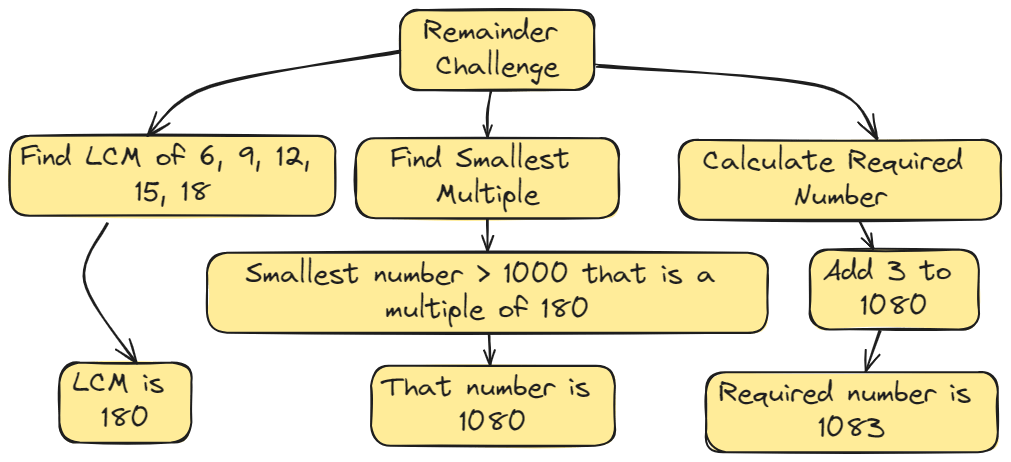
Remainder Challenge

What is the smallest number greater than 1000 that when divided by any one of the numbers 6, 9. 12, 15, 18 leaves a remainder of 3? Read More »

Let p be a two-digit number and q be the number consisting of same digits written in reverse order. If p × q = 2430, then what is the difference between p and q?

Q. Let p be a two-digit number aand q be the number consisting of same digits written in reverse order. If p × q = 2430, then what is the difference between p and q?

a. 45
b. 27
c. 18
d. 9
Correct Answer: d. 9

Question from UPSC Prelims 2022 CSAT Paper

Explanation : 

Difference between p and q

Let’s say that p = 10x + y and q = 10y + x where x and y are digits.

Then p × q = (10x + y)(10y + x) = 100xy + 10xy + 10xy + xy = 2430. Simplifying this equation gives us xy = 2430/121 = 20.

Since x and y are digits, the only possibility is that x=5 and y=4 or vice versa. Therefore p=54 and q=45 or vice versa. The difference between p and q is |54-45|=9.

Let p be a two-digit number and q be the number consisting of same digits written in reverse order. If p × q = 2430, then what is the difference between p and q? Read More »

When 70% of a number x is added to another number y, the sum becomes 165% of the value of y. When 60% of the number x is added to another number z, then the sum becomes 165% of the value of z. Which one of the following is correct?

Q. When 70% of a number x is added to another number y, the sum becomes 165% of the value of y. When 60% of the number x is added to another number z, then the sum becomes 165% of the value of z.

Which one of the following is correct?
a.    z < x < y
b.   x < y < z
c.    y < x < z
d.   z < y < x
Correct Answer: a.    z < x < y

Question from UPSC Prelims 2022 CSAT Paper

Explanation : 

When 70% of a number x is added to another number y, the sum becomes 165% of the value of y.

We can represent this information as an equation:
y + 0.70x = 1.65y

When 60% of the number x is added to another number z, then the sum becomes 165% of the value of z.

We can represent this information as another equation:
z + 0.60x = 1.65z

Now we can solve the system of equations:

From the first equation, we can express x in terms of y:
0.70x = 1.65y – y
0.70x = 0.65y
x = 0.65y / 0.70
x = 13y/14

Now, substitute x in the second equation:
z + 0.60x = 1.65z
z + 0.60(13y/14) = 1.65z
z + 13y/23 = 1.65z

Now, let’s solve for z in terms of y:
13y/23 = 1.65z – z
13y/23 = 0.65z
z = 13y/23 / 0.65
z = 13y/15

Now we have:
x = 13y/14
z = 13y/15

Since 13/15 < 13/14, we can conclude that z < x.

Now let’s compare x and y. Since x = 13y/14, this means that x < y (because 13/14 < 1).

Thus, we have established the following relationship: z < x < y.

Therefore, the correct answer is (a) z < x < y.

Relationships between numbers x y and z

When 70% of a number x is added to another number y, the sum becomes 165% of the value of y. When 60% of the number x is added to another number z, then the sum becomes 165% of the value of z. Which one of the following is correct? Read More »

The digits 1 to 9 are arranged in three rows in such a way that each row contains three digits, and the number formed in the second row is twice the number formed in the first row; and the number formed in the third row is thrice the number formed in the first row.

Q. The digits 1 to 9 are arranged in three rows in such a way that each row contains three digits, and the number formed in the second row is twice the number formed in the first row; and the number formed in the third row is thrice the number formed in the first row. Repetition of digits is not allowed. If only three of the four digits 2,3,7 and 9 are allowed to use in the first row, how many such combinations are possible to be arranged in the three rows?

a. 4
b. 3
c. 2
d. 1
Correct Answer: c. 2

Question from UPSC Prelims 2022 CSAT Paper

Explanation : 

The digits 1 to 9 are arranged in three rows

On arranging according to the given statements we get only two possibilities i.e.,

Row 1: 273 327
Row 2: 546 654
Row 3: 819 981

Therefore, only two combinations are possible.

Hence, the correct answer is an option(3) i.e., 2.

The digits 1 to 9 are arranged in three rows in such a way that each row contains three digits, and the number formed in the second row is twice the number formed in the first row; and the number formed in the third row is thrice the number formed in the first row. Read More »

What is the remainder when 91 × 92× 93 ×94 ×95 ×96 ×97 ×98 ×99 is divided by 1261?

Q. What is the remainder when
91 × 92× 93 ×94 ×95 ×96 ×97 ×98 ×99 is divided by 1261?

a. 3
b. 2
c. 1
d. 0
Correct Answer: d. 0

Question from UPSC Prelims 2022 CSAT Paper

Explanation : 
91 × 92 × 93 × 94 × 95 × 96 × 97 × 98 × 99 is divided by 1261.
Factors of 1261 are 13 and 97.
So, dividing the given expression by 13 × 97.
(91 × 92 × 93 × 94 × 95 × 96 × 97 × 98 × 99)/(13 × 97)
= 7 × 92 × 93 × 94 × 95 × 96 × 98 × 99
It means this expression is completely divisible by 1261.
Hence, option 4 is correct.

What is the remainder when 91 × 92× 93 ×94 ×95 ×96 ×97 ×98 ×99 is divided by 1261? Read More »

There are eight equidistant points on a circle. How many right-angled triangles can be drawn sing these points as vertices and taking the diameter as one side of the triangle?

Q. There are eight equidistant points on a circle. How many right-angled triangles can be drawn sing these points as vertices and taking the diameter as one side of the triangle?

a. 24
b. 16
c. 12
d. 8
Correct Answer: a. 24

Question from UPSC Prelims 2022 CSAT Paper

Explanation : 

There are eight equidistant points on a circle

Angle subtended by the diameter chord at the circumference of the circle is 90.

To form a right-angled triangle using the diameter of the circle as one side and the eight equidistant points as vertices, we need to select two points on the circle that are equidistant from both ends of the diameter.

There are four such pairs of points.

To form a right-angled triangle, we need to choose one of these pairs of points as the endpoints of the diameter and then select one of the remaining six points as the third vertex. There are six ways to choose the third vertex for each pair of points, so the total number of right-angled triangles is: 4*6 = 24

There are eight equidistant points on a circle. How many right-angled triangles can be drawn sing these points as vertices and taking the diameter as one side of the triangle? Read More »

There is a numeric lock which has a 3-digit PIN. The PIN contains digits 1 to 7. There is no repetition of digits. The digits in the PIN from left to right are in decreasing order. Any two digits in the PIN differ by at least 2. How many maximum attempts does one need to find out the PIN with certainty?

Q. There is a numeric lock which has a 3-digit PIN. The PIN contains digits 1 to 7. There is no repetition of digits. The digits in the PIN from left to right are in decreasing order. Any two digits in the PIN differ by at least 2. How many maximum attempts does one need to find out the PIN with certainty?

a.    8
b.   8
c.    10
d.   12
Correct Answer: c.    10

Question from UPSC Prelims 2022 CSAT Paper

Explanation : 

Numeric Lock 3 digit PIN Combinations

All Possible Values for a 3-digit PIN are 753, 752, 751, 742, 741, 731, 642, 641, 631, 531.
So, the maximum number of attempts one need to find out the PIN with certainty is 10.
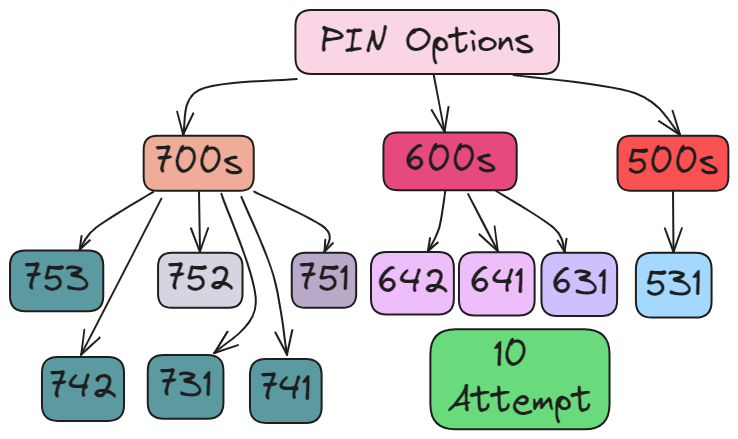
Numeric Lock 3 digit PIN Combinations

There is a numeric lock which has a 3-digit PIN. The PIN contains digits 1 to 7. There is no repetition of digits. The digits in the PIN from left to right are in decreasing order. Any two digits in the PIN differ by at least 2. How many maximum attempts does one need to find out the PIN with certainty? Read More »

The average weight of A, B, C is 40 kg, the average weight of B, D, E is 42 kg and the weight of F is equal to that of B What is the average weight of A, B, C, D, E and F?

Q. The average weight of A, B, C is 40 kg, the average weight of B, D, E is 42 kg and the weight of F is equal to that of B. What is the average weight of A, B, C, D, E and F?

a. 40.5 kg
b. 40.8 kg
c. 41 kg
d. Cannot be determined as data is Inadequate
Correct Answer: c. 41 kg

Question from UPSC Prelims 2022 CSAT Paper

Explanation : 
(A + B + C)/3 = 40
A + B + C = 120 ——-(1.)

(B + D + E)/3 = 42
B + D + E = 126 ——–(2.)

As B = F, so we can write F in place of B in equation (2.)
We get, F + D + E = 126 ——-(3.)

Adding equation (1.) and (3.), we get

A + B + C + D + E + F = 120 + 126
A + B + C + D + E + F = 246

Avereage weight of A, B, C, D, E and F = 246 / 6 = 41

Hence, option 3 is correct.

The average weight of A, B, C is 40 kg, the average weight of B, D, E is 42 kg and the weight of F is equal to that of B What is the average weight of A, B, C, D, E and F? Read More »

Q. X and Y run a 3 km race along a circular course of length 300 m. Their speeds are in the ratio 3:2. If they start together in the same direction, how many times would the first one pass the other (the start-off is not counted as passing)?

Q. X and Y run a 3 km race along a circular course of length 300 m. Their speeds are in the ratio 3:2. If they start together in the same direction, how many times would the first one pass the other (the start-off is not counted as passing)?

a. 2
b. 3
c. 4
d. 5
Correct Answer: b. 3

Question from UPSC Prelims 2022 CSAT Paper

Explanation : 

X and Y run a 3 km race

The faster runner will cross the slower one when he covers an extra 300 m. Let their speeds be 3 m/sec and 2 m/sec. So, their relative speed = 3 – 2 = 1 m/sec. So, the time taken by the faster runner to cross the slower one = Distance/Relative Speed = 300/1 = 300 seconds.

It basically means that the faster runner will cross the slower one every 300 seconds or 5 minutes. Now, the time taken for the faster racer to complete the entire race = Total Distance/Speed = 3000/3 =1000 seconds.

So, during the entire race, which lasts for 1000 seconds, the faster racer will cross the slower one 3 times – after 300 seconds, 600 seconds, and 900 seconds.
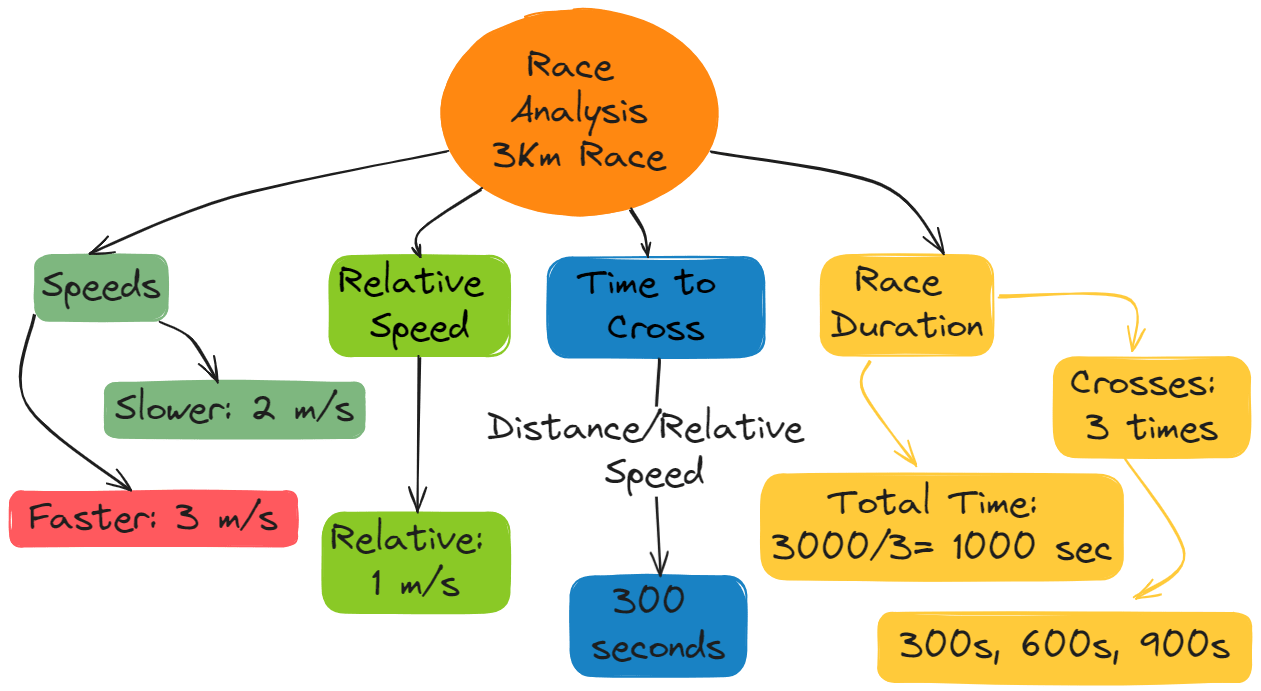
X and Y run a 3 km race

Q. X and Y run a 3 km race along a circular course of length 300 m. Their speeds are in the ratio 3:2. If they start together in the same direction, how many times would the first one pass the other (the start-off is not counted as passing)? Read More »