Model Answer:
The 73rd and 74th Amendments established local bodies as foundational pillars for realizing democratic decentralization and grassroots good governance.
1. Role of Local Bodies in Good Governance
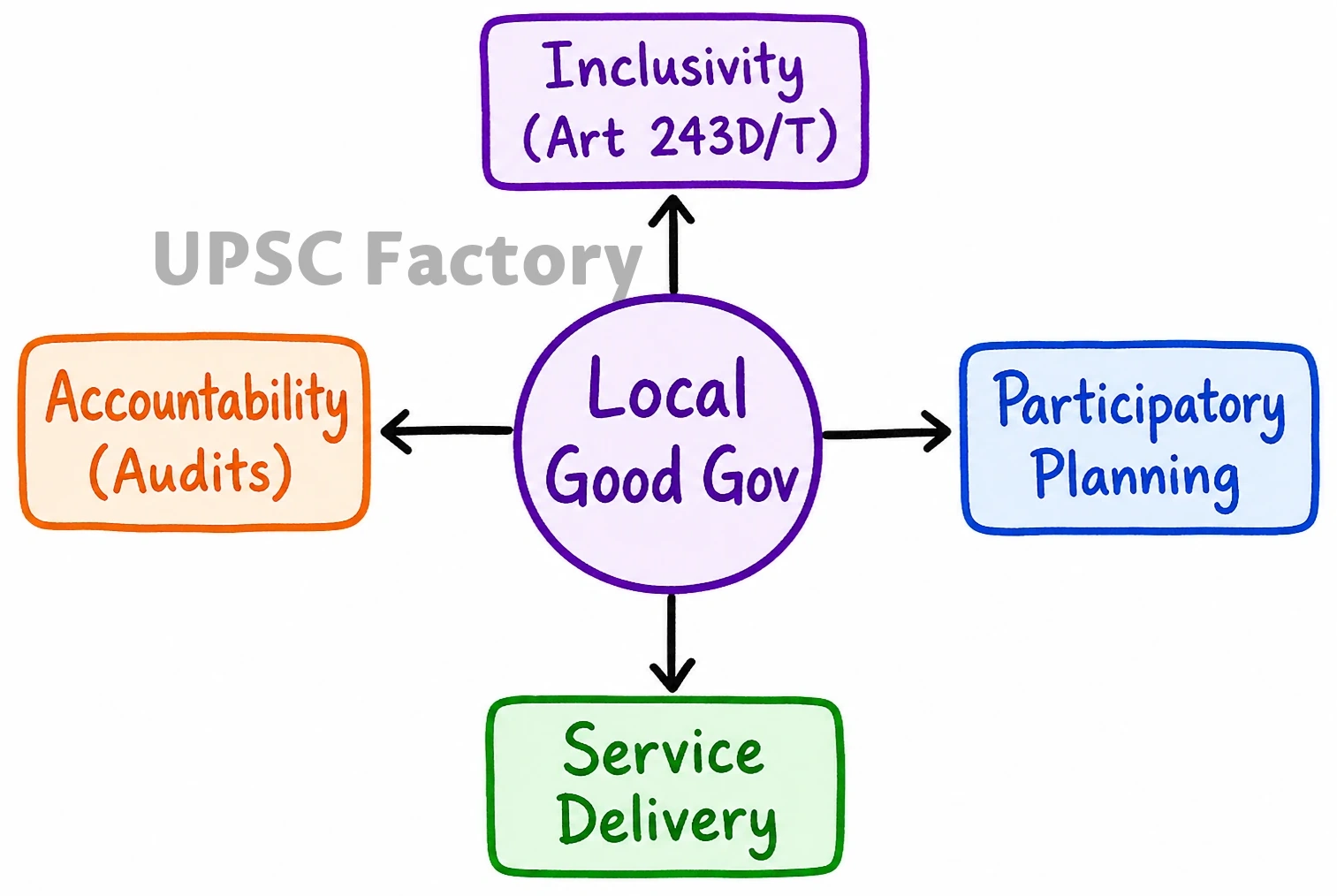
- Participatory Planning: Bottom-up policy formulation closely aligns with localized developmental needs (Kerala’s People’s Plan).
- Accountability: Statutory Gram Sabhas and social audits ensure administrative transparency (MGNREGA audits).
- Inclusivity: Mandatory constitutional reservations (Article 243D/T) politically empower women and marginalized communities.
- Service Delivery: Ensures efficient, last-mile execution of basic amenities like sanitation and primary healthcare.
2. Merging Rural and Urban Local Bodies: Pros & Cons
Pros of Merger:
- Integrated Spatial Planning: Effectively manages unregulated peri-urban expansion and contiguous transitional zones.
- Resource Optimization: Pools technical, human, and financial capacities, thereby reducing administrative duplication.
- Holistic Infrastructure: Facilitates unified regional solid waste management and transport networks.
Cons of Merger:
- Divergent Priorities: Rural livelihood and agricultural needs may be overshadowed by urban infrastructure demands.
- Democratic Deficit: Larger, merged administrative units risk diluting direct citizen-representative interaction.
- Resource Skew: Powerful urban centers might disproportionately absorb consolidated funds, starving rural peripheries.
Rather than a structural merger, empowering District Planning Committees (Article 243ZD) can effectively foster functional rural-urban synergy, aligning with the Rurban Mission’s vision.