Model Answer:
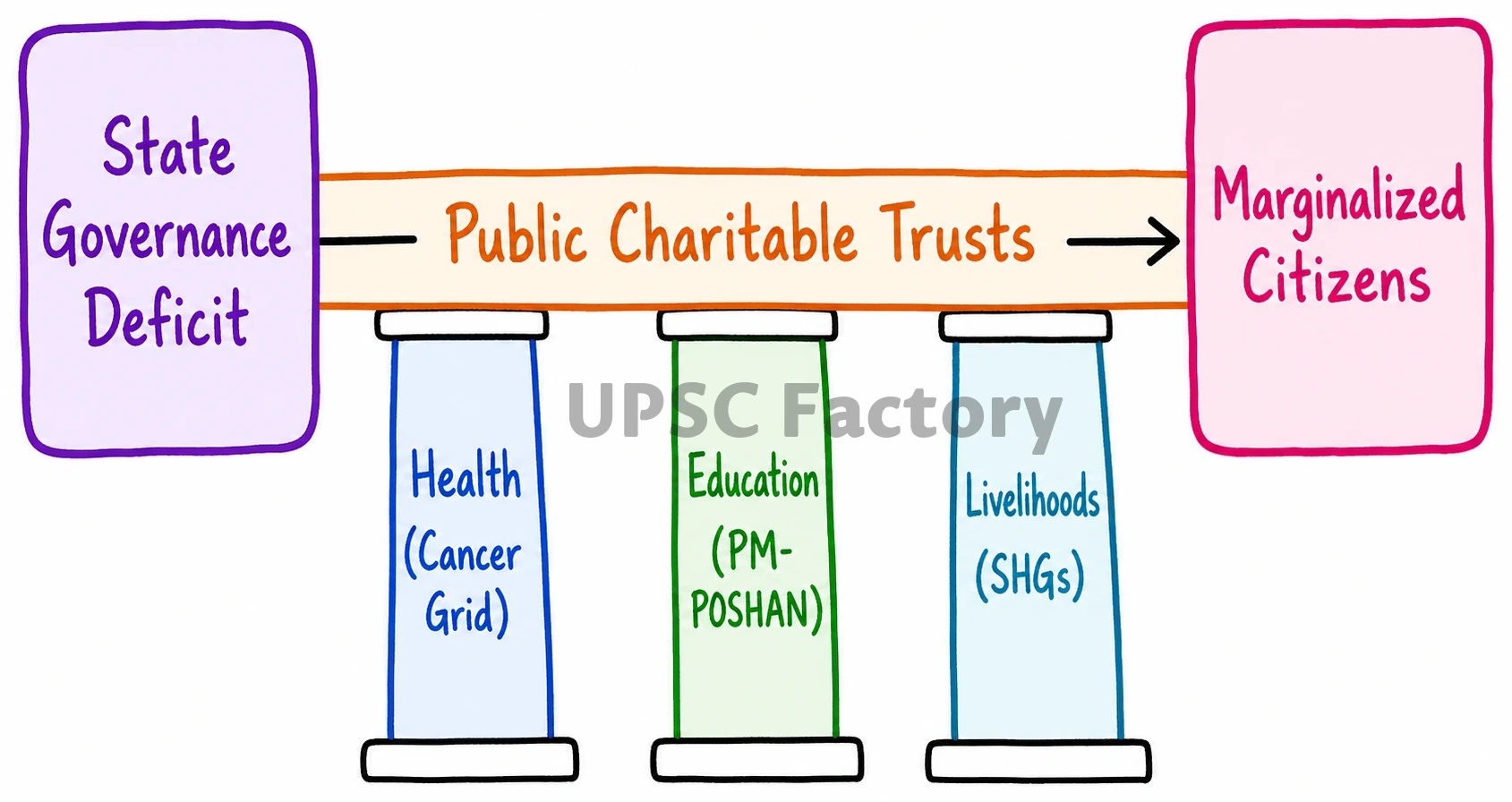
Public charitable trusts (guided by the Indian Trusts Act, 1882) act as vital non-state multipliers, bridging governance deficits and driving grassroots socio-economic equity.
1. Role in Vital Public Issues & Inclusive Development
- Healthcare Access: Bridging critical affordability and infrastructure gaps for marginalized demographics (Tata Trusts’ National Cancer Grid).
- Education & Nutrition: Enhancing school retention and tackling hidden hunger via scaled grassroots interventions (Akshaya Patra under PM-POSHAN).
- Livelihood Generation: Driving rural micro-entrepreneurship and capacity-building, specifically empowering women and vulnerable castes.
- Last-Mile Delivery: Translating top-down state welfare policies into accessible realities and acting as swift first-responders during disasters.
2. Bottlenecks Limiting Potential
- Regulatory Chokeholds: Stringent FCRA 2010 amendments severely limit foreign philanthropic inflows for genuine community-focused trusts.
- Financial Opacity: Misuse of charitable tax exemptions (Sec 12A/80G, Income Tax Act) through shell entities for money laundering.
- Geographic Asymmetry: Over-concentration of institutional funding and trust activities in developed urban centers, neglecting backward/aspirational districts.
Adopting an “enabling yet accountable” regulatory architecture, bolstered by centralized digital transparency portals (like DARPAN), will optimally harness charitable trusts for India’s inclusive growth.