Model Answer:
The 19th-century railway revolution catalyzed global “time-space compression,” transforming both industrialized and colonized nations through profound, yet distinct, socio-economic paradigm shifts.
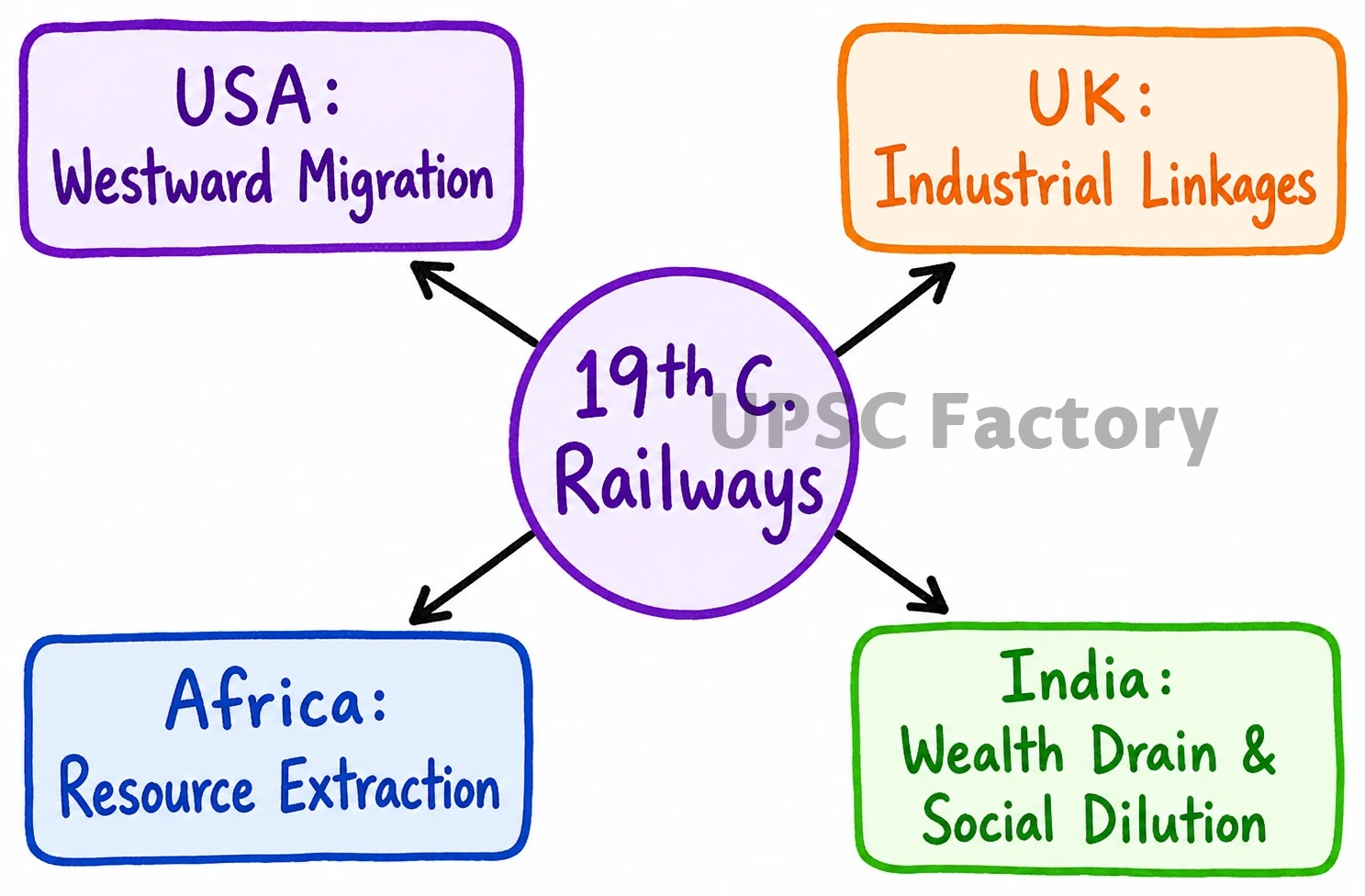
Economic Effects
- Industrial Linkages: Drove immense forward/backward linkages, rapidly accelerating coal, iron, and heavy engineering sectors (Britain’s Industrial Revolution).
- Market Integration: Connected vast hinterlands, transforming subsistence agriculture into profitable commercial farming (USA’s Transcontinental Railroad, Russia’s Trans-Siberian).
- Colonial Extraction: Acted as imperial tools for the “drain of wealth,” funneling cheap interior raw materials to global ports (Africa’s Cape-to-Cairo project, India).
Social Effects
- Demographic Shifts: Accelerated massive urbanization, inland migration, and new town settlements (USA Westward expansion, Siberian colonization).
- Social Dilution: Unintentionally eroded rigid traditional hierarchies and prejudices through shared public transit spaces (Caste system dilution in India).
- Indigenous Displacement: Enabled military mobility that rapidly marginalized aboriginal populations and appropriated native lands (Native Americans, African tribes).
- Labor Mobilization: Triggered the large-scale intercontinental movement of cheap, often exploited, workforces (Chinese labor on US railroads).
While railways decisively accelerated modern capitalist globalization and national integration, they simultaneously entrenched colonial underdevelopment and indigenous marginalization across the globe.