Model Answer:
Immanuel Wallerstein’s World-Systems Theory builds on A.G. Frank’s Dependency Theory to challenge W.W. Rostow’s modernization model. It posits that global capitalism creates structural inequalities, making underdevelopment a structurally created condition rather than a traditional stage.
Dynamics of Unequal Exchange
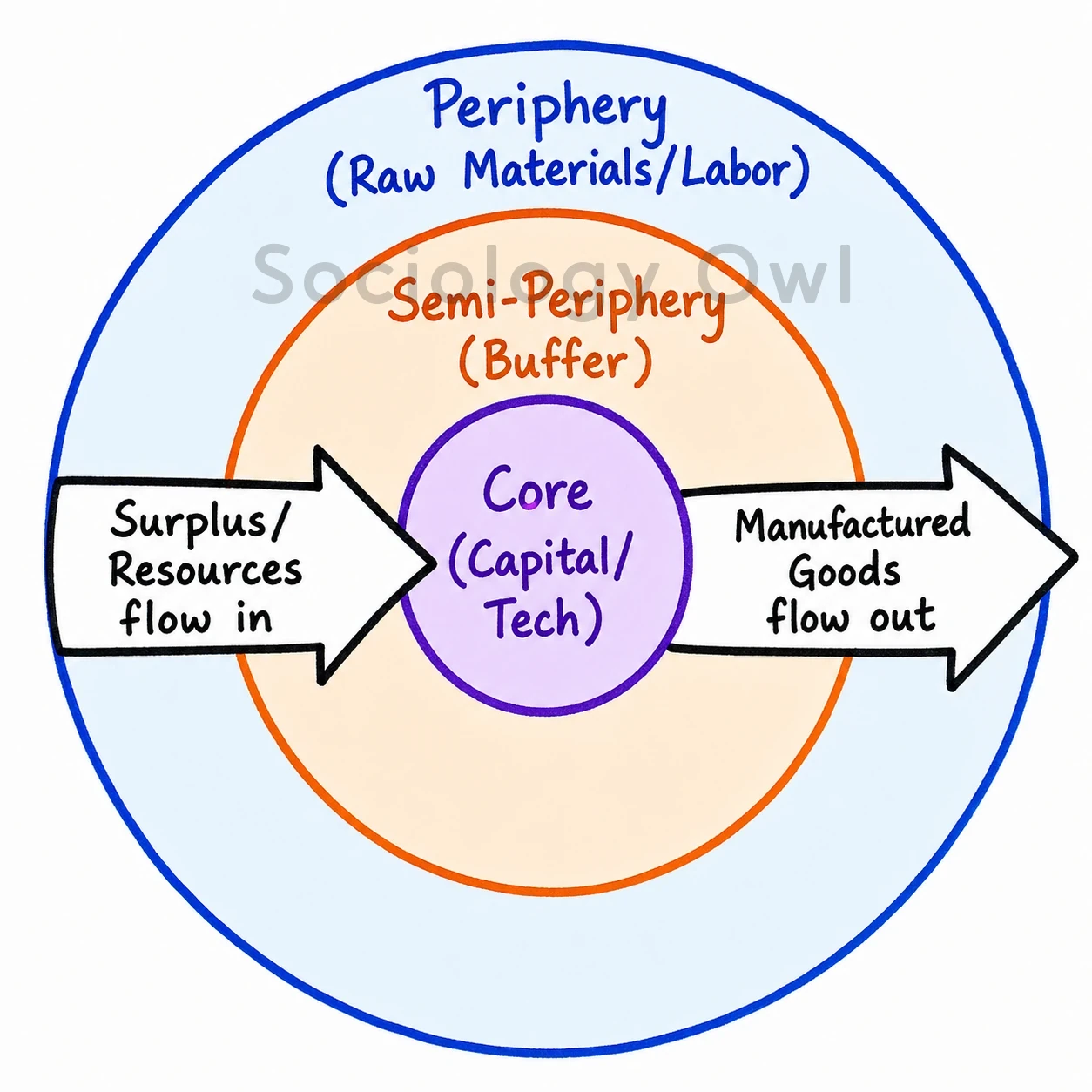
- International Division of Labor: The global economy divides nations into the Core (capital-intensive), Periphery (resource-extraction), and Semi-Periphery (buffers preventing polarization).
- Surplus Appropriation: Core nations systematically exploit the Periphery via unequal exchange, perpetuating their dependency.
Critiques of the Theory
- Theda Skocpol: Criticizes Wallerstein’s economic reductionism, highlighting the ignored autonomous role of the State and political-military structures.
- F.H. Cardoso: Argues for “associated-dependent development,” showing that capitalist growth within peripheral nations is possible.
- East Asian Miracle: The rapid upward mobility of the “Asian Tigers” challenges Wallerstein’s rigid determinism.
Today, BRICS represents the modern Semi-Periphery. Furthermore, extracting DRC cobalt (Periphery) to fuel Silicon Valley monopolies (Core) highlights ongoing digital neo-colonialism.
Conclusion
Despite valid critiques of economic reductionism, Wallerstein provides an indispensable macro-sociological framework for decoding structural inequalities and neo-colonial exploitation within modern global capitalism.