Model Answer:
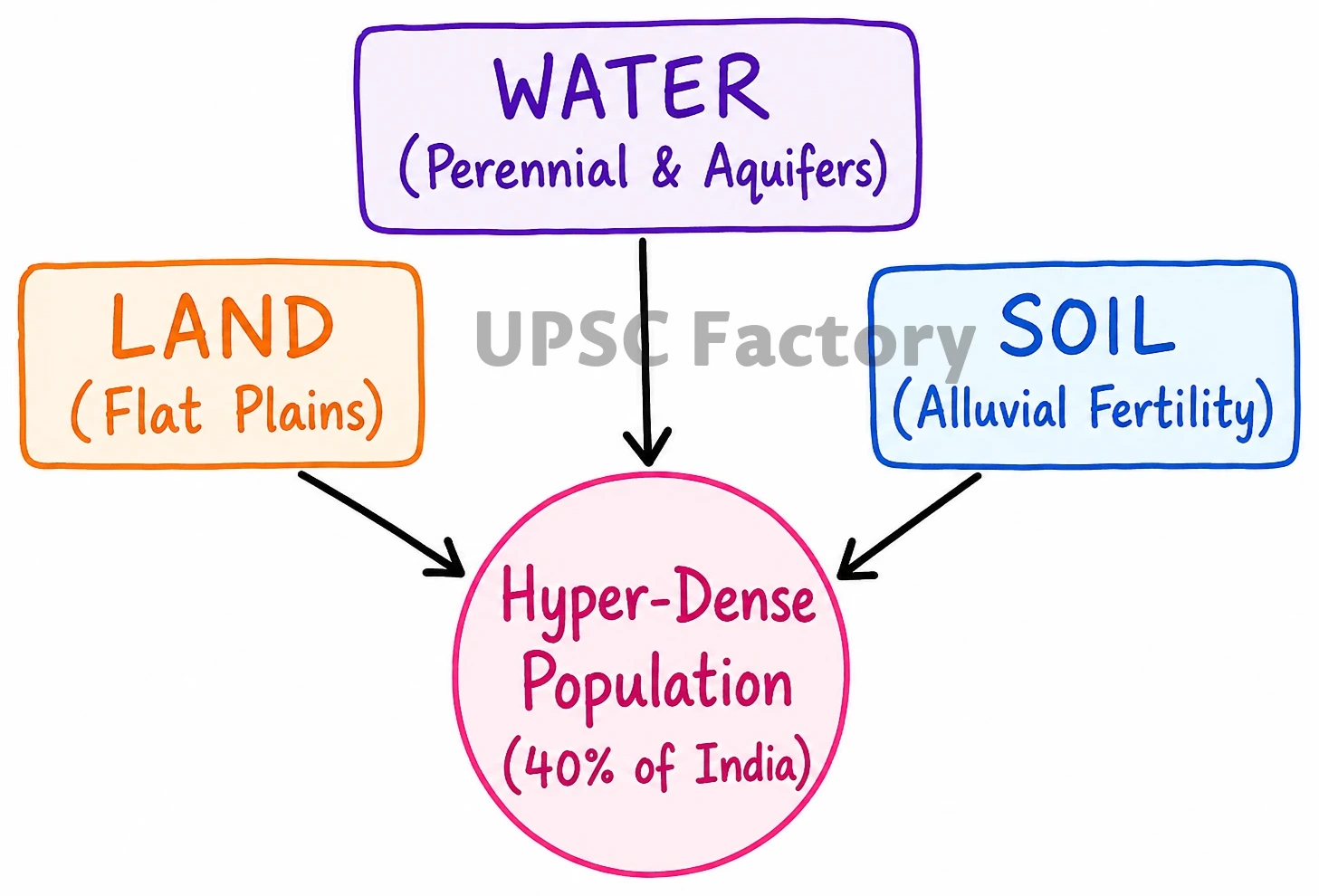
The Ganga River Basin, hosting ~40% of India’s population, forms a demographic heartland where immense population density directly correlates with rich geographical resource endowments.
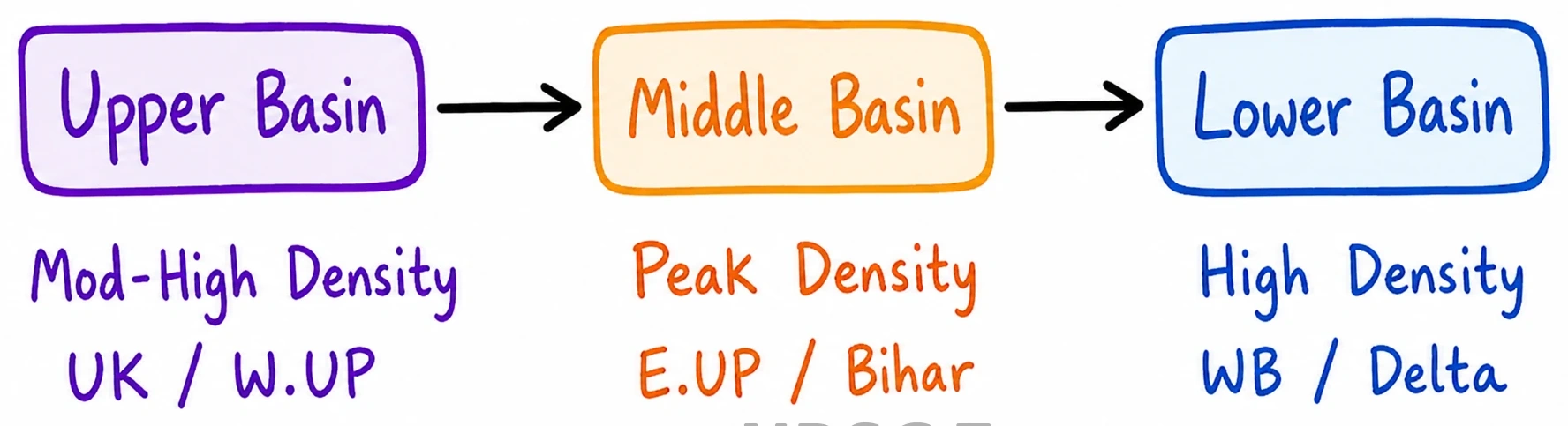
Spatial Distribution and Density Patterns
- Upper Basin (Uttarakhand, Western UP): Moderate-to-high density marking the transition from sparse hills to fertile plains (Haridwar, Meerut).
- Middle Basin (Eastern UP, Bihar): Records the highest density peaks due to vast, unbroken flatlands (Census 2011: Bihar 1106, UP 829 persons/sq.km).
- Lower Basin (West Bengal): Extremely high density driven by deltaic fertility and historical industrialization (Hooghly urban belt: 1029 persons/sq.km).
- Urban Agglomerations: Concentrated pockets of hyper-density exist along riverbanks due to historical trade and transit (Kanpur, Patna, Varanasi).
Resource-Demography Nexus: Land, Soil, and Water
- Topography and Infrastructure (Land): Expansive flat plains minimize construction costs, facilitating dense rail/road networks and sprawling settlements (Indo-Gangetic plains).
- Agrarian Carrying Capacity (Soil): Deep, fertile alluvial soils (Khadar and Bangar) support intensive multi-cropping, ensuring food security for massive populations (Rice-wheat belt).
- Perennial Surface Supply (Water): Glacial-fed rivers provide uninterrupted water for domestic needs, navigation, and agriculture, anchoring ancient human settlements (Ganga canal system).
- Rich Aquifer Wealth (Water): Thick sedimentary aquifers enable widespread tubewell irrigation, reducing monsoon dependency and sustaining dense rural populations (Green Revolution zones).
- Industrial Magnetism (Water & Land): Water abundance and flat terrain attract water-intensive industries, spawning mega-cities that absorb immense migrant labor (Kanpur leather, Hooghly jute).
While the basin’s resources historically sustained India’s greatest demographic concentrations, escalating population pressures now demand sustainable agro-ecological planning and robust rejuvenation efforts (Namami Gange) to prevent resource collapse.