Model Answer:
India’s recent GDP expansion has increasingly decoupled from job creation, reflecting “jobless growth” driven primarily by rising output per worker rather than workforce expansion, as highlighted by the India Employment Report 2024.
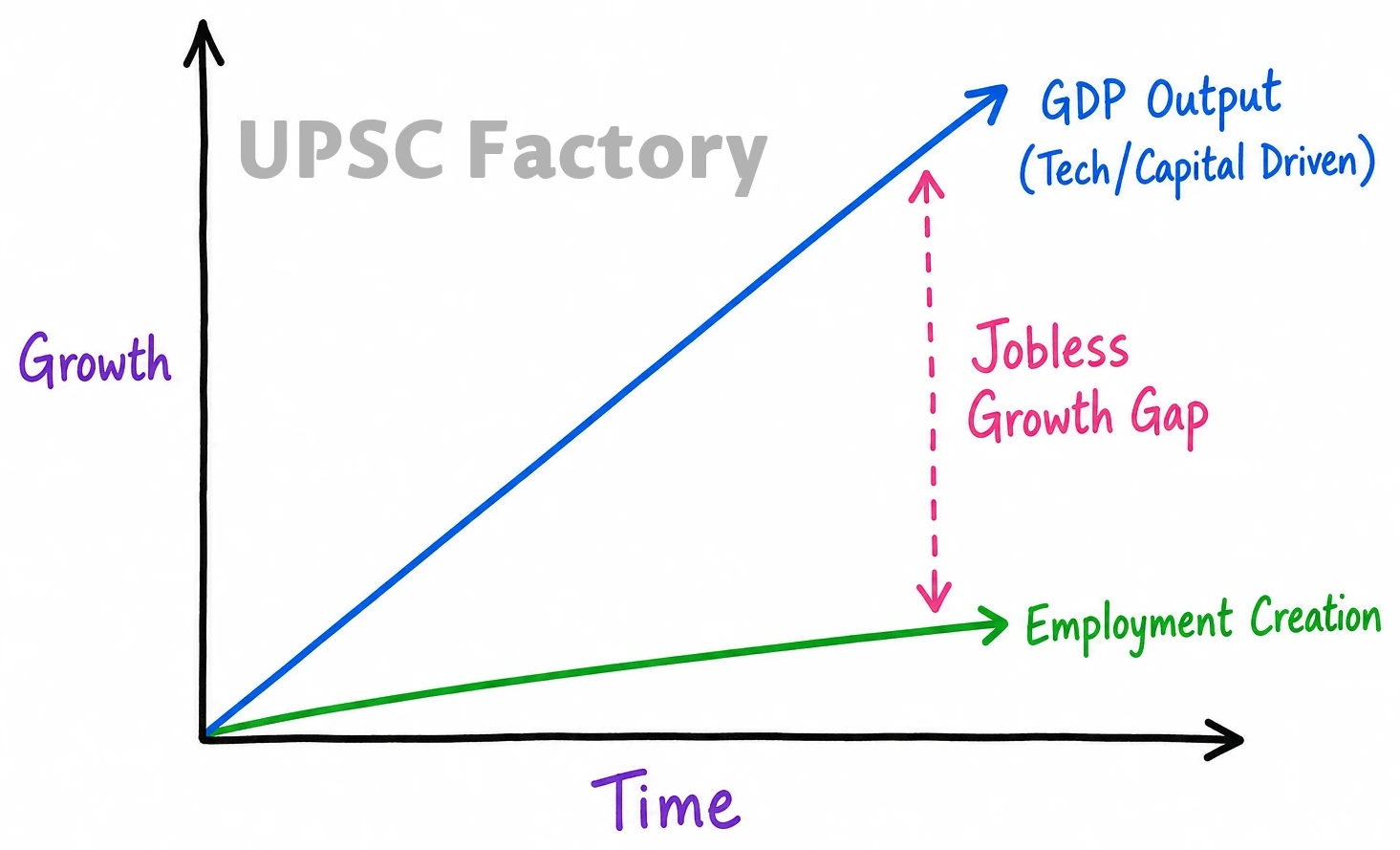
Drivers of Productivity-Led Economic Growth
- Capital-Intensive Manufacturing: Industries increasingly favor automation and machinery over hiring to bypass structural bottlenecks and rigid labour laws (e.g., auto-components, pharmaceuticals).
- Service Sector Dominance: India’s growth engines (IT, telecommunications, finance) require highly skilled, high-productivity workers but absorb a minuscule fraction of the overall workforce.
- Technological Capital Deepening: Rapid integration of AI, digitization, and mechanization has boosted Total Factor Productivity (TFP), maximizing output per existing employee.
- Declining Employment Elasticity: Economic output grows, but the rate at which this growth generates new jobs has fallen sharply across organized sectors.
Suggested Growth Pattern: Balancing Jobs and Productivity
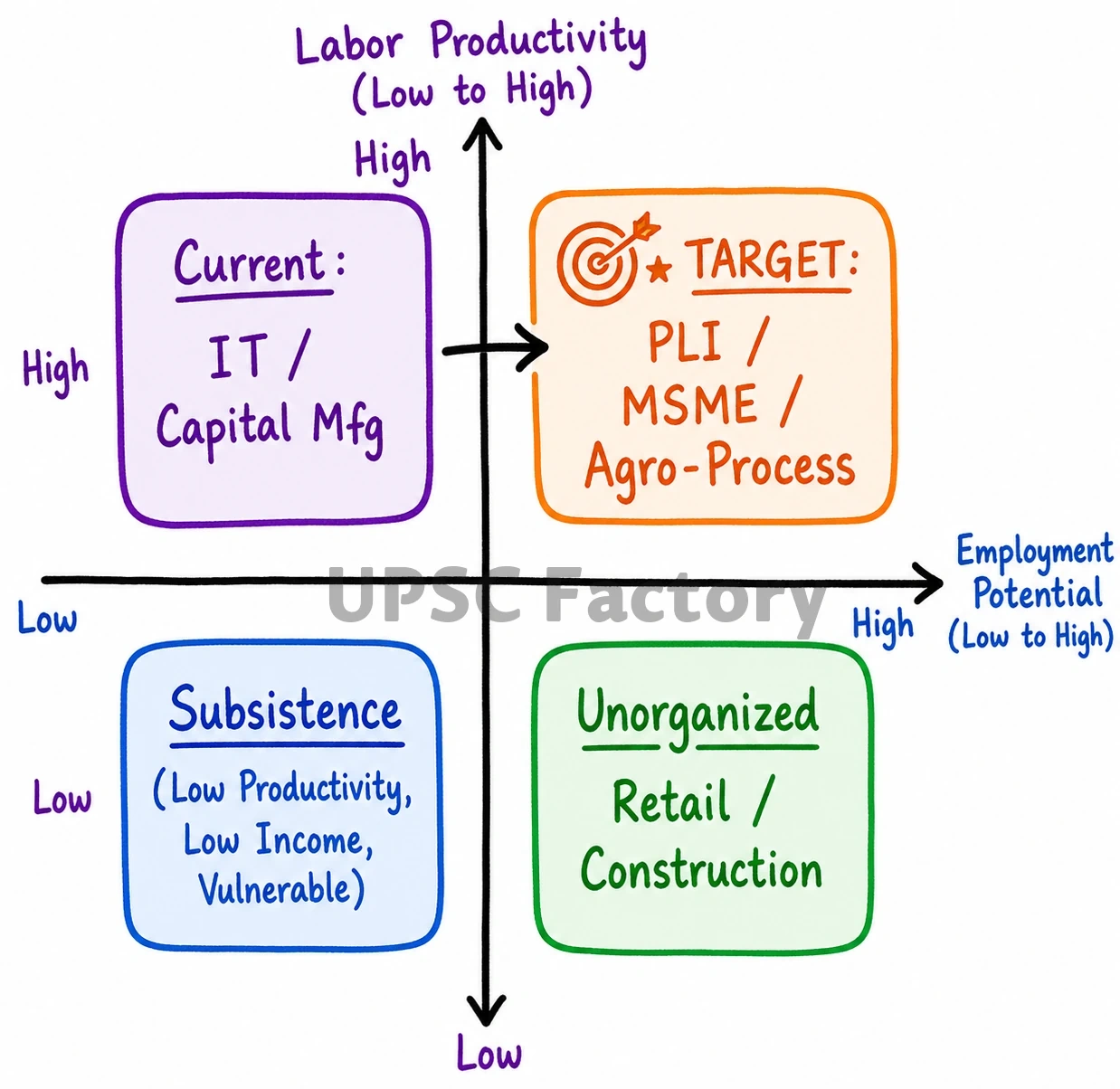
- Labor-Intensive Export Manufacturing: Combine mass employment with high efficiency by me achieving global scale in textiles, footwear, and electronics (e.g., PLI Scheme for mobile assembly).
- Agro-Processing & Value Addition: Transition surplus agricultural labour into localized food processing, boosting rural productivity and non-farm jobs (e.g., Amul cooperative model).
- MSME Upgradation: Integrate MSMEs into global value chains through credit access and technology transfers, scaling their output capacity and job creation potential.
- Expanding the ‘Care’ and ‘Green’ Economies: Invest in localized healthcare, education, and renewable energy grids to generate massive, sustainable, and productive employment.
- Industry 4.0 Skilling: Align vocational training with modern industry needs to ensure the demographic dividend transitions into high-productivity, formal sector roles.
Shifting from purely capital-driven expansion to an employment-elastic, MSME-led manufacturing and services ecosystem is vital to achieving inclusive, high-productivity economic development.