Model Answer:
Evaluating a civil servant requires assessing both administrative efficiency and their moral compass, as emphasized by the Nolan Committee and 2nd ARC.
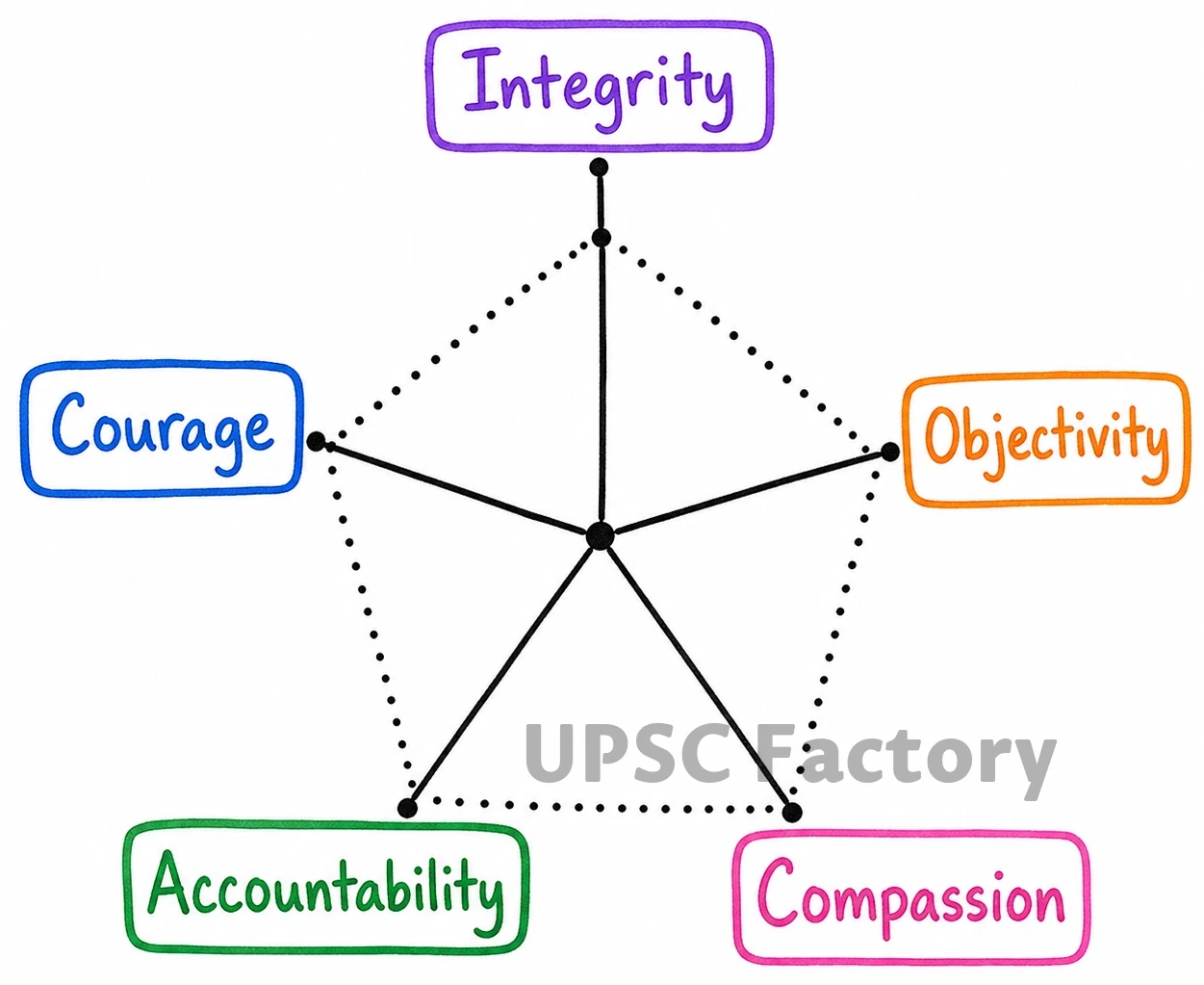
Matrix of Ethical Traits & Justification
Plotting performance on an ethical matrix requires evaluating traits that directly impact public trust and governance:
- Integrity: Prevents corruption and aligns personal actions with public interest, ensuring absolute financial probity (e.g., E. Sreedharan’s transparent project management).
- Objectivity: Guarantees merit-based, non-partisan decision-making, crucial for upholding constitutional equity without political bias (e.g., T.N. Seshan’s electoral reforms).
- Compassion towards Vulnerable: Transforms bureaucratic apathy into proactive, citizen-centric service delivery for marginalized sections (e.g., Armstrong Pame’s crowd-funded ‘People’s Road’).
- Accountability: Cultivates democratic answerability, ensuring optimal, transparent utilization of public resources and reducing systemic leakage (e.g., Proactive RTI disclosures).
- Courage of Conviction: Empowers officers to speak truth to power and uphold the rule of law against vested interests (e.g., Satyendra Dubey exposing corruption).
Integrating this five-trait ethical matrix into traditional performance appraisals (like ACRs) ensures the transition from mere bureaucratic administration to true, values-driven public stewardship.