Model Answer:
Foundational values act as the moral compass for civil servants, ensuring that administrative actions align with constitutional morality and public interest (2nd ARC).
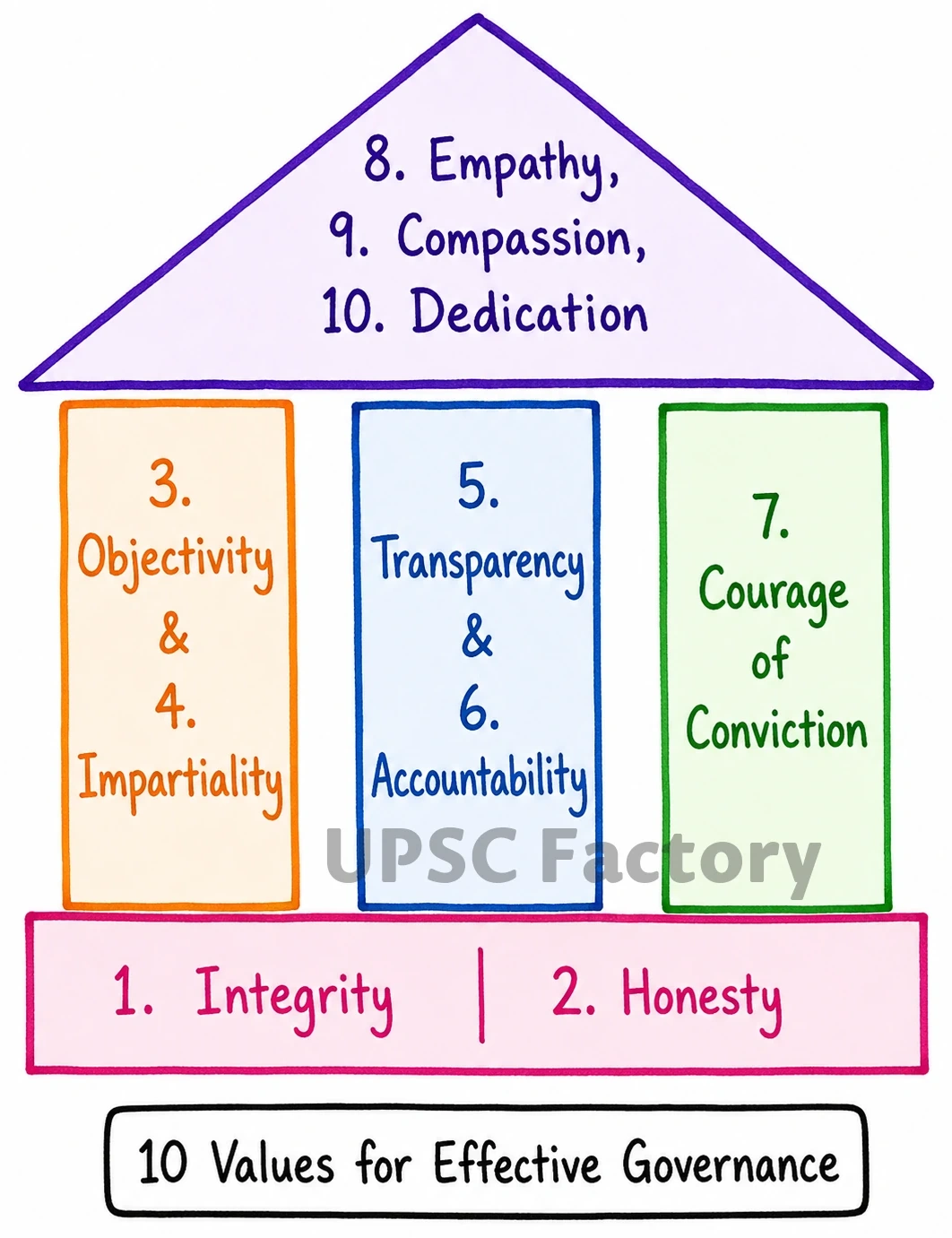
Ten Essential Values for Effective Public Servants
Based on the Nolan Committee and constitutional ideals, an effective public servant must possess:
- Integrity: Absolute moral and financial uprightness (e.g., E. Sreedharan).
- Objectivity: Taking decisions strictly on merit and facts.
- Impartiality: Functioning without political or ideological bias.
- Empathy: Deeply understanding the grievances of citizens.
- Compassion: Proactive support for marginalized and vulnerable sections.
- Dedication to Public Service: Commitment transcending mere duty hours.
- Accountability: Taking ownership of administrative decisions and outcomes.
- Transparency: Ensuring openness in governance.
- Courage of Conviction: Upholding truth despite pressures (e.g., Ashok Khemka).
- Honesty: Truthfulness in public and private conduct.
Ways and Means to Prevent Non-Ethical Behaviour
- Technological Interventions: Minimizing human interface and administrative discretion via e-Governance (DBT, GeM, e-Tendering).
- Statutory Deterrence: Strict, time-bound enforcement of the Prevention of Corruption Act, 1988, and Conduct Rules, 1964.
- Participatory Accountability: Empowering stakeholders through institutional mechanisms (RTI, Social Audits, updated Citizen Charters).
- Capacity Building: Shifting from rule-based to role-based ethical training to foster intrinsic motivation (Mission Karmayogi).
- Ethical Auditing & Whistleblower Protection: Incentivizing ethical conduct and securing those exposing systemic corruption (Whistle Blowers Protection Act).
Preventing unethical behaviour requires a paradigm shift from enforcing a prescriptive “Code of Conduct” to institutionalizing a self-driven “Code of Ethics,” ultimately ensuring citizen-centric good governance.