Model Answer:
Probity transcends mere financial honesty; it entails strict adherence to the highest ethical ideals of integrity, transparency, and accountability (Nolan Committee principles).
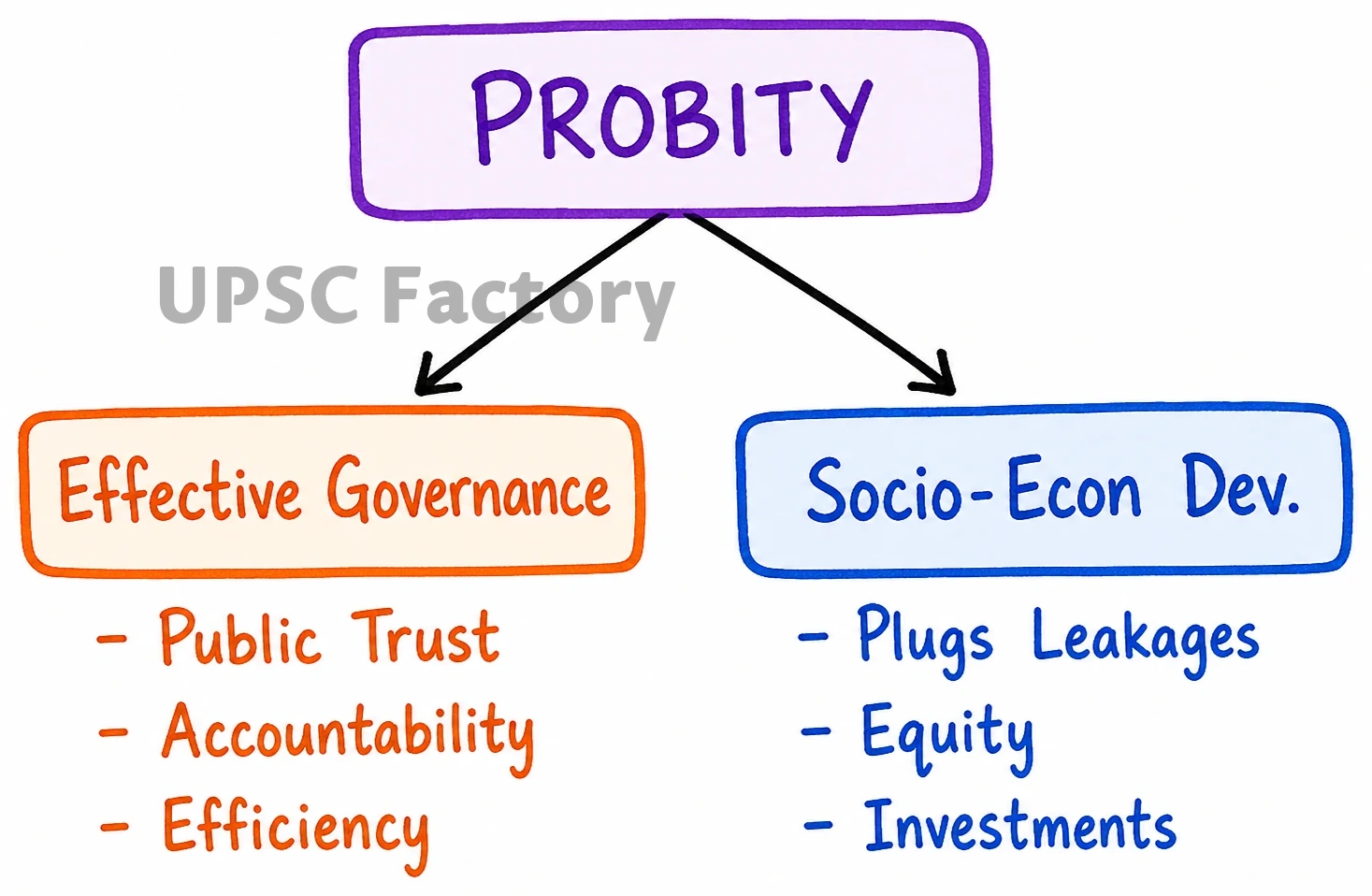
1. Probity for Effective Governance
- Builds Public Trust: Fosters citizens’ faith in state machinery and democratic institutions by minimizing information asymmetry (RTI Act 2005).
- Ensures Accountability: Prevents the arbitrary exercise of power and promotes objective, merit-based decision-making.
- Enhances Operational Efficiency: Reduces administrative red tape and prevents cost-time overruns in public projects (e.g., E-Sreedharan’s execution of Delhi Metro).
- Curbs Malfeasance: Institutionalizes a culture of zero tolerance towards systemic corruption (Prevention of Corruption Act).
2. Probity for Socio-Economic Development
- Plugs Resource Leakages: Ensures public funds reach targeted beneficiaries without bureaucratic diversion (e.g., JAM trinity and DBT eliminating ghost beneficiaries in PDS).
- Promotes Inclusive Growth: Prevents elite capture of public resources, ensuring equitable socio-economic justice for marginalized sections.
- Boosts Economic Investment: A transparent, predictable, and rule-based governance ecosystem attracts robust domestic and foreign investments.
As highlighted by the 2nd ARC, probity is the absolute bedrock of ‘Surajya’ (good governance), indispensable for transforming India into a thriving, equitable welfare state.