UPSC GS4 2025

Q. Rajesh is a Group A officer with nine years of service. He is posted as Administrative Officer in an Oil Public Sector undertaking.

As an Administrative Officer he is responsible for managing and coordinating various administrative tasks to ensure smooth functioning of office. He also manages office supplies, equipment etc. Rajesh is now sufficient senior and is expecting his next promotion in JAG (Junior Administrative Grade) in the next one or two years. He knows that promotion is based on examination of ACRs/Performance Appraisal of last few years (5 years or so) of an officer by a DPC (Departmental Promotion Committee) and an officer lacking requisite grading of ACRs may not be found fit for promotion. Consequences of losing promotion may entail financial and reputational loss and set-back for career progression. Though he also puts his best efforts in official discharge of his duties, yet he is unsure of assessment by his superior officer. He is now putting extra efforts so that he gets thumping report at the end of financial year. As Administrative Officer, Rajesh is regularly interacting with his immediate boss, who is his reporting officer for writing his ACR. One day he calls Rajesh and wants him to buy computer-related stationery on priority from a particular vendor. Rajesh instructs his office to initiate action for procuring these items. During the day, the dealing Assistant brings an estimate of Rupees Thirty Five Lakhs covering all stationery items from the same vendor. It is noticed that as per delegated financial powers, as provided in the GFR (General Financial Rules) as applicable in that Organisation, expenditure for office items exceeding Rupees Thirty Lakhs requires sanction of the next higher authority (boss in the present case). Rajesh knows that immediate superior would expect all these purchases should be done at his level and may not appreciate such lack of initiative on his part. During discussions with office, he learns that common practice of splitting of expenditure (where large order is divided into a series of smaller ones) is followed to avoid obtaining sanction from higher authority. This practice is against the rules and may come to the adverse notice of Audit. Rajesh is perturbed. He is unsure of taking decision in the matter.
(a) What are the options available with Rajesh in the above situation?
(b) What are the ethical issues involved in this case?
(c) Which would be the most appropriate option for Rajesh and why?

UPSC Mains 2025 GS4 Paper

Model Answer:

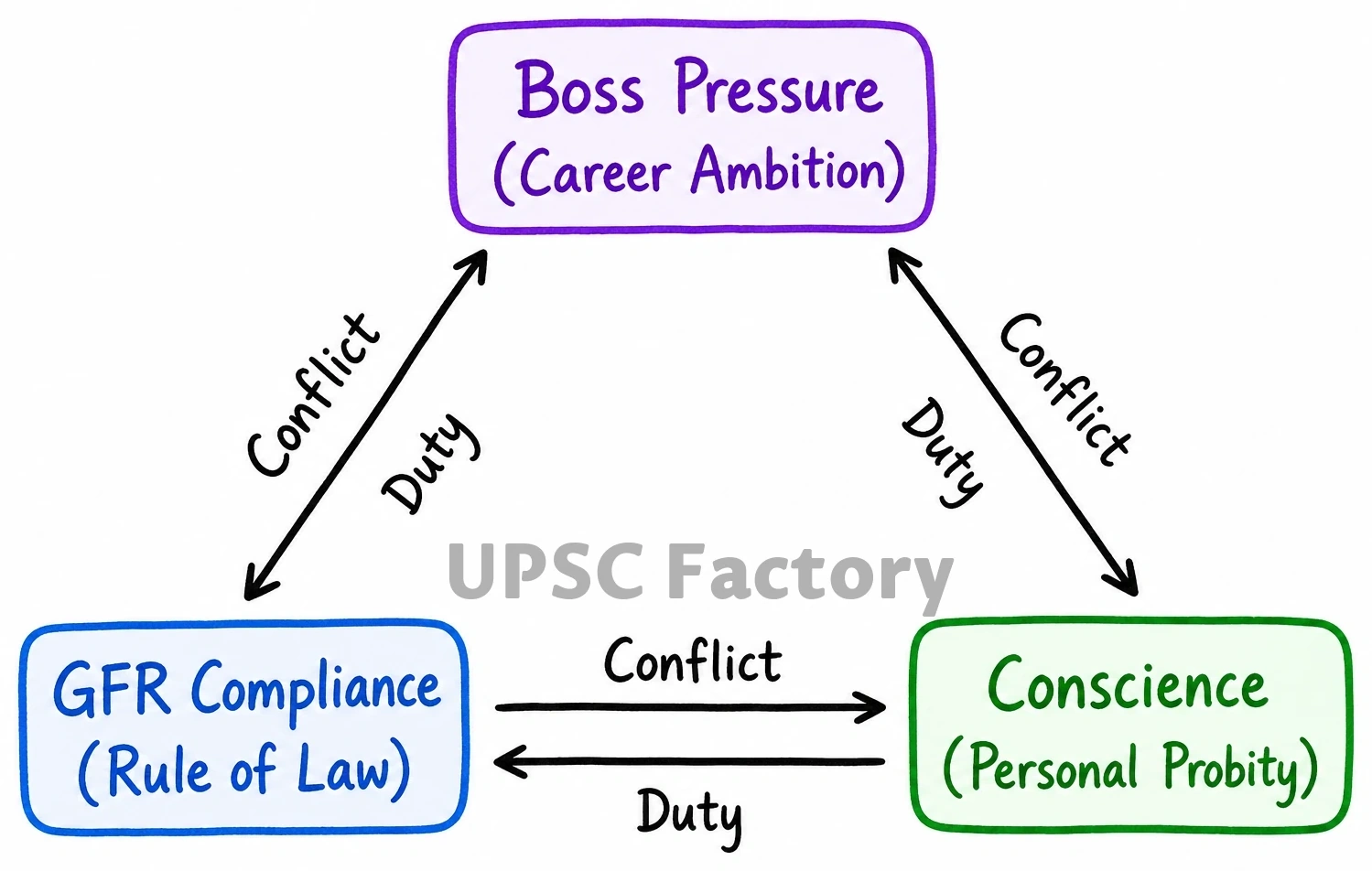
Rajesh faces a crisis of conscience involving personal career ambition (promotion) versus administrative probity, objectivity, and strict adherence to the General Financial Rules (GFR).

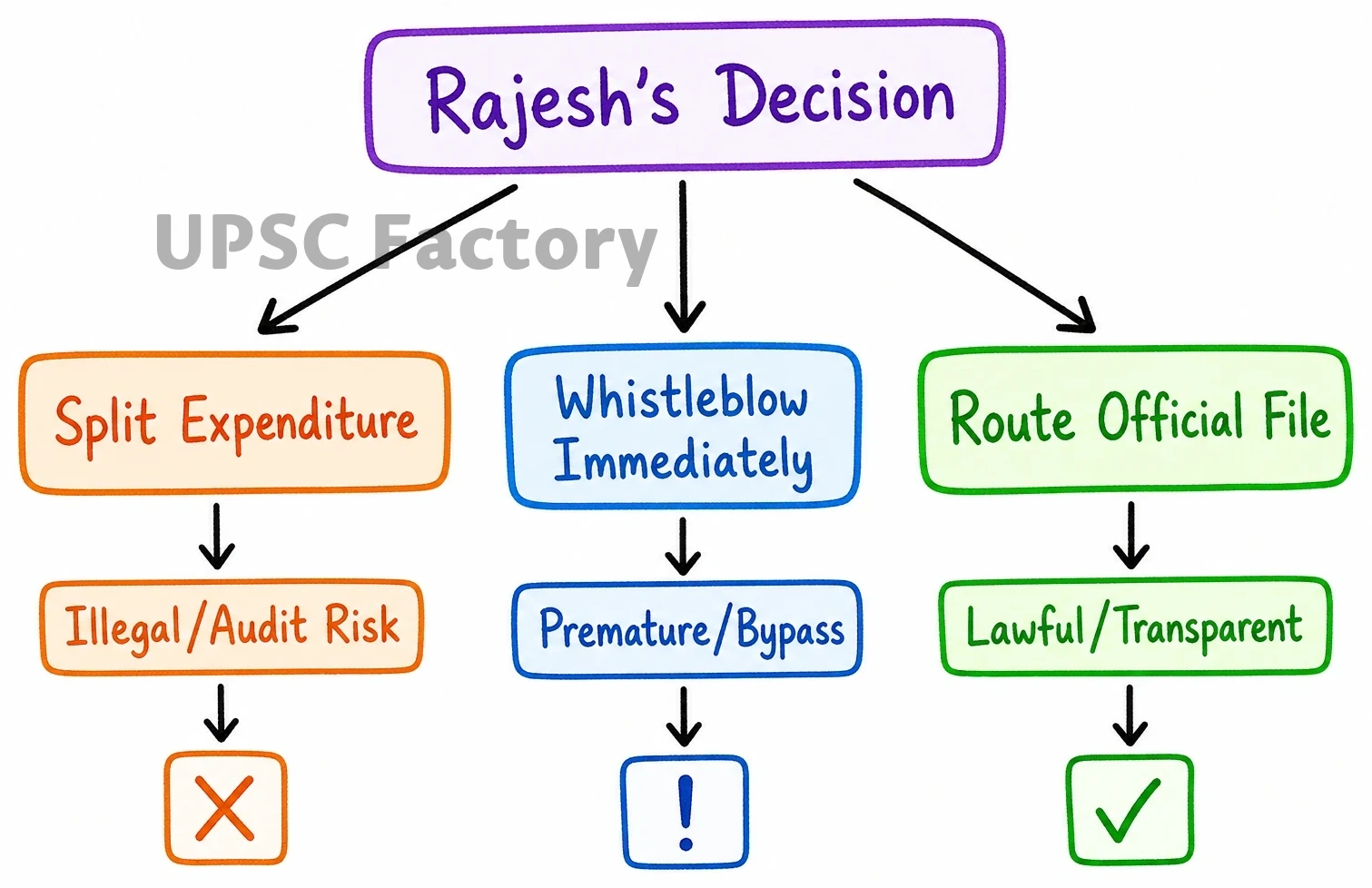
(a) Options Available with Rajesh

  1. Split the expenditure: Orally comply with the boss to secure a favorable ACR. (Action: Illegal, risks audit trap).
  2. Outright refusal & whistleblowing: Reject the order and complain to the Chief Vigilance Officer. (Action: Premature, bypasses internal file routing).
  3. Process file strictly as per rules: Note the ₹35 lakh estimate on the file and forward it to the boss for formal financial sanction. (Action: Lawful, transparent).
(b) Ethical Issues Involved

  • Probity in Governance: Safeguarding public funds against arbitrary or potentially corrupt procurement practices.
  • Conflict of Interest: Balancing personal career advancement (JAG promotion) against the constitutional duty of lawful administration.
  • Violation of Rule of Law: Splitting expenditures to bypass authority strictly violates Rule 157 of GFR 2017.
  • Courage of Conviction: Exhibiting moral courage to resist undue pressure from a reporting officer (CCS Conduct Rules).
(c) Most Appropriate Option & Justification

Rajesh should adopt Option 3. He must document the single ₹35 lakh estimate on the official file, cite the ₹30 lakh GFR sanctioning limit, and officially route it to the boss for higher approval.

Justification:

  • Upholds Rule of Law: Strict compliance with GFR prevents the illegal splitting of bills.
  • Establishes Accountability: Putting everything on paper forces the boss to officially sanction the vendor and amount, shielding Rajesh from subsequent CAG/Audit objections.
  • Nolan Principles: Demonstrates Integrity and Objectivity.
  • Safeguards Career Logically: If the boss writes an adverse ACR in retaliation, Rajesh’s transparent paper trail provides concrete grounds to appeal to the reviewing authority (DPC) against arbitrary grading.

Public servants must exhibit administrative courage. True civil service ethos demands that career progression never be secured at the cost of institutional integrity and public trust (e.g., Ashok Khemka’s rule compliance).

Check Demo Video

UPSC Factory : Prepare Offline 🎯

4000+ Prelims PYQs, mains answers with diagrams, ncert, syllabus tracker, topper notes, past papers.
Give it a try, you will love it !!💯

UPSC Factory for Android
Mains PYQ's with Diagram, Prelims PYQs, Test Series.
Give it a try, you will love it 💯