Model Answer:
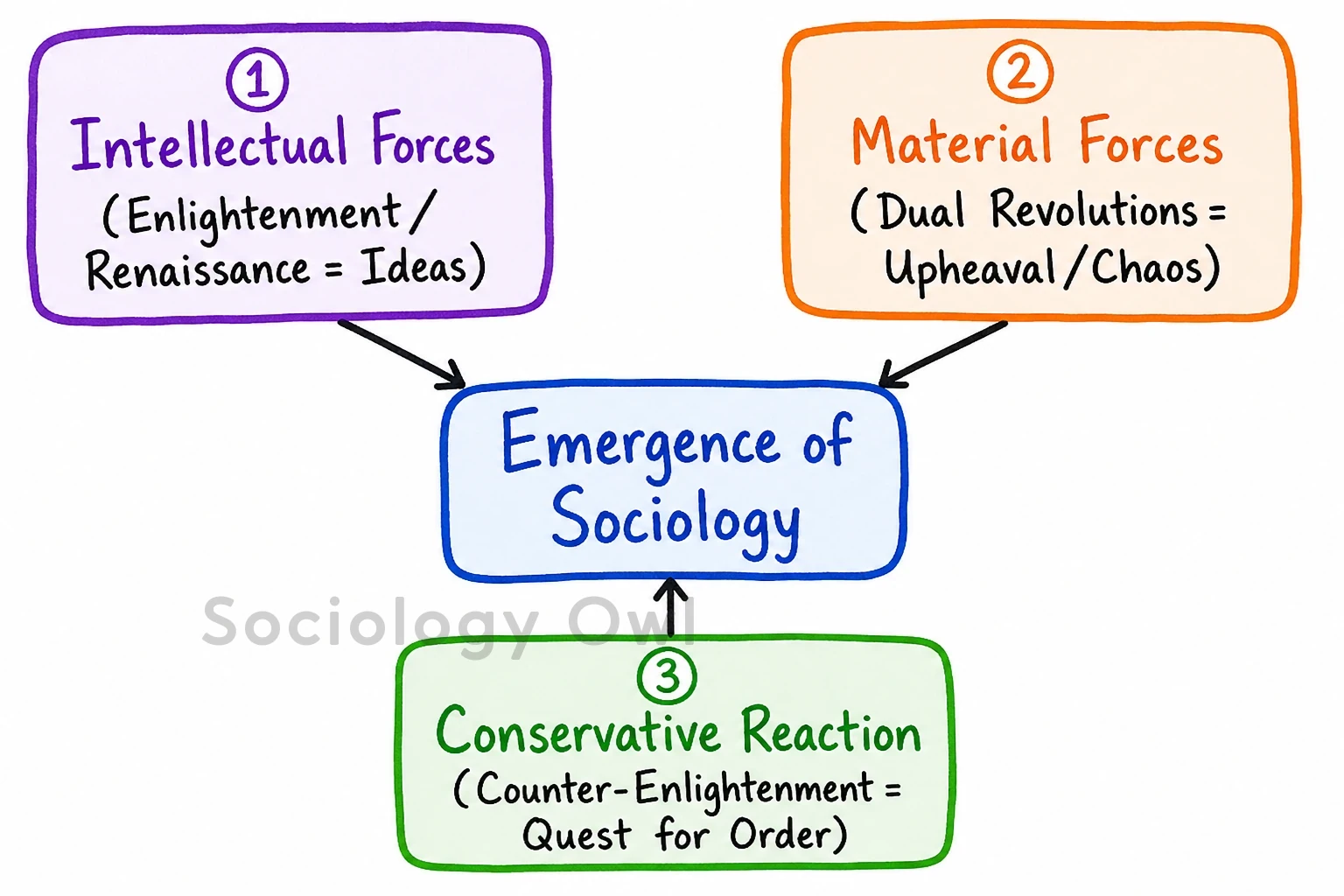
The emergence of sociology marked an epistemological shift from “Theodicy” (explaining society through divine will) to “Sociodicy” (rational understanding of society). The Renaissance birthed Humanism, while the Enlightenment introduced Reason and Positivism, providing the primary intellectual bedrock for the discipline.
Intellectual Foundations: Enlightenment and Renaissance
Rationalism and Positivism
Thinkers like Montesquieu (The Spirit of the Laws) pioneered comparative methods, while the Enlightenment belief that society is governed by discoverable laws inspired Auguste Comte’s Positivism.
Humanism and Secularization
The Renaissance shifted the analytical focus to human-centric studies, empowering Karl Marx’s historical materialism and critique of capitalism over religious dogmas.
Critical Examination: Catalysts, Reactions, and Eurocentrism
The Conservative Reaction
The Counter-Enlightenment heavily shaped classical sociology. Thinkers like Louis de Bonald and Joseph de Maistre rejected extreme Enlightenment individualism. Emile Durkheim drew from this, scientifically studying the breakdown of community and diagnosing modernity’s “Anomie”.
Material and Political Catalysts
Enlightenment provided the ideas, but the French Revolution and Industrial Revolution provided the chaos. Sociology emerged fundamentally as a quest for “Social Order” amid these upheavals.
Critique of Enlightenment Optimism
Max Weber challenged the unbridled celebration of reason, warning of modernity’s “Iron Cage of Rationality” and the consequent “Disenchantment of the World”.
The Eurocentric Blindspot
Raewyn Connell (Southern Theory) and Gurminder K. Bhambra argue classical sociology ignored how colonialism built “modernity.” Furthermore, Ibn Khaldun’s 14th-century work on “Asabiyyah” (social cohesion) significantly predates European sociology.
Contemporary Relevance
The ongoing global movement of “Decolonizing the Curriculum” actively challenges sociology’s Eurocentric origins. By integrating Indigenous, African (Ubuntu), and Asian epistemologies, modern universities are transforming sociology into a truly multipolar discipline.
Conclusion
While the Renaissance and Enlightenment supplied the crucial intellectual raw materials of reason and empiricism, sociology was fundamentally forged in the furnace of 19th-century socio-political crises. Today, the discipline continuously evolves past its European birth to critically analyze diverse global realities.