Model Answer:
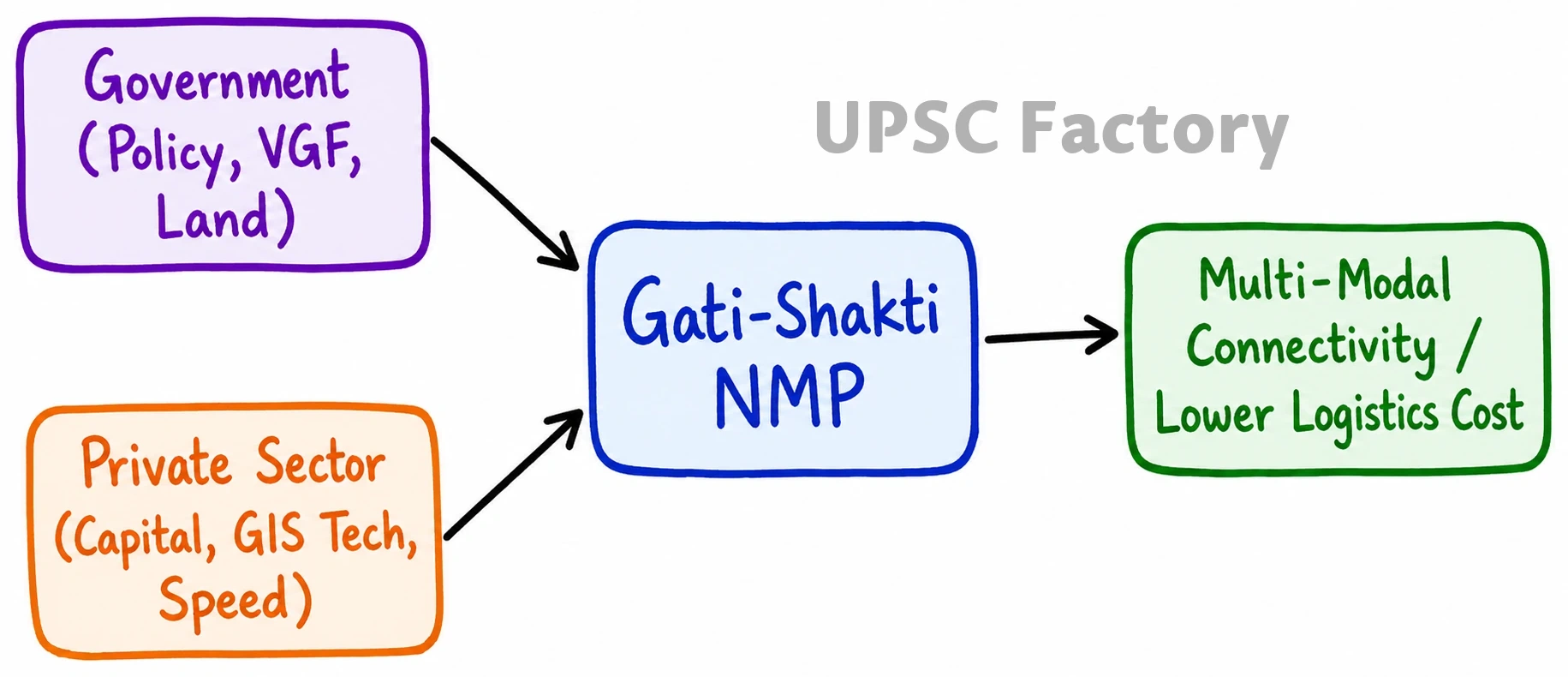
The PM Gati-Shakti National Master Plan (NMP) aims to break departmental silos for integrated multi-modal connectivity, necessitating robust Public-Private Partnership (PPP) to leverage capital and expertise.
1. Imperatives for Govt-Private Synergy
- Funding Deficit: The ₹111 lakh crore National Infrastructure Pipeline (NIP) relies on ~21% private capital contribution (Kelkar Committee).
- Technology Transfer: Private integration brings advanced GIS analytics and logistics management to the NMP portal.
- Operational Efficiency: Innovative PPP models (HAM, TOT) ensure timely multi-modal execution (Bharatmala, Sagarmala), reducing logistics costs.
- Asset Monetization: Private management of brownfield infrastructure generates capital for greenfield projects (National Monetisation Pipeline).
2. Coordination Bottlenecks & Required Solutions
- Risk Apportionment: Skewed financial risks deter private investors; requires rationalized Viability Gap Funding (VGF).
- Clearance Bottlenecks: Land acquisition and environmental delays demand seamless single-window clearances via the e-Gati Shakti portal.
- Information Asymmetry: NMP spatial data must be transparently accessible to private developers for synchronized planning.
- Dispute Resolution: Rigid contracts require independent sectoral regulators and faster arbitration mechanisms for viable renegotiations.
Meticulous PPP coordination, shifting from transactional contracts to collaborative governance, is vital to actualize Gati-Shakti’s vision and propel India toward a $5-trillion economy.