Model Answer:
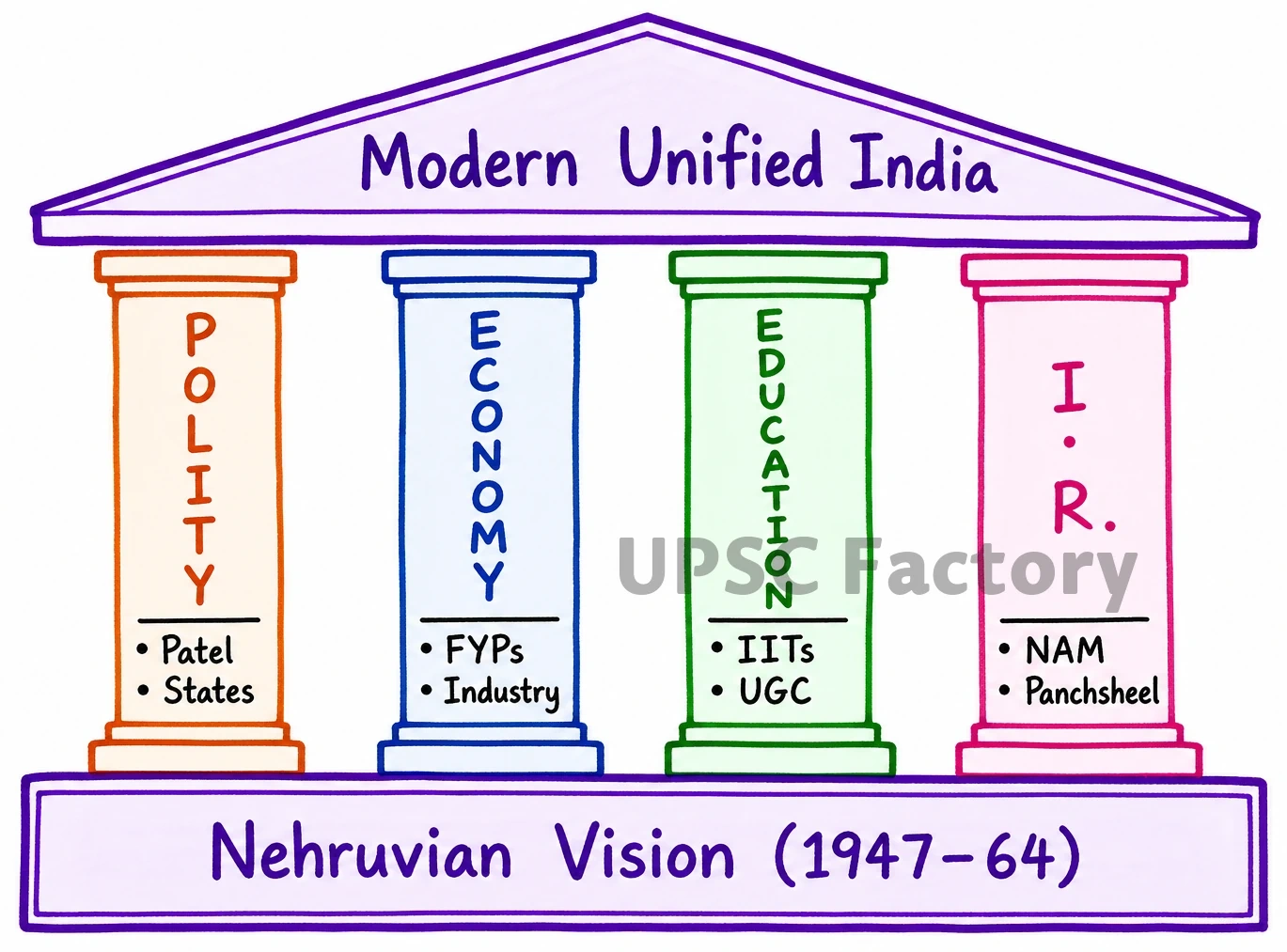
The early post-independence era (1947–1964) witnessed foundational nation-building under the Nehruvian vision, transforming a fragmented, impoverished colony into a resilient, unified democratic republic.
1. Political Consolidation
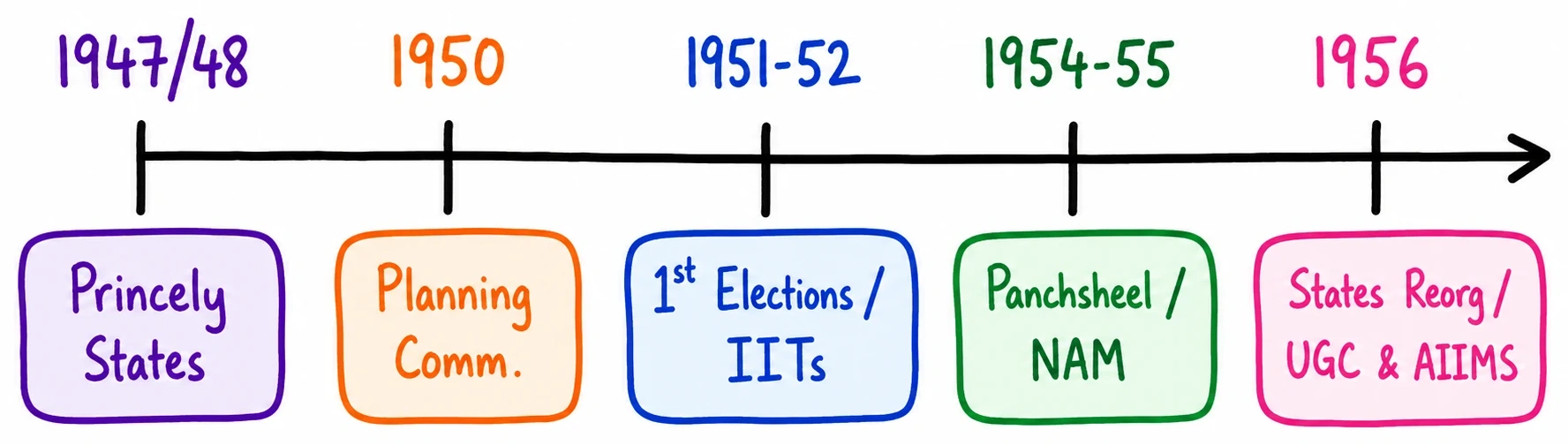
- Territorial Integration: Sardar Patel’s astute diplomacy successfully assimilated 562 princely states into the Indian Union (Instrument of Accession, Operation Polo).
- Linguistic Reorganization: Mitigated sub-nationalist chauvinism while preserving federal unity and administrative efficiency (States Reorganization Act 1956, Fazl Ali Commission).
- Democratic Institutionalization: Enacted a sovereign Constitution and conducted the world’s largest democratic exercise (Article 1: Union of States, 1951-52 General Elections).
2. Economic Consolidation
- Planned Development: Instituted a mixed economy framework driven by state-led resource allocation (Planning Commission 1950, First Five-Year Plan).
- Industrial Base: Rapid industrialization emphasizing heavy industries and capital goods via the Mahalanobis Model (Second Plan, Bhilai/Durgapur steel plants).
- Agrarian Reforms: Targeted rural poverty through land tenure restructuring and grassroots initiatives (Zamindari Abolition, Community Development Programme 1952).
3. Educational & International Foundations
Educational Infrastructure
- Higher Education & Technical Skill: Established premier institutes to foster scientific temper and human capital (IIT Kharagpur 1951, AIIMS 1956).
- Institutional Funding: Created apex statutory bodies to standardize and finance tertiary education (Radhakrishnan Commission 1948, UGC Act 1956).
- Scientific Research: Built a robust institutional ecosystem for strategic research (CSIR, Atomic Energy Commission 1948, INCOSPAR 1962).
International Relations
- Strategic Autonomy: Spearheaded the Non-Aligned Movement (NAM) to avoid Cold War bipolarity and retain sovereign decision-making (Bandung Conference 1955).
- Peaceful Coexistence: Championed regional diplomacy based on mutual respect for sovereignty and non-interference (Panchsheel Agreement 1954).
- Multilateralism: Actively advocated for anti-colonialism, anti-apartheid, and robust UN peacekeeping engagement (Korea, Congo missions).
These foundational pillars successfully integrated a highly diverse populace, establishing a robust socio-economic, political, and diplomatic bedrock for modern India’s contemporary global ascent.