Model Answer:
Carbon Capture, Utilization, and Storage (CCUS) is a technological suite designed to mitigate climate change by extracting CO2 from emission sources or the atmosphere for recycling or permanent storage.
1. Components of CCUS
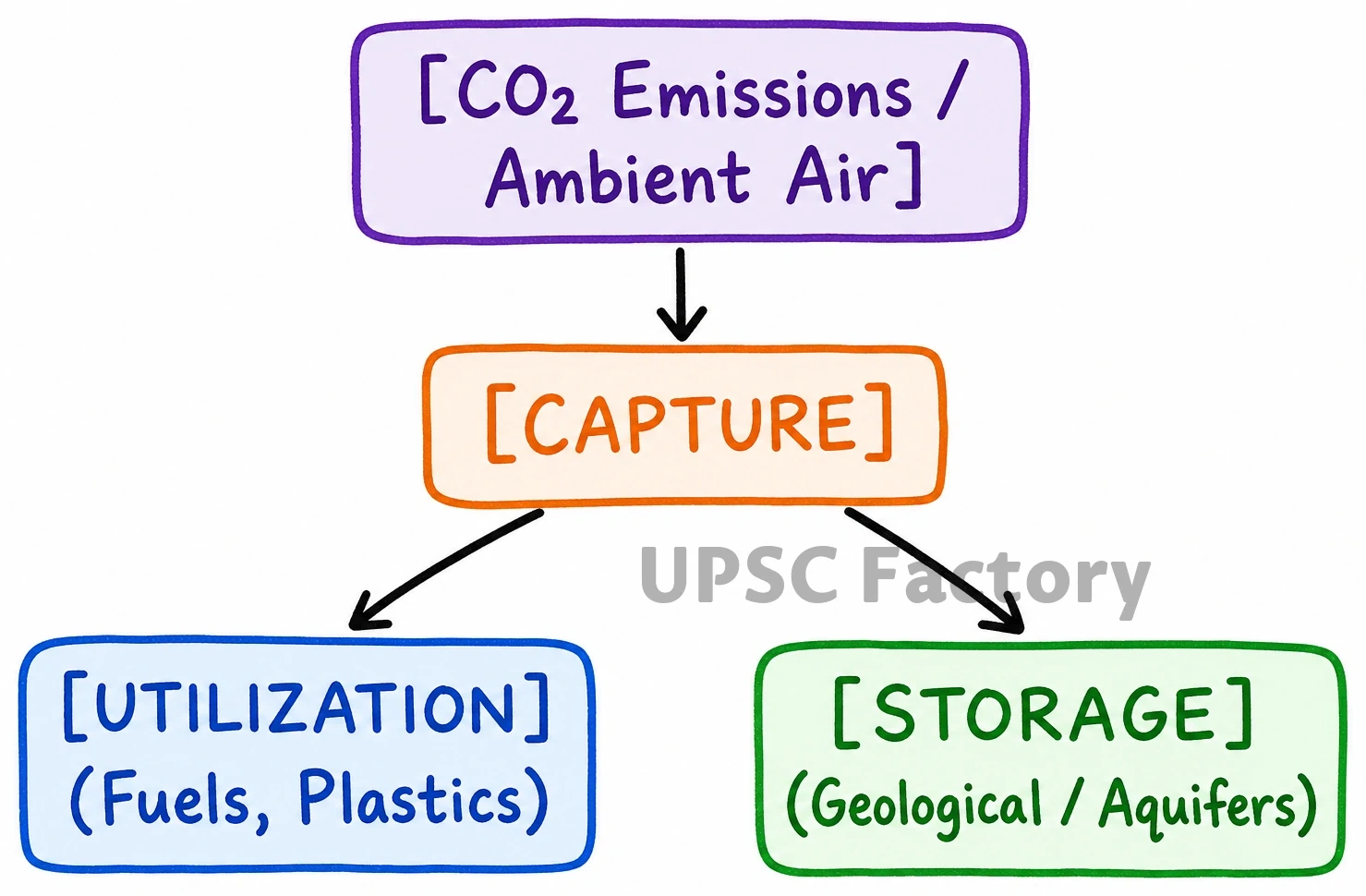
- Capture: Separating CO2 from industrial flue gases or ambient air (Direct Air Capture).
- Utilization: Converting captured CO2 into viable commercial products (synthetic fuels, plastics, building materials).
- Storage: Injecting compressed CO2 into deep geological formations for permanent isolation (Sleipner project, Norway).
2. Role in Tackling Climate Change
- Hard-to-Abate Sectors: Decarbonizes heavy industries where complete electrification is unfeasible (steel, cement, fertilizers).
- Net-Zero Commitments: Vital for limiting warming to 1.5°C (IPCC AR6) and achieving India’s Panchamrit 2070 goal.
- Circular Carbon Economy: Transforms CO2 from a hazardous greenhouse gas into a valuable industrial feedstock.
- Negative Emissions: Pairs with bioenergy (BECCS) to actively extract historical carbon from the biosphere.
Scaling CCUS through strategic R&D—like India’s National Centres of Excellence (IIT-Bombay)—is critical to bridging the gap between fossil-fuel reliance and absolute global decarbonization.