Model Answer:
Launched via LVM3-M4, Chandrayaan-3 represents India’s triumphant milestone in lunar exploration, successfully cementing the nation’s indigenous engineering capabilities in deep-space missions.
Main Task & Successful Nations
- The Unachieved Task: The primary objective was to execute a safe, soft landing on the lunar surface and demonstrate rover mobility. Its predecessor, Chandrayaan-2, failed at this specific phase due to a software glitch leading to a hard crash.
- Successful Nations: Prior to India, only three countries achieved a lunar soft landing: the USA, USSR (Russia), and China. (India became the fourth, and the first globally to land near the rugged Lunar South Pole).
Subsystems of the Spacecraft
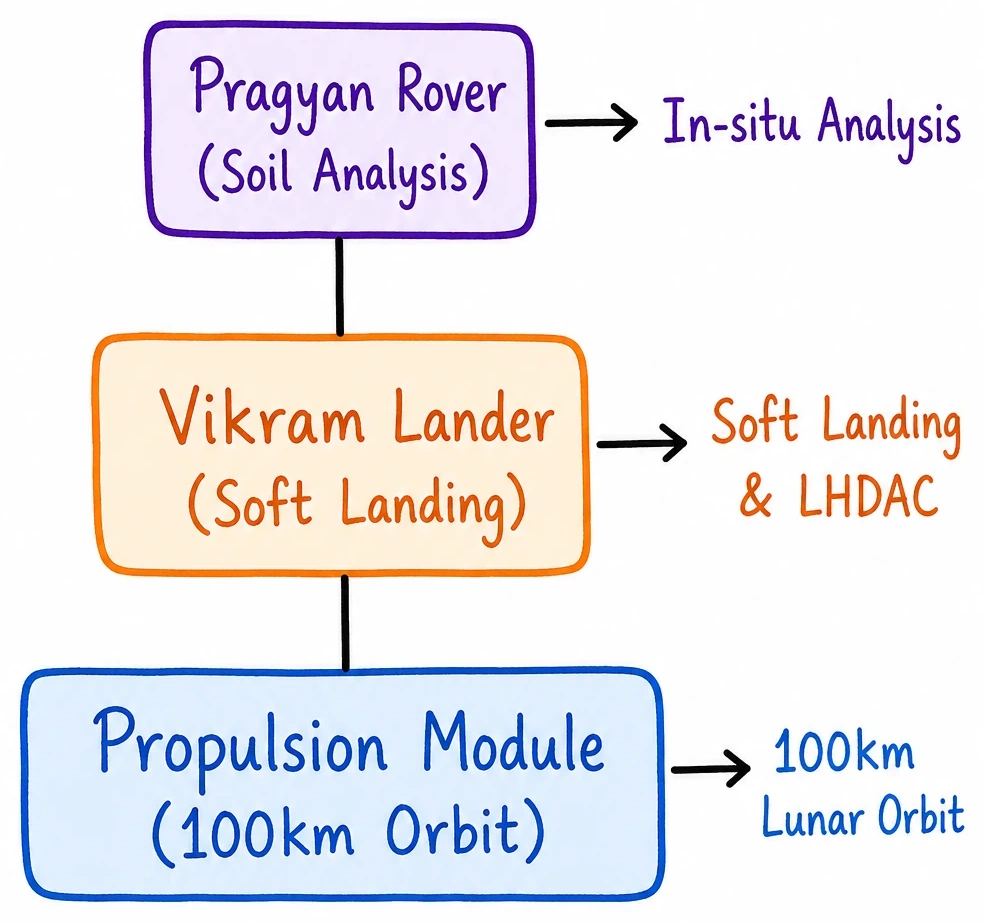
The mission was an integrated configuration of three distinct indigenous modules:
- Propulsion Module (PM): Ferried the lander-rover configuration to a 100 km lunar orbit. It uniquely carried the SHAPE payload to study Earth’s spectro-polarimetric signatures.
- Lander Module (Vikram): Specifically designed for the autonomous soft landing. Upgraded with enhanced legs, redundant sensors, and the critical Lander Hazard Detection and Avoidance Camera (LHDAC).
- Rover (Pragyan): A 6-wheeled robotic vehicle deployed to conduct in-situ chemical and elemental analysis of lunar soil (using APXS and LIBS payloads).
Role of Virtual Launch Control Centre (VLCC)
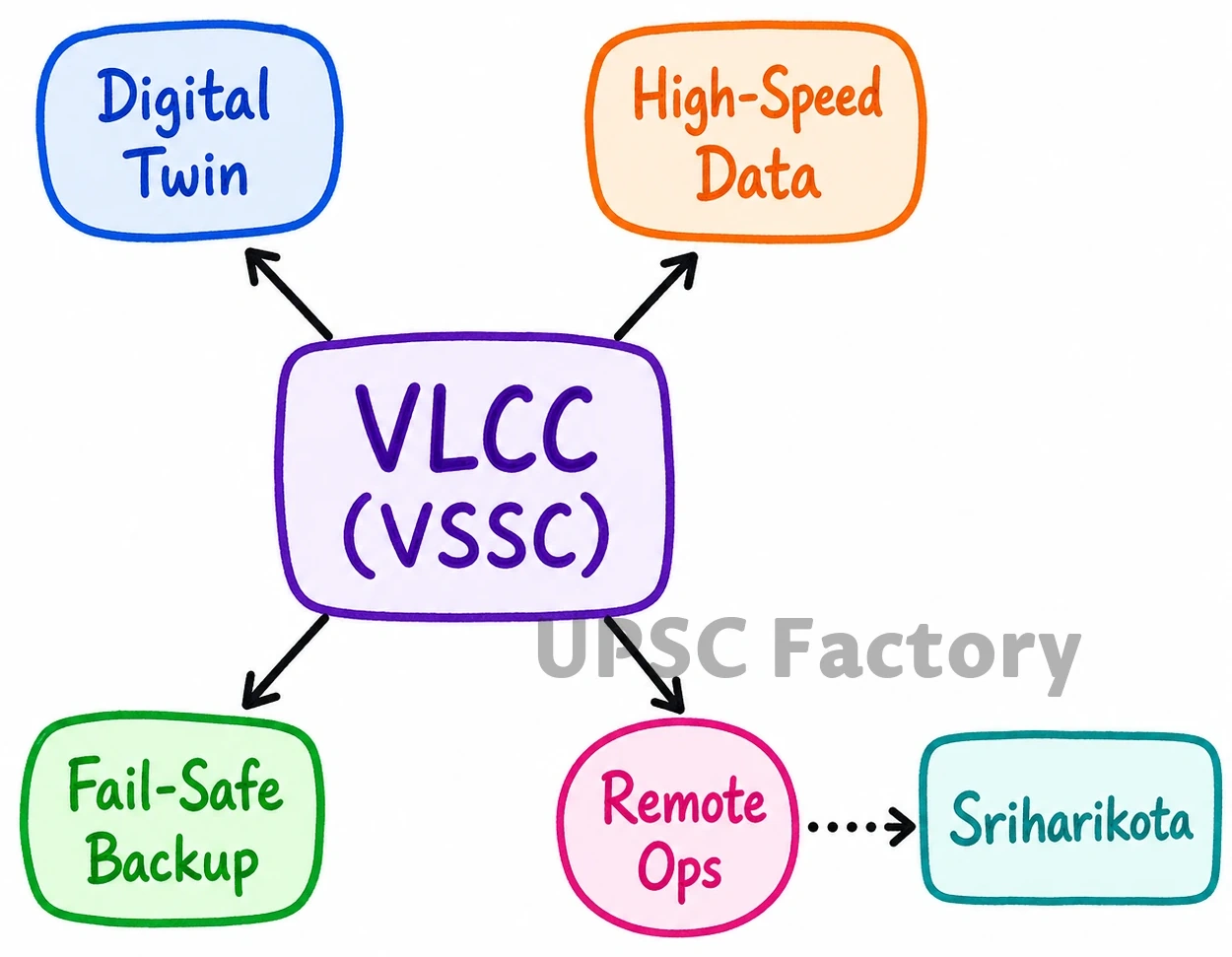
Located at VSSC (Thiruvananthapuram), the VLCC revolutionized the launch process from Sriharikota:
- Remote Operations: Enabled senior scientists to perform system checkouts, monitor telemetry, and authorize launch sequences digitally, minimizing physical footprint at the launchpad.
- Digital Twin Simulation: Provided real-time virtual simulations of the launch vehicle to predict subsystem behaviors and mitigate risks dynamically.
- High-Speed Data Processing: Processed massive pre-launch data arrays instantly for flawless system monitoring and immediate anomaly detection.
- Mission Redundancy: Functioned as a robust, fail-safe backup command center, ensuring uninterrupted launch protocols.
Chandrayaan-3’s success (immortalized at the Shiv Shakti Point) marks a paradigm shift in India’s space ecosystem, proving the efficacy of indigenous systems and setting the stage for Gaganyaan and ISRO’s future interplanetary endeavors.