Model Answer:
Attitude is a learned psychological tendency expressed by evaluating a particular entity with favor or disfavor. It acts as the foundational blueprint shaping human character and destiny.
Attitude as an Input in Human Development
Through the CAB (Cognitive, Affective, Behavioural) model, attitude shapes holistic development:
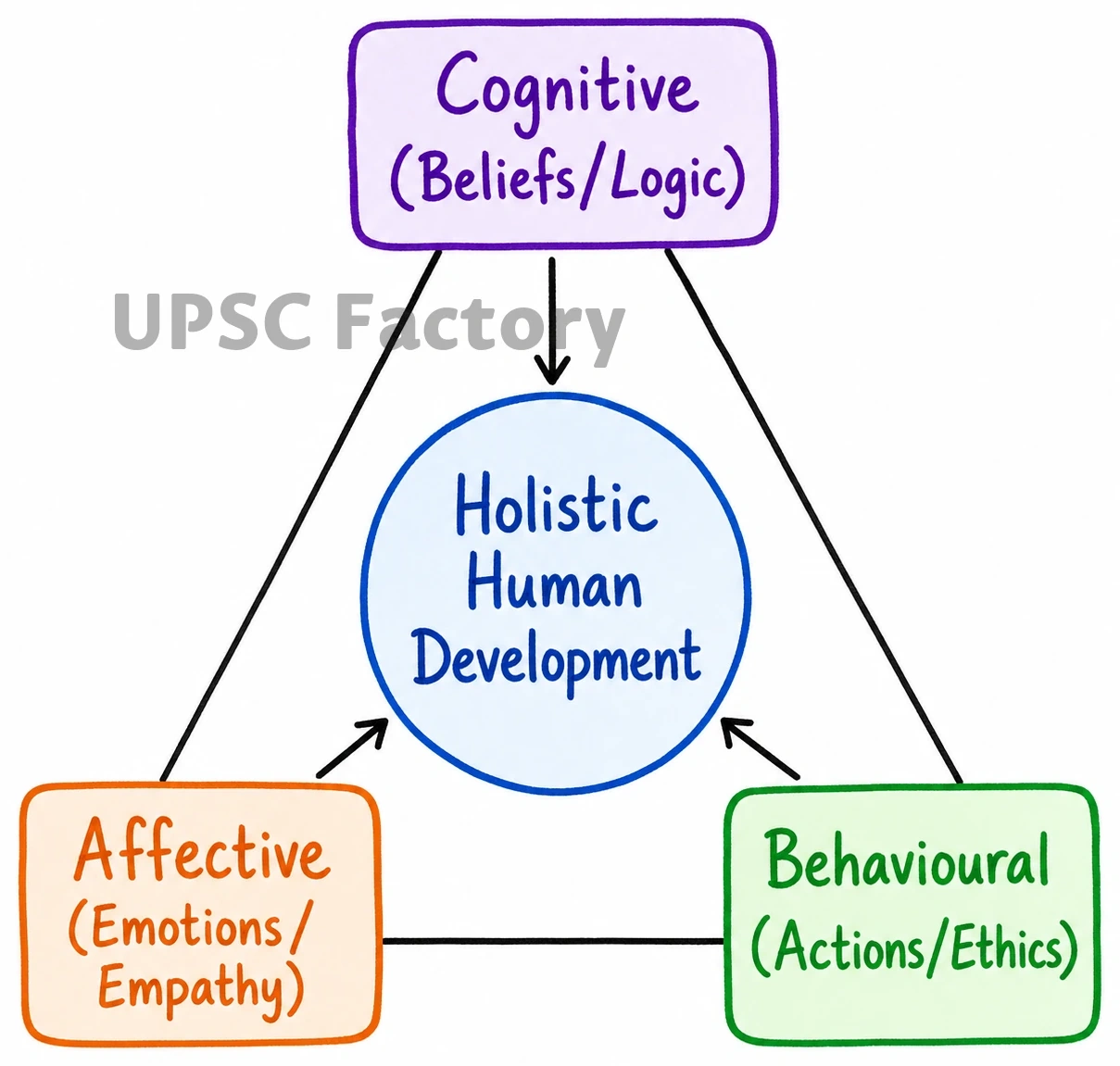
- Cognitive (Thoughts): Shapes objective worldview, rational beliefs, and moral reasoning.
- Affective (Emotions): Cultivates emotional intelligence, compassion, and resilience.
- Behavioural (Actions): Translates inner values into concrete ethical actions (Armstrong Pame’s compassionate crowdfunded road).
Strategies to Build Suitable Attitude in Public Servants
Building a democratic, citizen-centric attitude requires sustained interventions:
- Institutional Training: Shifting from ‘rule-based’ to ‘role-based’ continuous capacity building (Mission Karmayogi).
- Role Modelling: Emulating exemplary leadership, neutrality, and fearless integrity (T.N. Seshan’s electoral reforms).
- Value Socialization: Embedding core public life values (Nolan Committee Principles) systematically during probation and foundation courses.
- Experiential Learning: Mandatory grassroots village immersions (Bharat Darshan) to cultivate deep empathy for marginalized sections.
- Behavioural Reinforcement: Utilizing 360-degree performance appraisals and reward-punishment mechanisms to deter apathy and reinforce proactive public service.
- Persuasion & Nudge: Using cognitive dissonance to break bureaucratic inertia and bureaucratic elitism.
Cultivating a progressive, empathetic attitude is vital to transform civil servants from mere rule-bound administrators into true ‘Karmayogis’ driving inclusive, citizen-centric national development.