Model Answer:
Indian federalism is evolving towards a “cooperative-competitive” model, though recent financial, legislative, and administrative shifts have triggered significant Centre-State trust deficits.
Recent Changes in Centre-State Relations
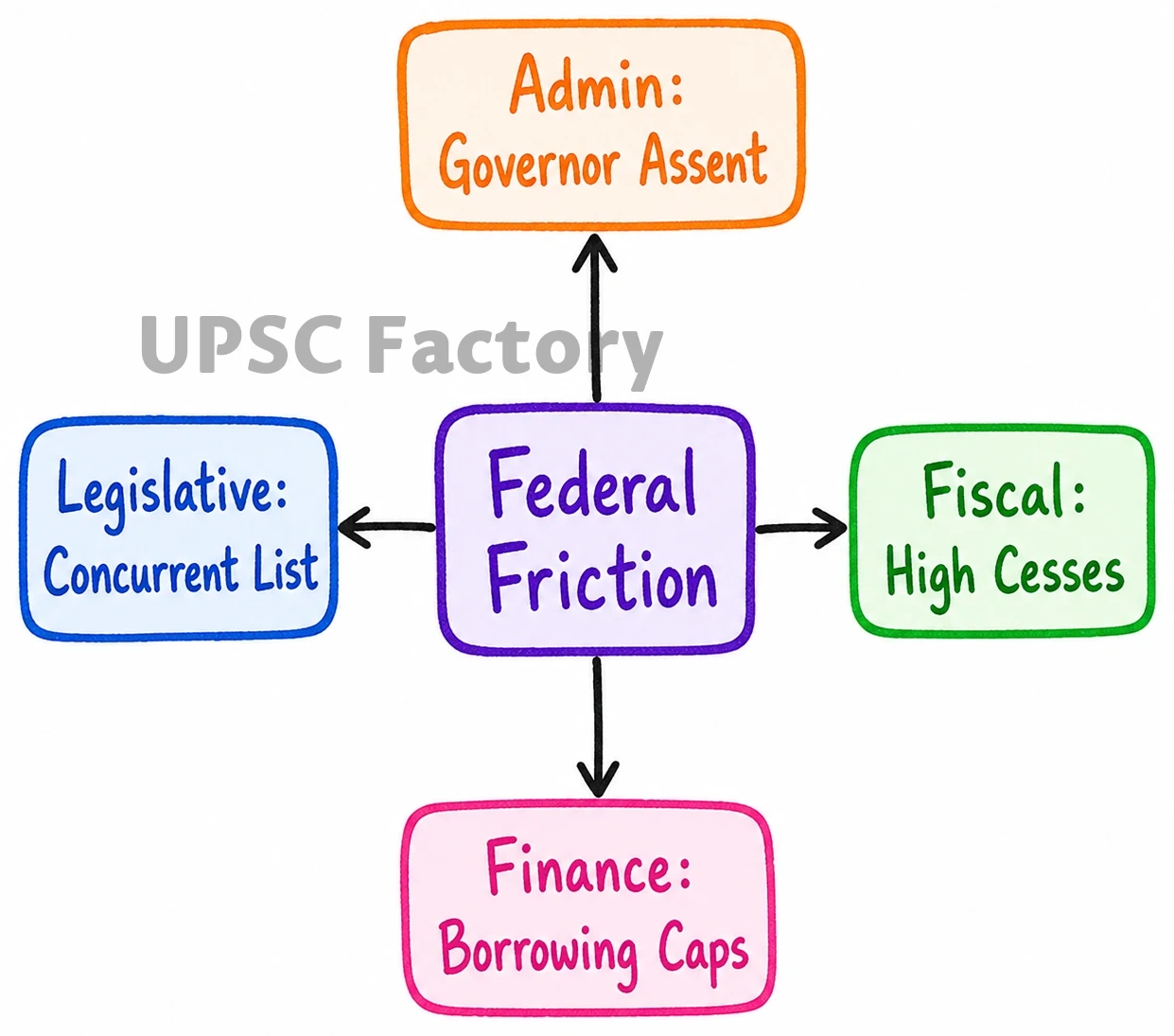
- Fiscal Centralization: Rising cesses and surcharges bypass the divisible tax pool, shrinking States’ net revenue share (currently ~20% of gross tax revenue).
- Borrowing Restrictions: Stricter enforcement of Net Borrowing Ceilings (Article 293) limiting State off-budget borrowings (Kerala’s recent Supreme Court petition).
- Legislative Dominance: Unilateral Central legislations on Concurrent/State subjects with minimal prior State consultation (GNCTD Amendment Act 2023, Farm Laws).
- Tied Fiscal Transfers: Increased reliance on Centrally Sponsored Schemes (CSS) via Article 282 grants, severely reducing States’ discretionary fiscal space.
- Administrative Friction: Escalating delays in gubernatorial assent to State Bills (Punjab, Tamil Nadu) and contentious deployment of central investigative agencies.
Measures to Build Trust and Strengthen Federalism
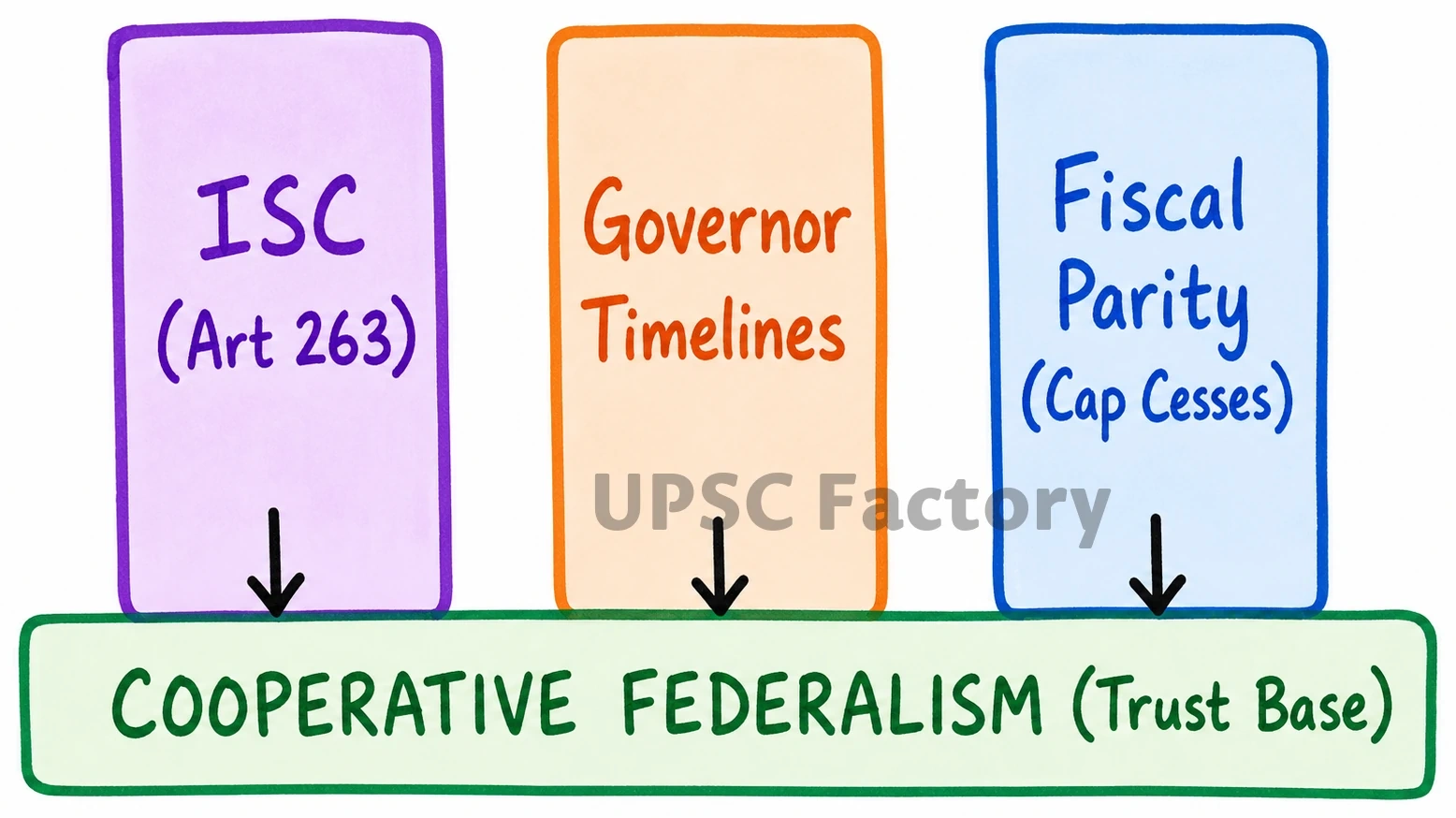
- Revitalize Inter-State Council: Mandate regular dialogues (Article 263) for binding pre-legislative consultation on Concurrent List subjects (Sarkaria Commission).
- Fiscal Parity: Introduce statutory caps on cesses and surcharges to protect the 16th Finance Commission’s divisible tax pool (Punchhi Commission).
- Governor’s Accountability: Establish strict constitutional timelines for Governors to either grant assent or reserve State Bills to prevent policy paralysis.
- Flexible Devolution: Rationalize and consolidate CSS mechanisms, replacing rigid schemes with untied block grants tailored to specific state-level needs.
- Proactive Mediation: Empower Zonal Councils to mediate regional and administrative disputes politically, minimizing reliance on judicial litigation (Article 131).
Strengthening cooperative federalism through institutionalized dialogue and fiscal equity is not just a constitutional mandate, but a prerequisite for realizing a decentralized, resilient, and developed India by 2047.