Model Answer:
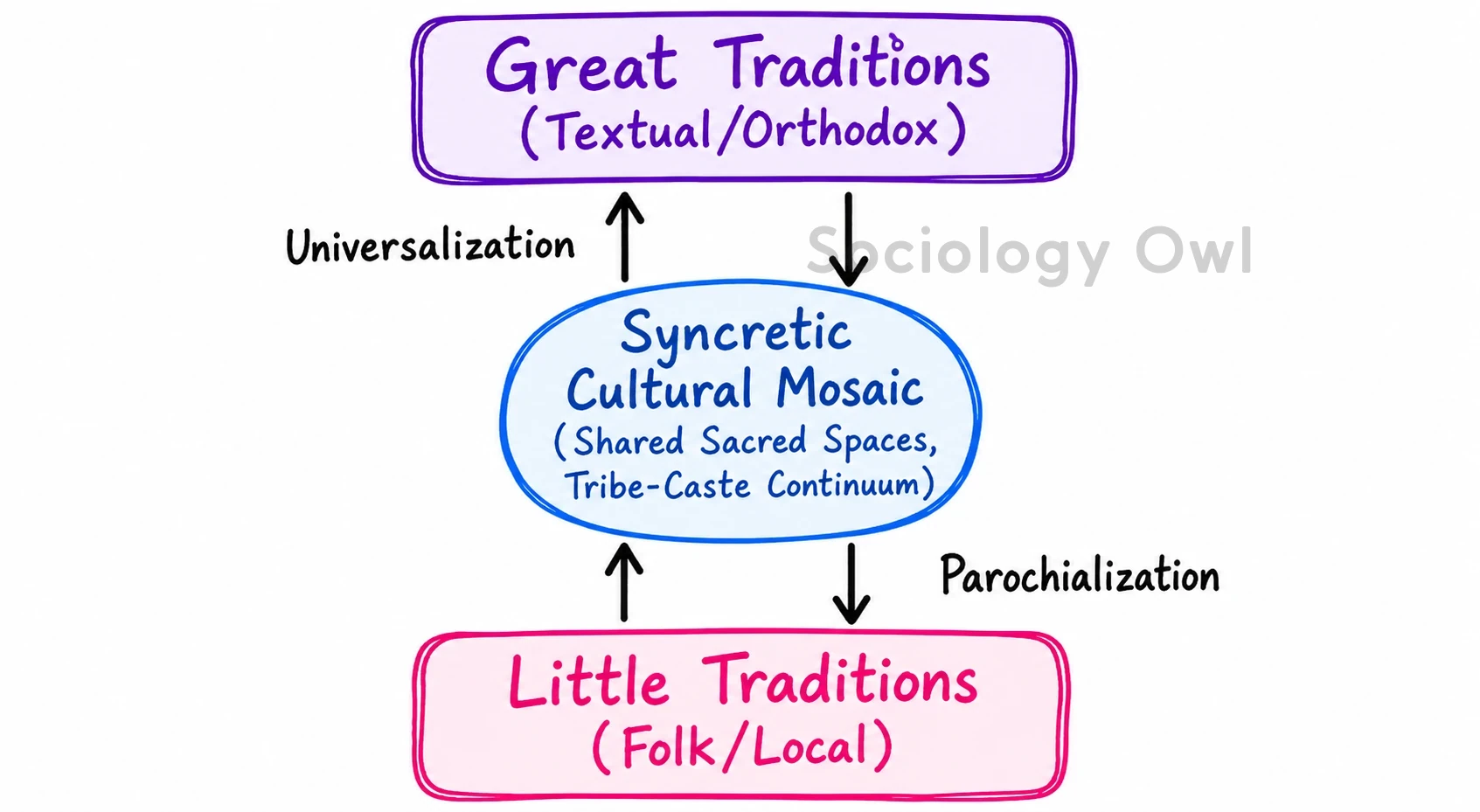
Sociologically, India’s religious communities foster cultural diversity by localizing text-based “Great Traditions” into diverse, folk-based “Little Traditions” (Milton Singer and Robert Redfield). While G.S. Ghurye emphasized the assimilative unity of Hinduism, this pluralistic landscape is a dynamic mosaic of distinct religious identities, socio-cultural negotiations, and shared practices.
Dimensions of Religious and Cultural Diversity
- Syncretism and Shared Spaces: T.N. Madan highlights how blended traditions enrich cultural expressions. S.C. Dube observed this in the Meo Muslims (blending Islamic and Rajput customs), while Susan Bayly notes that shared sacred spaces like Dargahs act as cultural melting pots.
- Sacred Geography: L.P. Vidyarthi’s concept of the “Sacred Complex” demonstrates how pilgrimage centers integrate linguistically and regionally diverse communities, acting as dynamic vehicles for cultural exchange.
- Tribal Pluralism: Tribal animism adds ecological and egalitarian dimensions to India’s culture. Surajit Sinha’s Tribe-Caste Continuum explains the continuous cultural negotiation between indigenous faiths and mainstream religions.
- Material Culture and Boundaries: Food and dress act as cultural markers. Utilizing Emile Durkheim’s perspective on symbols, attire maintains religious boundaries, while dietary laws dictate Commensality, simultaneously driving structural interdependence.
- Modernization: As Yogendra Singh argues, traditions adapt to modernity. Milton Singer’s “Compartmentalization” explains how communities maintain diverse traditional rituals at home while adopting uniform secular practices in modern workspaces.
Critique and Homogenization Threats
This diversity faces structural challenges from political homogenization. Ashis Nandy distinguishes between religion as faith (which is inherently plural and syncretic) and religion as ideology (which promotes homogenization and communalism, threatening cultural diversity).
The ongoing demand by tribal communities in Jharkhand and Odisha for a separate “Sarna Religious Code” in the Census exemplifies contemporary struggles to assert and preserve unique cultural-religious identities against mainstream assimilation.
Conclusion
India’s religious communities inherently provide the sociological foundation for cultural diversity. However, as Andre Beteille suggests, it is the modern constitutional framework of secularism and minority rights that institutionally protects and sustains this dynamic, pluralistic society today.