Model Answer:
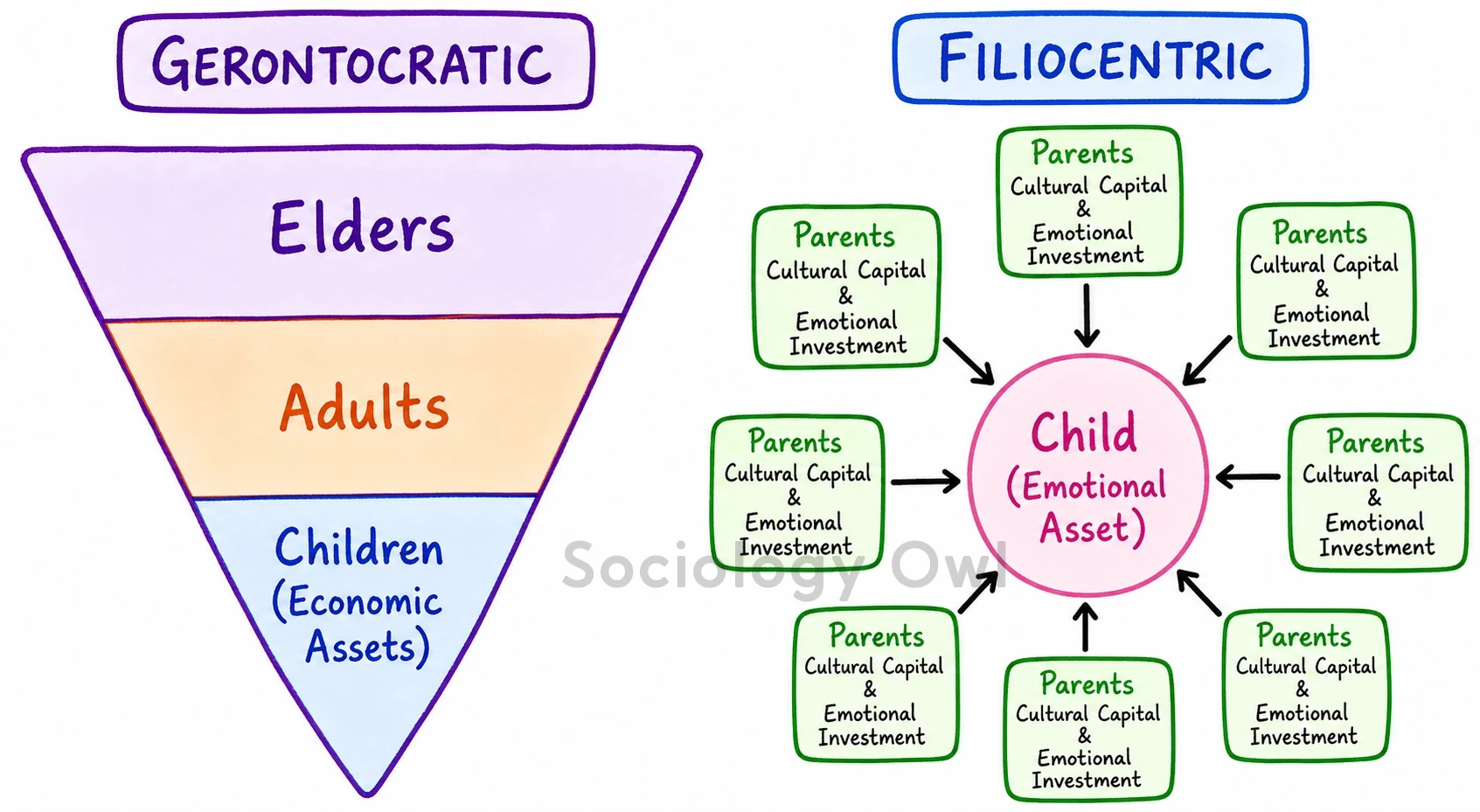
Modern families are transitioning from gerontocratic (elder-dominated) extended units to neo-local (independent households) and nuclear structures. Concurrently, they have become filiocentric—placing children at the center of the family’s power dynamics and emotional economy, prioritizing their development over adult leisure.
Sociological Drivers of Filiocentrism
Industrialization & Demography: William J. Goode (World Revolution and Family Patterns) argued industrial capitalism demands a mobile, neo-local nuclear family. Consequent lower fertility rates allow parents to concentrate vast resources into fewer children.
Evolution of Childhood: Philippe Ariès (Centuries of Childhood) highlighted that modernity transformed childhood from a phase of miniature adulthood into a distinct, protected stage requiring intense adult supervision.
Class Reproduction: Through a conflict lens, Pierre Bourdieu argues modern parents heavily invest in children’s education and extracurriculars to accumulate cultural capital, securing their child’s future class status in a hyper-competitive capitalist economy.
Emotional Anchoring: While Talcott Parsons emphasized the family’s functional role in emotional stabilization, Ulrich Beck and Elisabeth Beck-Gernsheim (The Normal Chaos of Love) argue that amid high divorce rates and fragile adult relationships in late modernity, “the child is the final anchor” for unconditional emotional stability.
Critical Analysis and Context
Class Disparities: Annette Lareau contrasts middle-class “concerted cultivation” (intense, child-centric scheduling) with working-class “accomplishment of natural growth,” demonstrating that intense filiocentrism is largely an upper/middle-class privilege.
Psychological Toll: Extreme focus breeds “Helicopter Parenting”, which places immense performance pressure on children while contributing to the institutionalization of childhood.
China’s “Little Emperor Syndrome,” born from the One-Child Policy intersecting with neo-local urbanization, exemplifies extreme global filiocentrism where the entire household’s consumption and goals revolve entirely around a single child.
Conclusion
While the shift towards neo-local and filiocentric families reflects the adaptive capacity of kinship to late modernity, it profoundly transforms children from traditional economic assets into highly precious emotional assets, introducing unprecedented care alongside modern anxieties.