Model Answer:
Digital technology acts as a social equalizer, enhancing individual agency and inclusion by eliminating structural information asymmetries (Faheema Shirin case: Internet access under Article 21).
Digital Technology as an Instrument of Empowerment
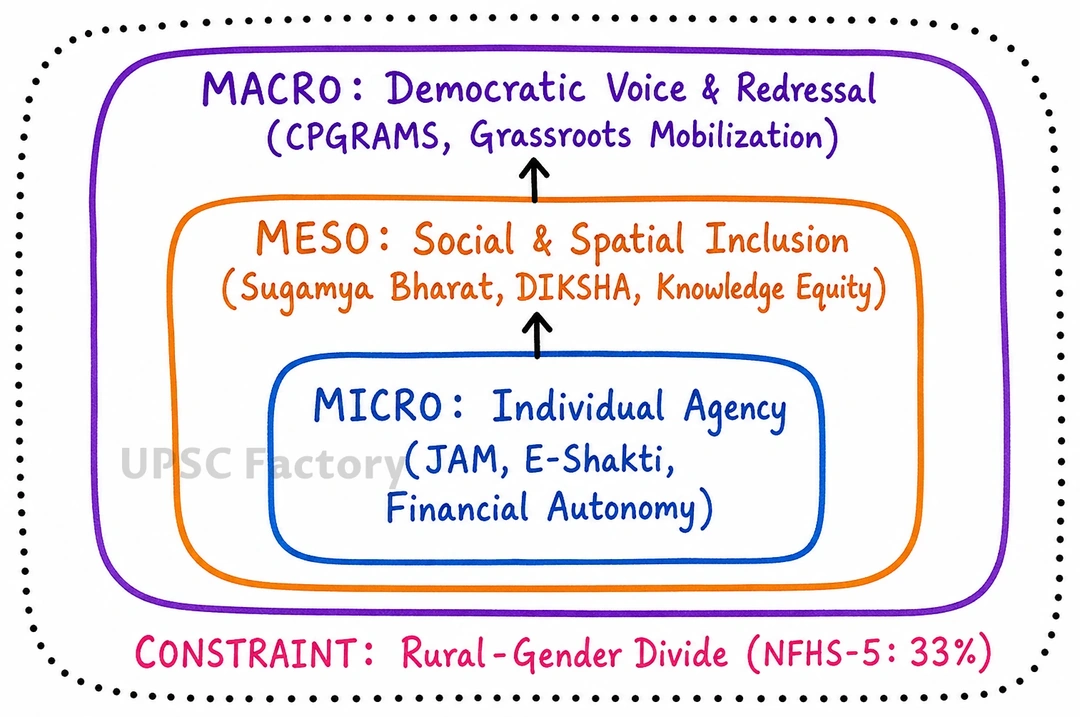
- Financial & Gender Autonomy: Digitized welfare and microfinance eliminate intermediaries, strengthening female economic self-reliance (JAM Trinity, NABARD’s E-Shakti).
- Disability & Spatial Inclusion: Assistive digital platforms and accessible interfaces break physical and institutional barriers (Sugamya Bharat App, screen-reading tools).
- Democratic Voice & Redressal: Decentralized networks facilitate grassroots mobilization and transparent citizen grievance redressal (CPGRAMS, digital civil rights campaigns).
- Democratization of Knowledge: Open-source platforms bridge rural-urban educational divides for marginalized youth (DIKSHA, PM e-VIDYA).
Fault Lines Limiting Equitable Empowerment
- Gender & Rural Divide: Deep-rooted socio-cultural barriers restrict device ownership and digital literacy (NFHS-5: only 33% rural women accessed internet).
- Technological Exclusion: Biometric authentication glitches and algorithmic biases risk disenfranchising vulnerable welfare beneficiaries (PDS identity mismatch issues).
- Safety & Online Harassment: Rising cyber-crimes and targeted abuse disproportionately restrict women’s free digital participation (NCRB cybercrime data).
True social empowerment requires bridging the digital divide by pairing universal connectivity (BharatNet) with community-level digital literacy (PMGDISHA).