Model Answer:
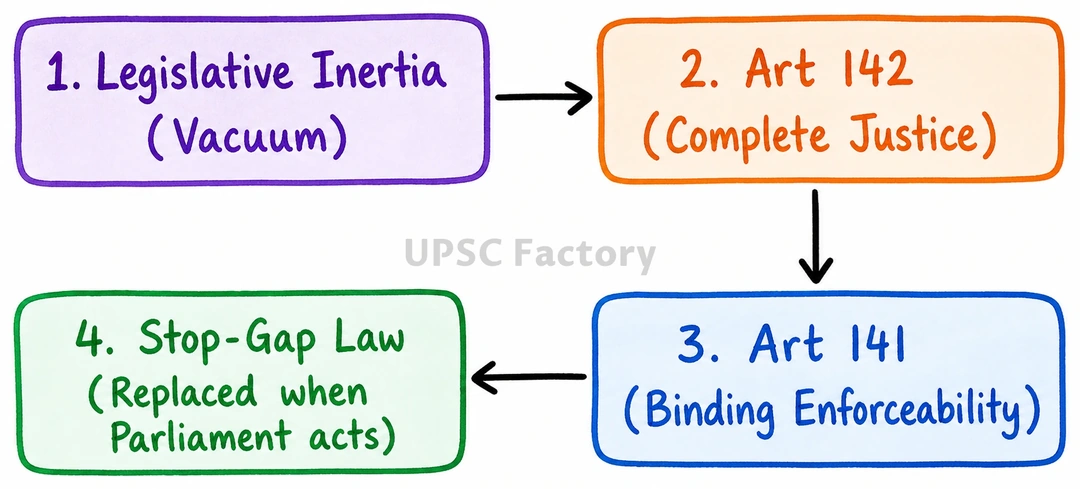
Judicial legislation refers to the judiciary laying down binding rules, procedures, and norms to fill legislative voids, exercising powers under Articles 141 and 142 (e.g., Vishaka Guidelines).
1. Concept and Dimensions of Judicial Legislation
- Constitutional Basis: Invoked under Article 142 (complete justice) to enforce fundamental rights when statutes are silent.
- Normative Lawmaking: Creates enforceable obligations equivalent to statutory law under Article 141 until Parliament legislates (e.g., D.K. Basu guidelines).
- Triggered by Inaction: Operates as a constitutional stop-gap against legislative inertia on complex socio-legal questions.
- Separation of Powers Tension: Stretches judicial review into the legislative domain, risking judicial overreach if unconstrained.
2. SC Verdicts on Passive Euthanasia and Living Wills as Judicial Lawmaking
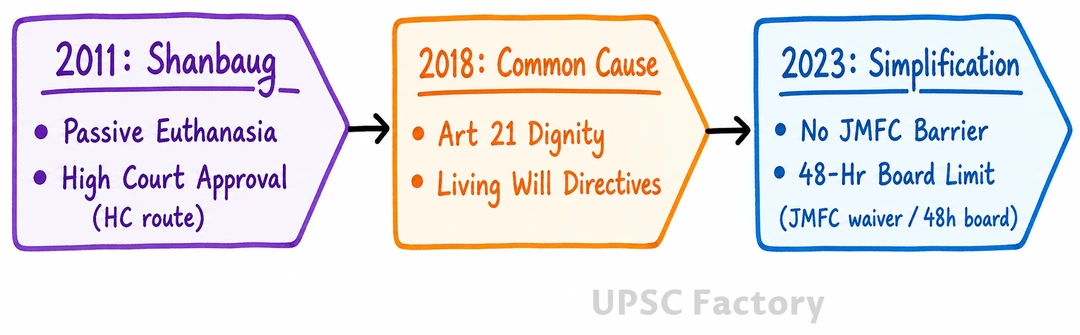
- Aruna Shanbaug Case (2011):
- Legalized passive euthanasia (withholding life support) for terminally ill patients in Permanent Vegetative State (PVS).
- Formulated mandatory interim guidelines requiring High Court approval, bridging the complete statutory vacuum.
- Common Cause v. UOI (2018):
- Held the “right to die with dignity” as an intrinsic facet of the Right to Life (Article 21).
- Legally sanctioned Advance Medical Directives (Living Wills) to preserve patient autonomy.
- Prescribed detailed administrative mechanisms, including execution protocols and multi-tier Medical Boards (Hospital and Collector-level).
- Simplification Order (2023):
- Acted as an iterative regulator by streamlining cumbersome 2018 procedures (e.g., removing Judicial Magistrate attestation; setting strict 48-hour board timelines).
- Policy Substitution: Directly filled the vacuum left by the unenacted Management of Patients with Terminal Illness Bill.
While judicial legislation protects constitutional freedoms amidst legislative inertia, Parliament must proactively enact a comprehensive end-of-life care law to restore structural separation of powers.