Model Answer:
The capitalist mode of production (CMP) refers to a socio-economic system driven by private ownership of the means of production, generalized commodity exchange, and the extraction of surplus value from wage labor.
Structural and Institutional Transformations
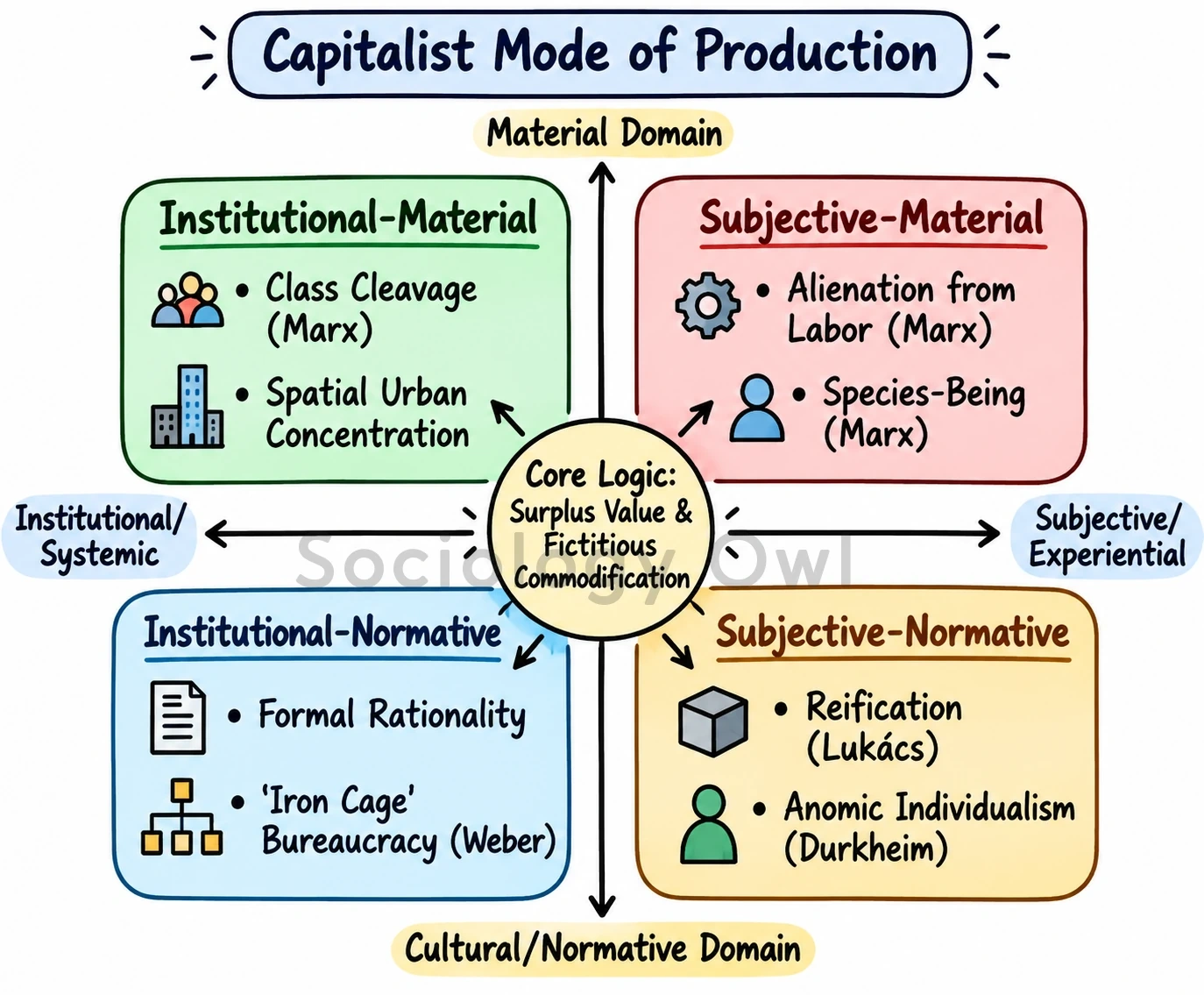
- Class Polarization and Stratification: Karl Marx argued that CMP simplifies complex stratification into two antagonistic classes—the bourgeoisie and the proletariat—widening wealth inequality through systematic capital accumulation.
- Commodification of Social Life: As Karl Polanyi demonstrated in The Great Transformation, capitalism turns land, labor, and money into fictitious commodities, dis-embedding economic transactions from traditional kinship and moral ties.
- Restructuring of Family and Gender: Friedrich Engels in The Origin of the Family, Private Property and the State highlighted how industrial capitalism separated home from workplace, privatized domestic labor, and consolidated patriarchal property inheritance.
- Bureaucratization and Formal Rationality: Max Weber showed that capitalist expansion demands predictable, calculable administration, driving pervasive rationalization and trapping modern society within a bureaucratic iron cage.
- Spatial Reorganization and Urbanization: CMP dismantled agrarian communities, creating dense, segregated industrial metropolises designed around logistics, labor concentration, and capital circulation.
Psycho-Social and Cultural Consequences
- Pervasive Alienation (Entfremdung): Under wage labor, workers experience profound estrangement from the product, the act of production, fellow human beings, and their intrinsic creative potential or species-being.
- Reification and Commodity Fetishism: Georg Lukács observed that market logic objectifies social reality, making human social relationships appear as immutable, natural relations between things.
- Erosion of Collective Solidarity: The shift toward hyper-individualistic, instrumental relations dissolves community integration, precipitating what Émile Durkheim categorized as anomic strain.
- Manufactured Consciousness and Consumerism: Critical theorists like Theodor Adorno noted that late capitalism deploys a culture industry to commodify art and leisure, neutralizing political dissent through pacifying consumer desires.
The capitalist mode of production fundamentally restructured human society, liberating productive capacities while systematically commodifying social relations, labor, and human consciousness.