Model Answer:
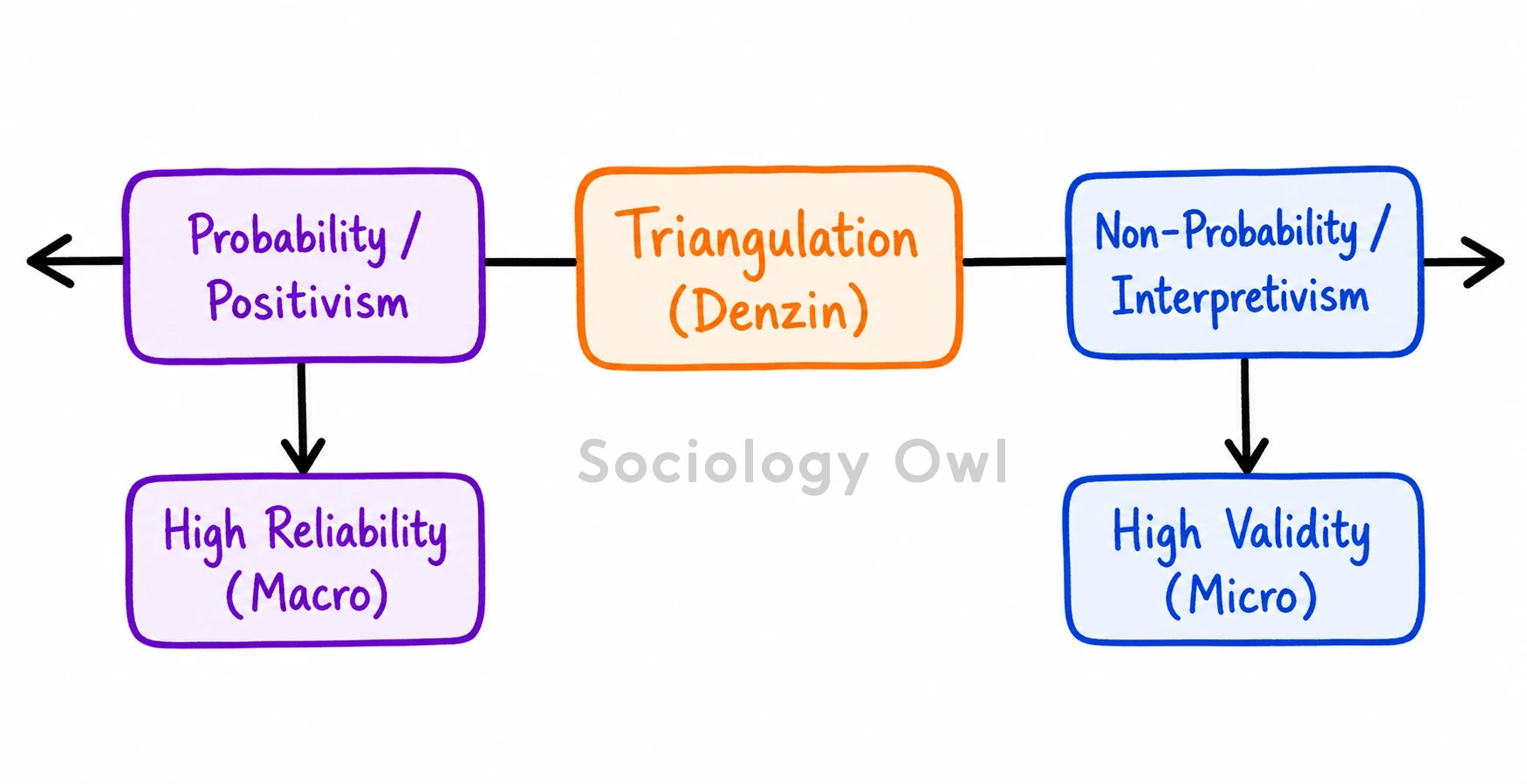
Non-probability sampling selects participants without equal selection chances. While Positivists favor probability sampling for macro-level Reliability, Interpretivists (following Max Weber’s Verstehen) and Phenomenologists utilize non-probability methods to achieve deep subjective understanding and high Validity of micro-level social realities.
Types and Conditions of Non-Probability Sampling
- Snowball Sampling: Essential for studying “hidden” or deviant populations lacking a sampling frame. Howard Becker utilized this in Becoming a Marihuana User, asking initial contacts to refer others to study a deviant subculture.
- Purposive (Judgmental) Sampling: Applied when specific participant characteristics are vital. William Foote Whyte in Street Corner Society purposefully selected “Doc” as a key informant to access the Italian-American slum’s social dynamics.
- Quota Sampling: Aims for proportional representation across categories without random selection. Early researchers like Charles Booth used structured approaches resembling this to study London poverty. Modern sociologists use it to study Intersectionality (e.g., quotas for Dalit women and upper-caste men).
- Convenience Sampling: Used under resource constraints for easily accessible subjects, such as a sociologist surveying students on a campus about gig-economy participation.
- Self-Selection Sampling: Volunteers participate based on an invitation. Feminist and Conflict theorists often use this to study sensitive, marginalized experiences (e.g., domestic abuse survivors) missed by macro-census data.
Methodological Debate: Reliability vs. Validity
Positivists critique non-probability methods for researcher bias and an inability to generate macro-sociological generalizations (Reliability). Conversely, Interpretivists argue these methods provide unparalleled Ecological Validity, capturing authentic, nuanced reflections of real-world settings.
Today, non-probability sampling is crucial for researching structurally invisible populations. For example, studying LGBTQ+ individuals in conservative societies or tracking the informal networks of undocumented manual scavengers heavily relies on purposive and snowball techniques.
Conclusion
Modern sociology recognizes the trade-offs of standalone methodologies. To balance statistical breadth with deep subjective insight, sociologists increasingly rely on Methodological Pluralism and Triangulation (championed by Norman Denzin), blending probability and non-probability techniques for holistic social research.