UPSC Mains 2025 GS4 Model Answer

Q. “The strength of a society is not in its laws, but in the morality of its people.” – Swami Vivekananda

Q. “The strength of a society is not in its laws, but in the morality of its people.” – Swami Vivekananda

UPSC Mains 2025 GS4 Paper

Model Answer:

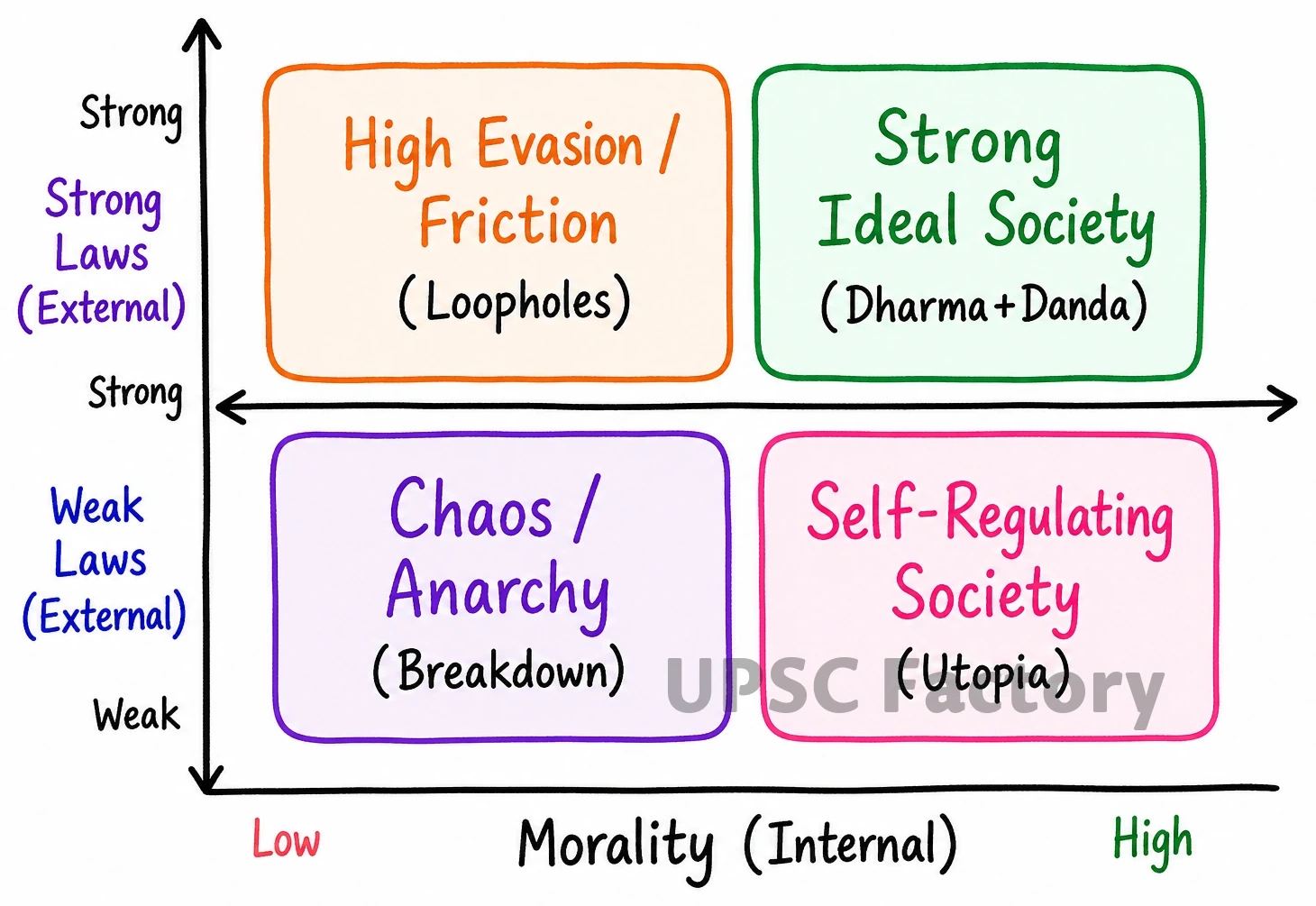
Swami Vivekananda emphasizes that while laws provide external regulation, true societal resilience fundamentally relies on the internal moral compass of its citizens.

1. Limitations of Laws Devoid of Morality

  • Lack of Internal Deterrence: External coercion fails without intrinsic ethics; citizens actively exploit systemic loopholes.
  • Social Acceptance Gap: Progressive legislation remains ineffective without grassroots cultural backing (e.g., widespread violations of the Dowry Prohibition Act, 1961).
  • Governance Burden: Enforcing behavior solely through policing drains state resources (e.g., rampant traffic violations despite the amended Motor Vehicles Act).
2. Morality as the Engine of Societal Strength

  • Proactive Self-Regulation: Ethical citizens voluntarily uphold public order, drastically reducing administrative friction (e.g., Japanese citizens cleaning sports stadiums).
  • Building Social Capital: Shared values generate trust, solidarity, and empathy, which formal laws cannot legislate (e.g., community-driven relief during COVID-19).
  • Foundation of Just Laws: Morality must inform legislation; laws devoid of ethical grounding risk becoming oppressive (e.g., Apartheid was legal, yet highly immoral).

A robust society requires a synthesis of equitable laws and value-based education, ensuring a self-regulating nation where inner Dharma (righteousness) naturally precedes external Danda (punishment).
Q. “The strength of a society is not in its laws, but in the morality of its people.” – Swami Vivekananda Read More »

Q. “The greatest discovery of my generation is that a human being can alter his life by altering his attitudes.” – William James

Q. “The greatest discovery of my generation is that a human being can alter his life by altering his attitudes.” – William James

UPSC Mains 2025 GS4 Paper

Model Answer:

The quote highlights that attitude—our psychological predisposition—acts as the foundational driver of human behavior, shaping our choices, resilience, and ultimate life trajectories.

1. Mechanism: How Attitude Drives Transformation

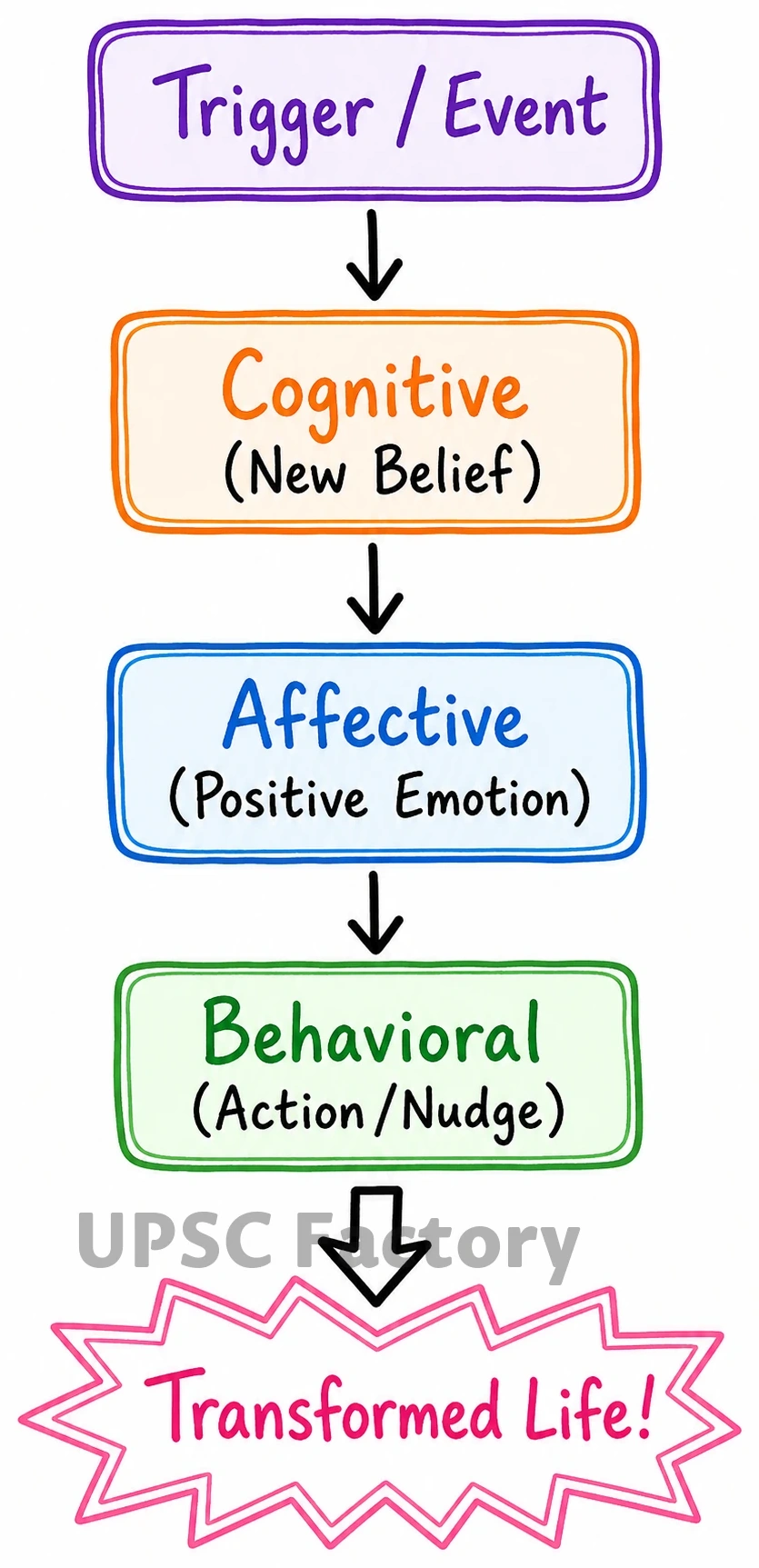
  • CAB Model Realignment: Changing core beliefs (Cognitive) transforms emotions (Affective), directly altering real-world actions (Behavioral).
  • Growth Mindset: Shifting from deterministic fatalism to learning capability converts failures into stepping stones (Carol Dweck).
  • Overcoming Dissonance: Resolving internal cognitive dissonance by adopting progressive values breaks deeply ingrained negative habits.
  • Resilience Building: Cultivating a positive, proactive outlook fosters emotional intelligence, crucial for navigating personal and systemic adversities.

2. Practical Applications of Attitudinal Shifts

  • Administrative Reforms: Shifting from punitive to reformative policing transforms institutional impact and rehabilitates lives (Kiran Bedi, Tihar Jail).
  • Social Persuasion: Nudging collective attitudes eradicates entrenched societal dogmas through mass behavioral change (Swachh Bharat Abhiyan; Nudge Theory).
  • Citizen-Centric Governance: Transitioning from bureaucratic apathy to compassionate empathy ensures ethical, inclusive public service delivery.

Ultimately, cultivating a progressive attitude is not merely a psychological exercise, but the fundamental bedrock of ethical leadership and transformative governance.

Q. “The greatest discovery of my generation is that a human being can alter his life by altering his attitudes.” – William James Read More »

Q. “Those who in trouble untroubled are, Will trouble trouble itself.” – Thiruvalluvar

Q. “Those who in trouble untroubled are, Will trouble trouble itself.” – Thiruvalluvar

UPSC Mains 2025 GS4 Paper

Model Answer:

This couplet from the Tirukkural highlights the power of fortitude and equanimity. It signifies that an unshakeable mind can outlast and ultimately defeat adversity itself.

1. Philosophical Essence: The Untroubled Mind

  • Equanimity (Sthitaprajna): Maintaining a perfectly balanced intellect prevents external circumstances from dictating internal peace (Bhagavad Gita).
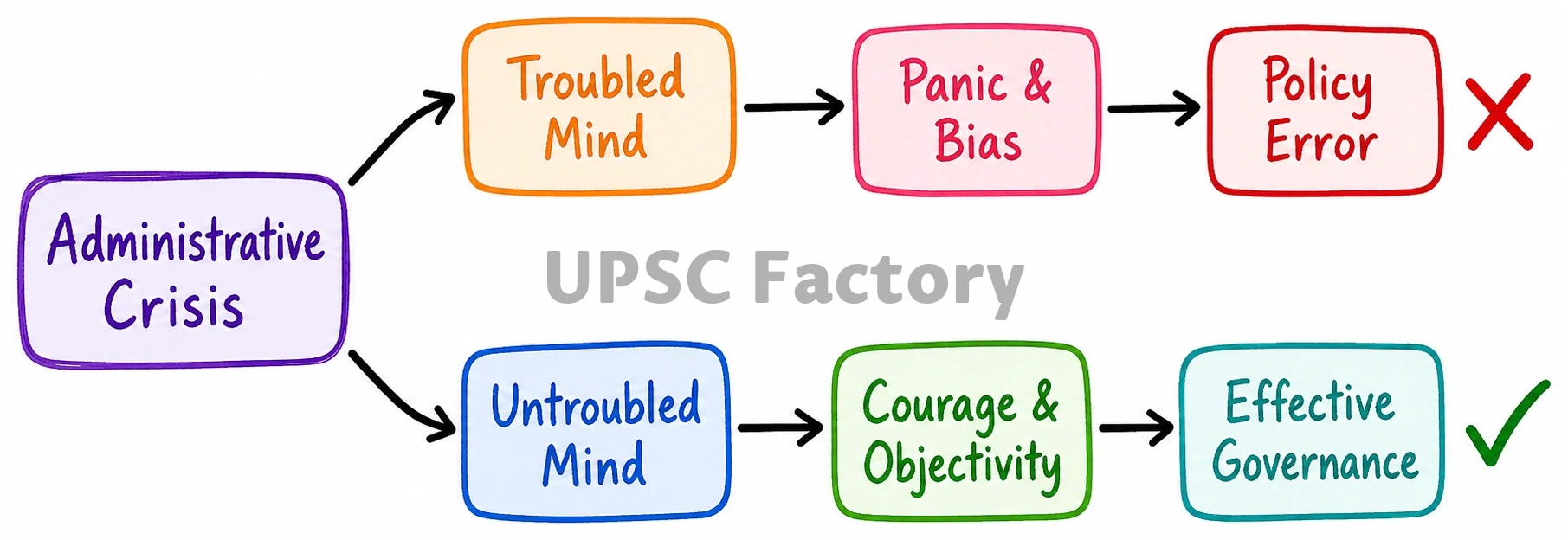
  • Emotional Intelligence: High self-regulation halts panic, allowing rationality to govern responses rather than fear (Daniel Goleman).
  • Stoicism: Accepting challenges without emotional turbulence channels human energy directly into constructive problem-solving (Marcus Aurelius).

2. Administrative Application: Defeating Crises

  • Effective Crisis Management: A calm demeanor inspires public confidence and operational cohesion during disasters (ISRO’s composure from Chandrayaan-2 failure to Chandrayaan-3 success).
  • Objective Decision-Making: An unclouded mind prevents hasty, emotion-driven policy errors under immense time and resource constraints.
  • Unfazed Moral Courage: Steadfast resilience empowers administrators to withstand severe political or systemic threats (T.N. Seshan implementing bold electoral reforms despite intense political backlash).

In public administration, cultivating an “untroubled” mind is not merely a personal virtue but a professional necessity, ensuring resilient, ethical, and effective governance during unprecedented challenges.

Q. “Those who in trouble untroubled are, Will trouble trouble itself.” – Thiruvalluvar Read More »

Q. Keeping the national security in mind, examine the ethical dilemmas related to controversies over environmental clearance of development projects in ecologically sensitive border areas in the country.

Q. Keeping the national security in mind, examine the ethical dilemmas related to controversies over environmental clearance of development projects in ecologically sensitive border areas in the country.

UPSC Mains 2025 GS4 Paper

Model Answer:

Environmental clearances for strategic border infrastructure involve a fragile balancing act between sovereign defense imperatives and ecological preservation, sparking profound ethical conflicts.

Ethical Dilemmas in Border Project Clearances

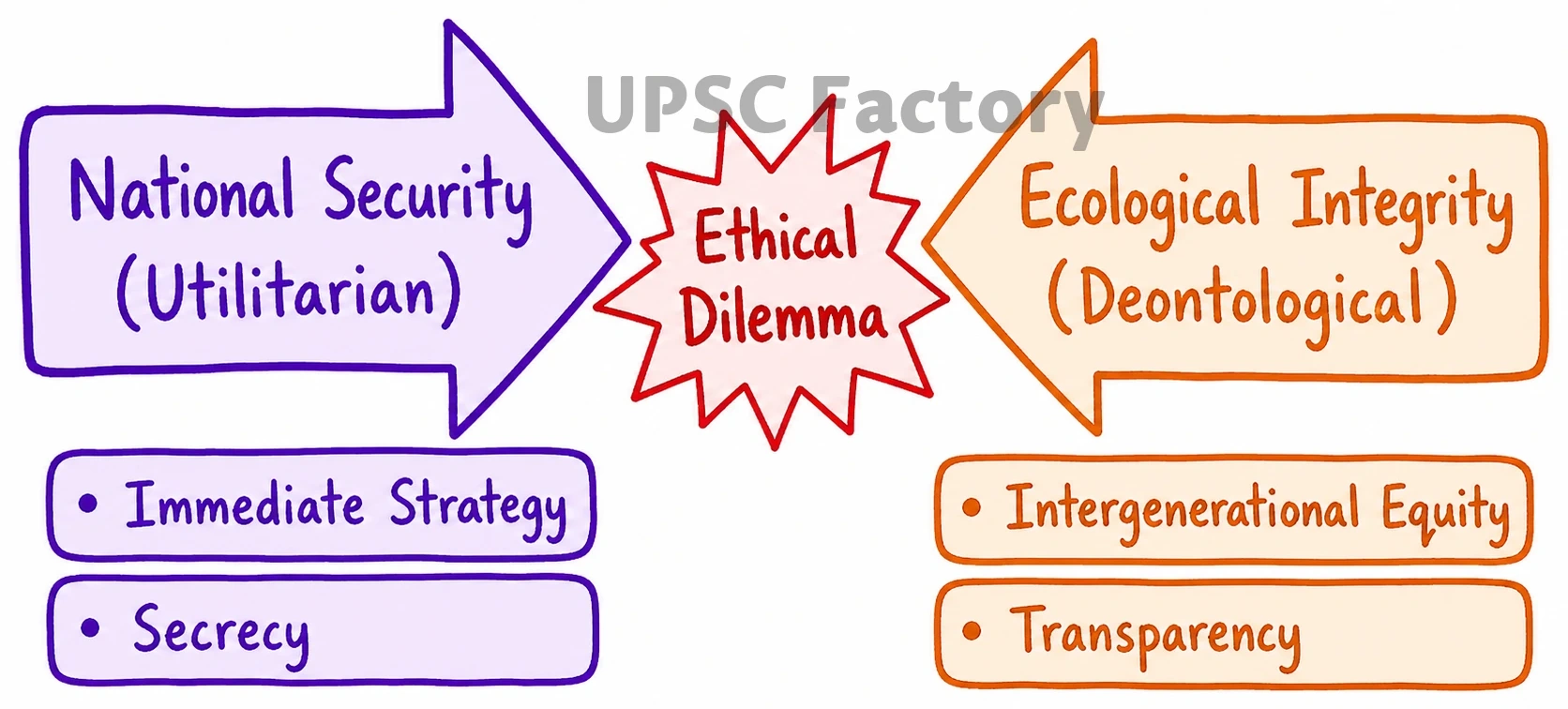
  • Utilitarianism vs. Eco-centrism: Balancing the “greater good” of national defense against the intrinsic right of fragile ecosystems to flourish (Char Dham Pariyojana).
  • Immediate Strategy vs. Intergenerational Equity: Prioritizing immediate border infrastructure risks permanent, irreversible ecological degradation for future generations (Great Nicobar Island Project).
  • Strategic Secrecy vs. Democratic Transparency: Bypassing mandatory Environmental Impact Assessments (EIA) for strategic projects breaches public trust and administrative accountability (Forest Conservation Amendment Act 2023).
  • Consequentialism vs. Deontology (Rights): The consequentialist goal of securing national borders clashes with the fundamental duty to protect indigenous and tribal land rights.
  • Distributive Justice: Border communities disproportionately bear the harsh consequences of ecological disasters (like landslides) while the broader nation reaps the security benefits.

Resolving this requires a “Green Security” paradigm—integrating ecological intelligence into strategic planning to ensure national sovereignty does not ultimately compromise overall societal well-being and long-term environmental sustainability.

Q. Keeping the national security in mind, examine the ethical dilemmas related to controversies over environmental clearance of development projects in ecologically sensitive border areas in the country. Read More »

Q. Carl von Clausewitz once said, “War is a diplomacy by other means.” Critically analyse the above statement in the present context of contemporary geo-political conflict

Q. Carl von Clausewitz once said, “War is a diplomacy by other means.” Critically analyse the above statement in the present context of contemporary geo-political conflict

UPSC Mains 2025 GS4 Paper

Model Answer:

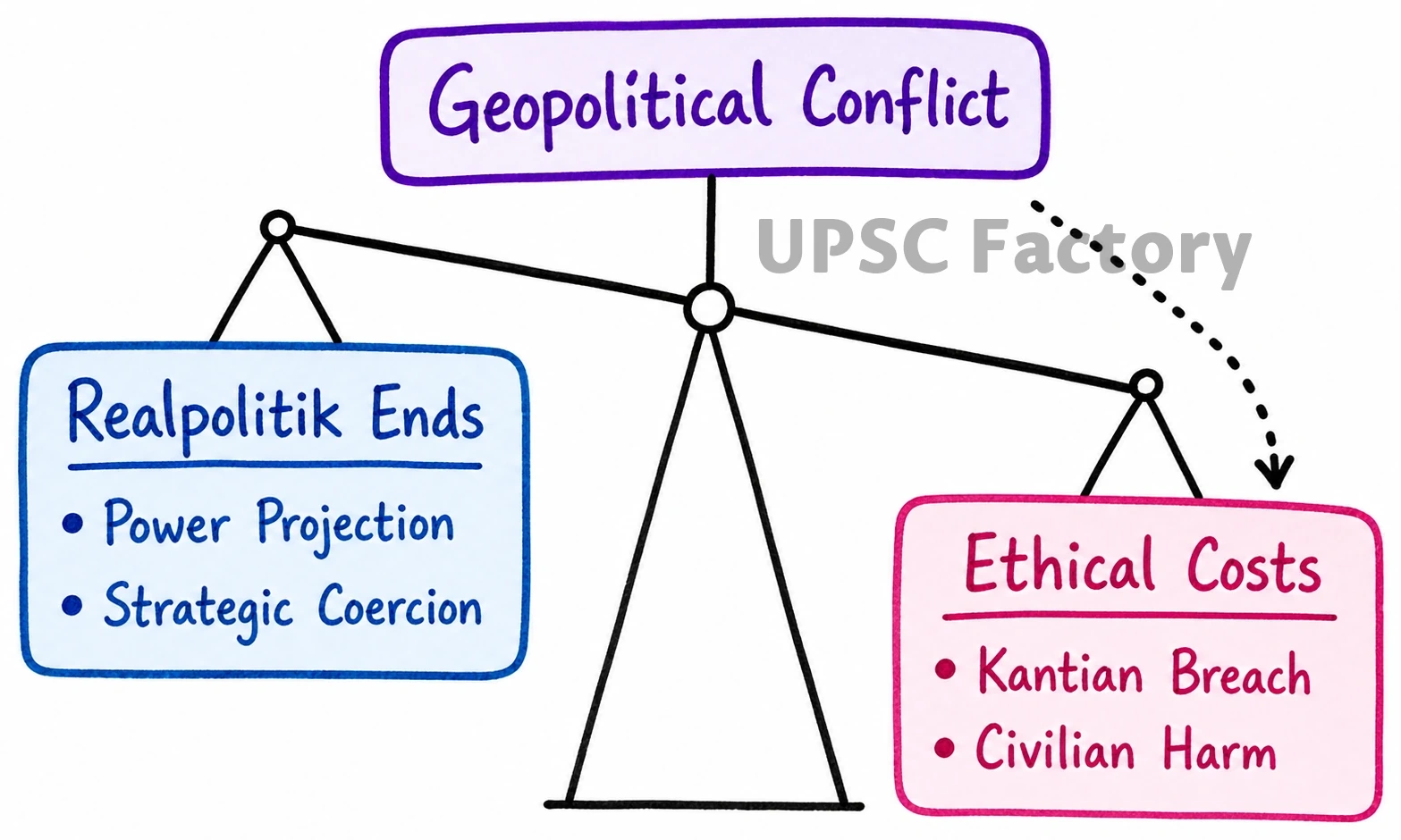
Clausewitz’s assertion reflects Realpolitik, framing war as a rational, calculated extension of statecraft. However, ethically, equating war with routine diplomacy normalizes violence over dialogue.

1. Relevance: War as a Geopolitical Tool (Realpolitik)

  • Strategic Coercion: Armed force is used to extract concessions when peaceful dialogue stalls (Russia-Ukraine territorial demands).
  • Power Projection: Aggressive military posturing secures regional hegemony and asymmetric diplomatic advantage (South China Sea tensions).
  • State Survival: Realists view armed conflict as a justifiable, pragmatic tool to protect national sovereignty against perceived existential threats.

2. Ethical Critique: The Limits of Normalizing War

  • Violates Just War Theory: Ignores Jus ad bellum, treating war as a strategic option rather than an absolute last resort.
  • Kantian Breach: Instrumentalizes human lives, treating innocent civilians merely as a means to geopolitical ends (Gaza humanitarian crisis).
  • Disproportionate Harm: Normalizes collateral damage, overriding international humanitarian laws and human rights (Geneva Conventions violations).
  • Diplomatic Atrophy: Prioritizing hard power destroys global trust, triggering arms races and diverting resources from human development.

Conclusion: True diplomacy resolves conflicts; war represents its absolute failure. Contemporary geopolitics must reject the normalization of violence, prioritizing the Gandhian ideal of dialogue and institutional peace-building.

Q. Carl von Clausewitz once said, “War is a diplomacy by other means.” Critically analyse the above statement in the present context of contemporary geo-political conflict Read More »

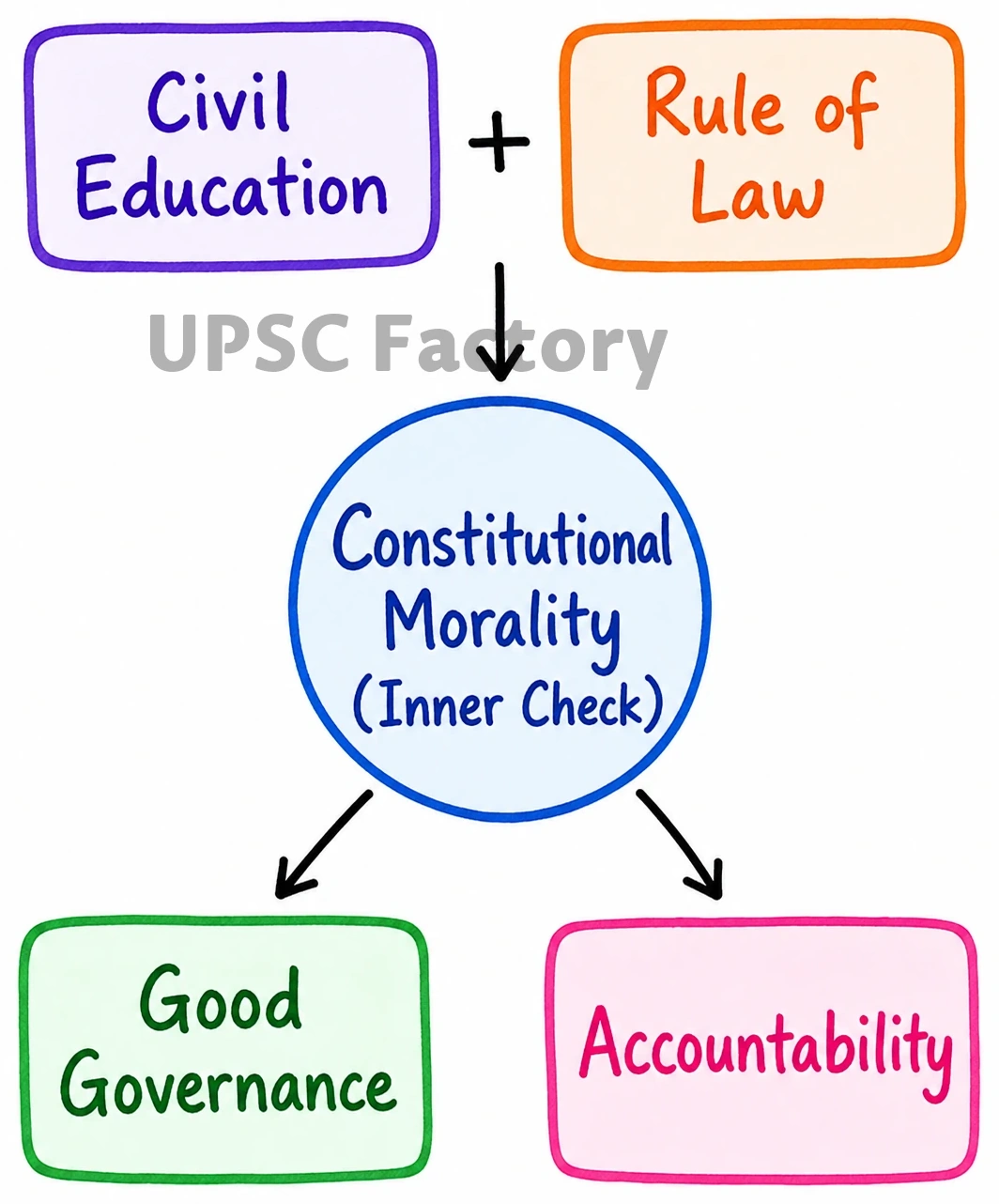
Q. “Constitutional morality is not a natural sentiment but a product of civil education and adherance of the rule of law.”

Q. “Constitutional morality is not a natural sentiment but a product of civil education and adherance of the rule of law.” Examine the significance of constitutional morality for public servant highlighting the role in promoting good governance and ensuring accountability in public administration.

UPSC Mains 2025 GS4 Paper

Model Answer:

Dr. B.R. Ambedkar viewed constitutional morality as a cultivated reverence for constitutional principles, guiding public servants beyond mere statutory compliance toward ethical administration.

Significance for Public Servants

  • Ethical Compass: Resolves administrative dilemmas by prioritizing constitutional values over personal or political biases (e.g., upholding secularism).
  • Minority Protection: Safeguards fundamental rights against populist or majoritarian pressures (e.g., applying Navtej Johar principles).
  • Transformative Constitutionalism: Drives civil servants to actively dismantle systemic inequalities (e.g., proactive SC/ST welfare schemes).

Role in Good Governance & Accountability

  • Curbing Arbitrariness: Enforces the strict Rule of Law over arbitrary discretion, ensuring impartial service delivery.
  • Enhancing Answerability: Compels administrators to respect democratic oversight mechanisms (e.g., proactive RTI disclosures, CAG audits).
  • Public Trusteeship: Fosters financial and moral integrity, preventing corruption and ensuring optimal resource use (e.g., Ashok Khemka’s anti-corruption stance).
  • Citizen-Centricity: Aligns bureaucratic action with constitutional guarantees of human dignity and liberty (e.g., Article 21).

Ultimately, constitutional morality acts as the ultimate “inner check” for civil servants, transforming the rigid bureaucratic apparatus into a responsive engine of inclusive, ethical governance.

Q. “Constitutional morality is not a natural sentiment but a product of civil education and adherance of the rule of law.” Read More »

Q. In the present digital age, social media has revolutionised our way of communication and interaction. However, it has raised several ethical issues and challenges. Describe the key ethical dilemmas in this regard.

Q. In the present digital age, social media has revolutionised our way of communication and interaction. However, it has raised several ethical issues and challenges. Describe the key ethical dilemmas in this regard.

UPSC Mains 2025 GS4 Paper

Model Answer:

Social media acts as a democratic equalizer for global connectivity but simultaneously spawns profound ethical dilemmas threatening individual rights and social harmony.

Key Ethical Dilemmas in Social Media

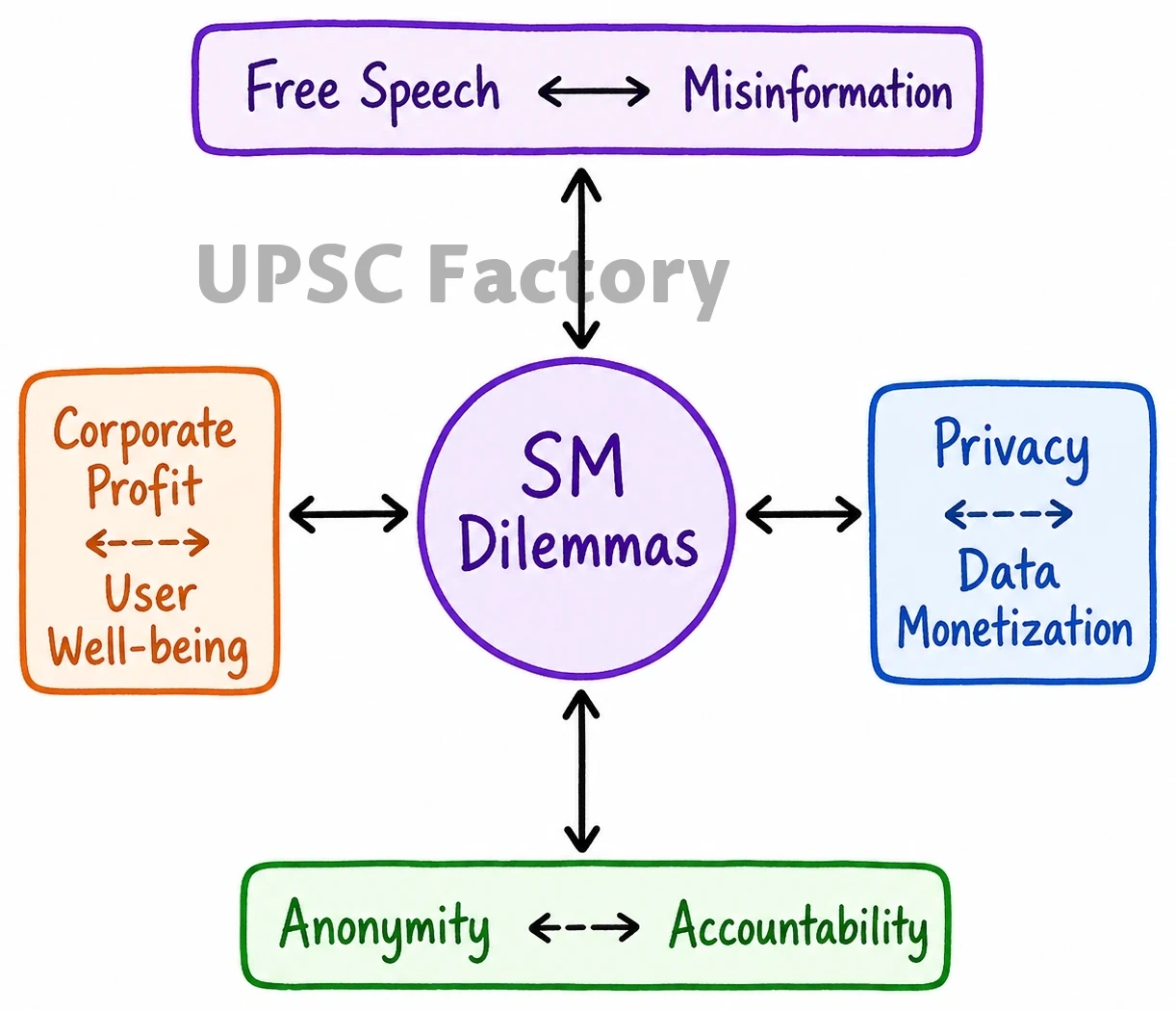
  • Free Speech vs. Misinformation: Balancing the fundamental right to expression against the unchecked, viral spread of fake news and propaganda (Deepfakes during elections).
  • Privacy vs. Data Monetization: Exploiting personal data for corporate profit without explicit, informed consent, violating digital autonomy (Cambridge Analytica; Puttaswamy judgment).
  • Algorithmic Bias vs. Neutrality: Engagement-driven AI architectures intentionally create “echo chambers,” polarizing society and radicalizing vulnerable demographics by prioritizing extreme content.
  • Anonymity vs. Accountability: Shielding identities behind fake profiles enables users to perpetrate cyberbullying, trolling, and hate speech without facing moral or legal repercussions.
  • Corporate Profit vs. Psychological Well-being: Designing addictive interfaces (doom-scrolling) that degrade mental health, especially among youth, prioritizing commercial screen time over human welfare.

Resolving these dilemmas requires a techno-ethical paradigm, blending civic digital literacy with robust frameworks like India’s IT Rules 2021 and DPDPA 2023 to ensure human-centric digital flourishing.

Q. In the present digital age, social media has revolutionised our way of communication and interaction. However, it has raised several ethical issues and challenges. Describe the key ethical dilemmas in this regard. Read More »

Q. Ashok is Divisional Commissioner of one of the border districts of the North East State.

Q. Ashok is Divisional Commissioner of one of the border districts of the North East State.

A few years back, Military has taken over the neighbouring country after overthrowing the elected civil government. Civil war situation is prevailing in the country especially in last two years. However, internal situation further deteriorated due to rebel groups taking over control of certain populated areas near own border. Due to intense fight between military and rebel groups, civilian casualties has increased manifold in recent past. In the meantime, in one night Ashok got information from the local police guarding the border check post that there are about 200-250 people mainly women and children trying to cross over to our side of the border. There are also about 10 soldiers with their weapons in military uniform part of this group who wants to cross over. Women and Children are also crying and begging for help. A few of them are injured and bleeding profusely need immediate medical care. Ashok tried to contact Home Secretary of the State but failed to do so due to poor connectivity mainly due to inclement weather.
(a) What are the options available with Ashok to cope with the situation?
(b) What are the ethical and legal dilemmas being faced by Ashok?
(c) Which of the options, do you think would be more appropriate for Ashok to adopt and why?
(d) In the present situation, what are the extra precautionary measures to be taken by the Border Guarding Police in dealing with soldiers in uniform?

UPSC Mains 2025 GS4 Paper

Model Answer:

(a) Options Available to Ashok:

Ashok faces three primary options:
• Strict enforcement: Deny entry citing Foreigners Act, 1946 – legally sound but morally problematic given injured civilians
• Unconditional entry: Allow all including armed soldiers – humanitarian but security risk
• Balanced approach: Conditional temporary shelter with security protocols – pragmatic middle path

(b) Ethical and Legal Dilemmas:

Ethical conflicts:
– Humanitarian duty vs national security (crying children vs armed foreigners)
– Personal conscience vs official protocol
– Immediate compassion vs long-term consequences

Legal challenges:
– Non-refoulement principle vs sovereignty rights
– Foreigners Act provisions vs Right to Life
– Exceeding authority vs doctrine of necessity during emergency

(c) Most Appropriate Option:

The balanced humanitarian approach is optimal. Ashok should:

Immediate actions:
• Provide medical aid to bleeding victims
• Segregate civilians from soldiers
• Establish temporary cordoned shelter (school/community hall)
• Document all entrants with photographs

Security measures:
• Disarm soldiers respectfully as entry condition
• Maintain constant surveillance
• Continue contacting Home Secretary

This approach upholds India’s humanitarian tradition while safeguarding security. It demonstrates administrative qualities of decisiveness and compassion under pressure. The doctrine of necessity justifies temporary emergency measures when lives are at stake (like Uttarakhand floods response).

(d) Precautionary Measures for Border Guards:

• Communication: Non-confrontational approach using translators
• Disarmament: Frame as standard procedure, not confrontation
• Verification: Document rank, unit, circumstances of defection
• Segregation: Keep soldiers separate under discreet surveillance
• Intelligence coordination: Alert military intelligence immediately
• Treatment: Follow international humanitarian law principles

Guards must balance firmness with dignity, treating soldiers as asylum seekers, not combatants.

Conclusion:
Compassionate pragmatism balancing humanitarian imperatives with security protocols best serves national interest and human dignity.

Q. Ashok is Divisional Commissioner of one of the border districts of the North East State. Read More »

Q. Mahatma Gandhi National Rural Employment Guarantee Program, MGNREGA was earlier known as National Rural Employment Scheme, NREGA.

Q. Mahatma Gandhi National Rural Employment Guarantee Program, MGNREGA was earlier known as National Rural Employment Scheme, NREGA.

It is an Indian Social Welfare Program that aimed at fulfilling the ‘Right to Work’ provisions made in the Constitution. MGNREGA was launched in 2006 under Rural Employment Sector by the Ministry of Rural Development. Main objective of the program is to give legal guarantee of wage employment to the adult members of rural households who are willing to do unskilled manual labour work subject to a maximum of 100 days per year for every household. Every rural household has the right to register under the scheme, job card is issued to the registered, Job Card holder can seek employment; State Government shall pay 25% of minimum wage for the first 30 days as compensatory daily unemployment allowance to the families and of wage for remaining period of the year. MGNREGA work was undertaken by various Gram Panchayats. You have been appointed as an Administrator Incharge of the District. You have been given the responsibility of monitoring MGNREGA work undertaken by various Gram Panchayats. You are also given the authority to give technical sanctions to all MGNREGA works.

In one of the Panchayats in your jurisdiction, you notice that your predecessor has mismanaged the Program in terms of :
(i) Money not disbursed to actual job-seekers.
(ii) Muster Rolls of the Labourers not properly maintained.
(iii) Mismatch between the work done and payments made.
(iv) Payments made to fictitious persons.
(v) Job Cards were given without looking into the need of person.
(vi) Mismanagement of funds and to the extent of siphoning of funds.
(vii) Approved works that never existed.
(a) What is your reaction to the above situation and how do you restore the proper functioning of MGNREGA Program in this regard?
(b) What actions would you initiate to solve the various issues listed above?
(c) How would you deal with the above situation?

UPSC Mains 2025 GS4 Paper

Model Answer:

This case reveals serious governance failure affecting vulnerable rural households’ constitutional right to work. As District Administrator, my response must balance firm corrective action with systemic reforms to restore MGNREGA’s integrity.

(a) Reaction and Restoration Strategy:

My immediate reaction is of grave concern, requiring calm, evidence-based intervention. The restoration approach involves:
• Immediate damage control – Freeze suspicious payments, secure all records (muster rolls, job cards), prevent evidence tampering
• Trust rebuilding – Personal Panchayat visit, emergency Gram Sabha, direct beneficiary interaction
• Two-pronged strategy- Corrective measures for existing fraud; preventive reforms for transparency

(b) & (c) Comprehensive Action Plan:

Phase 1: Immediate (72 hours)
• Form Special Task Force – SDM, Accounts Officer, Executive Engineer
• Halt all payments pending inquiry
• Initiate preliminary field verification

Phase 2: Investigation (1-2 months)
• Money disbursement issues – 100% payment audit, DBT verification, door-to-door surveys (identify ghost beneficiaries)
• Muster roll irregularities – Check forged signatures, conduct technical audit of work-payment mismatch
• Job card verification – Special Gram Sabha for public verification, cancel bogus cards
• Non-existent works – Physical verification, geo-tagging (expose ghost projects)

Phase 3: Systemic Reforms
• Technology integration – Mandatory NMMS attendance, e-muster rolls, Geo-MGNREGA for asset tracking
• Social audits – Quarterly reviews with mandatory Action Taken Reports
• Grievance mechanism – District helpline, WhatsApp complaints channel
• Capacity building – PRI training workshops on ethics and guidelines

Administrative Action:
• Panchayat officials – Suspension, FIR filing, recovery proceedings under Prevention of Corruption Act
• Predecessor – Comprehensive report to Divisional Commissioner recommending formal inquiry
• Community participation – Women SHGs as vigilance committees, youth volunteers for documentation

Conclusion:
Combining administrative firmness with technological innovation and community participation will transform MGNREGA from corrupted scheme to empowering reality.

Q. Mahatma Gandhi National Rural Employment Guarantee Program, MGNREGA was earlier known as National Rural Employment Scheme, NREGA. Read More »