UPSC Mains 2025 GS4 Model Answer

Q. Rajesh is a Group A officer with nine years of service. He is posted as Administrative Officer in an Oil Public Sector undertaking.

Q. Rajesh is a Group A officer with nine years of service. He is posted as Administrative Officer in an Oil Public Sector undertaking.

As an Administrative Officer he is responsible for managing and coordinating various administrative tasks to ensure smooth functioning of office. He also manages office supplies, equipment etc. Rajesh is now sufficient senior and is expecting his next promotion in JAG (Junior Administrative Grade) in the next one or two years. He knows that promotion is based on examination of ACRs/Performance Appraisal of last few years (5 years or so) of an officer by a DPC (Departmental Promotion Committee) and an officer lacking requisite grading of ACRs may not be found fit for promotion. Consequences of losing promotion may entail financial and reputational loss and set-back for career progression. Though he also puts his best efforts in official discharge of his duties, yet he is unsure of assessment by his superior officer. He is now putting extra efforts so that he gets thumping report at the end of financial year. As Administrative Officer, Rajesh is regularly interacting with his immediate boss, who is his reporting officer for writing his ACR. One day he calls Rajesh and wants him to buy computer-related stationery on priority from a particular vendor. Rajesh instructs his office to initiate action for procuring these items. During the day, the dealing Assistant brings an estimate of Rupees Thirty Five Lakhs covering all stationery items from the same vendor. It is noticed that as per delegated financial powers, as provided in the GFR (General Financial Rules) as applicable in that Organisation, expenditure for office items exceeding Rupees Thirty Lakhs requires sanction of the next higher authority (boss in the present case). Rajesh knows that immediate superior would expect all these purchases should be done at his level and may not appreciate such lack of initiative on his part. During discussions with office, he learns that common practice of splitting of expenditure (where large order is divided into a series of smaller ones) is followed to avoid obtaining sanction from higher authority. This practice is against the rules and may come to the adverse notice of Audit. Rajesh is perturbed. He is unsure of taking decision in the matter.
(a) What are the options available with Rajesh in the above situation?
(b) What are the ethical issues involved in this case?
(c) Which would be the most appropriate option for Rajesh and why?

UPSC Mains 2025 GS4 Paper

Model Answer:

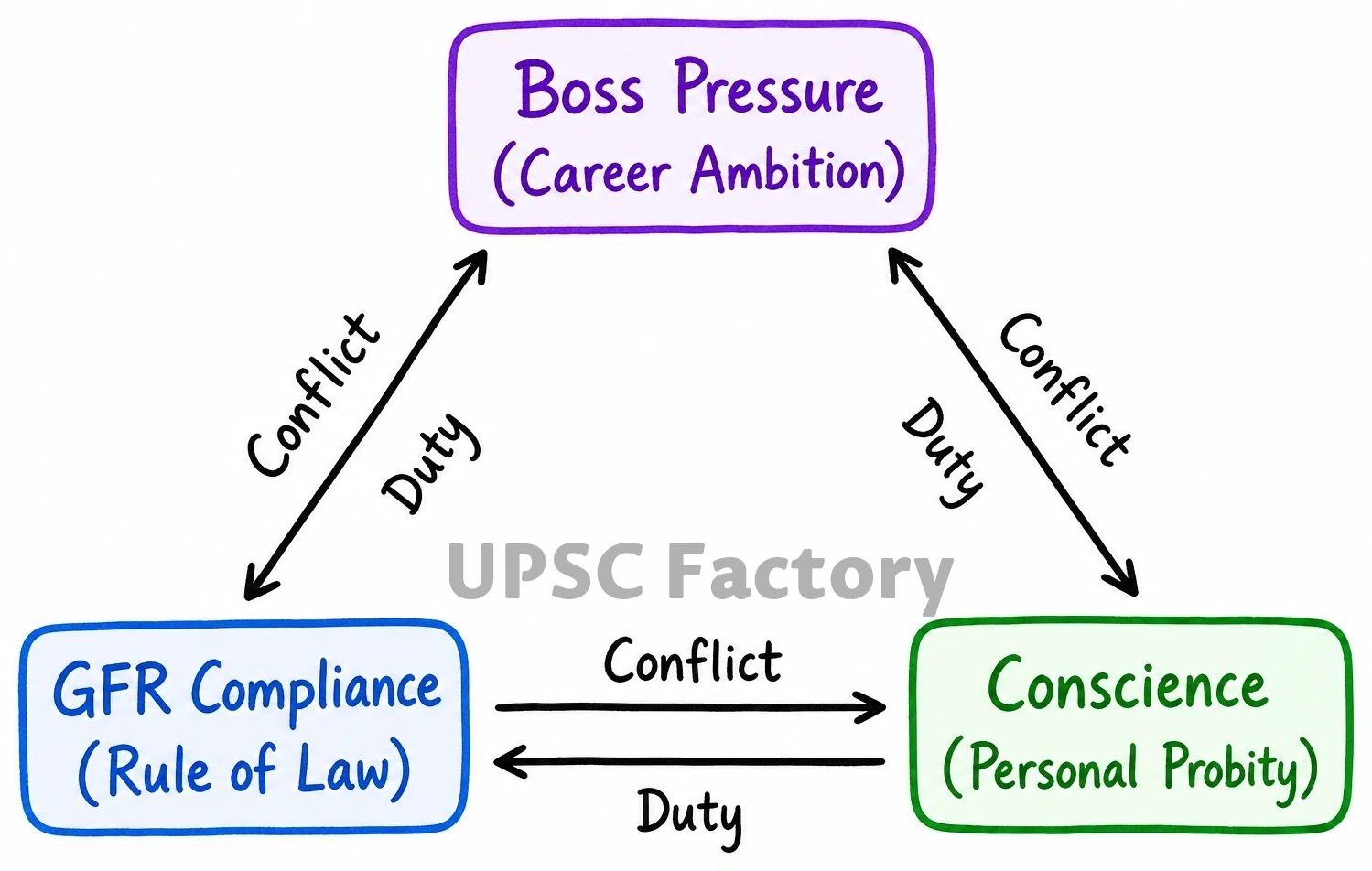
Rajesh faces a crisis of conscience involving personal career ambition (promotion) versus administrative probity, objectivity, and strict adherence to the General Financial Rules (GFR).

(a) Options Available with Rajesh

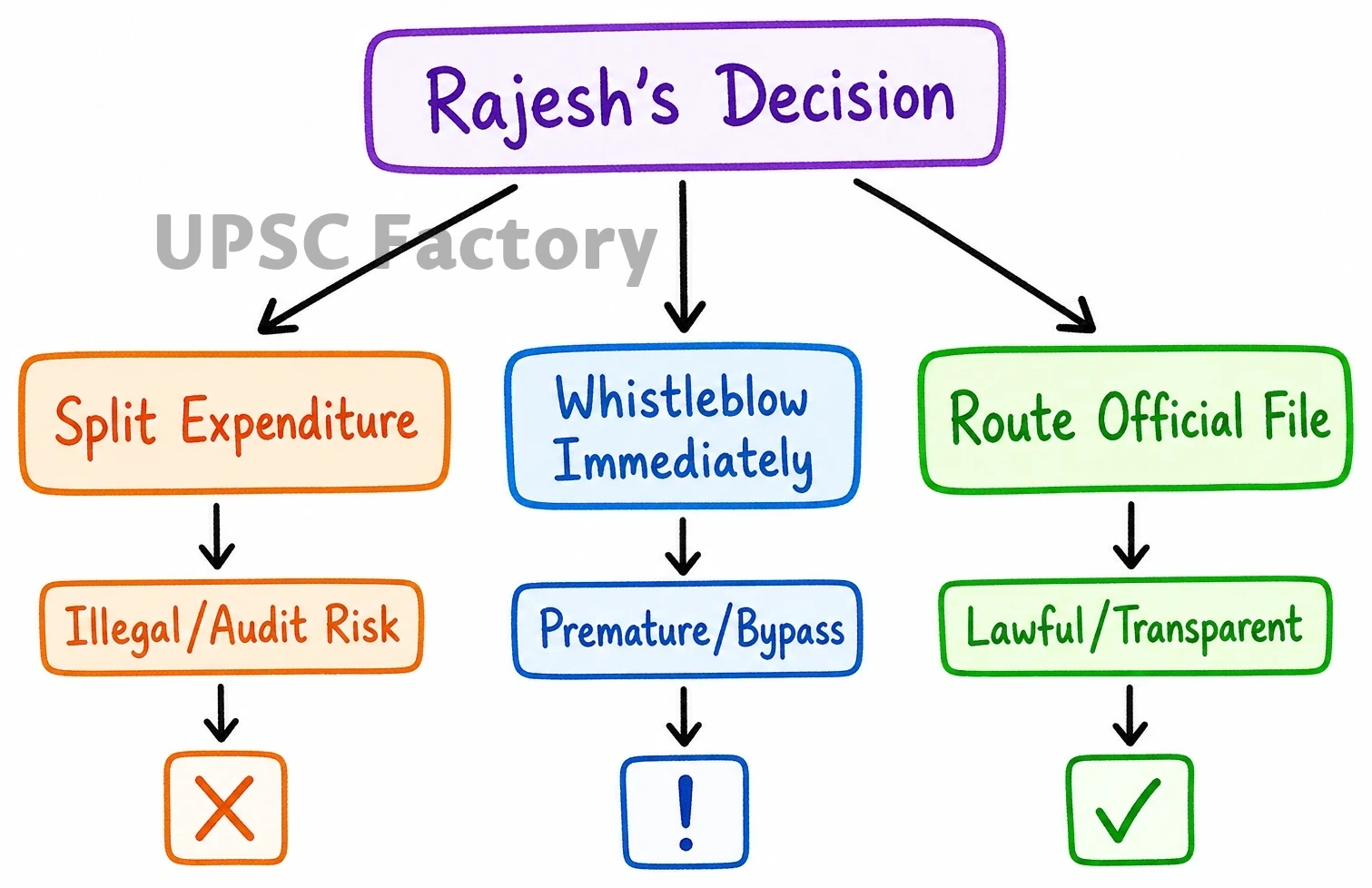
  1. Split the expenditure: Orally comply with the boss to secure a favorable ACR. (Action: Illegal, risks audit trap).
  2. Outright refusal & whistleblowing: Reject the order and complain to the Chief Vigilance Officer. (Action: Premature, bypasses internal file routing).
  3. Process file strictly as per rules: Note the ₹35 lakh estimate on the file and forward it to the boss for formal financial sanction. (Action: Lawful, transparent).
(b) Ethical Issues Involved

  • Probity in Governance: Safeguarding public funds against arbitrary or potentially corrupt procurement practices.
  • Conflict of Interest: Balancing personal career advancement (JAG promotion) against the constitutional duty of lawful administration.
  • Violation of Rule of Law: Splitting expenditures to bypass authority strictly violates Rule 157 of GFR 2017.
  • Courage of Conviction: Exhibiting moral courage to resist undue pressure from a reporting officer (CCS Conduct Rules).
(c) Most Appropriate Option & Justification

Rajesh should adopt Option 3. He must document the single ₹35 lakh estimate on the official file, cite the ₹30 lakh GFR sanctioning limit, and officially route it to the boss for higher approval.

Justification:

  • Upholds Rule of Law: Strict compliance with GFR prevents the illegal splitting of bills.
  • Establishes Accountability: Putting everything on paper forces the boss to officially sanction the vendor and amount, shielding Rajesh from subsequent CAG/Audit objections.
  • Nolan Principles: Demonstrates Integrity and Objectivity.
  • Safeguards Career Logically: If the boss writes an adverse ACR in retaliation, Rajesh’s transparent paper trail provides concrete grounds to appeal to the reviewing authority (DPC) against arbitrary grading.

Public servants must exhibit administrative courage. True civil service ethos demands that career progression never be secured at the cost of institutional integrity and public trust (e.g., Ashok Khemka’s rule compliance).
Q. Rajesh is a Group A officer with nine years of service. He is posted as Administrative Officer in an Oil Public Sector undertaking. Read More »

Q. Subash is Secretary, PWD in the State Government. He is a senior officer, known for his competence, integrity and dedication to work.

Q. Subash is Secretary, PWD in the State Government. He is a senior officer, known for his competence, integrity and dedication to work.

He enjoys the trust and confidence of Minister Incharge of PWD and Programme Implementation. As a part of his job profile, he is responsible for policy formulation, execution of projects relating to infrastructure initiatives in the State. Besides, he oversees the technical and administrative aspects, relating to planning, designing and construction etc. Subash’s Minister is an important Minister in the state and significant growth in urban infrastructure development and road network has been registered during his tenure. He is very keen for launching of ambitious road construction project in the near future. Subash is in regular touch with the Minister and is working various modalities of road construction project. Regular meetings, interactions and presentations are made by him to the Minister before a formal public announcement of the project is made by the Minister. Subash’s only son Vikas is in real estate business. His son from his own sources is aware that a mega road project is on the anvil and announcement in this regard is expected anytime. He is very keen to know from his father the exact location of the upcoming project. He knows that there would be quantum jump in the prices of land in the vicinity. Buying land at this stage at cheaper prices would pay him rich dividends. He is pleading with him (his father) day in and day out to share him location of the proposed project. He assured him that he would handle the matter discretely as it would not attract any adverse notice as he in the normal course, keeps on buying land as a part of his business. He feels pressurised because of constant pleadings by his son. Another significant aspect of the matter pertained to the extra/undue interest in the above project by the Minister PWD. His nephew was also having big infrastructure project company. In fact, the Minister has also introduced his nephew to him and indicated to him to take care of his nephew’s business interest in the forthcoming project. The Minister encouraged him to act fast in the matter as early announcement and execution of mega road project would enhance his status in the party and public life. In the above backdrop, Subash is in a fix as to the future course of action.
(a) Discuss the ethical issues involved in the case.
(b) Critically examine the options available to Subash in the above situation.
(c) Which of the above would be most appropriate and why?

UPSC Mains 2025 GS4 Paper

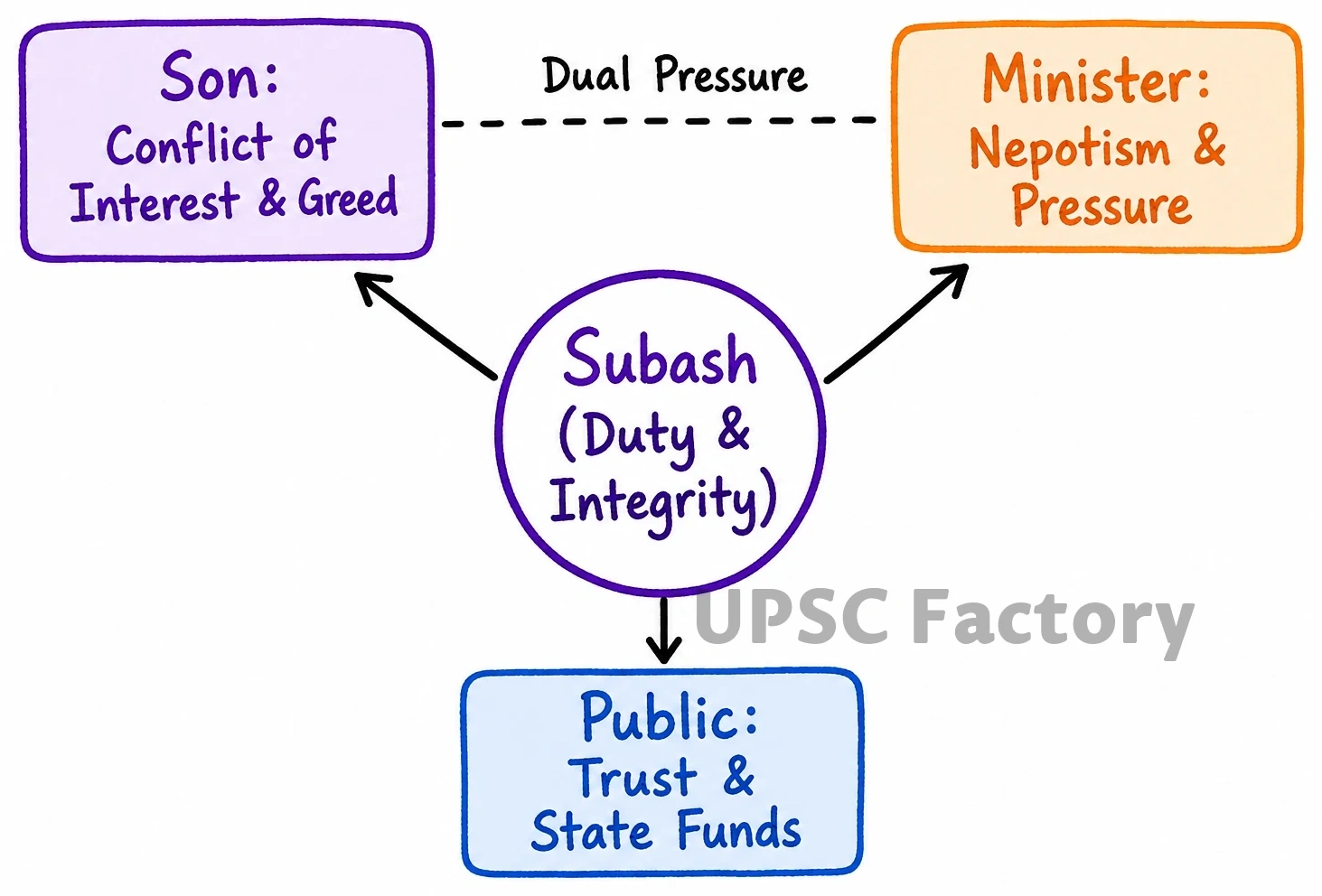
Model Answer: This case highlights a dual dilemma of personal conflict of interest and political nepotism, testing Subash’s professional integrity and adherence to AIS (Conduct) Rules, 1968.

1. Ethical Issues Involved

  • Conflict of Interest: Son’s private real estate profiteering directly conflicts with Subash’s public duty.
  • Breach of Confidentiality: Leaking project coordinates violates the Official Secrets Act, 1923 and fiduciary trust.
  • Crony Capitalism & Nepotism: Minister pressuring Subash to favor his nephew undermines fair competition and public welfare.
  • Compromise of Nolan Principles: Threats to Objectivity, Integrity, and Honesty in public service.

2. Critical Examination of Options

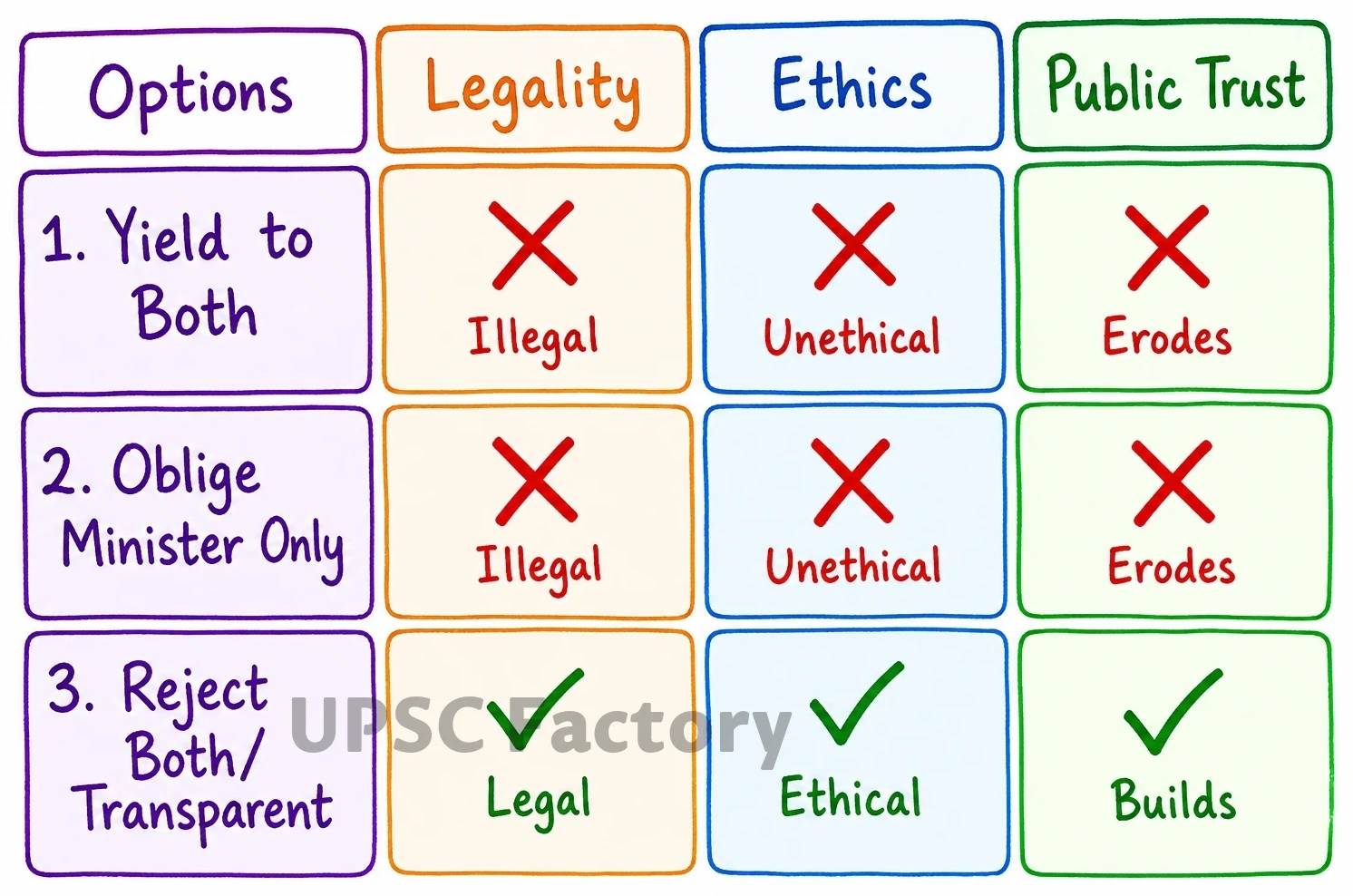
  1. Yield to both son and Minister:
    • Merit: Ensures familial harmony and political patronage.
    • Demerit: Illegal, destroys public trust, and invites severe vigilance/CBI probes.
  2. Reject son’s plea but oblige the Minister:
    • Merit: Avoids personal financial gain; maintains the Minister’s trust.
    • Demerit: Hypocritical, legally culpable for rigged tendering, and ethically bankrupt.
  3. Refuse both and execute the project transparently:
    • Merit: Upholds Constitutional morality, legal frameworks, and personal conscience.
    • Demerit: Alienates son and risks punitive transfers or political harassment.

3. Most Appropriate Action & Justification

Option 3 is the only ethically sound and legally viable course of action.
  • Handling the Son: Subash must firmly deny the information, warning his son of the legal and reputational repercussions of insider trading.
  • Tackling Political Pressure: He must mandate an open, transparent, and competitive e-tendering process (e.g., EPC mode) to preclude the Minister’s nephew from gaining undue advantages.
  • Institutional Safeguard: Subash should rigorously document all project files. If the Minister issues verbal directives to bypass rules, Subash must seek them in writing or apprise the Chief Secretary (reflecting Ashok Khemka’s uprightness).
By prioritizing rule of law over familial greed and political pressure, Subash will safeguard public funds, echoing E. Sreedharan’s benchmark of uncompromised contractual probity.

Q. Subash is Secretary, PWD in the State Government. He is a senior officer, known for his competence, integrity and dedication to work. Read More »

Q. In line with the Directive Principles of State Policy enshrined in the Indian Constitution, the government has a constitutional obligation to ensure basic needs – “Roti, Kapda aur Makan (Food, Clothes and Shelter)” – for the under-privileged.

Q. In line with the Directive Principles of State Policy enshrined in the Indian Constitution, the government has a constitutional obligation to ensure basic needs – “Roti, Kapda aur Makan (Food, Clothes and Shelter)” – for the under-privileged.

Pursuing this mandate, the district administration proposed clearing a portion of forest land to develop housing for the homeless and economically weaker sections of the society. The proposed land, however, is an ecologically sensitive zone densely populated with age-old trees, medicinal plants and vital biodiversity. Besides, these forests help to regulate micro-climate and rainfalls; provide habitat for wildlife, support soil fertility and prevent land/soil erosion and sustain livelihoods of tribal and nomadic communities. Inspite of the ecological and social costs, the administration argues in favour of the said proposal by highlighting that this very initiative addresses fundamental human rights as a critical welfare priority. Besides, it fulfils the government’s duty to uplift and empower the poor through inclusive housing development. Further, these forest areas have become unsafe due to wild-animal threats and recurring human-wild life conflicts. Lastly, clearing forest-zones may help to curb anti-social elements allegedly using these areas as hideouts, thereby enhancing law and order.
(a) Can deforestation be ethically justified in the pursuit of social welfare objectives like, housing for the homeless?
(b) What are the socio-economic, administrative and ethical challenges in balancing environmental conservation with human development?
(c) What substantial alternatives or policy interventions can be proposed to ensure that both environmental integrity and human dignity are protected?

UPSC Mains 2025 GS4 Paper

Model Answer:

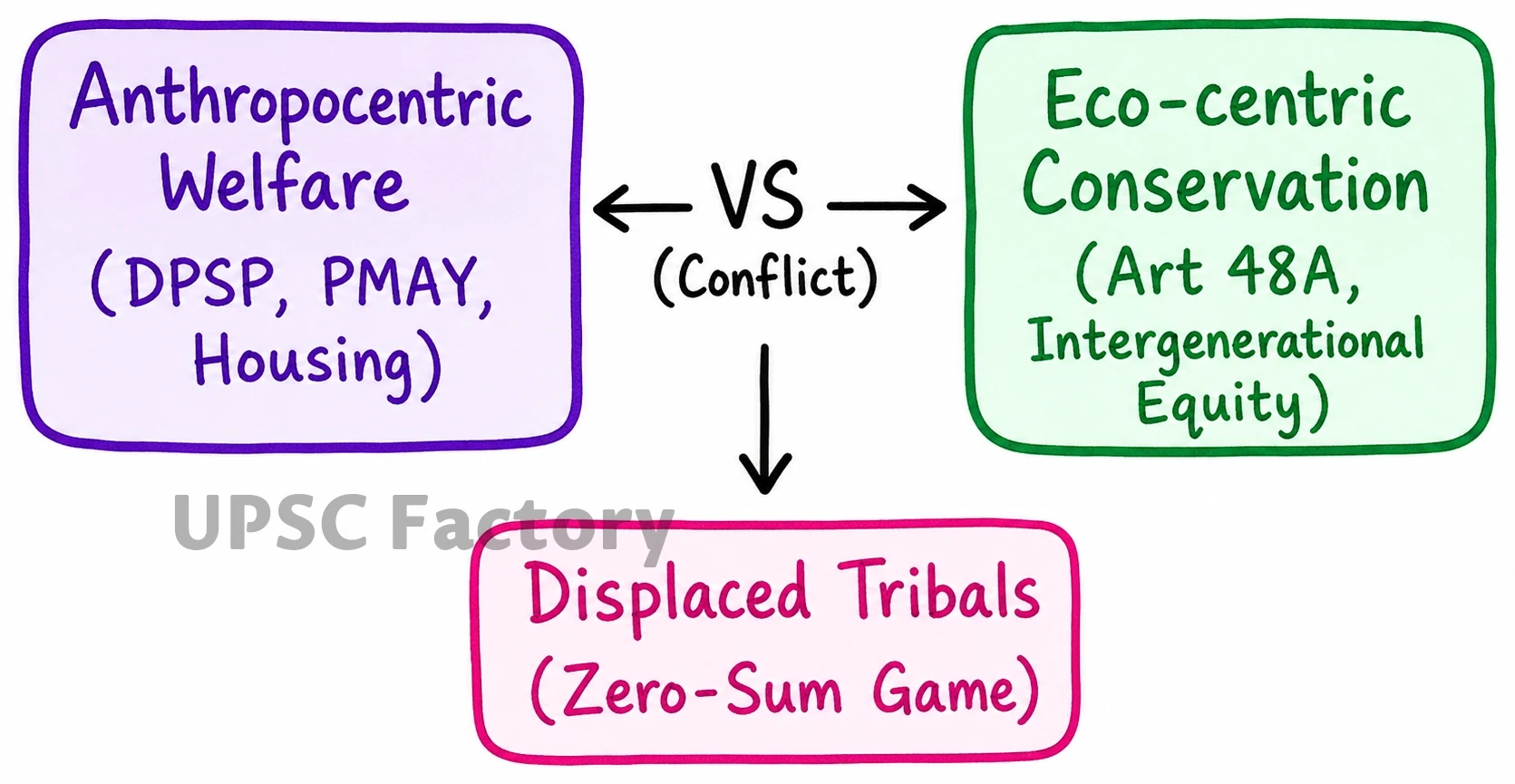
The case presents a classic “Development vs. Environment” dilemma, contrasting anthropocentric welfare (housing the poor) against eco-centric sustainability, intergenerational equity, and tribal livelihood preservation.

1. Ethical Justification & Balancing Challenges

a) Ethical Justification of Deforestation:

  • Unjustified Utilitarianism: Short-term welfare (housing) cannot justify irreversible ecological destruction, violating long-term public interest (Right to healthy environment, Article 21).
  • Violation of Eco-centrism: Forests hold intrinsic value beyond human utility; destroying them breaches the principle of intergenerational equity.
  • Conflicting Rights: Deforestation displaces indigenous tribes, creating an unethical “marginalized vs. marginalized” zero-sum game between the homeless and forest-dwellers.

b) Challenges in Balancing Conservation and Development:

  • Ethical: Reconciling constitutional welfare mandates (DPSP Articles 38/47) with strict environmental stewardship (Article 48A, Fundamental Duty 51A(g)).
  • Administrative: Achieving rigid housing targets (PMAY) while navigating strict Forest (Conservation) Act norms and managing human-wildlife conflicts.
  • Socio-Economic: Bureaucracies often ignore the massive hidden economic costs of climate disruption (loss of rainfall/soil fertility) for the allure of “free” forest land.
  • Security: Addressing law-and-order threats without resorting to the extreme, irreversible measure of ecological clearance.

2. Sustainable Alternatives & Policy Interventions

c) Proposed Interventions:

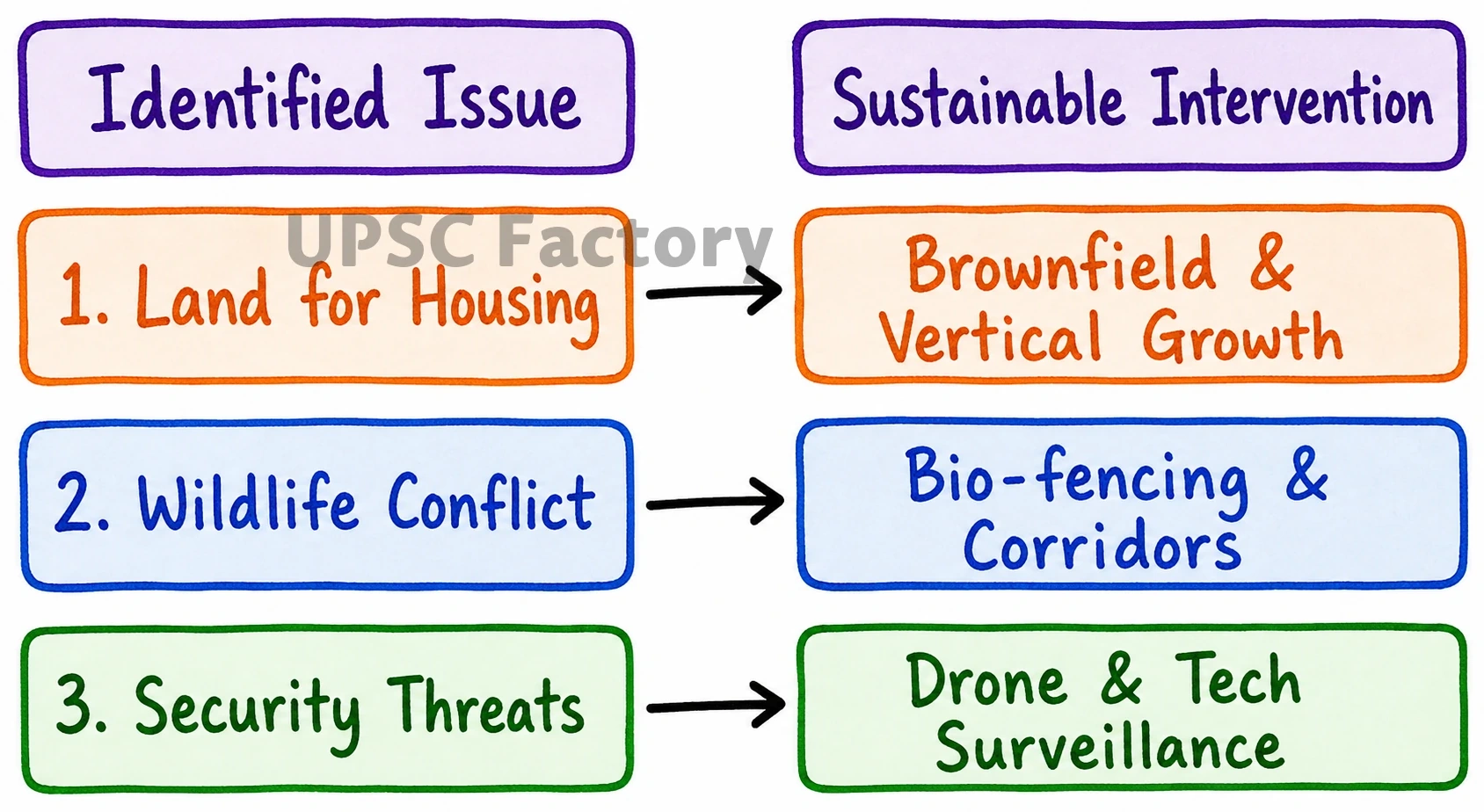
  • Brownfield Redevelopment: Repurpose abandoned industrial zones, unutilized government land banks, and existing urban slums instead of pristine eco-zones.
  • Vertical Housing Growth: Promote high-density, multi-story affordable housing to maximize shelter while minimizing the required land footprint.
  • Non-Destructive Mitigation: Establish wildlife corridors, bio-fencing, and community-led monitoring to curb human-animal conflicts safely (Aarey Forest model).
  • Technology-Driven Security: Deploy drone surveillance, thermal imaging, and intensive patrolling to curb anti-social hideouts rather than destroying habitats.
  • Tribal Empowerment: Formalize forest rights (FRA, 2006) to make indigenous communities active partners in conservation and micro-climate regulation.

True human dignity cannot be built on ecological graves. Sustainable development requires harmonizing basic human needs with uncompromising ecological stewardship, ensuring “Housing for All” without compromising a sustainable future.

Q. In line with the Directive Principles of State Policy enshrined in the Indian Constitution, the government has a constitutional obligation to ensure basic needs – “Roti, Kapda aur Makan (Food, Clothes and Shelter)” – for the under-privileged. Read More »

Q. Vijay was Deputy Commissioner of remote district of Hilly Northern State of the country for the last two years.

Q. Vijay was Deputy Commissioner of remote district of Hilly Northern State of the country for the last two years.

In the month of August heavy rains lashed the complete state followed by cloud burst in the upper reaches of the said district. The damage was very heavy in the complete state especially in the affected district. The complete road network and telecommunication were disrupted and the buildings were damaged extensively. People’s houses have been destroyed and they were forced to stay in open. More than 200 people have been killed and about 5000 were badly injured. The Civil Administration under Vijay got activated and started conducting rescue and relief operations. Temporary shelter camps and hospitals were established to provide shelter and medical facilities to the homeless and injured people. Helicopter services were pressed in, for evacuating sick and old people from remote areas. Vijay got a message from his hometown in Kerala that his mother was seriously sick. After two days Vijay received the unfortunate message that his mother has expired. Vijay has no close relative except one elder sister who was US citizen and staying there for last several years. In the meantime, the situation in the affected district deteriorated further due to resumption of heavy rains after a gap of five days. At the same time, continuous messages were coming on his mobile from his hometown to reach at the earliest for performing last rites of his mother.
(a) What are the options available with Vijay?
(b) What are the ethical dilemma being faced by Vijay?
(c) Critically evaluate and examine each of these options identified by Vijay.
(d) Which of the options, do you think, would be most appropriate for Vijay to adopt and why?

UPSC Mains 2025 GS4 Paper

Model Answer:

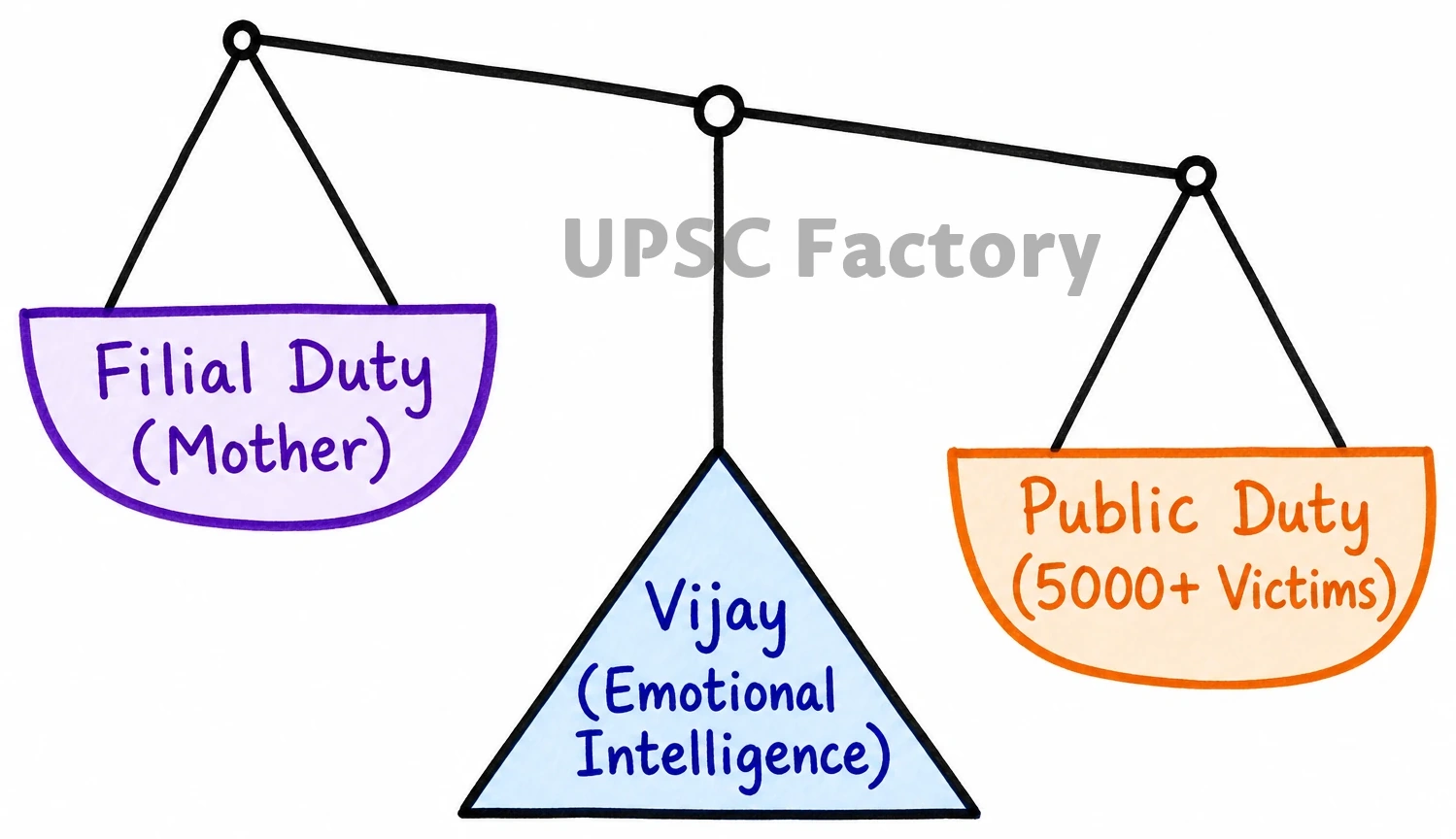
This case highlights a profound test of emotional intelligence, pitting an administrator’s deepest personal grief against supreme public duty during a worsening humanitarian crisis.

1. Options and Ethical Dilemmas

Options Available:

  • Leave immediately: Hand over the charge and travel to Kerala for last rites.
  • Stay and lead: Remain in the district to manage the disaster, missing the final rites.
  • Short leave: Delegate command, fly for a day, and return immediately.

Ethical Dilemmas Faced:

  • Filial Duty vs. Public Duty: Deontological obligation to a deceased mother versus the immediate mandate of saving 5000+ vulnerable citizens.
  • Utilitarianism vs. Personal Conscience: Greatest good for the greatest number (public safety) versus immense personal guilt (missing last rites).
  • Emotional Vulnerability vs. Objective Leadership: Coping with sudden grief while maintaining resolute command (Nolan Principles: Objectivity, Leadership).

2. Critical Evaluation of Options

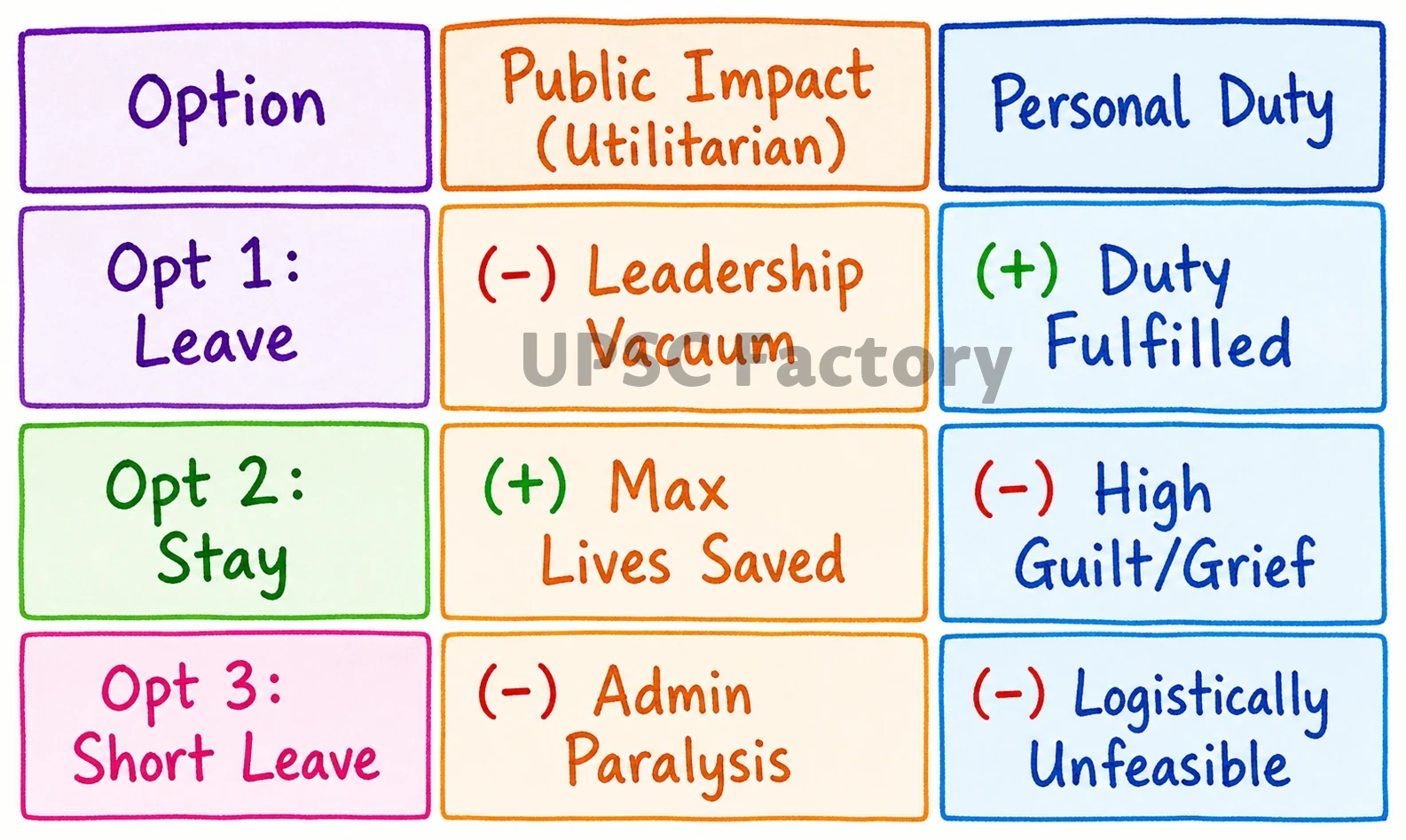
  • Option 1 (Leave): Fulfills a son’s traditional duty. However, creating a leadership vacuum during renewed heavy rains could cost hundreds of lives, severely violating public trust.
  • Option 2 (Stay): Maximizes public good (Utilitarianism) and prevents administrative paralysis, but exacts a heavy, lifelong emotional toll on Vijay.
  • Option 3 (Short Leave): Appears balanced, but practically unfeasible due to disrupted transport. Delegating mid-disaster risks catastrophic delayed decision-making.

3. Most Appropriate Option & Justification

Vijay must adopt Option 2 (Stay and lead).

  • Action Plan: He should coordinate with Kerala’s local administration, neighbors, or NGOs to perform the last rites. He and his sister (in the US) can participate virtually via video link. After stabilizing the district, he can visit later for subsequent rituals.
  • Justification: The Right to Life (Article 21) of thousands supersedes personal rituals. As Deputy Commissioner, his strategic presence is indispensable.
  • Ethical Basis: This embodies Nishkama Karma (selfless action) and Kantian Deontology, where protecting human life is the supreme categorical imperative (e.g., Civil servants prioritizing pandemic duties over personal loss during COVID-19).

By placing collective survival above profound personal sorrow, Vijay exemplifies the highest echelons of civil service ethos, proving that true public service demands unyielding selflessness.

Q. Vijay was Deputy Commissioner of remote district of Hilly Northern State of the country for the last two years. Read More »

Q. India is an emerging economic power of the world as it has recently secured the status of fourth largest economy of the world as per IMF projection.

Q. India is an emerging economic power of the world as it has recently secured the status of fourth largest economy of the world as per IMF projection.

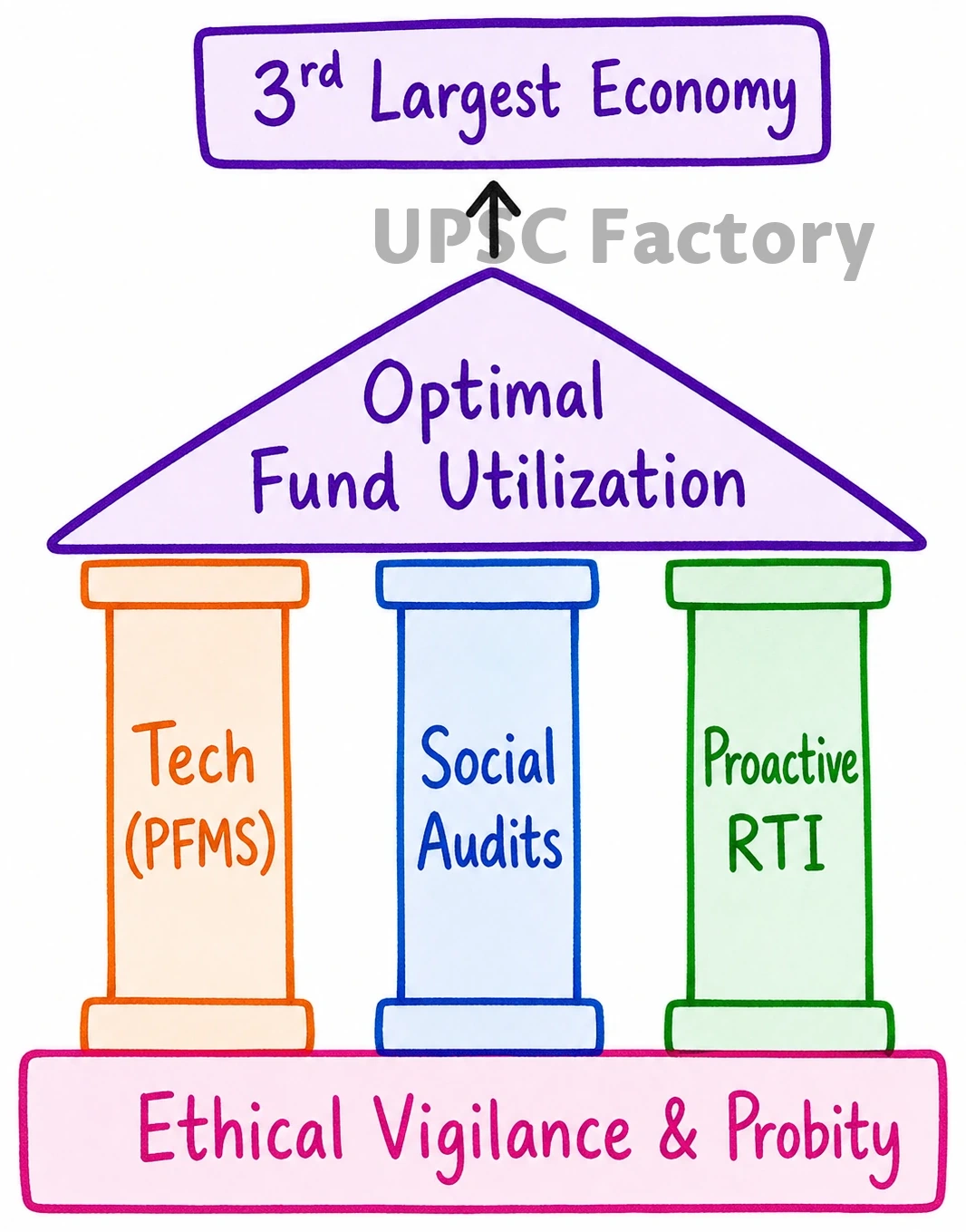
However, it has been observed that in some sectors, allocated funds remain either under-utilised or misutilised. What specific measures would you recommend for ensuring accountability in this regard to stop leakages and gaining the status of third largest economy of the world in near future?

UPSC Mains 2025 GS4 Paper

Model Answer:

India’s rise towards becoming the third-largest global economy is hindered by public fund misutilization and under-utilization, reflecting a severe ethical and administrative deficit in governance.

1. Core Reasons for Fund Mismanagement

  • Administrative Apathy: Poor local capacity and flawed top-down planning lead to unspent allocations.
  • Ethical Deficit: Vested interests, nepotism, and rent-seeking cause massive leakages (violating Nolan Principles).
  • Procedural Red-Tapism: Rigid bureaucratic bottlenecks and complex compliance delay timely disbursements.

2. Specific Measures to Ensure Accountability

  • Technological Integration: Mandate 100% real-time financial tracking via the Public Financial Management System (PFMS) and expand the JAM Trinity (eliminating ghost beneficiaries).
  • Statutory Social Audits: Institutionalize mandatory community oversight across all sectors, modeled on Meghalaya’s Social Audit Act.
  • Proactive Transparency: Strictly enforce Section 4 of the RTI Act for mandatory digital disclosure of project funds, timelines, and contractor details.
  • Outcome-Based Budgeting: Shift from mere outlays to tangible outcome metrics, penalizing bureaucratic inertia for under-utilized capital.
  • Ethical Vigilance: Institutionalize robust Whistleblower protection frameworks and train officials specifically in financial probity and integrity.

Upholding strict financial integrity ensures that public wealth serves its intended equitable purpose, accelerating India’s sustainable transition into a top-tier global economic power.

Q. India is an emerging economic power of the world as it has recently secured the status of fourth largest economy of the world as per IMF projection. Read More »

Q. It is said that for an ethical work culture, there must be code of ethics in place in every organisation. To ensure value-based and compliance-based work culture, what suitable measures would you adopt in your work place?

Q. It is said that for an ethical work culture, there must be code of ethics in place in every organisation. To ensure value-based and compliance-based work culture, what suitable measures would you adopt in your work place?

UPSC Mains 2025 GS4 Paper

Model Answer:

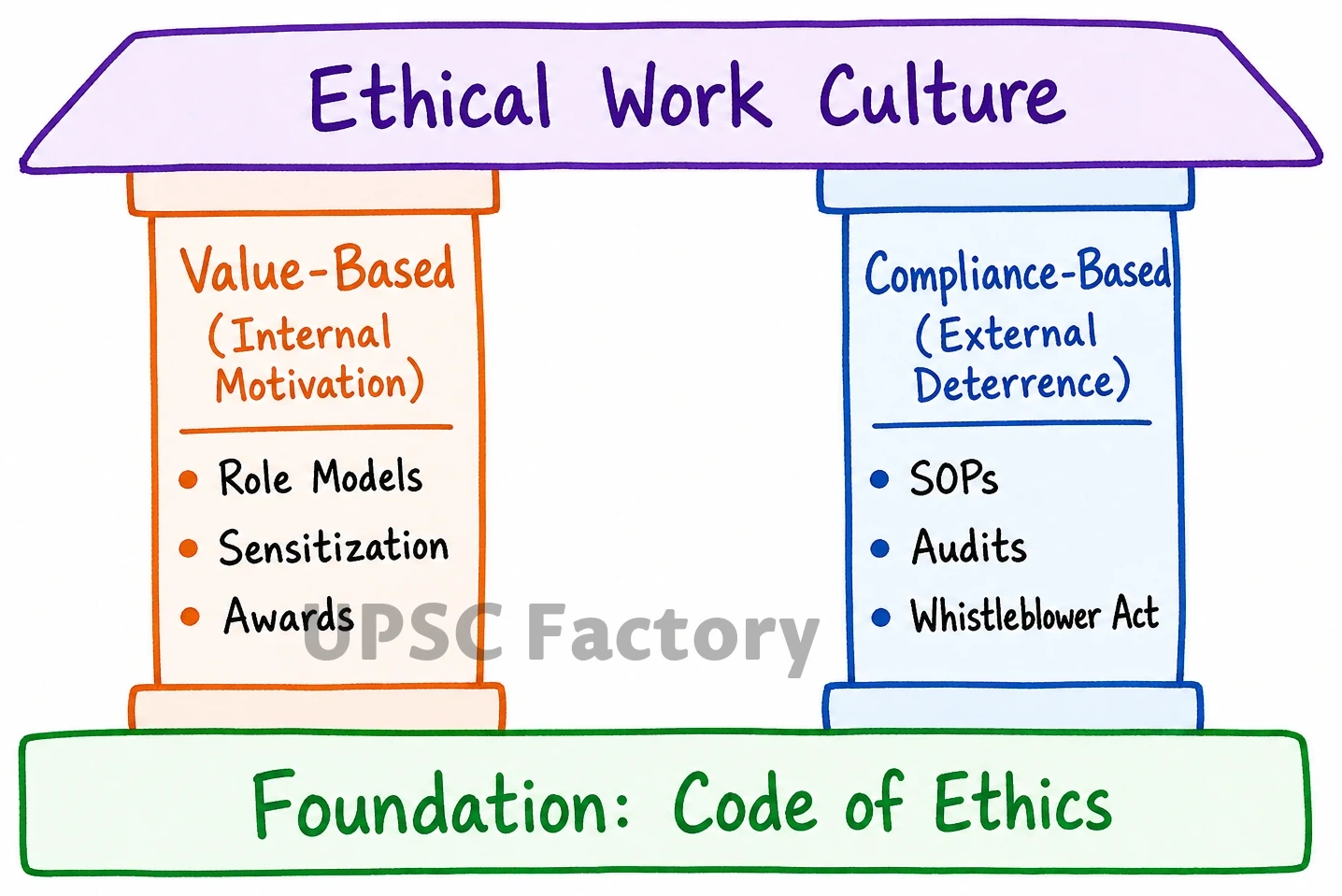
A Code of Ethics acts as an organization’s moral compass. However, realizing true workplace probity requires a dual framework of value-internalization (internal motivation) and rule-compliance (external deterrence).

1. Measures for a Value-Based Work Culture

  • Lead by Example: Administrators must personify the ‘Nolan Principles’ of integrity and selflessness to inspire subordinates (e.g., E. Sreedharan at DMRC).
  • Ethical Sensitization: Conduct regular, case-study-based moral reasoning workshops to build an internally driven ethical compass.
  • Incentivizing Probity: Institutionalize periodic ‘Ethics Awards’ or positive performance appraisals to publicly recognize morally upright behavior.

2. Measures for a Compliance-Based Work Culture

  • Enforceable Code of Conduct: Translate abstract ethical norms into strict, actionable, and measurable Standard Operating Procedures (e.g., Tata Group Code of Conduct).
  • Robust Vigilance & Audits: Institute regular e-governance tracking, surprise inspections, and social audits to minimize discretionary powers and deter malfeasance.
  • Whistleblower Protection: Establish secure, anonymous grievance redressal channels to shield truth-tellers from institutional retaliation (Whistle Blowers Protection Act, 2014).

By synergizing value-based self-regulation with strict compliance-based accountability, organizations can eradicate administrative opacity and achieve the 2nd ARC’s vision of genuine ‘Ethics in Governance’.

Q. It is said that for an ethical work culture, there must be code of ethics in place in every organisation. To ensure value-based and compliance-based work culture, what suitable measures would you adopt in your work place? Read More »

Q. To achieve holistic development goal, a civil servant acts as an enabler and active facilitator of growth rather than a regulator. What specific measures will you suggest to achieve this goal?

Q. To achieve holistic development goal, a civil servant acts as an enabler and active facilitator of growth rather than a regulator. What specific measures will you suggest to achieve this goal?

UPSC Mains 2025 GS4 Paper

Model Answer:

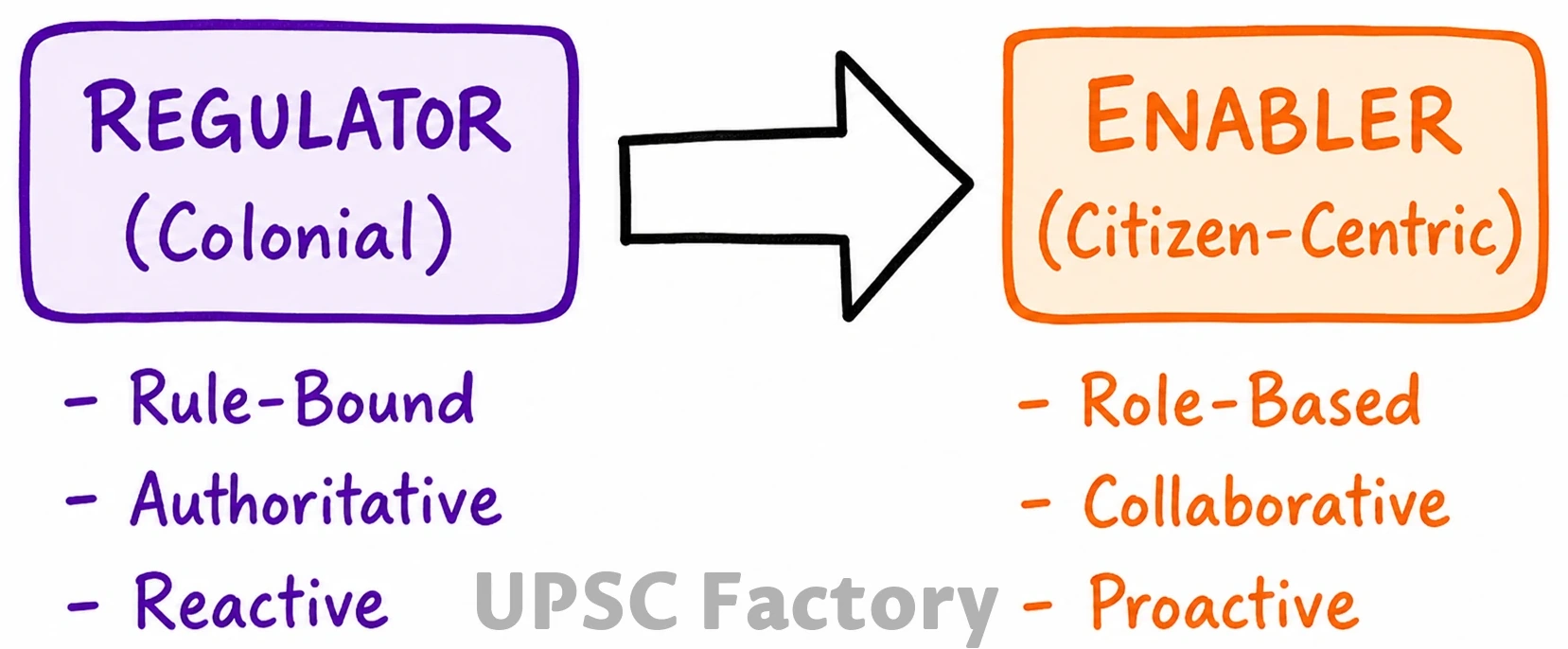
To achieve holistic development, civil servants must transition from a colonial “command-and-control” mindset to a citizen-centric “facilitator” role, promoting participatory governance.

1. Attitudinal Shift: Regulator to Enabler

  • Rule to Role Transition: Moving from rigid rule-enforcement to outcome-oriented problem-solving (Mission Karmayogi).
  • Authoritative to Collaborative: Treating citizens as equal partners in development rather than subjects.
  • Reactive to Proactive: Anticipating citizen needs instead of merely responding to systemic crises.

2. Specific Measures to Facilitate Holistic Growth

  • Social Persuasion: Motivating community participation to drive behavioral change in governance (e.g., Swachh Bharat local campaigns).
  • Crowdsourcing & Collaboration: Mobilizing public resources to overcome structural deficits (e.g., Armstrong Pame’s crowdfunded ‘People’s Road’).
  • Applying Emotional Intelligence: Tailoring proactive welfare infrastructure to vulnerable communities (e.g., O.P. Choudhary facilitating Dantewada’s ‘Education City’).
  • De-bureaucratization: Simplifying procedures, adopting single-window clearances, and promoting self-certification to reduce citizen compliance burdens.
  • Capacity Building: Undertaking continuous ethical and functional training to cultivate a growth-oriented, empathetic mindset.

Adopting an enabler attitude aligns with the 2nd ARC’s vision of proactive, citizen-centric administration, transforming civil servants into true catalysts of inclusive nation-building.

Q. To achieve holistic development goal, a civil servant acts as an enabler and active facilitator of growth rather than a regulator. What specific measures will you suggest to achieve this goal? Read More »

Q. “One who is devoted to one’s duty attains highest perfection in life.” Analyse this statement with reference to sense of responsibility and personal fulfilment as a civil servant.

Q. “One who is devoted to one’s duty attains highest perfection in life.” Analyse this statement with reference to sense of responsibility and personal fulfilment as a civil servant.

UPSC Mains 2025 GS4 Paper

Model Answer:

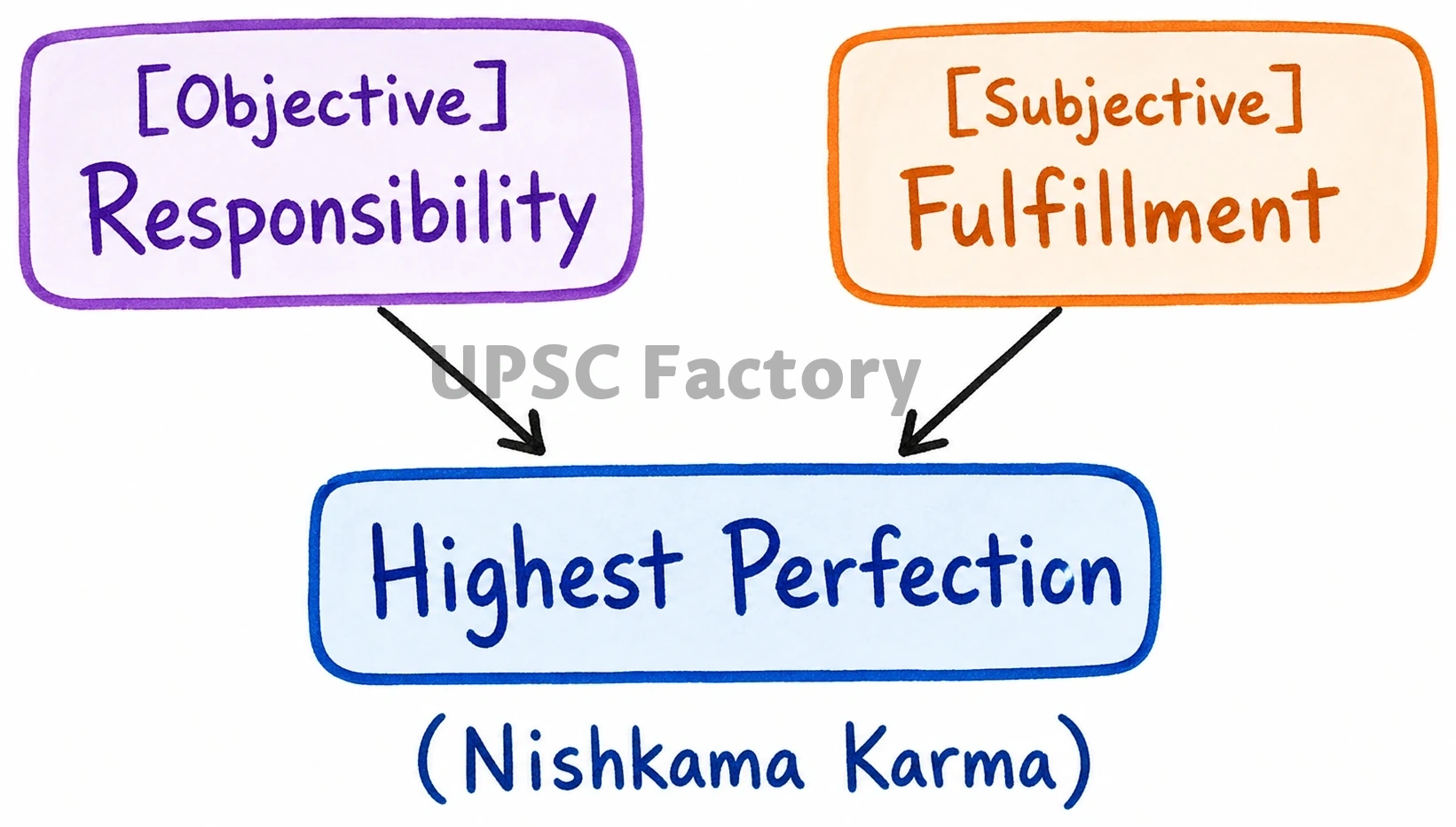
The statement embodies the Bhagavad Gita’s ideal of Nishkama Karma (selfless action), where steadfast commitment to public duty constitutes the highest ethical pursuit and perfection for a civil servant.

1. Devotion to Duty and Sense of Responsibility

  • Objective Action: Prioritizing constitutional mandates and public interest over personal biases (Kant’s Categorical Imperative).
  • Public Trust: Institutionalizing absolute accountability, integrity, and selflessness (Nolan Principles) to uphold democratic credibility.
  • Resilience in Crisis: Elevating public welfare above personal comfort or safety during emergencies (e.g., frontline district administrators during COVID-19).
  • Excellence in Execution: Translating moral responsibility into timely, tangible public outcomes (e.g., E. Sreedharan’s perfection and punctuality in executing the Delhi Metro).

2. Public Service as a Pathway to Personal Fulfilment

  • Self-Actualization: Reaching one’s highest human potential through transformative societal contribution (e.g., IAS Armstrong Pame’s fulfillment in building the crowdfunded “People’s Road”).
  • Intrinsic Reward: Deriving profound satisfaction from empowering the marginalized, which deeply transcends mere material or promotional incentives.
  • Moral Harmony: Aligning professional actions with inner ethical conscience, thereby eliminating cognitive dissonance and fostering lasting inner peace.

For a civil servant, duty transcends bureaucratic obligation; it becomes a meaningful spiritual vocation where the advancement of societal welfare and the attainment of personal perfection seamlessly converge.

Q. “One who is devoted to one’s duty attains highest perfection in life.” Analyse this statement with reference to sense of responsibility and personal fulfilment as a civil servant. Read More »

Q. What are the major teachings of Mahavir? Explain their relevance in the contemporary world.

Q. What are the major teachings of Mahavir? Explain their relevance in the contemporary world.

UPSC Mains 2025 GS4 Paper

Model Answer:

Vardhamana Mahavira, the 24th Jain Tirthankara, propagated an ethical framework centered on non-violence, self-control, and spiritual discipline to attain liberation (Moksha).

1. Major Teachings of Mahavira

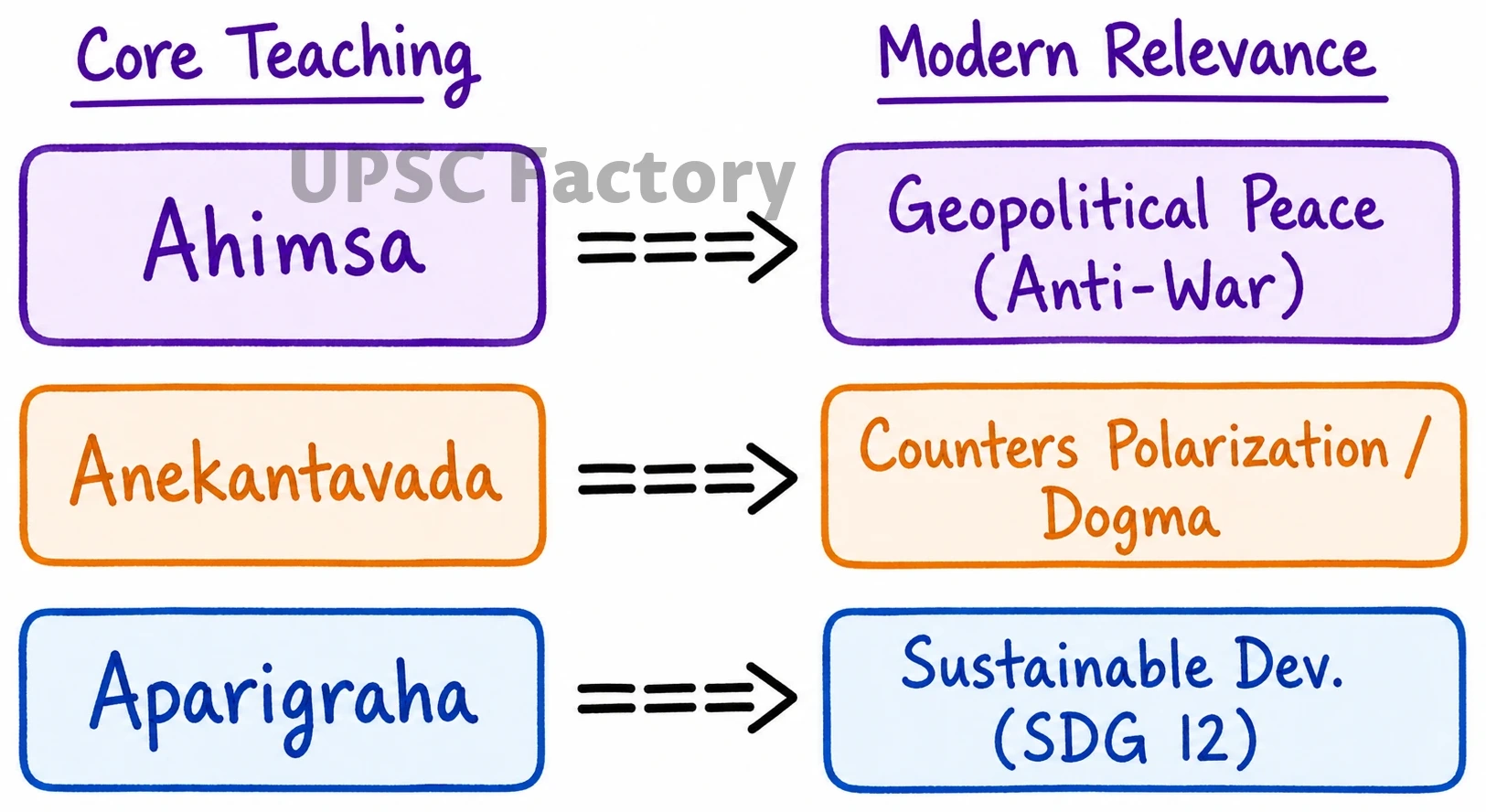
  • Ahimsa (Non-violence): Supreme emphasis on non-injury to all living beings in thought, word, and deed.
  • Anekantavada & Syadvada (Pluralism): Reality is multi-faceted; no single perspective holds the absolute truth.
  • Aparigraha (Non-possession): Complete detachment from material wealth and minimization of worldly desires.
  • Pancha Mahavrata: Includes Ahimsa, Satya (truth), Asteya (non-stealing), Brahmacharya (celibacy), and Aparigraha.
  • Triratna (Three Jewels): Emphasizes Right Faith (Samyak Darshana), Right Knowledge (Samyak Jnana), and Right Conduct (Samyak Charitra).

2. Contemporary Relevance

  • Geopolitical Peace: Ahimsa serves as a moral deterrent against modern warfare and terrorism (e.g., Russia-Ukraine conflict, Middle East crises).
  • Countering Polarization: Anekantavada promotes intellectual tolerance, directly combating religious extremism, dogmatism, and digital ‘cancel culture’.
  • Sustainable Development: Aparigraha acts as an antidote to hyper-consumerism and ecological degradation (e.g., Mission LiFE, SDG 12-Responsible Consumption).
  • Administrative Integrity: Practicing Asteya and Triratna instills probity, self-restraint, and anti-corruption values in public service.

Mahavira’s teachings transcend religious boundaries, offering a timeless, pragmatic blueprint to resolve the modern world’s socio-political, economic, and environmental crises.

Q. What are the major teachings of Mahavir? Explain their relevance in the contemporary world. Read More »

Q. “For any kind of social re-engineering by successfully implementing welfare schemes, a civil servant must use reason and critical thinking in an ethical framework.” Justify this statement with suitable examples.

Q. “For any kind of social re-engineering by successfully implementing welfare schemes, a civil servant must use reason and critical thinking in an ethical framework.” Justify this statement with suitable examples.

UPSC Mains 2025 GS4 Paper

Model Answer:

Social re-engineering aims for equitable socio-economic transformation (Article 38). Achieving this requires civil servants to combine cognitive tools (reason) with moral guardrails (ethics).

1. Role of Reason and Critical Thinking

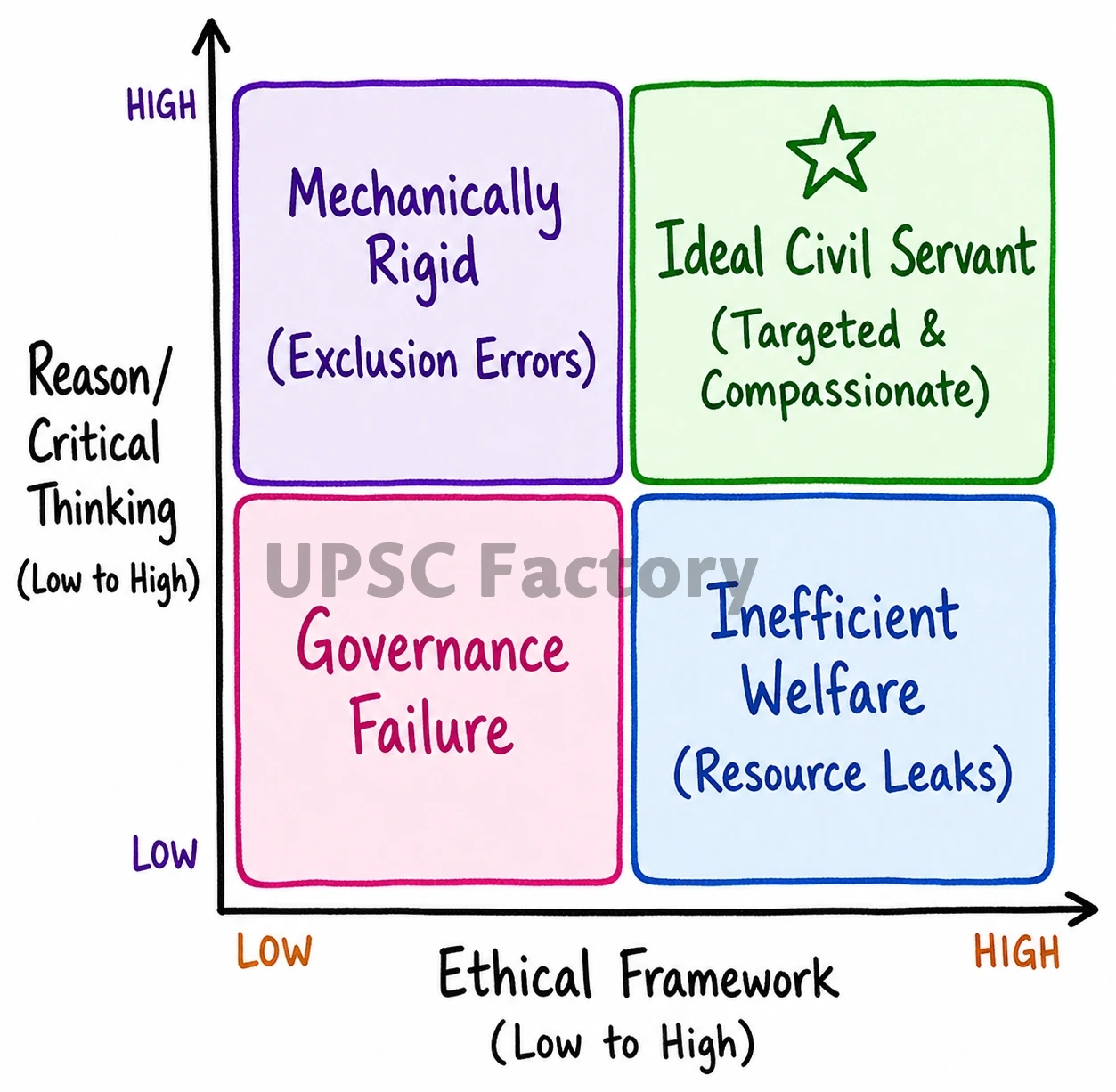
  • Evidence-Based Targeting: Uses empirical data to identify genuine beneficiaries and eliminate leakages (e.g., weeding out ghost identities via Direct Benefit Transfers).
  • Resource Optimization: Employs rational cost-benefit analysis to maximize welfare impact within strict fiscal constraints.
  • Predicting Bottlenecks: Critical thinking preempts systemic implementation hurdles (e.g., mapping digital literacy gaps before mandating exclusive e-governance portals).

2. Necessity of an Ethical Framework

  • Mitigating Exclusion: Prevents blind procedural adherence from causing human tragedies (e.g., allowing manual overrides during Aadhaar-PDS biometric failures to prevent starvation deaths).
  • Distributive Justice: Ensures rational policies inherently prioritize the most vulnerable, aligning with Rawls’ Theory of Justice (e.g., Antyodaya approach).
  • Compassionate Innovation: Merges logical resource mobilization with deep empathy (e.g., IAS Armstrong Pame applying critical thinking to crowdfund the ‘People’s Road’ in Manipur).

Reason without ethics is mechanically rigid, while ethics without reason is inefficient. Their synthesis guarantees an administration that is both highly effective and profoundly compassionate.

Q. “For any kind of social re-engineering by successfully implementing welfare schemes, a civil servant must use reason and critical thinking in an ethical framework.” Justify this statement with suitable examples. Read More »