Q. Ladakh is strategically located between China and Pakistan. As a measure to win hearts and minds of locals, discuss the Border Area Development Programmes (BADP) by the Central Government and civic actions by the Army. Also discuss demand of promulgation of provision of the Sixth Schedule of constitution for Ladakh.
Question from UPSC Mains 2026 GS3 Paper
Model Answer:
Flanked by the Line of Actual Control (LAC) and Line of Control (LoC), Ladakh’s national security paradigm relies heavily on local communities acting as India’s primary “eyes and ears.”
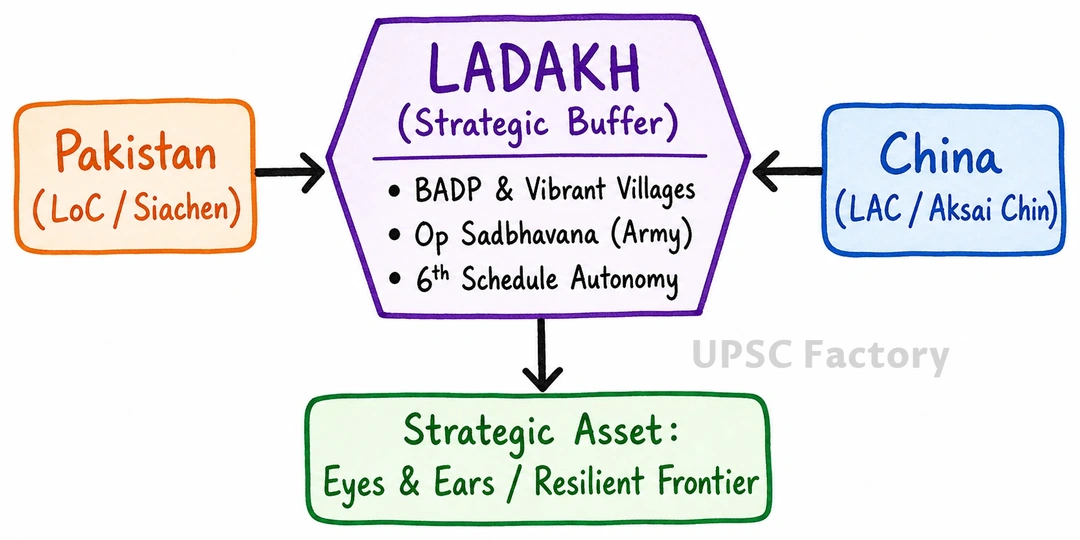
1. BADP and Military Civic Actions: Winning Hearts and Minds
Operation Sadbhavana: Provides quality education through Army Goodwill Schools, specialized medical camps, and micro-infrastructure in far-flung pockets (e.g., Nyoma, Turtuk).
Strategic Human Intelligence: Fosters deep civil-military integration, turning nomadic pastoralists (e.g., Changpas) into reliable early-warning and logistical assets for the armed forces.
2. Sixth Schedule Demand: Drivers and Security Implications
Tribal and Ecological Safeguards: Aims to protect Ladakh’s >97% tribal population, fragile Himalayan ecology, and land rights under Article 244(2) from unregulated commercialization.
Addressing Democratic Deficits: Mobilized by the Leh Apex Body and Kargil Democratic Alliance (LAB–KDA) to regain legislative representation lost post-2019 UT reorganization.
Frontier Stability: Resolving political grievances prevents disaffection, ensuring local populations remain emotionally integrated with the Indian Union amidst external geopolitical friction.
Harmonizing national security imperatives with regional tribal autonomy—via the MHA High-Powered Committee or enhanced powers to Ladakh Autonomous Hill Development Councils (LAHDC)—is crucial for long-term frontier resilience.
Q. Explain how fake news and disinformation pose threat to Internal Security and Public Order in Indian context? In this regard, discuss salient features of amendments in respect of Information Technology (Intermediary Guidelines and Digital Media Ethics Code) Rules 2021.
Question from UPSC Mains 2026 GS3 Paper
Model Answer:
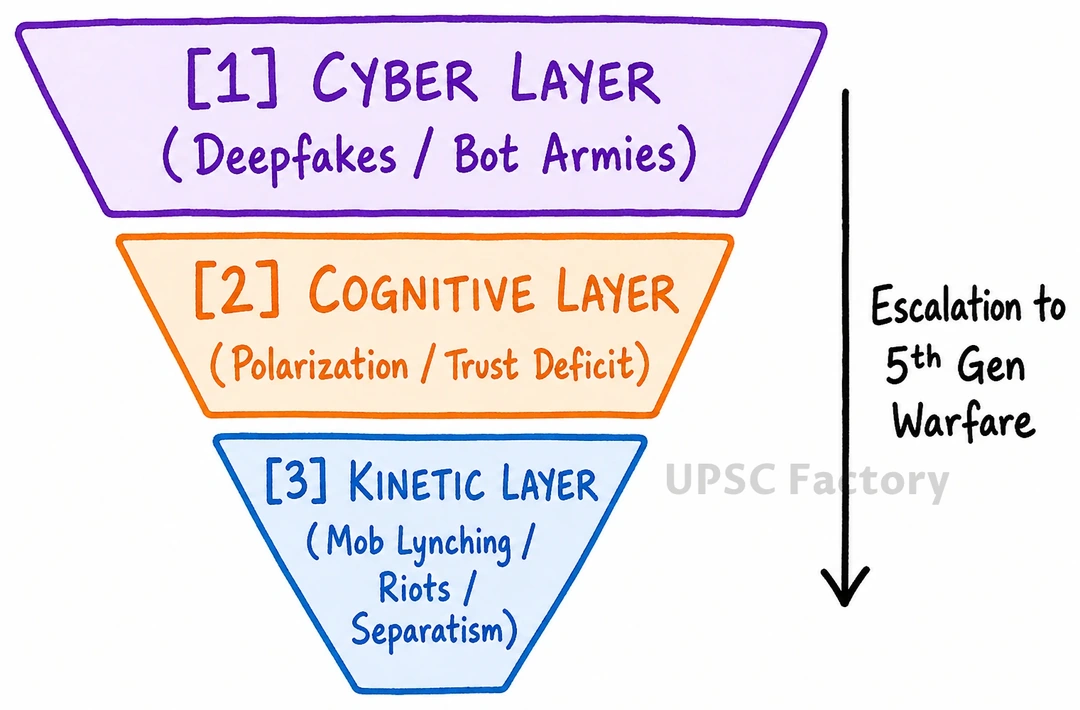
Disinformation serves as a non-kinetic tool in fifth-generation warfare, weaponizing digital hyper-connectivity to destabilize public order and internal security.
Cross-Border Asymmetric Warfare: Adversaries leverage bot networks and echo chambers for terror recruitment and separatism (e.g., ISIS/Khalistani propaganda).
Institutional Destabilization: Coordinated cognitive warfare erodes public trust in democratic apparatuses, disaster management, and public health systems.
Salient Features of Amended IT Rules (2022–2023)
Grievance Appellate Committees (GACs): Establishes government-appointed appellate panels to hear citizen appeals against Big Tech moderation decisions.
Enhanced Due Diligence (Rule 3(1)(b)): Obligates intermediaries to proactively prevent users from hosting misinformation, deepfakes, or impersonated content.
Conditioned Safe Harbour: Strips legal immunity under Section 79 of the IT Act if platforms fail to remove unlawful content within prescribed timelines (72 hours).
Fact-Check Mechanism: Empowers notified government bodies to flag false information regarding Union Government business.
Combating digital subversion requires institutional deterrence and algorithmic accountability, balancing internal security mandates with constitutional free speech under Article 19.
Q. Discuss the aim and goals of Kunming-Montreal global biodiversity framework. Mention India’s commitments and initiatives to achieve the goals and targets of this framework giving suitable examples.
Question from UPSC Mains 2026 GS3 Paper
Model Answer:
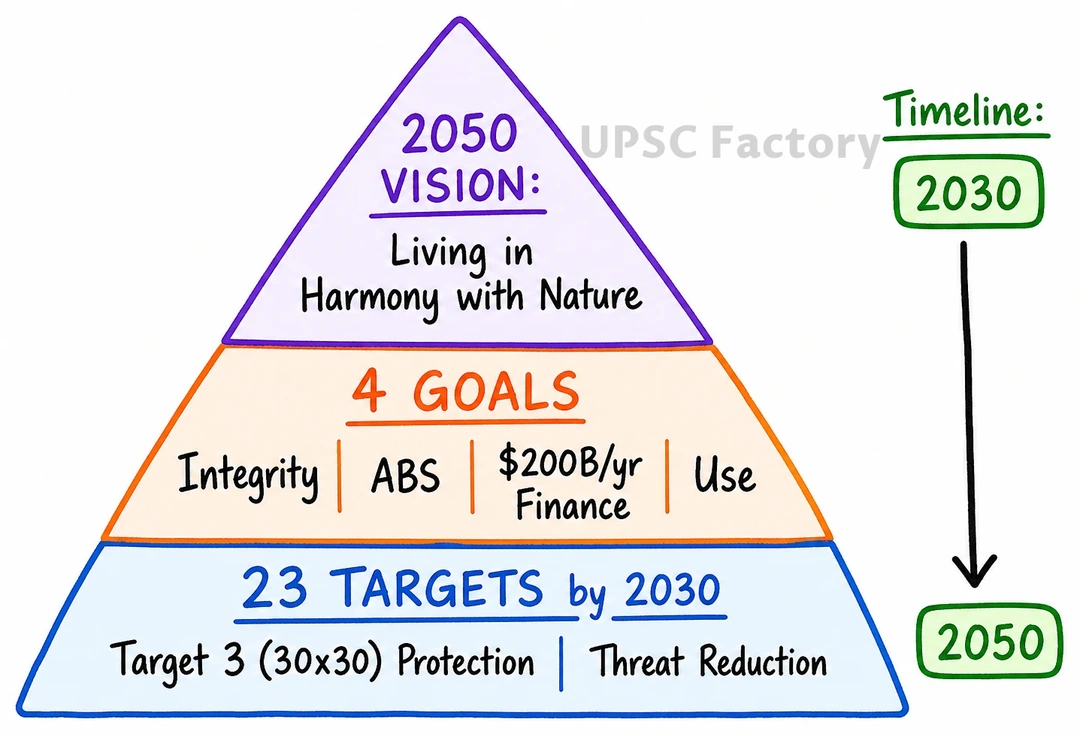
Adopted at CBD COP15, the Kunming-Montreal Global Biodiversity Framework (KMGBF) provides a global roadmap to halt and reverse biodiversity loss, aiming for “Living in Harmony with Nature” by 2050.
Aim, Goals, and Targets of KMGBF
Four 2050 Goals: Maintain ecosystem integrity and connectivity; sustainable biodiversity use; fair and equitable Access and Benefit-Sharing (ABS); and adequate financing ($200 billion/year).
23 Global Targets (2030):
Target 3 (30×30): Conserve 30% of degraded terrestrial, inland water, and coastal/marine areas.
Threat Reduction: Halve excess nutrients, pesticide risks, and global food waste; reduce invasive alien species by 50%.
India’s Commitments and Key Initiatives
Policy Alignment: Updated National Biodiversity Strategy and Action Plan (NBSAP 2024) and enforced the Biological Diversity (Amendment) Act, 2023 to streamline ABS and conservation goals.
Target 3 (30×30) & Habitat Restoration:
Mangrove restoration via MISHTI Scheme.
Conservation of 85 Ramsar wetland sites through Amrit Dharohar.
Formal notification of Other Effective Area-based Conservation Measures (e.g., Aravalli Biodiversity Park).
Species Recovery Leadership: Spearheading the International Big Cat Alliance (IBCA) for global transboundary conservation of 7 big cats (Project Tiger/Cheetah).
Sustainable Consumption: Mainstreaming pro-planet behavioral shifts to curb ecological footprints via Mission LiFE (Target 16).
Through updated statutory frameworks and targeted ecological missions, India harmonizes national developmental priorities with KMGBF targets to advance global planetary resilience.
Q. Discuss how the contradiction between ‘rapid infrastructure development’ and ‘disaster-risk reduction’ in ecologically-sensitive areas of India can be managed, with suitable examples.
Question from UPSC Mains 2026 GS3 Paper
Model Answer:
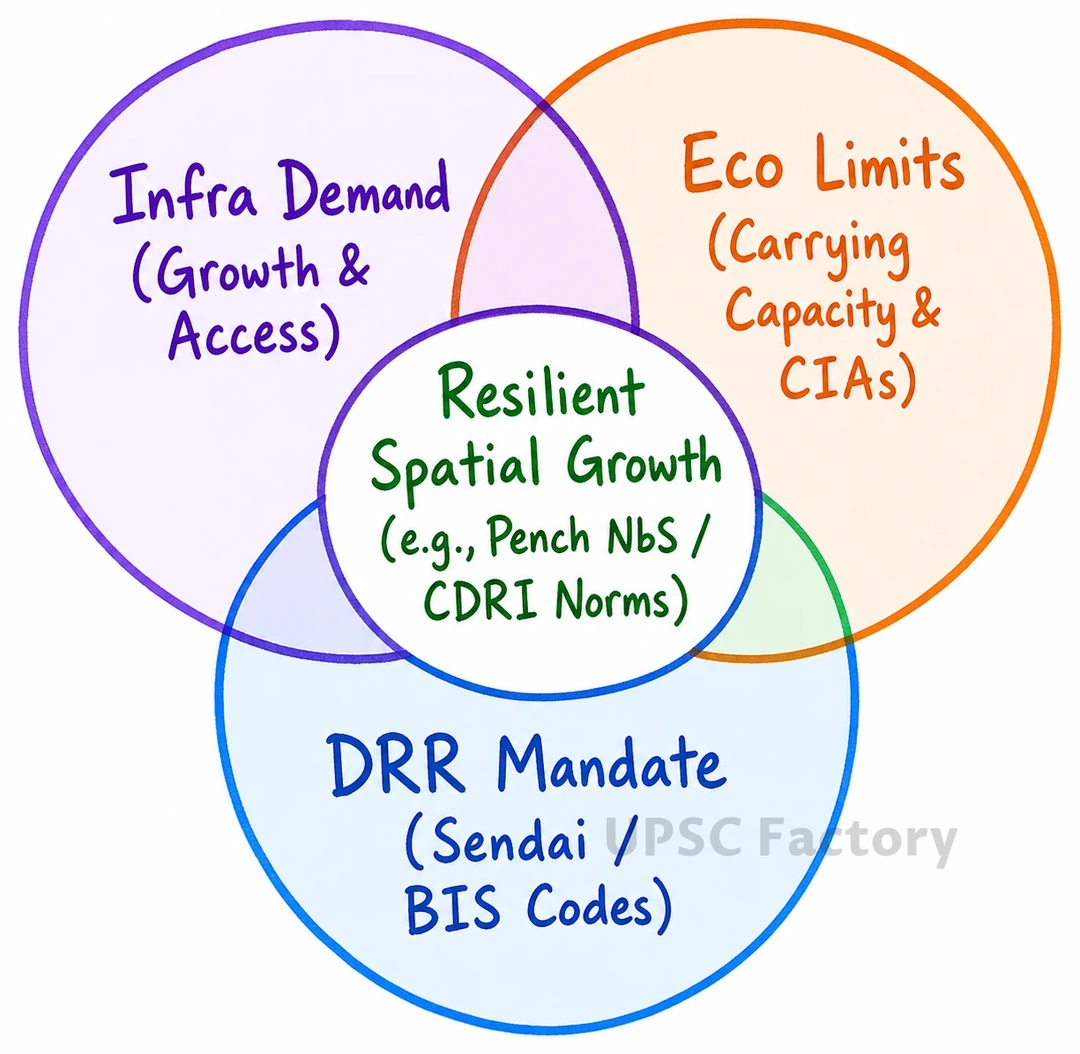
Rapid infrastructure expansion in India’s fragile biomes often triggers systemic disasters, demanding an operational transition toward risk-informed, climate-resilient spatial development.
Manifestations of the Infra–DRR Trade-off
Geological Instability: Deep tunneling and unscientific slope-cutting trigger severe land subsidence (e.g., Joshimath crisis, Chardham project).
Hydrological Disruption: Unregulated construction on floodplains and peri-glacial zones amplifies flash floods and GLOFs (e.g., 2023 Teesta dam breach, Sikkim).
Pathways to Manage the Contradiction
Carrying-Capacity Audits: Mandate regional Cumulative Impact Assessments (CIAs) to cap project densities in fragile ecologies.
Eco-Engineering & NbS: Deploy bio-engineering, hydroseeding, and structural underpasses to stabilize slopes and maintain habitats (e.g., NH-44 Pench eco-bridges).
Resilient Design Standards: Enforce Bureau of Indian Standards (BIS) seismic codes and flexible micro-tunneling instead of heavy blasting.
Advanced Hazard Telemetry: Install satellite-based InSAR monitoring, LiDAR slope-mapping, and automated sensor-driven Early Warning Systems (EWS).
Policy & Fiscal Alignment: Embed Sendai Framework Priority 3 (Resilient Infrastructure) through Coalition for Disaster Resilient Infrastructure (CDRI) technical benchmarks.
Mainstreaming disaster-risk auditing into project lifecycles is essential to achieve sustainable economic growth without compromising fragile ecological frontiers.
Q. Explain the factors responsible for inefficiency of agri-produce marketing. How e-commerce helps to reduce inefficiency of agri-produce marketing? Explain.
Question from UPSC Mains 2026 GS3 Paper
Model Answer:
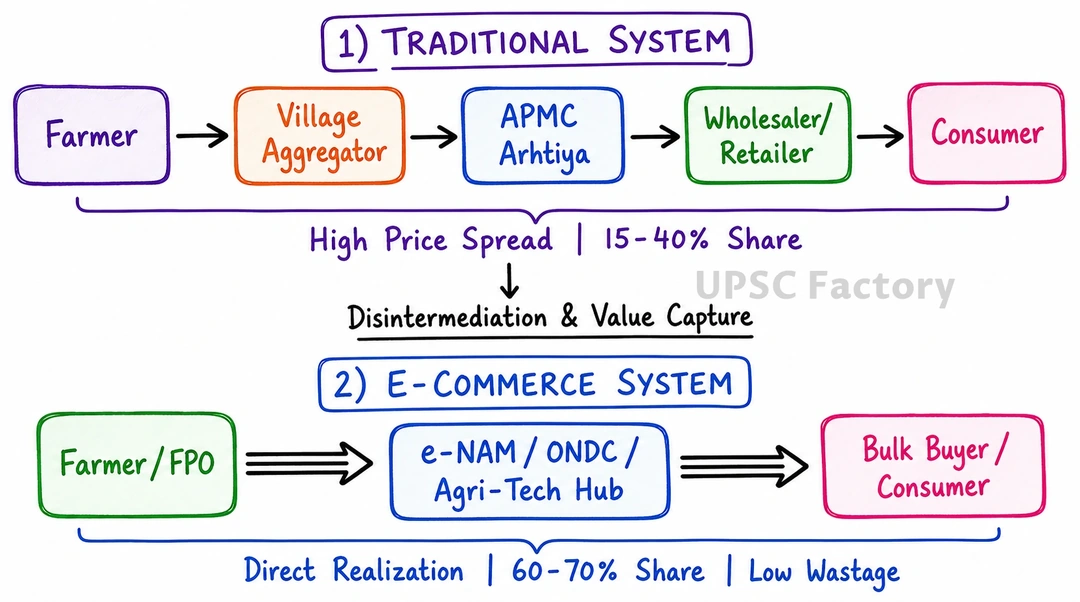
Agricultural marketing in India suffers from structural fragmentation, causing high post-harvest losses and restricting the farmer’s share in the consumer rupee to 15–40% (Ashok Dalwai Committee).
1. Factors Responsible for Marketing Inefficiencies
APMC Monopolies & Intermediation: Multi-layered intermediaries (Arhtiyas) and high market fees create cartelization and high price spreads.
Information Asymmetry: Lack of real-time price dissemination forces distress sales to local village aggregators.
Infrastructure Deficits: Inadequate cold-chain, scientific storage, and automated assaying facilities lead to 15–20% perishable losses.
Credit-Tied Sales: Informal credit dependency (Dadni system) binds smallholders to sell produce below market value.
2. How E-Commerce Reduces Inefficiencies
Supply Chain Disintermediation: Direct farm-to-fork procurement bypasses intermediaries, increasing farmer margins by 15–20% (e.g., Ninjacart, DeHaat).
Transparent Price Discovery: Digital bidding aggregates nationwide demand, eliminating local price manipulation (e.g., e-NAM, ONDC).
Predictive Logistics & Storage: Tech-enabled logistics integrate farm-gate collection and cold warehousing, minimizing transit time and post-harvest wastage.
Financial & Market Inclusivity: Transaction trails facilitate formal credit underwriting and forward-contracting for Farmer Producer Organisations (FPOs).
Scaling digital agri-commerce integrated with FPOs and rural physical infrastructure is vital to achieve a unified national agriculture market and double farmers’ income.
Q. Explain by giving two examples, how biotechnology has helped the Indian farmers in processing their perishable crops.
Question from UPSC Mains 2026 GS3 Paper
Model Answer:
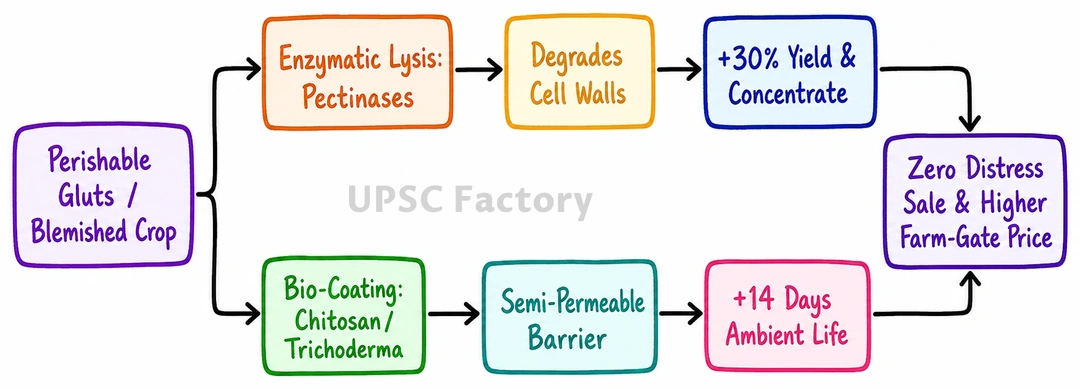
Biotechnology mitigates India’s ~15–20% post-harvest perishable losses by utilizing biocatalysts, microbial fermentation, and bio-preservatives to enhance shelf-life, recovery yields, and value addition.
1. Enzymatic Processing: Fruit Juice Extraction and Clarification
Mechanism: Application of recombinant pectinases, cellulases, and tannases to degrade fruit cell walls, reduce viscosity, and eliminate colloidal haze.
Farmer Impact: Developed by CSIR-CFTRI/CSIR-IHBT, this allows apple and citrus farmers to increase juice extraction yields by 20–30% and process low-grade/blemished harvests into commercial concentrates, avoiding distress sales during gluts.
2. Microbial Bio-Preservation: Edible Bio-Coatings for Tropical Fruits
Mechanism: Formulations utilizing chitosan, bacteriocins, and Trichoderma-derived biocontrol agents that act as semi-permeable atmospheric barriers and suppress fungal pathogens.
Farmer Impact: ICAR-CISH bio-coatings delay ripening and control anthracnose in mangoes and bananas, extending ambient shelf-life by 10–14 days and enabling long-distance domestic transit without cold-chain degradation.
Integrating indigenous biotechnological processing into FPOs under the PM-FME Scheme minimizes post-harvest loss, turning agricultural surplus into stable farmer profits.
Q. Distinguish between a Fast Breeder Reactor (FBR) and a thermal nuclear reactor. In the context of first indigenously developed prototype FBR at Kalpakkam, explain the term ‘criticality’. What are its implications for clean energy future of our country?
Question from UPSC Mains 2026 GS3 Paper
Model Answer:
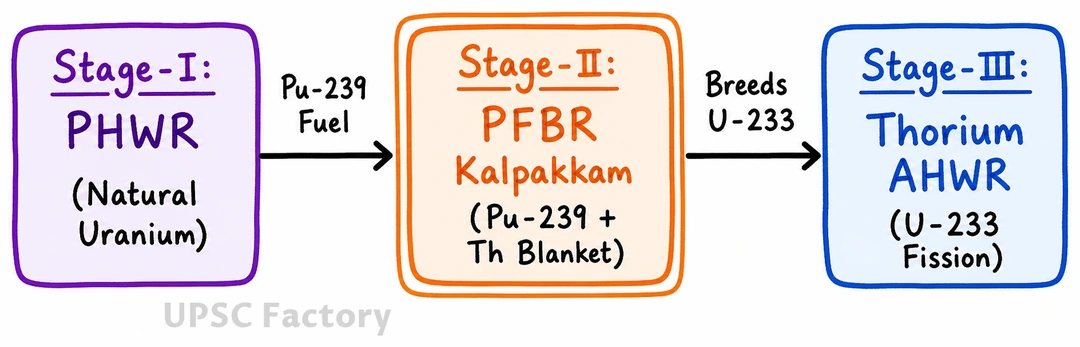
Core loading at the 500 MWe Prototype Fast Breeder Reactor (PFBR) at Kalpakkam operationalizes Stage-II of India’s Three-Stage Nuclear Programme, accelerating the transition toward a closed fuel cycle.
Distinction: FBR vs. Thermal Reactor
Parameter
Fast Breeder Reactor (FBR)
Thermal Nuclear Reactor (e.g., PHWR)
Neutron Energy
Fast neutrons (>0.1 MeV)
Slow/thermal neutrons (≈ 0.025 eV)
Moderator
None used
Heavy/Light water or Graphite required
Coolant
Liquid Sodium
Heavy water / Light water
Fuel Cycle
Breeds more fissile material (Pu-239) than it burns
Net consumer of fissile fuel (U-235)
‘Criticality’ Explained
Criticality refers to the state where a nuclear fission chain reaction becomes self-sustaining—the neutron multiplication factor (keff) equals 1, ensuring stable, continuous power generation without external neutron injection.
Implications for Clean Energy Future
Thorium Roadmap: Acts as the vital bridge to Stage-III by breeding fissile U-233 from vast domestic Thorium reserves.
Waste & Fuel Efficiency: Multiplies energy extraction from uranium by >70× while incinerating long-lived minor actinides, minimizing radioactive waste.
Firm Green Baseload: Supplies stable, round-the-clock clean electricity to balance intermittent solar-wind grids, supporting the Net-Zero 2070 target.
PFBR criticality cements indigenous technological mastery (BHAVINI), unlocking long-term energy security through sustainable, closed-loop nuclear power.
Q. Examine the view that financial inclusion is an integral part of social and economic inclusion in a country like India. Also throw light on the usefulness of the R.B.I.’s Financial Inclusion Index.
Question from UPSC Mains 2026 GS3 Paper
Model Answer:
Financial inclusion provides vulnerable segments timely access to affordable formal financial services, serving as a vital prerequisite for bridging socio-economic disparities and fostering equitable growth.
Leakage-Free Welfare Delivery: Secures direct transfer of subsidies to marginalized citizens, bolstering economic agency (e.g., DBT via JAM Trinity, PM-KISAN).
Social Safety Net Creation: Shields low-income households against health and climate shocks through micro-insurance and pensions (e.g., PMJJBY, Atal Pension Yojana).
Strategic Utility of RBI’s FI-Index
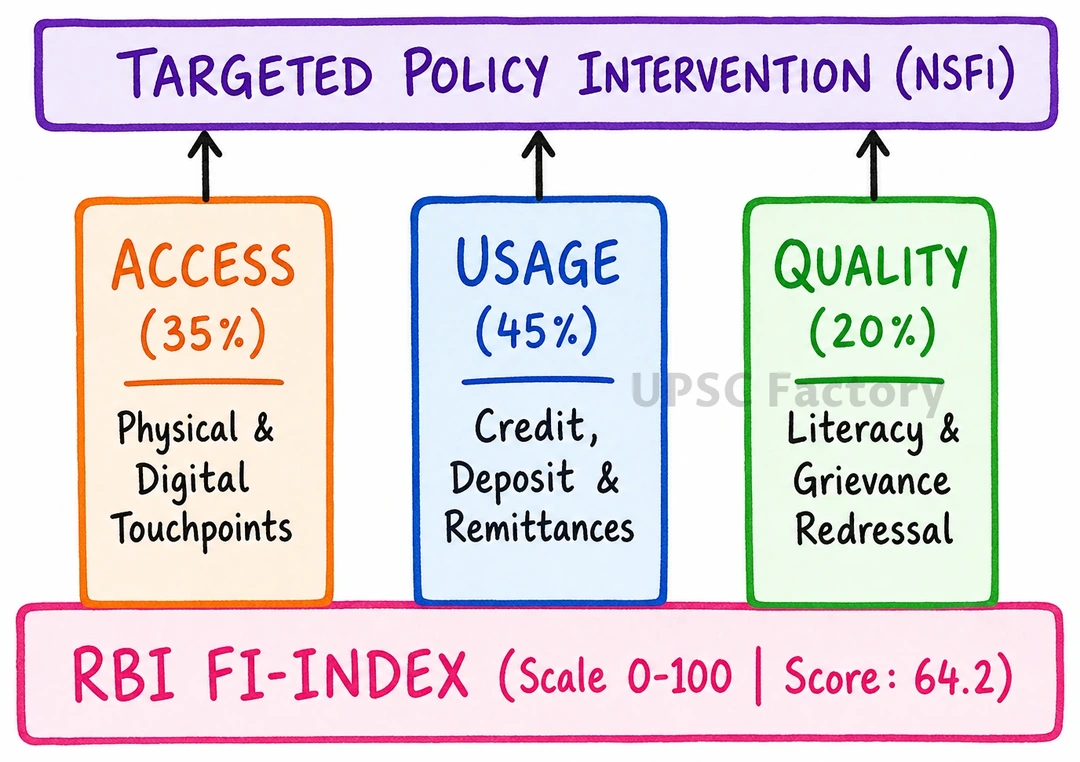
Comprehensive Measurement: Computes a single metric (0–100) reflecting multi-dimensional progress across Access (35%), Usage (45%), and Quality (20%)(Score: 64.2 in March 2024).
Beyond Mere Account Opening: Incorporates the ‘Quality’ parameter to track financial literacy, consumer protection, and grievance redressal.
Evidence-Based Policymaking: Highlights demand-side underutilization versus supply-side deficits, guiding targeted interventions under the National Strategy for Financial Inclusion (NSFI).
Transitioning from basic access to active usage and quality-driven financial integration is essential for achieving equitable, resilient, and inclusive growth (Viksit Bharat @2047).
Q. What do you mean by Digital Rupee? In this context, explain the working and progress of India’s Central Bank Digital Currency (CBDC).
Question from UPSC Mains 2026 GS3 Paper
Model Answer:
The Digital Rupee (e₹) is India’s sovereign Central Bank Digital Currency (CBDC) issued by the Reserve Bank of India (RBI) under the amended RBI Act, 1934, serving as a fungible legal tender backed 1:1 by physical currency.
Working & Architecture of Digital Rupee
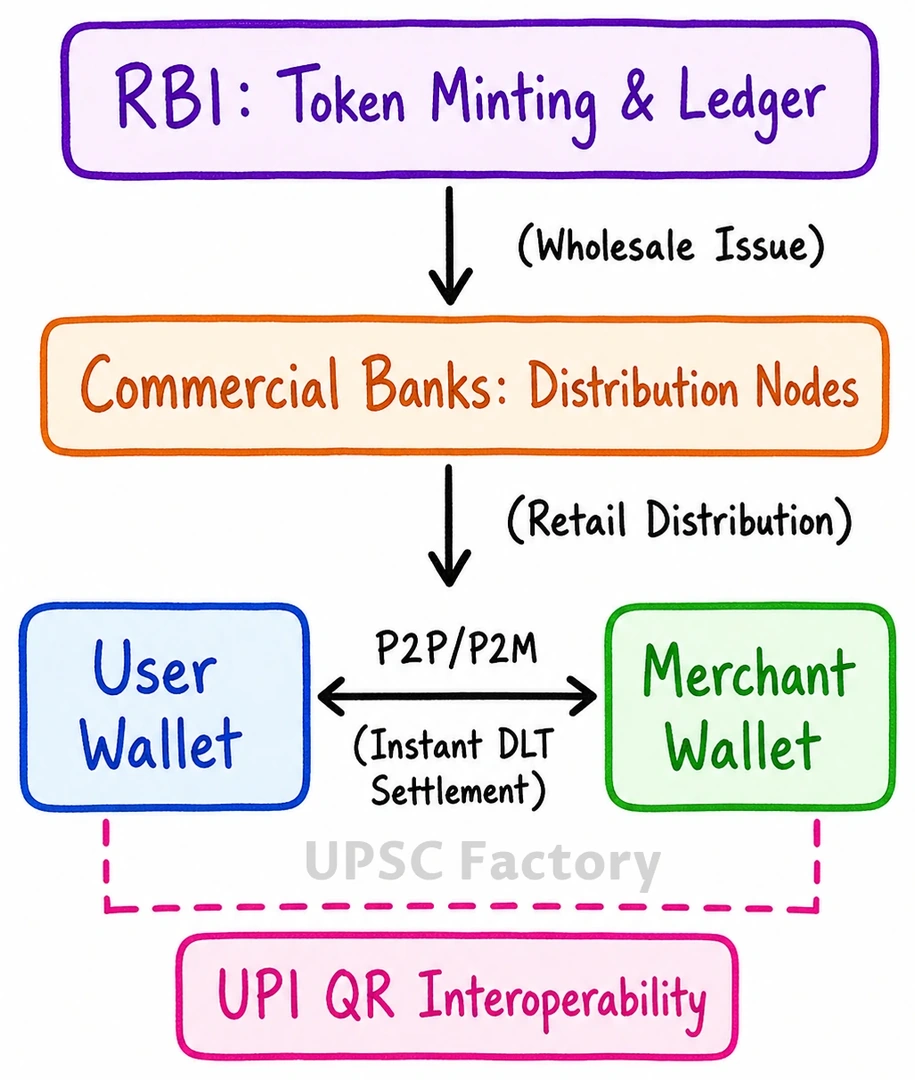
Two-Tier Distribution Model: RBI mints and transfers e₹ to intermediary commercial banks, which distribute tokens to end-users’ digital wallets.
Token-Based Architecture: Utilizes cryptography and hybrid Distributed Ledger Technology (DLT) for peer-to-peer (P2P) and peer-to-merchant (P2M) settlement without intermediate bank clearance.
Cash-Like Finality: Provides instant settlement finality and operational autonomy with tiered privacy protocols for small-value transactions.
Progress of India’s CBDC Pilots
Wholesale Pilot (e₹-W): Operationalized for interbank secondary market transactions in Government Securities, reducing counterparty settlement risk and transaction costs.
Retail Pilot (e₹-R): Scaled across closed user groups (CUG) in participating banks, achieving over 1 million daily pilot transactions.
UPI Interoperability: Integrated single QR-code compatibility, allowing users to scan existing merchant UPI codes via CBDC wallets.
Programmability & Offline Mode: Tested programmable use-cases (e.g., targeted agricultural subsidies) and NFC-based offline transactions for low-connectivity regions.
The Digital Rupee significantly lowers physical cash-logistics overheads, strengthens monetary sovereignty against private cryptocurrencies, and lays the digital rail for frictionless cross-border remittances.