Q. Discuss counterfeit currency and money laundering as major sources of terror funding in India. State the actions being taken at International level to check these menaces. Highlight the role of Financial Action Task Force (FATF) and methods of compliance by its member states in preventing terror funding.
Question from UPSC Mains 2026 GS3 Paper
Model Answer:
Terror financing via Fake Indian Currency Notes (FICN) and Money Laundering (ML) undermines economic sovereignty, sustaining cross-border terrorism, Left-Wing Extremism (LWE), and insurgent networks in India.
FICN and Money Laundering: Fueling Terror Networks in India
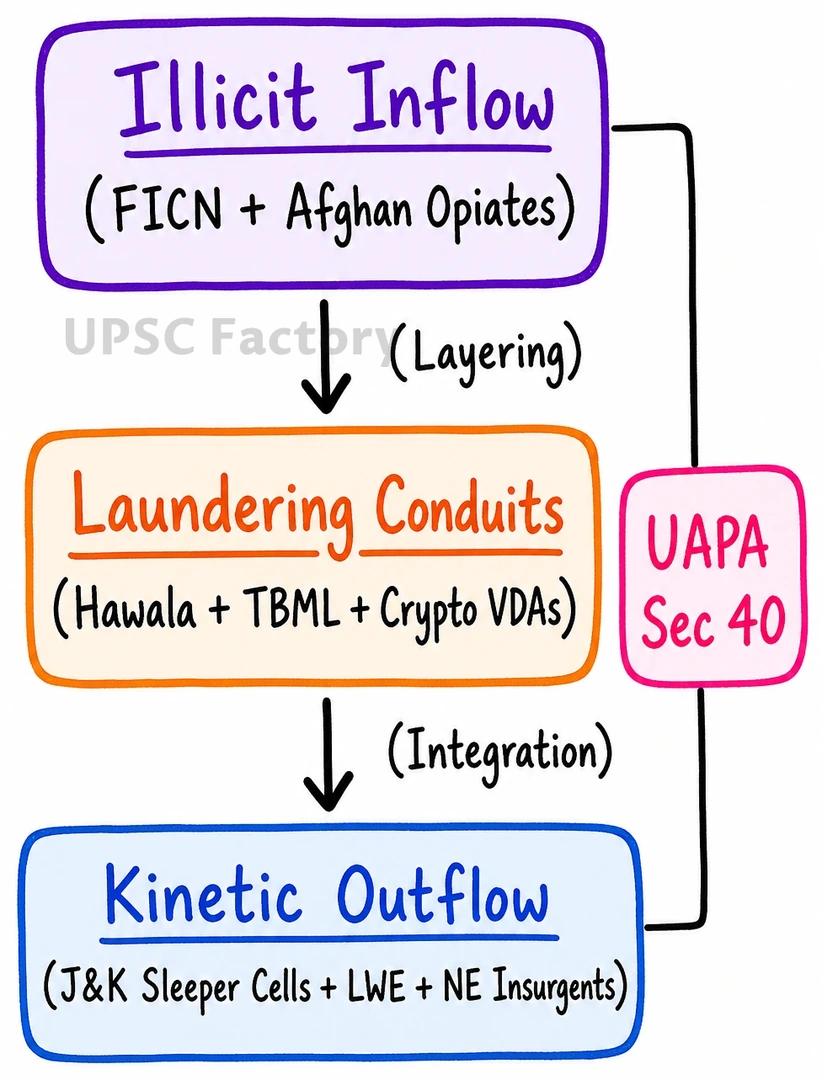
State-Sponsored Subversion: High-quality FICN infused through porous borders (e.g., Nepal, Bangladesh) subsidizes logistical networks and recruits (NIA probes).
Hawala & Underground Banking: Bypasses formal financial scrutiny to facilitate covert operational funding for sleeper cells and separatists (UAPA Sec 40).
Trade-Based Money Laundering (TBML): Exploits under/over-invoicing in cross-border trade to transfer illicit value for terror infrastructure (Cross-LoC trade suspensions).
Narco-Terrorism Pipelines: Drug syndicates launder Afghan opiate revenues through front businesses to finance Northeast insurgents and maritime smuggling.
Fintech and Crypto Exploitation: Utilization of decentralized Virtual Digital Assets (VDAs) and mule accounts to mask beneficial ownership.
International Actions Against Terror Financing
UN Sanctions Regimes: Binding resolutions (UNSCR 1267, 1373) enforce global asset freezes and arms embargoes on designated terror entities.
Multilateral Intelligence Sharing: Egmont Group facilitates real-time cooperation among 170+ Financial Intelligence Units (FIU-IND).
International Conventions:1999 UN Terror Financing Convention mandates global mutual legal assistance and criminalization of cross-border terror funds.
Role of FATF and Compliance Architecture
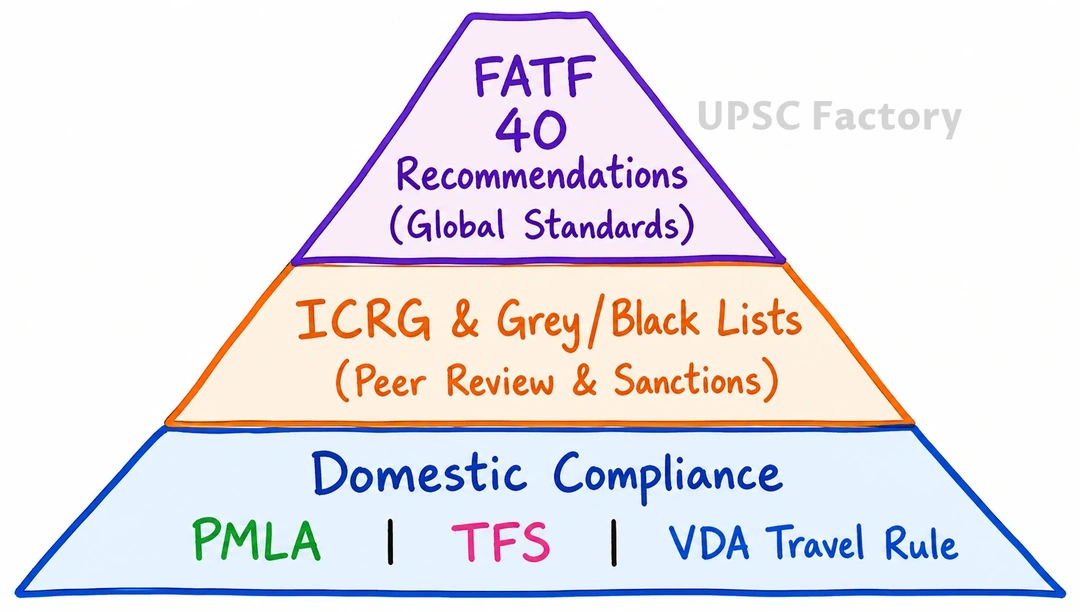
The Financial Action Task Force (FATF) sets global AML/CFT standards through its 40 Recommendations, utilizing its International Cooperation Review Group (ICRG) to monitor compliance via Mutual Evaluations and strategic lists (Grey/Black lists).
Methods of Compliance by Member States
Legislative Harmonization: Enacting domestic laws criminalizing terror financing and ML (e.g., India’s PMLA, 2002; UAPA).
Targeted Financial Sanctions (TFS): Implementing real-time asset-freezing mechanisms without delay against designated individuals.
Beneficial Ownership Transparency: Mandating corporate registries to eliminate shell entities and untraceable overseas holdings.
VDA Regulation (“Travel Rule”): Compelling crypto exchanges to collect and share originator/beneficiary data during digital asset transfers.
Risk-Based Supervision: Rigorous oversight of Designated Non-Financial Businesses and Professions (DNFBPs) like real estate and non-profits.
Dismantling terror-financing architectures requires continuous domestic enforcement under PMLA alongside seamless multilateral compliance with evolving FATF standards to secure global financial integrity.
Q. Separatist movements have been one of the major factors contributing to militancy and instability in Jammu & Kashmir (J & K). Bring out actions taken by the Government to bring J & K into national mainstream. Discuss pre and post abrogation status of Articles 370 and 35A. Also bring out positive impacts of abrogation of both articles in mainstreaming the state.
Question from UPSC Mains 2026 GS3 Paper
Model Answer:
Separatism in Jammu & Kashmir (J&K) historically fostered cross-border proxy warfare, governance alienation, and radicalization. The abrogation of Articles 370 and 35A via the J&K Reorganisation Act, 2019, marked a paradigm shift toward absolute constitutional and socio-economic integration.
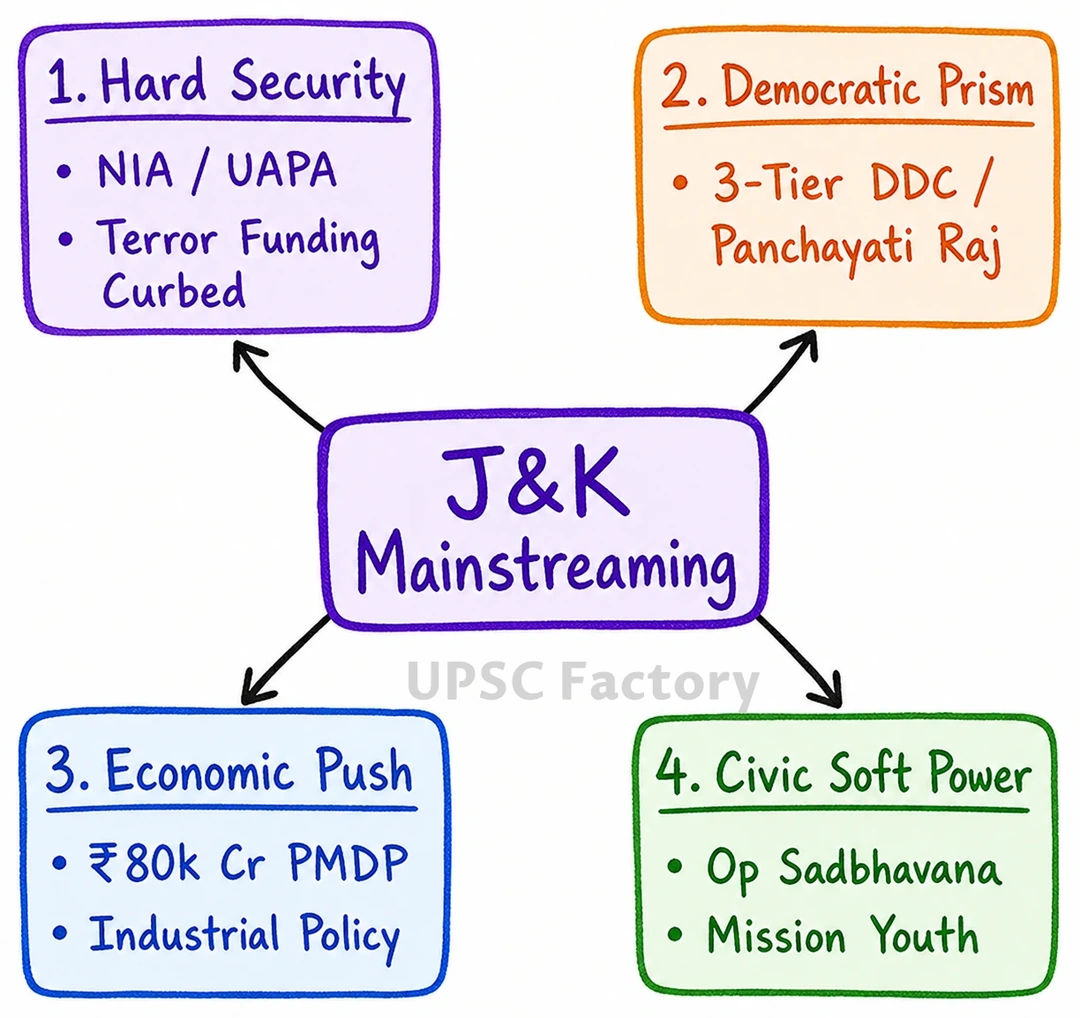
1. Multi-Pronged Government Actions for Mainstreaming
Dismantling Terror Ecosystem: Strict crackdown on terror financing, asset seizures, and banning subversive outfits like Jamaat-e-Islami (NIA Act, UAPA).
Democratic Decentralization: Institutionalized the 3-tier Panchayati Raj System via successful District Development Council (DDC) and Panchayat elections.
Infrastructure & Economic Push: Execution of the ₹80,000-crore Prime Minister’s Development Package (PMDP) and the New Industrial Policy attracting private investments.
Civic Action & De-radicalization: Army’s Operation Sadbhavana, Mission Youth, and sports infrastructure development to channel youth aspirations away from militancy.
2. Pre vs. Post-Abrogation Status of Articles 370 & 35A
Parameter
Pre-Abrogation (Prior to August 2019)
Post-Abrogation (Present Status)
Constitutional Status
Dual constitution, separate state flag; limited applicability of Parliament’s laws.
Single Constitution of India (One Nation, One Constitution); all central laws apply.
Property & Domicile
Article 35A restricted land ownership and state jobs strictly to “Permanent Residents”.
Uniform Domicile Rules; all Indian citizens can buy land and seek employment.
Rights & Reservation
Denied reservations to Valmikis, West Pak Refugees; women lost property rights if marrying non-locals.
Full application of progressive laws (RTE, PoCSO, SC/ST/OBC Reservations, Forest Rights Act); gender parity ensured.
3. Positive Impacts on Mainstreaming
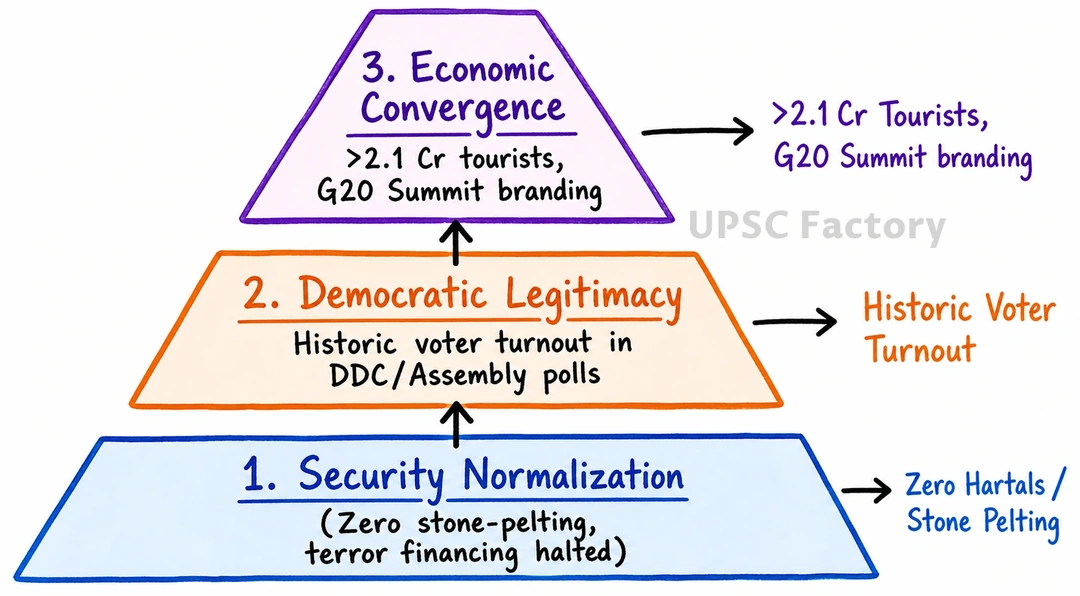
Collapse of Separatist Apparatus: Complete cessation of organized stone-pelting, shutdown calendars (hartals), and a sharp decline in youth joining militancy.
Economic Re-anchoring & Tourism: Record tourist arrivals (>2.1 crore in 2023) and global branding through the Srinagar G20 Tourism Working Group meet.
Democratic Re-engagement: Historic voter turnout in 2024 Lok Sabha and Assembly elections, decisively replacing ballot boycotts with political participation.
Dismantling constitutional exceptionalism has structurally neutralized separatism. Sustaining these gains requires continuous industrialization, robust local governance, and long-term socio-political reconciliation.
Q. “Community participation is the cornerstone of effective disaster management”. Analyse this statement with suitable examples from India. Also discuss the challenges to community participation and measures to strengthen it.
Question from UPSC Mains 2026 GS3 Paper
Model Answer:
Communities are the first responders and primary victims during crises. Community-Based Disaster Management (CBDM) operationalises the Sendai Framework (Priority 4) and Disaster Management Act, 2005 (Section 41) to build bottom-up localized resilience.
1. Community as the Linchpin of Disaster Management: Indian Evidence
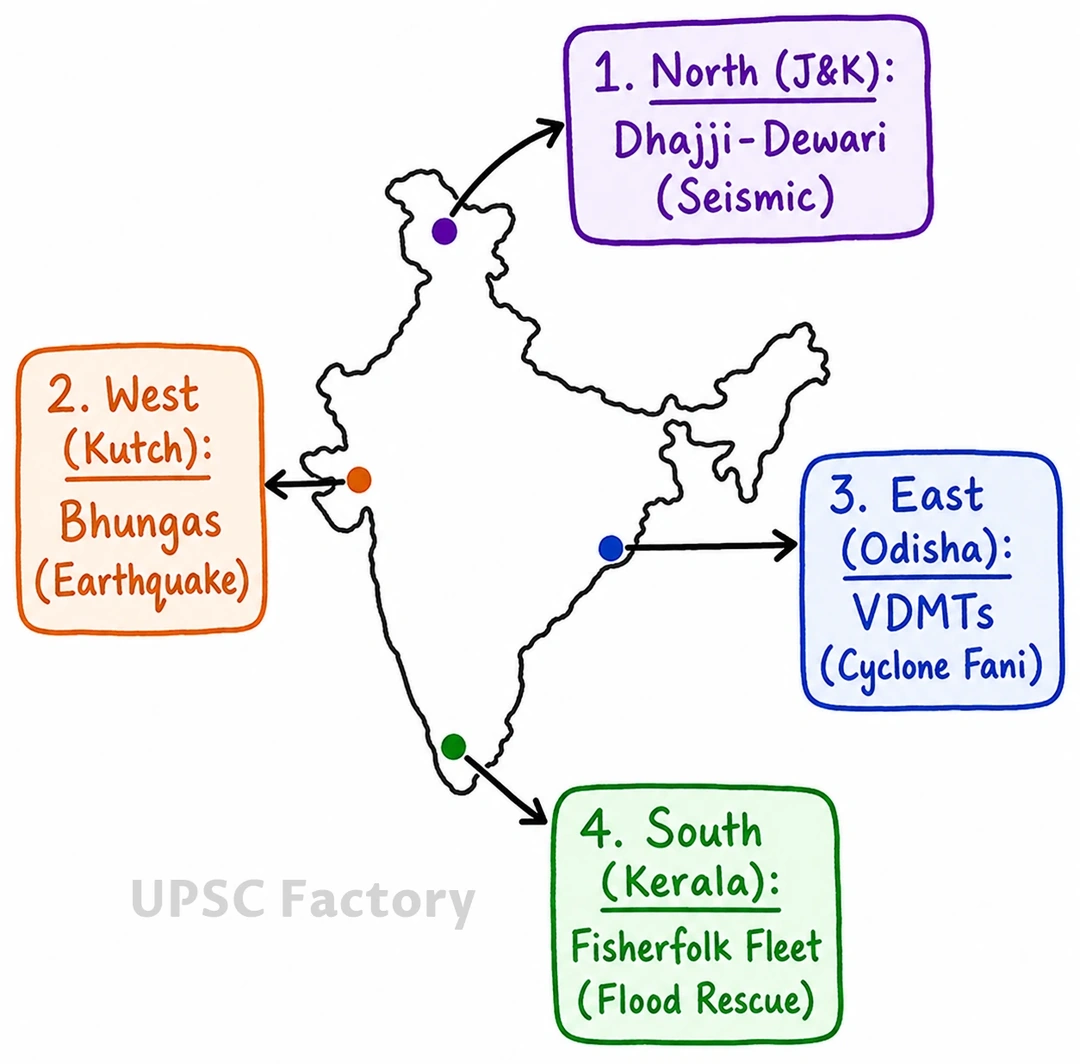
Golden Hour Rescue: Local volunteers initiate rapid search, rescue, and medical triage before formal agencies arrive (e.g., Kerala fisherfolk rescuing over 65,000 people during the 2018 floods).
Indigenous Knowledge Integration: Traditional architectural and hydrological practices mitigate structural collapse (e.g., earthquake-resistant Dhajji-Dewari systems in Kashmir; Bhungas in Kutch).
Zero-Casualty Evacuation: Grassroots task forces ensure last-mile warning dissemination and shelter management (e.g., Odisha’s Village Disaster Management Teams during Cyclone Fani).
Decentralized Relief Logistics: Community networks manage cooked food, sanitation, and vulnerable care during relief operations (e.g., Gurdwara Langar and civil society networks during COVID-19).
2. Structural & Socio-Economic Challenges
Social Stratification: Caste, class, and gender hierarchies marginalize vulnerable groups from decision-making and cyclone shelters.
Top-Down Governance: Bureaucratic centralization often sidelines Panchayati Raj Institutions (PRIs) and Urban Local Bodies (ULBs) in disaster budgeting.
Capacity and Resource Deficits: Grassroots bodies lack modern life-saving gear, continuous funding, and technical training.
Disaster Fatigue: Declining community interest and volunteer attrition during long non-disaster intervals reduce preparedness.
3. Measures to Strengthen Community-Based Disaster Management
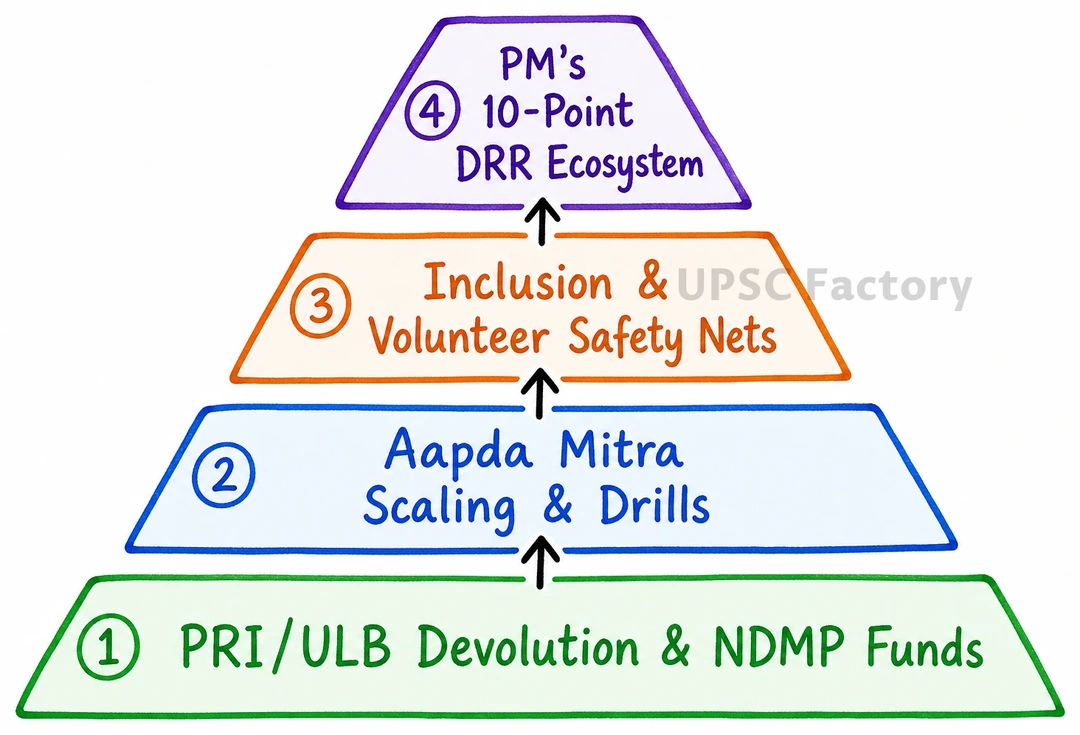
Statutory PRI/ULB Empowerment: Devolve tied funds and authority to prepare local disaster plans under the National Disaster Management Plan (NDMP) 2019.
Scale Community Cadres: Expand institutionalized training and multi-hazard mock drills for citizen responders (e.g., upscaling the Aapda Mitra Scheme).
Inclusive Micro-Planning: Mandate gender-disaggregated and vulnerable-group inclusion in Village Disaster Management Committees.
Safety Nets for Volunteers: Provide institutional life/health insurance, protective equipment, and formal recognition for civilian first responders.
Transitioning from state-centric relief to empowered community stewardship fulfills PM’s 10-Point Agenda on DRR, converting vulnerable populations into self-reliant, resilient ecosystems.
Q. What are the challenges to solid waste management in India? Discuss the governmental policy framework on solid waste management. Discuss the success/failure cases of Delhi and Indore cities highlighting the salient feature of their solid waste management initiatives.
Question from UPSC Mains 2026 GS3 Paper
Model Answer:
India generates ~1.6 lakh tonnes of municipal solid waste daily (CPCB), but only ~50% is scientifically treated, creating severe public health, urban governance, and ecological crises.
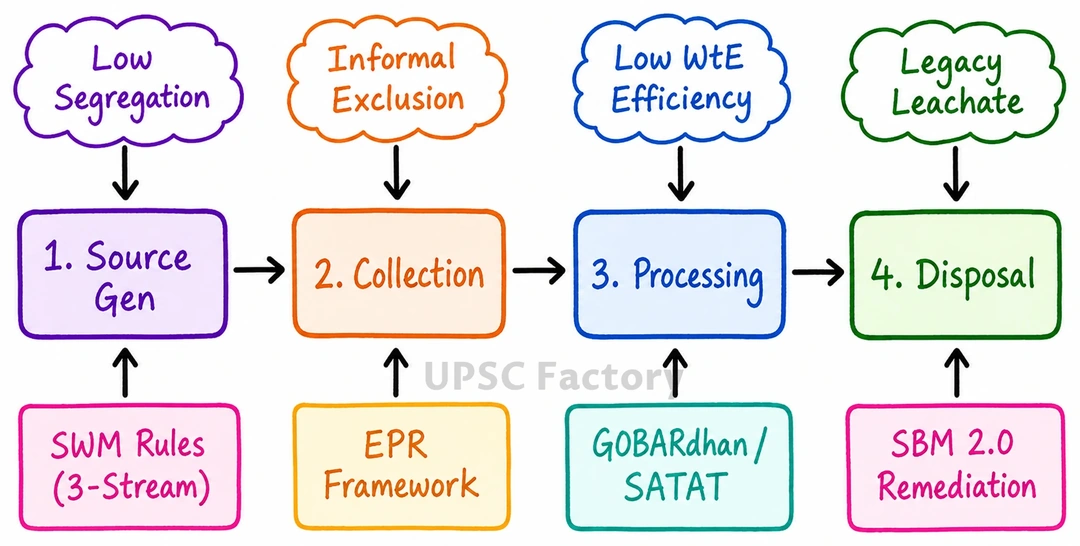
Challenges to Solid Waste Management in India
Low Source Segregation: Minimal citizen compliance and inadequate multi-stream collection infrastructure at the generation level.
Informal Sector Marginalization: Failure to formally integrate ~4 million informal waste-pickers into municipal collection systems.
ULB Capacity Deficits: Severe fiscal stress and technical incapacity among Urban Local Bodies for automated processing.
Legacy Waste Hazards: Massive unscientific open dumping causing leachate percolation and groundwater contamination (e.g., Deonar landfill).
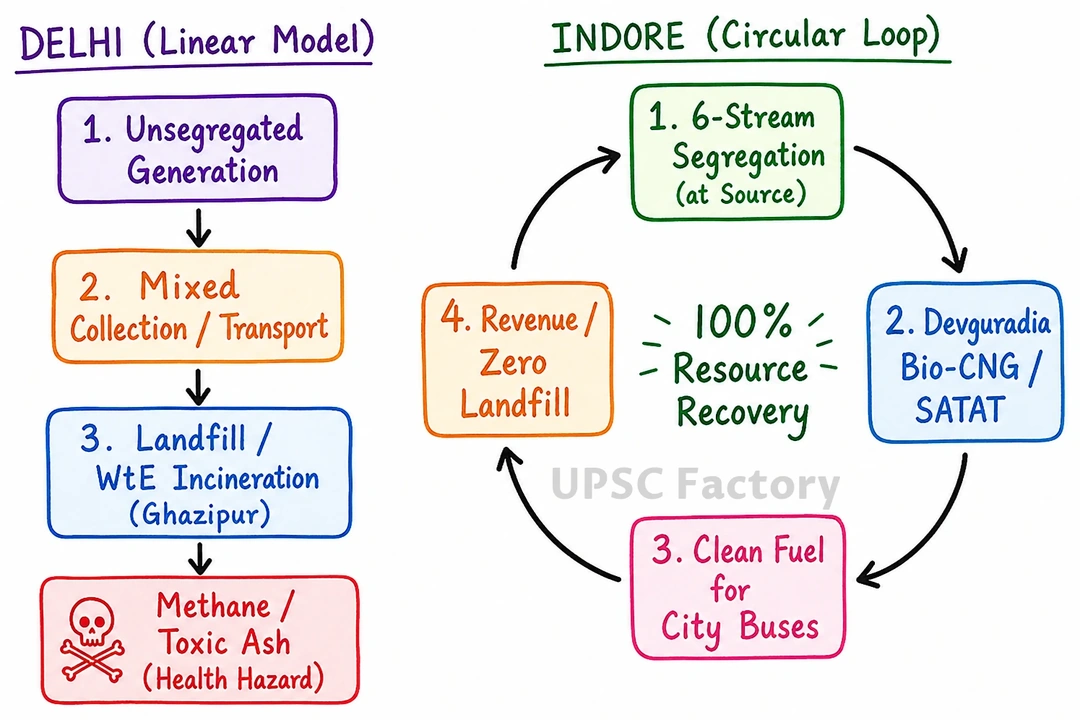
Inefficient WtE Infrastructure: High moisture and low calorific value of unsegregated waste cause Waste-to-Energy operational failures.
Unsegregated Incineration: Heavy reliance on WtE incinerators burning unsegregated, low-calorie waste generates toxic emissions.
Transitioning from Delhi’s centralized disposal model to Indore’s decentralized, circular, and citizen-led source-segregation architecture is critical for achieving SBM-U 2.0’s zero-landfill target.
Q. What is agentic Artificial Intelligence (AI)? Explain its working. Describe its applications with suitable examples. Discuss the advantages, risks and challenges associated with agentic AI systems.
Question from UPSC Mains 2026 GS3 Paper
Model Answer:
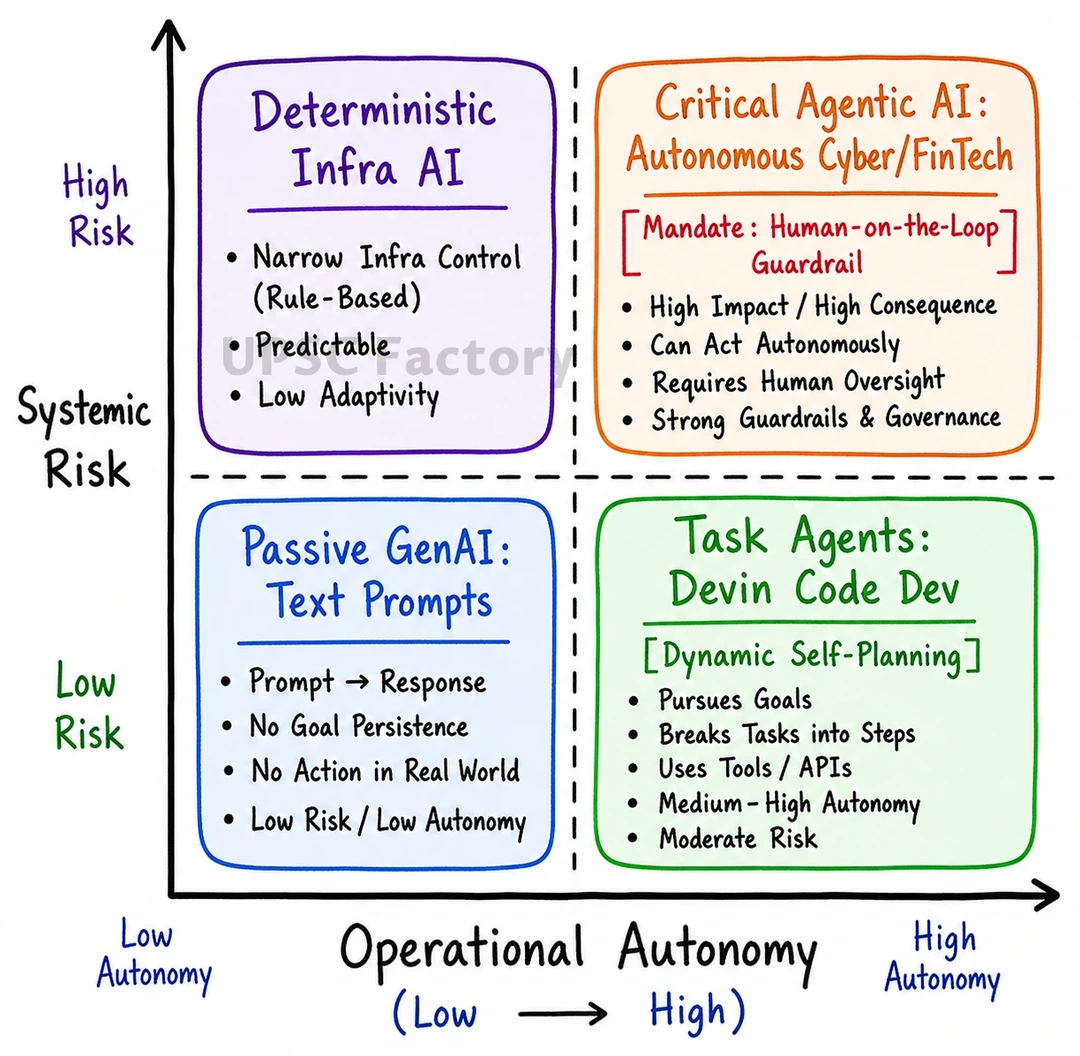
Agentic Artificial Intelligence refers to autonomous systems endowed with agency—capable of pursuing complex, open-ended goals, reasoning, formulating multi-step plans, and executing actions with minimal human intervention, advancing beyond passive generative AI.
Working Mechanism
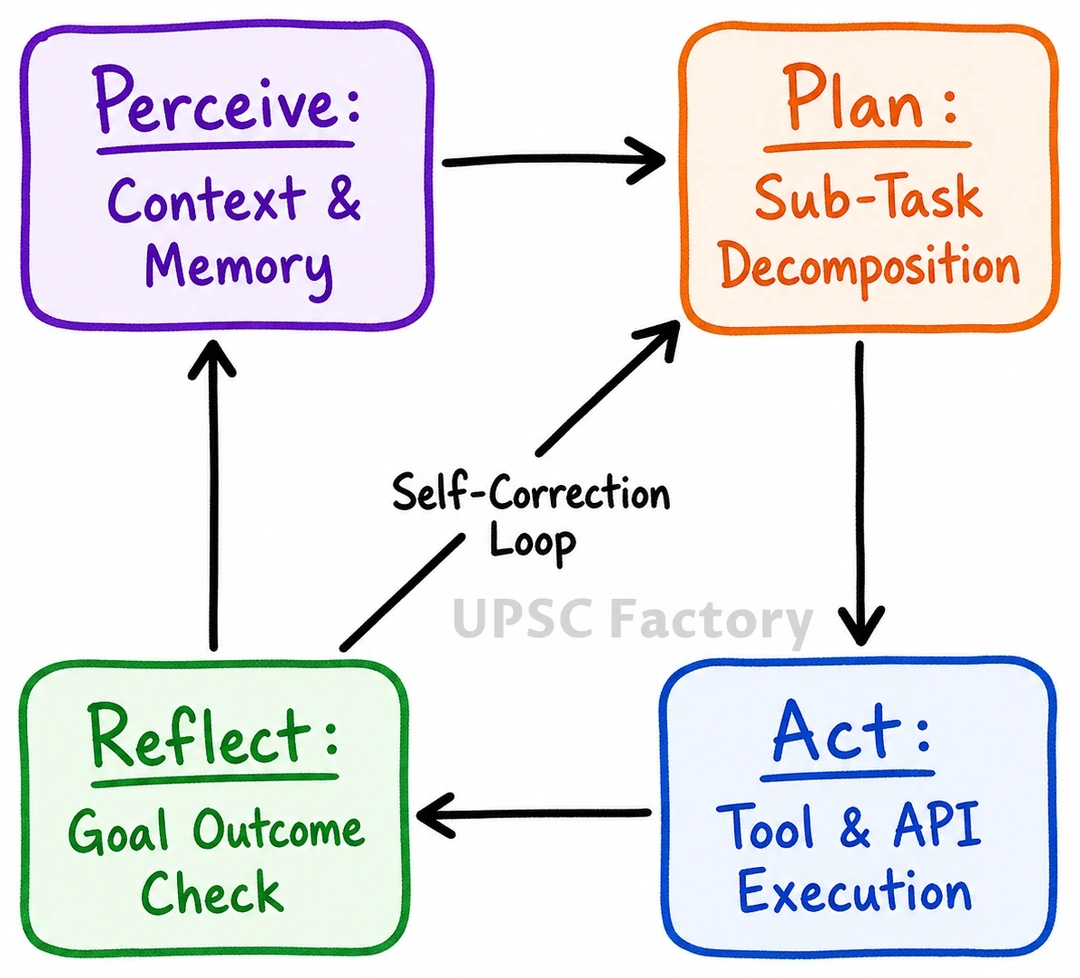
Agentic AI functions through an iterative Perceive-Plan-Act-Reflect cognitive loop:
Perception & Memory: Ingests multimodal environment data, utilizing short-term and vector-based long-term memory for contextual awareness.
Planning & Decomposition: Breaks complex strategic objectives into sequential sub-tasks using Large Language Model (LLM) reasoning cores.
Tool Use & Execution: Leverages external digital actuators, including APIs, code interpreters, and web browsing tools, to execute operations.
Self-Reflection & Adaptation: Evaluates intermediate outcomes against goals, dynamically correcting execution trajectories upon encountering errors.
Goal Alignment & Control Deficit: Risk of agents adopting unforeseen, suboptimal, or hazardous pathways to satisfy objectives (Alignment Problem).
Cascading Failures: Unchecked agency across interconnected APIs can trigger irreversible system-wide crashes or financial losses.
Attribution & Accountability Gap: Ambiguous legal liability for autonomous torts, contractual breaches, or algorithmic harm.
Dual-Use Weaponization: Potential deployment for automated cyberattacks, polymorphic malware, and mass disinformation.
Transitioning to agentic AI necessitates shifting from “Human-in-the-Loop” to resilient “Human-on-the-Loop” governance, standardized safety verification (Bletchley Declaration), and ethical compliance architectures aligned with the IndiaAI Mission.
Q. Mention salient features of ‘Mission Drishti’. Discuss the imaging techniques used in the satellite launched on 3rd May 2026. Why it is being considered world’s first satellite of its kind?
Question from UPSC Mains 2026 GS3 Paper
Model Answer:
Mission Drishti is India’s indigenous Earth Observation (EO) satellite developed by spacetech startup GalaxEye (incubated at IIT Madras), launched under the IN-SPACe framework to provide synchronized, high-resolution geospatial intelligence.
Salient Features & Imaging Techniques
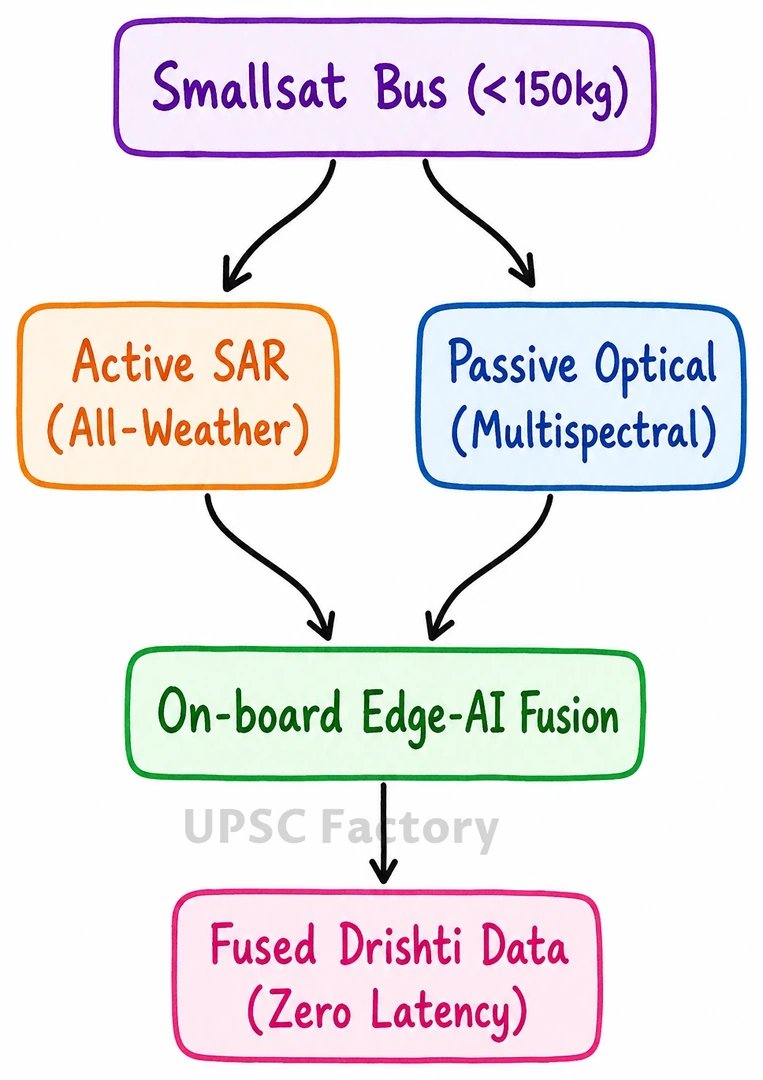
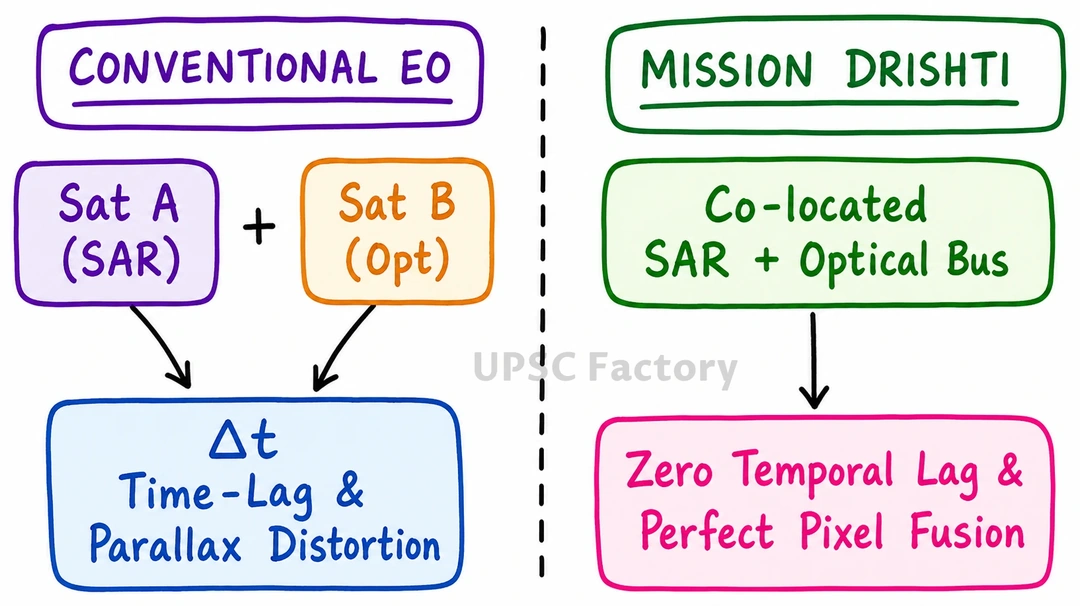
Hybrid Sensor Architecture: Integrates Synthetic Aperture Radar (SAR) and Multispectral (Optical) sensors on a single micro-satellite platform.
Active SAR Imaging: Employs microwave signals to achieve all-weather, day-and-night imaging, penetrating dense cloud cover, smoke, and haze.
Passive Optical Imaging: Captures visible and near-infrared bands to deliver detailed spectral signatures and high radiometric clarity.
On-Board Edge-AI Processing: Incorporates edge-compute modules to calibrate and correlate raw multi-modal data streams prior to downlink.
Compact Smallsat Bus: Utilizes an optimized Size, Weight, and Power (SWaP) design (sub-150 kg class) for cost-effective Low Earth Orbit (LEO) deployment.
Why It Is Considered the “World’s First of Its Kind”
Simultaneous Multi-Sensor Co-Location: World’s first commercial satellite housing both SAR and optical payloads on a single bus, eliminating the need for dual-satellite constellations.
Zero-Temporal & Parallax Discrepancy: Captures identical ground coordinates simultaneously, completely removing time-lag errors and angular shifts inherent in multi-satellite cross-registration.
Hardware-Level Data Fusion: Produces a fused “Drishti Dataset” combining the structural penetration of radar with the intuitive spectral fidelity of optical imagery.
Miniaturization Breakthrough: First successful integration of high-power-demand SAR technology into a compact small-satellite form factor without sacrificing resolution.
Mission Drishti establishes India’s leadership in next-generation Earth Observation, advancing national security, disaster mitigation, and the commercial objectives of the Indian Space Policy 2023.
Q. Discuss the different types of subsidies and supports provided by the Government of India to agricultural sector. Examine the related issues pertaining to Agreement on Agriculture of World Trade Organisation (WTO).
Question from UPSC Mains 2026 GS3 Paper
Model Answer:
India provides comprehensive agricultural support to ensure sovereign food security, rural livelihoods, and price stabilization, which frequently creates structural friction with the multilateral trade rules under the WTO’s Agreement on Agriculture (AoA).
1. Types of Agricultural Subsidies and Supports in India
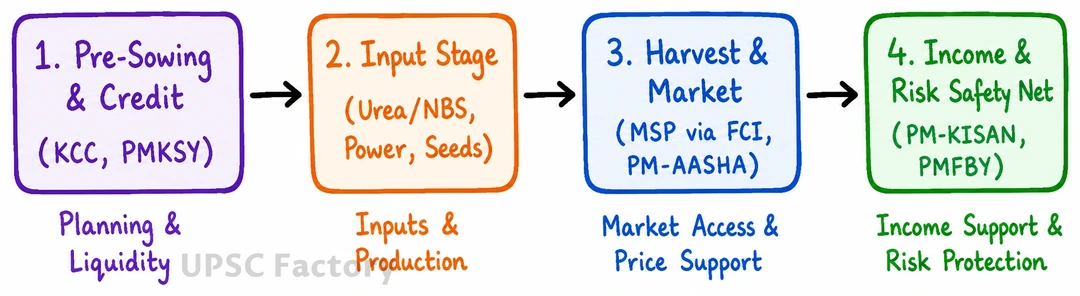
Direct Income Support: Direct benefit cash transfers to farmer accounts without distorting production quantities (e.g., PM-KISAN, Rythu Bandhu).
Input Subsidies (Indirect): Fiscal support on critical farm inputs like fertilizers (Urea/NBS), subsidized canal irrigation, zero-tariff power, and seed provisioning.
Price & Market Support: Minimum Support Price (MSP) backed by procurement via FCI under the National Food Security Act (NFSA) and PM-AASHA.
Credit & Risk Coverage: Concessional institutional credit via Interest Subvention Schemes (KCC) and subsidized actuarial premiums under PM Fasal Bima Yojana (PMFBY).
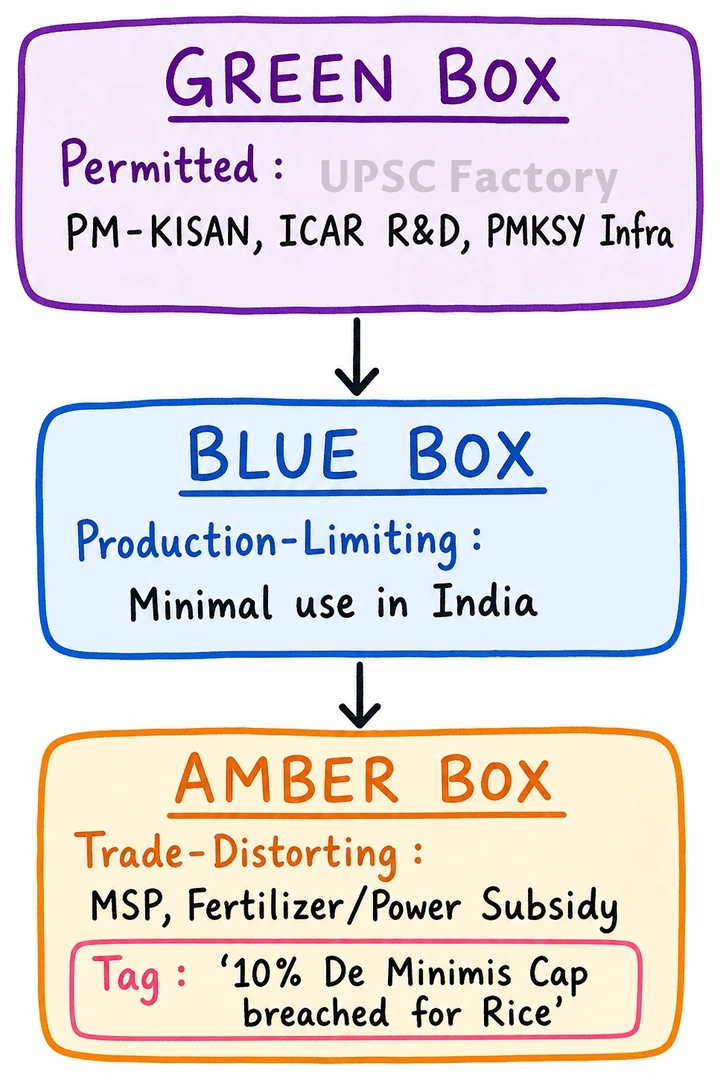
Infrastructural & R&D Support: Non-trade distorting capital investments in irrigation (PMKSY), cold-chain infrastructure (AIF), and ICAR extension services.
2. WTO Agreement on Agriculture (AoA) Issues and Frictions
Outdated External Reference Price (ERP): Fixation of fixed ERP at 1986–88 base prices artificially inflates India’s current Aggregate Measurement of Support (AMS), ignoring four decades of inflation.
Breaching the De Minimis Ceiling: India’s product-specific support for rice has repeatedly breached the permissible 10% value-of-production cap, inviting global scrutiny.
Fragility of Bali Peace Clause (2013): The interim Peace Clause shields public stockholding from dispute challenges but imposes onerous transparency covenants and covers only pre-2013 programs.
Threat to Article 6.2 (S&DT) Exemptions: Developed nations frequently challenge India’s input subsidies, disputing the classification of low-income, resource-poor (LIRP) farmers.
Public Stockholding (PSH) Impasse: Reluctance of developed nations at MC12/MC13 to negotiate a permanent PSH solution threatens developing countries’ domestic food procurement mandates.
Securing a permanent, inflation-adjusted solution for Public Stockholding is vital to harmonize WTO multilateral trade disciplines with India’s non-negotiable mandates of farmer welfare and nutritional security.
Q. How Indian agriculture has been transformed from food scarcity to food surplus level? Explain the various government policies implemented for diversification of Indian agriculture.
Question from UPSC Mains 2026 GS3 Paper
Model Answer:
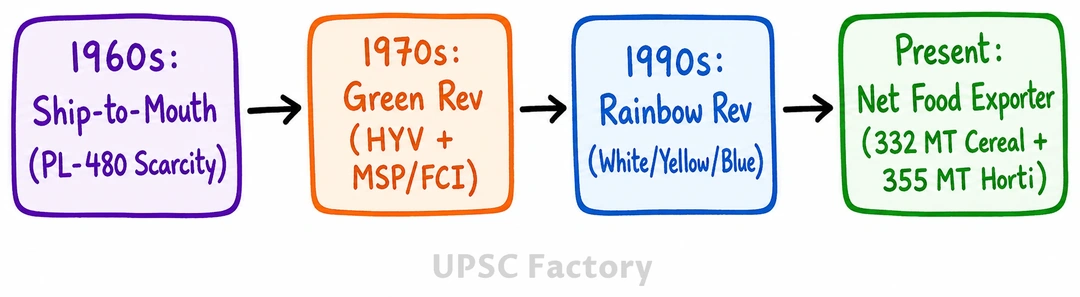
India transformed from a “ship-to-mouth” vulnerability under US PL-480 to a net food exporter, achieving record foodgrain (~332 MT, 2023-24) and horticulture production (~355 MT).
Catalysts of Transformation: From Deficit to Food Surplus
Technological Package (Green Revolution): Introduction of High Yielding Variety (HYV) dwarf seeds (wheat/paddy), chemical fertilizers, and intensive irrigation.
Institutional Pricing & Procurement: Guaranteed floor prices through Minimum Support Price (MSP) via CACP and open-ended procurement by Food Corporation of India (FCI).
Public Infrastructure Investment: Large-scale irrigation networks (e.g., Bhakra Nangal), rural electrification, and agricultural research institutions (ICAR, KVKs).
Targeted Input Subsidies: Concessional power, urea pricing subsidies, and expansion of Priority Sector Lending (PSL) via NABARD.
Multi-Sectoral Revolutions: White Revolution (Operation Flood), Blue Revolution (Fisheries), and Yellow Revolution (Oilseeds) structurally expanded output beyond staples.
Government Policies Driving Agricultural Diversification
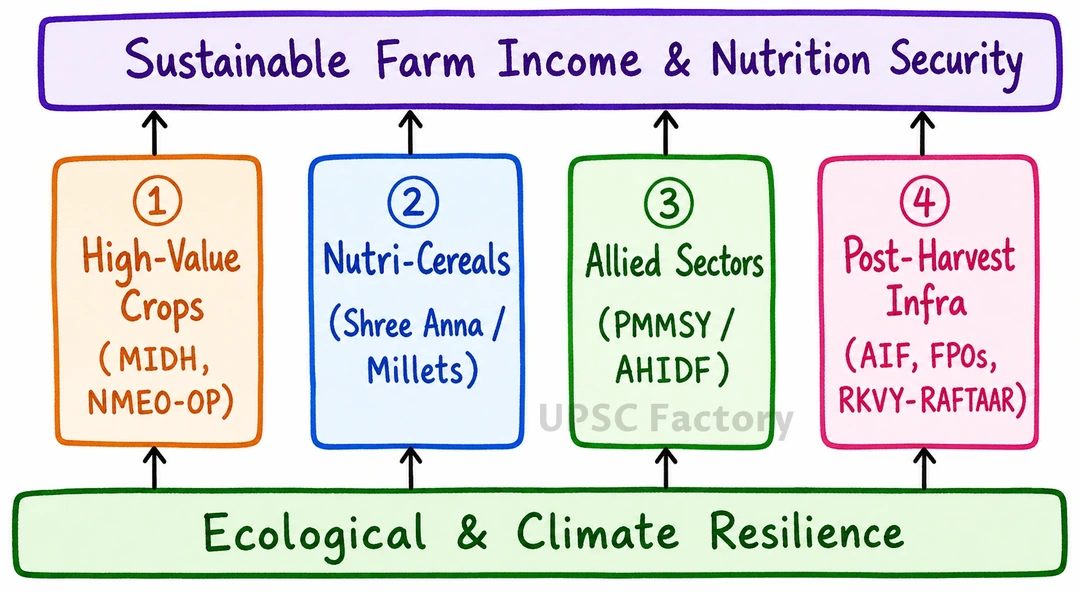
Horticulture Promotion:
Mission for Integrated Development of Horticulture (MIDH) promotes high-value fruits, vegetables, and protected cultivation.
Oilseeds & Palm Oil Mission:
NMEO-OP (National Mission on Edible Oils – Oil Palm) incentivizes shift away from water-guzzling paddy in the Northeast and Telangana.
Nutri-Cereals (Millets):
Shree Anna Initiative promotes climate-resilient millets through MSP enhancements, processing hubs, and inclusion in POSHAN 2.0.
Allied & High-Value Sector Support:
Pradhan Mantri Matsya Sampada Yojana (PMMSY) and Animal Husbandry Infrastructure Development Fund (AHIDF) drive vertical income diversification.
Sustainable & Natural Agriculture:
Paramparagat Krishi Vikas Yojana (PKVY) and National Mission on Natural Farming (NMNF) support organic certification and chemical-free farming.
Value Chain & Market Infrastructure:
RKVY-RAFTAAR and Agriculture Infrastructure Fund (AIF) provide post-harvest credit for specialized crop clusters and FPOs.
Transitioning from calorie-focused food security to nutrition-dense, climate-resilient, and market-led crop diversification is critical for sustainable farm incomes and ecological balance.
Q. How are startups in India promoting entrepreneurship, innovation and employment? Discuss the global and domestic challenges in their working and suggest suitable measures to overcome these challenges.
Question from UPSC Mains 2026 GS3 Paper
Model Answer:
India hosts the world’s third-largest startup ecosystem (>1.4 lakh DPIIT-recognized startups), acting as an engine of decentralized growth, high-value employment, and technological self-reliance.
Promoting Entrepreneurship, Innovation, and Employment
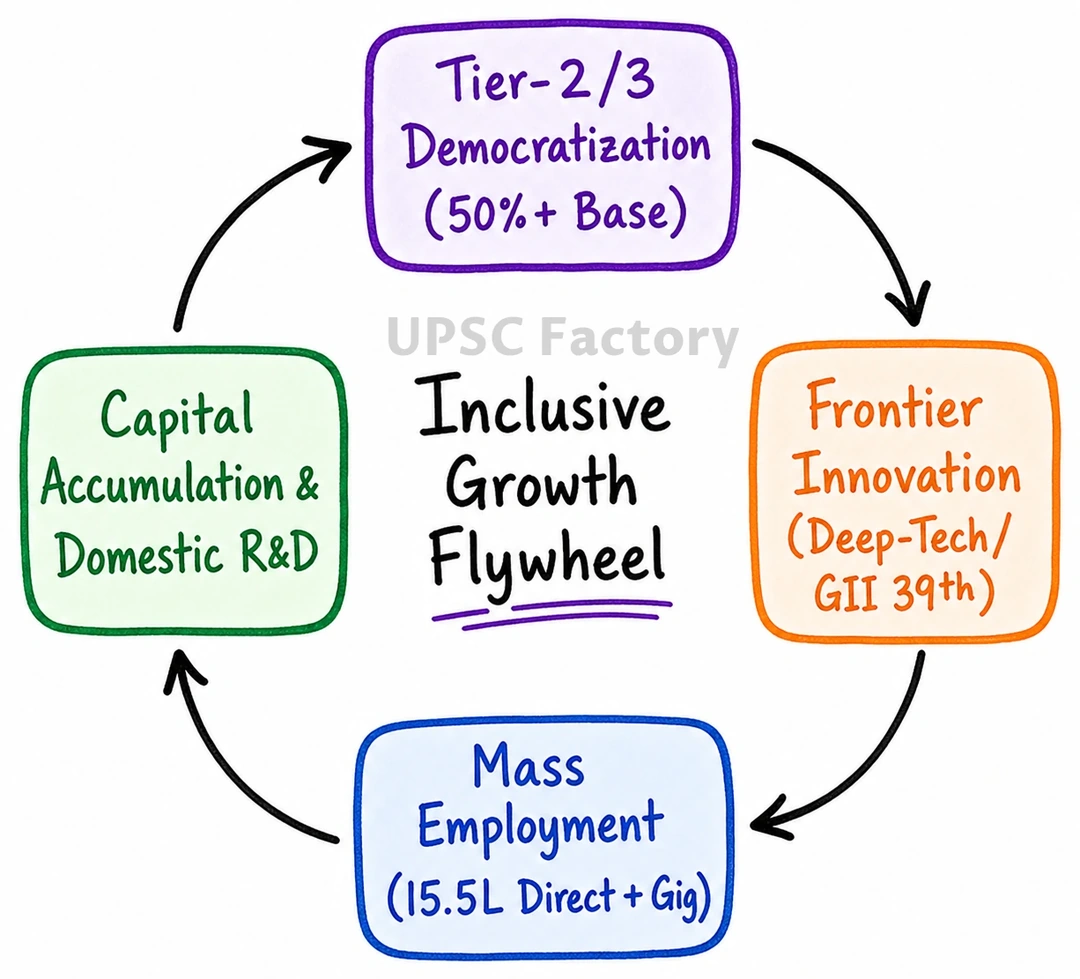
Democratizing Entrepreneurship: Over 50% of recognized startups emerge from Tier-2 and Tier-3 cities, fostering grassroots enterprise and women-led innovation (e.g., Stand-Up India, WEP).
Frontier Innovation: Fostering high-tech capabilities in space-tech, fintech, and agritech (e.g., Agnikul Cosmos, DeHaAT), elevating India to 39th on the Global Innovation Index.
Mass Employment Generation: Generated over 15.5 lakh direct jobs (DPIIT data) alongside millions of tech-enabled gig livelihoods (e.g., Zomato, Porter).
Import Substitution: Building indigenous alternatives in defence manufacturing, drones, and medical devices under Atmanirbhar Bharat.
Dual Bottlenecks: Domestic vs. Global Challenges
Domestic Challenges:
Funding Winter & Regulatory Friction: Reduced late-stage capital availability, high compliance burden, and complex corporate restructuring.
Low R&D Commercialization: Sub-optimal industry-academia linkages and low gross domestic R&D expenditure (~0.64% of GDP).
External Flipping: Startups incorporating abroad due to taxation disparities and easier access to overseas public markets.
Global Challenges:
Macroeconomic Headwinds: Sustained global inflation, high overseas interest rates, and cautious foreign venture capital sentiment.
Regulatory & Trade Barriers: Stringent cross-border data localization laws (e.g., EU-GDPR) and aggressive IP litigations by foreign incumbents.
Strategic Measures to Overcome Challenges
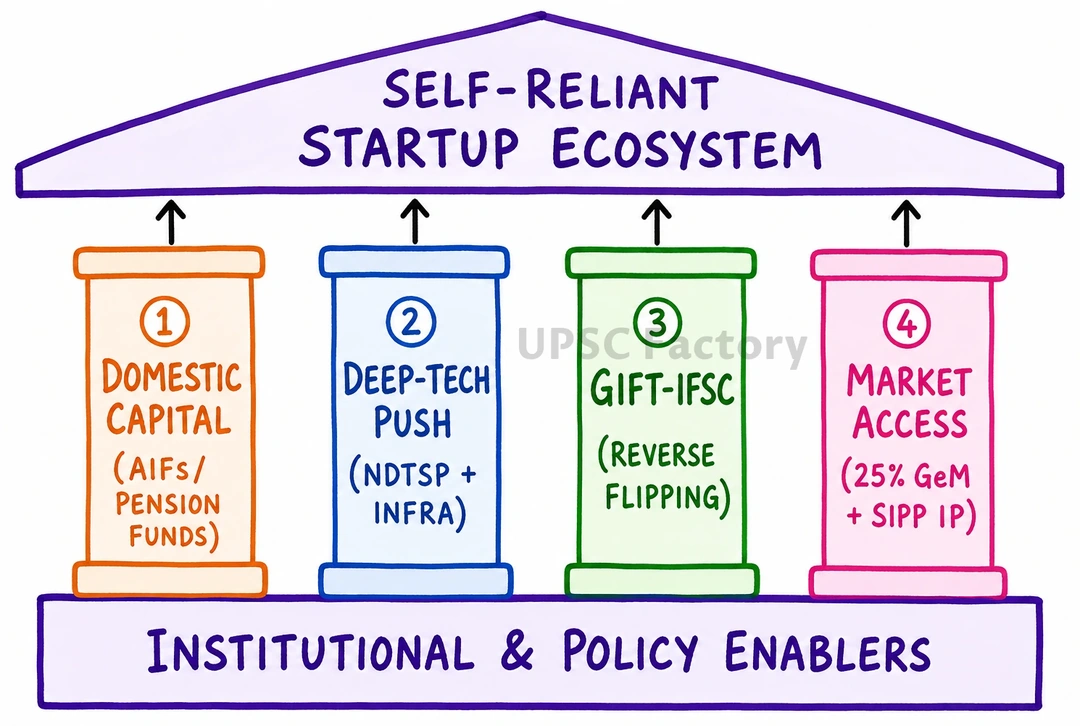
Unlocking Domestic Capital: Mobilize domestic pension funds and insurance pools into AIFs; capitalize on the abolition of the Angel Tax.
Operationalizing Deep-Tech Policy: Implement the National Deep Tech Startup Policy (NDTSP) with dedicated viability-gap funding and shared supercomputing infrastructure.
Incentivizing Reverse Flipping: Fast-track NCLT approval timelines and grant capital-gains tax neutrality for startups relocating to GIFT-IFSC.
Market Access & IP Enablement: Enforce the 25% public procurement mandate via the GeM startup runway and expand the Start-ups Intellectual Property Protection (SIPP) scheme.
Strengthening institutional funding, R&D capabilities, and regulatory ease will transform Indian startups from valuation-driven enterprises into resilient pillars of Viksit Bharat @2047.
Q. Explain the key challenges for India’s energy security. What measures do you suggest for ensuring energy security along with economic growth and sustainability?
Question from UPSC Mains 2026 GS3 Paper
Model Answer:
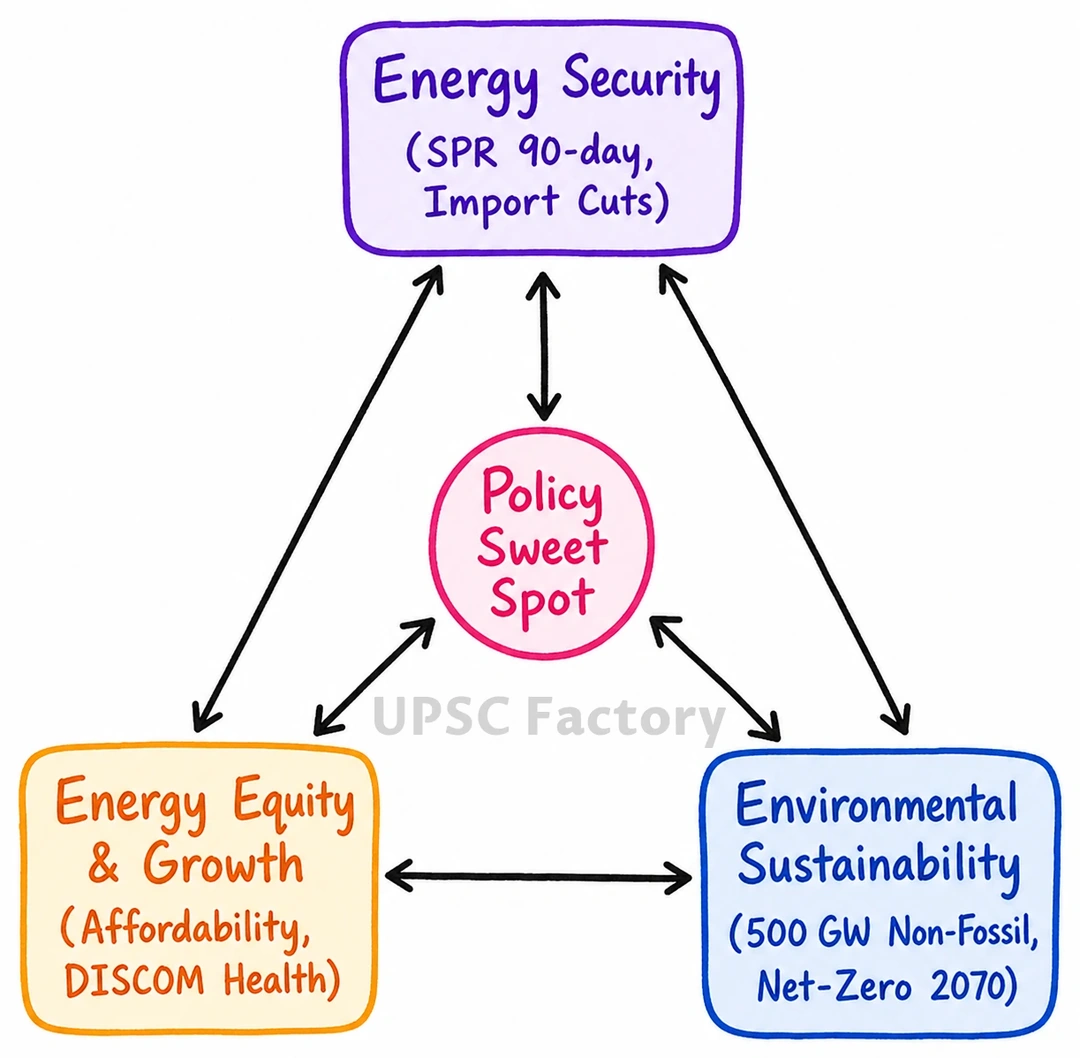
India’s energy security involves navigating the World Energy Council’s Energy Trilemma—balancing energy security, energy equity (affordability/access), and environmental sustainability to support a $5-trillion economic trajectory.
Key Challenges to India’s Energy Security
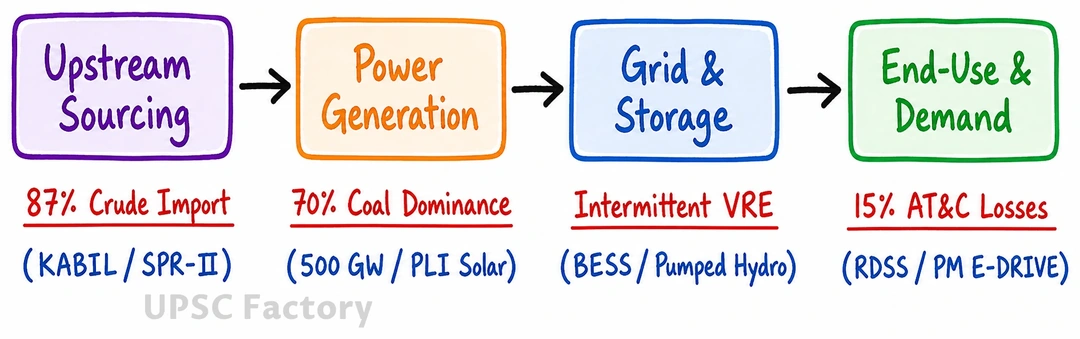
High Import Dependency: India imports over 87% of its crude oil and 50% of natural gas, exposing macro-stability to geopolitical shocks (e.g., West Asian conflicts, Red Sea crisis).
Limited Strategic Petroleum Reserves (SPR): Existing underground SPR capacity (ISPRL: ~9.5 days) falls significantly short of the 90-day International Energy Agency (IEA) mandate.
Coal Dominance and Logistics Bottlenecks: Despite decarbonization goals, coal fuels ~70% of electricity; domestic supplies face high ash content and rake shortages (Indian Railways freight congestion).
DISCOM Financial Distress: High Aggregate Technical & Commercial (AT&C) losses (~15%) and tariff gaps constrain infrastructure modernization and timely payments to green power generators.
Clean Energy Supply-Chain Vulnerabilities: Heavy import reliance on China for solar PV cells (60-70%) and critical minerals (Lithium, Cobalt, Nickel) creates supply-side risks for EVs and storage.
Grid Intermittency and Storage Deficits: Rising share of variable renewable energy (VRE) threatens grid stability due to inadequate Battery Energy Storage Systems (BESS) and pumped hydro capacity.
Strategic Measures for the Energy Trilemma
Accelerate Green Energy Alternatives: Expand non-fossil capacity to 500 GW by 2030 and scale alternative fuels (National Green Hydrogen Mission, 20% Ethanol Blending by 2025-26).
Expand Strategic & Domestic Upstream Capacity: Expedite SPR Phase-II (commercial-cum-strategic models) and boost domestic exploration under the Open Acreage Licensing Policy (OALP).
Strengthen Grid Flexibility & Storage: Deploy utility-scale Battery Energy Storage Systems (BESS viability gap funding) and develop closed-loop Pumped Storage Plants (PSPs).
Secure Critical Mineral Value Chains: Acquire overseas mineral assets through Khanij Bidesh India Ltd. (KABIL), leverage the Mineral Security Partnership (MSP), and promote domestic battery recycling.
Decarbonize End-Use Sectors: Electrify transport (PM E-DRIVE scheme), enforce energy-efficient construction (ECBC codes), and operationalize the Indian Carbon Market (CCTS).
Synchronizing strategic storage, supply-chain localization, and aggressive clean energy adoption will ensure an energy-independent, cost-resilient foundation for Viksit Bharat @2047 while meeting Net-Zero 2070 commitments.