Prelims Solution

Q14. Consider the following statements: Statements-I: The temperature contrast between continents and oceans is greater during summer than in winter.

Q14. Consider the following statements:

Statements-I: The temperature contrast between continents and oceans is greater during summer than in winter.
Statements-II: The specific heat of water is more than that of land surface.

Which one of the following is correct in respect of the above statements?
a. Both Statement-I and Statement-II are correct and Statement-II is the correct explanation for Statement-I
b. Both Statement-I and Statement-II are correct and Statement-II is not the correct explanation for Statement-I
c. Statement-I is correct but Statement-II is incorrect
d. Statement-I is incorrect but Statement-II is correct

Question from UPSC Prelims 2023 GS Paper

Explanation : 

Correct Answer: d. Statement-I is incorrect but Statement-II is correct

Temperature Contrast Between Continents and Oceans

Statement I: “The temperature contrast between continents and oceans is greater during summer than in winter.”
This statement is incorrect.

During summer, both continents and oceans receive more solar radiation and heat up. However, due to the high specific heat capacity of water, oceans take longer to heat up compared to land.
In winter, continents cool down quickly due to their lower specific heat capacity and the reduced solar radiation. However, oceans retain the heat accumulated during summer for a longer time due to their high specific heat capacity. This leads to a situation where continents become much colder than oceans, creating a larger temperature contrast.

Role of Specific Heat in Temperature Variations

Statement II: “The specific heat of water is more than that of land surface.” This statement is also correct.
Specific heat is the amount of heat per unit mass required to raise the temperature by one degree Celsius. Water has a higher specific heat capacity than land, meaning it takes more energy to raise the temperature of water by one degree compared to land. This is why water heats up and cools down more slowly than land.

Q14. Consider the following statements: Statements-I: The temperature contrast between continents and oceans is greater during summer than in winter. Read More »

Q9. Consider the following statements: 1. In India, the Biodiversity Management Committees are key to the realization of the objectives of the Nagoya Protocol.

Q9. Consider the following statements:

1. In India, the Biodiversity Management Committees are key to the realization of the objectives of the Nagoya Protocol.
2. The Biodiversity Management Committees have important functions in determining access and benefit sharing, including the power to levy collection fees on the access of biological resources within its jurisdiction.

Which of the statements given above is/are correct?

a. 1 only
b. 2 only
c. Both 1 and 2
d. Neither 1 nor 2

Question from UPSC Prelims 2023 GS Paper

Explanation : 

Correct Answer c. -> Both statements are correct.

Biodiversity Management Committees and Nagoya Protocol in India

In India, the Biodiversity Management Committees (BMCs) are instrumental in achieving the goals of the Nagoya Protocol. This international agreement focuses on the fair and equitable sharing of benefits derived from the use of genetic resources. BMCs, established at local levels, are pivotal in promoting the conservation, sustainable use, and documentation of biological diversity.

These committees are vital in implementing the Nagoya Protocol by facilitating access to genetic resources and associated traditional knowledge. They ensure that the benefits from their utilization are shared appropriately. Their role encompasses conservation efforts, sustainable usage of biodiversity, and managing the documentation of diverse biological resources.

Functions of Biodiversity Management Committees

The Biodiversity Management Committees play a significant role in access and benefit-sharing mechanisms. One of their key functions includes the authority to impose collection fees for accessing biological resources within their jurisdiction. This power is essential for regulating access to biological resources and associated traditional knowledge.

Moreover, BMCs are tasked with ensuring equitable sharing of benefits arising from the use of these resources. The imposition of collection fees aids in generating revenue, which is then utilized for conservation and sustainable use of biodiversity. This approach aligns with the broader objectives of the Nagoya Protocol, promoting a balanced and fair distribution of benefits among all stakeholders involved in the utilization of biological resources.

Q9. Consider the following statements: 1. In India, the Biodiversity Management Committees are key to the realization of the objectives of the Nagoya Protocol. Read More »

Q7. Consider the following statements: 1. According to the Constitution of India, the Central Government has a duty to protect States from internal disturbances.

Q7. Consider the following statements:

1. According to the Constitution of India, the Central Government has a duty to protect States from internal disturbances.
2. The Constitution of India exempts the States from providing legal counsel to a person being held for preventive detention.
3. According to the Prevention of Terrorism Act, 2002, confession of the accused before the police cannot be used as evidence.

How many of the above statements are correct?
a. Only one
b. Only two
c. All three
d. None

Question from UPSC Prelims 2023 GS Paper

Explanation : 

Correct Answer b. Only two

Central Government’s Duty to Protect States: Article 355 of the Indian Constitution

This statement is correct. Article 355 of the Constitution of India states that it shall be the duty of the Union to protect every State against external aggression and internal disturbance and to ensure that the government of every State is carried on in accordance with the provisions of this Constitution.

Article 22. Protection against arrest and detention in certain cases

(1) No person who is arrested shall be detained in custody without being informed, as soon as may be, of the grounds for such arrest nor shall he be denied the right to consult, and to be defended by, a legal practitioner of his choice.
(2) Every person who is arrested and detained in custody shall be produced before the nearest magistrate within a period of twenty-four hours of such arrest excluding the time necessary for the journey from the place of arrest to the court of the magistrate and no such person shall be detained in custody beyond the said period without the authority of a magistrate.
(3) Nothing in clauses (1) and (2) shall apply—
(a) to any person who for the time being is an enemy alien; or
(b) to any person who is arrested or detained under any law providing for preventive detention.
This statement is also correct

Admissibility of Confessions in POTA 2002

This statement is incorrect. The Prevention of Terrorism Act (POTA), 2002, which has been repealed, allowed confessions made by the accused before a police officer of the rank of Superintendent of Police or above to be admissible as evidence during the trial (Section 32 of POTA).

So, only two statement are correct.

Q7. Consider the following statements: 1. According to the Constitution of India, the Central Government has a duty to protect States from internal disturbances. Read More »

Q5. Consider the following statements: Statement-I: India’s public sector health care system largely focuses on curative care with limited preventive, promotive and rehabilitative care.

Q5. Consider the following statements:

Statement-I: India’s public sector health care system largely focuses on curative care with limited preventive, promotive and rehabilitative care.
Statement-II: Under India’s decentralized approach to health care delivery, the States are primarily responsible for organizing health services.

Which one of the following is correct in respect of the above statements?

a. Both Statement-I and Statement-II are correct and Statement-II is the correct explanation for Statement-I
b. Both Statement-I and Statement-II are correct and Statement-II is not the correct explanation for Statement-I
c. Statement-I is correct but Statement-II is incorrect
d. Statement-I is incorrect but Statement-II is correct

Question from UPSC Prelims 2023 GS Paper

Explanation : 

Correct Answer – b

Assessment of India’s Public Sector Health Care System

Statement-I: This statement is considered correct. India’s public sector health care system extensively focuses on various aspects of health care, including preventive measures (such as the Pulse Polio Campaign – Do Boond Zindagi Ki), promotive, curative, and rehabilitative care. A key initiative in this regard is the National Health Mission (NHM), which aims to offer comprehensive primary health care services. These services encompass preventive, promotive, and curative care, along with rehabilitative care, demonstrating the system’s wide-ranging focus.

India’s Decentralized Approach to Health Care Delivery

Statement-II: This statement is correct. The decentralized approach to health care delivery in India primarily places the responsibility of organizing health services on the State governments. While the central government contributes through financial and technical support, the actual implementation of health programs and the delivery of services are managed by the States. 

State List (List II – Entry 6): This entry specifically assigns “public health and sanitation; hospitals and dispensaries” to the State governments. It underscores that States have the primary responsibility for organizing and managing health services, allowing them to tailor health care systems to local needs and priorities.

Therefore, the correct answer is b. Both Statement-I and Statement-II are correct and Statement-II is not the correct explanation for Statement-I

Q5. Consider the following statements: Statement-I: India’s public sector health care system largely focuses on curative care with limited preventive, promotive and rehabilitative care. Read More »

Q1. Consider the following statements with reference to India: 1. According to the ‘Micro, Small and Medium Enterprises Development (MSMED) Act, 2006’, the ‘medium enterprises’ are those with investments in plant and machinery between Rs. 15 crore and Rs. 25 crore.

Q1. Consider the following statements with reference to India:

1. According to the ‘Micro, Small and Medium Enterprises Development (MSMED) Act, 2006’, the ‘medium enterprises’ are those with investments in plant and machinery between Rs. 15 crore and Rs. 25 crore.
2. All bank loans to the Micro, Small and Medium Enterprises qualify under the priority sector.

Which of the statements given above is/are correct?
a. 1 only
b. 2 only
c. Both 1 and 2
d. Neither 1 nor 2

Question from UPSC Prelims 2023 GS Paper

Explanation : 

Correct Answer  – b ( This is the official answer)

According to MSMED Act 2006 upsc

After 14 years since the MSME Development Act came into existence in 2006, a revision in MSME definition was announced in the Atmnirbhar Bharat package on 13th May, 2020.

As per this announcement, the definition of Micro manufacturing and services units was increased to Rs. 1 Crore of investment and Rs. 5 Crore of turnover. The limit of Small unit was increased to Rs. 10 Crore of investment and Rs 50 Crore of turnover. Similarly, the limit of Medium unit was increased to Rs. 20 Crore of investment and Rs. 100 Crore of turnover.

The Government of India on 01.06.2020 decided for further upward revision of the MSME Definition. For Medium Enterprises, now it will be Rs. 50 Crore of investment and Rs. 250 Crore of turnover.

Priority Sector Lending Guidelines

In terms of Master Direction on ‘Priority Sector Lending (PSL) – Targets and Classification’ dated September 4, 2020, all bank loans to MSMEs conforming to the conditions prescribed therein qualify for classification under priority sector lending.

According to UPSC, Statement 2 is correct.

Q1. Consider the following statements with reference to India: 1. According to the ‘Micro, Small and Medium Enterprises Development (MSMED) Act, 2006’, the ‘medium enterprises’ are those with investments in plant and machinery between Rs. 15 crore and Rs. 25 crore. Read More »

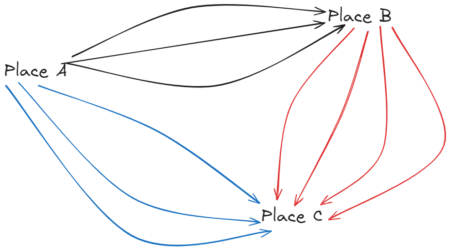
Q. A, B and C are three places such that there are three different roads from A to B, four different roads from B to C and three different roads from A to C. In how many different ways can one travel from A to C using these roads?

Q. A, B and C are three places such that there are three different roads from A to B, four different roads from B to C and three different roads from A to C. In how many different ways can one travel from A to C using these roads?

a.  10
b. 13
c.  15
d. 36
Correct Answer: c. 15

Question from UPSC Prelims 2022 CSAT Paper

Explanation : 

A B C are three places

A, B and C are three places

One can travel from A to C in 15 different ways. There are two possible routes: directly from A to C or from A to B and then from B to C.

The number of ways to travel directly from A to C is 3 (since there are 3 different roads). The number of ways to travel from A to B and then from B to C is the product of the number of roads between each pair of places: 3 x 4 = 12.

So, in total, there are 3 + 12 = 15 different ways one can travel from A to C using these roads.

Q. A, B and C are three places such that there are three different roads from A to B, four different roads from B to C and three different roads from A to C. In how many different ways can one travel from A to C using these roads? Read More »

Q. How many seconds in total are there in x weeks, x days, x hours, x minutes and x seconds?

Q. How many seconds in total are there in x weeks, x days, x hours, x minutes and x seconds?

a.  11580x
b. 11581x
c.  694860x
d. 694861x
Correct Answer: d. 694861x

Question from UPSC Prelims 2022 CSAT Paper

Explanation : 

Total number of seconds in x weeks, x days, x hours, x minutes and x seconds is 694861x.

So the correct answer is d. 694861x.

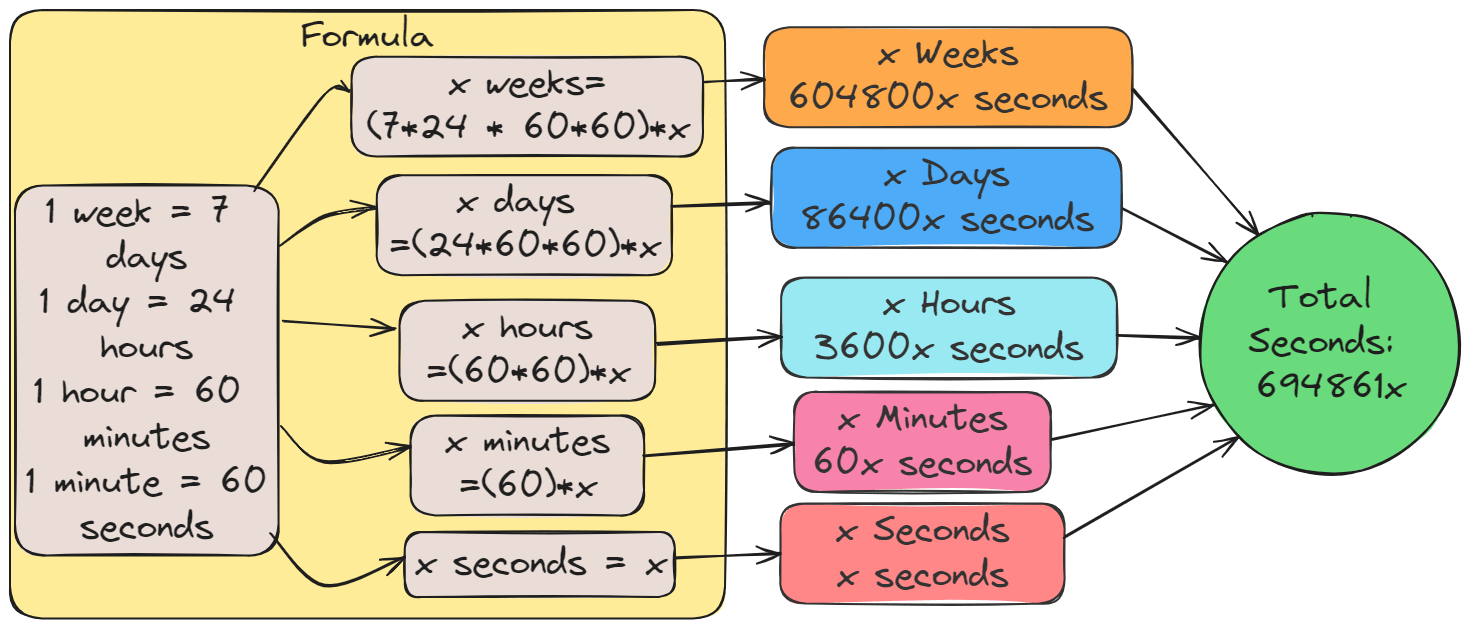
Here’s how you can calculate it: 1 week = 7 days 1 day = 24 hours 1 hour = 60 minutes 1 minute = 60 seconds

So, x weeks = (7 * 24 * 60 * 60) * x seconds x days = (24 * 60 * 60) * x seconds x hours = (60 * 60) * x seconds x minutes = (60) * x seconds

Adding all of these together with the additional x seconds gives us: 604800x + 86400x + 3600x + 60x + x=694861x
total seconds in x weeks x days

Q. How many seconds in total are there in x weeks, x days, x hours, x minutes and x seconds? Read More »

Q. D is a 3-digit number such that the ratio of the number to the sum of its digits is least. What is the difference between the digit at the hundred’s place and the digit at the unit’s place of D?

Q. D is a 3-digit number such that the ratio of the number to the sum of its digits is least. What is the difference between the digit at the hundred’s place and the digit at the unit’s place of D?

(a) 0
(b) 7
(c) 8
(d) 9
Correct Answer: (c) 8

Question from UPSC Prelims 2023 CSAT

Explanation : 

D is a 3-digit number

To minimize the ratio of a number to the sum of its digits, we need to maximize the sum of the digits and minimize the number itself.

The smallest 3-digit number is 100, but this doesn’t maximize the sum of the digits.

The smallest 3-digit number with the maximum digit sum is 199 (1+9+9=19). This gives us a ratio of 10.47, which is the smallest possible for a 3-digit number.

The difference between the digit at the hundred’s place (1) and the digit at the unit’s place (9) of D is 9-1=8.

So, the correct answer is (c) 8.

Q. D is a 3-digit number such that the ratio of the number to the sum of its digits is least. What is the difference between the digit at the hundred’s place and the digit at the unit’s place of D? Read More »

Q. What is the middle term of the sequence Z, Z, Y, Y, Y, X, X, X, X, W, W, W, W, W,…, A?

Q. What is the middle term of the sequence
Z, Z, Y, Y, Y, X, X, X, X, W, W, W, W, W,…, A?

(a) H
(b) I
(c) J
(d) M
Correct Answer: (b) I

Question from UPSC Prelims 2023 CSAT

Explanation :

Middle term of the sequence

The given sequence is a pattern of letters from the English alphabet starting from Z and going backwards to A. Each letter is repeated a number of times equal to its position in the reversed alphabet (Z is 1st, Y is 2nd, X is 3rd, and so on).

The total number of terms in the sequence is calculated by adding the number of repetitions for each letter, which forms an arithmetic series: 2 (for Z) + 3 (for Y) + 4 (for X) + … + 27 (for A).
The sum of this series is 377= (n(n+1)/2 -1), n=27

The middle term is the 189th term (since 377/2 = 188.5). To find out which letter this term is, we subtract the total number of terms for the letters before it from 189.

The total number of terms for the letters before I (starting from Z) is 188 (2 for Z, 3 for Y, 4 for X, …, 8 for S). So, 189 – 188 = 1, which means the 189th term is the first repetition of I. Therefore,

The middle term of the sequence is I.

Proof – A+B+C+D+E+F+G+H=27+26+25+24+23+22+21+20=188

Q. What is the middle term of the sequence Z, Z, Y, Y, Y, X, X, X, X, W, W, W, W, W,…, A? Read More »

Q. With reference to Indian history, consider the following texts: 1. Nettipakarana 2. Parishishtaparvan 3. Avadanashataka 4. Trishashtilakshana Mahapurana Which of the above are Jaina texts?

Q. With reference to Indian history, consider the following texts:
1. Nettipakarana
2. Parishishtaparvan
3. Avadanashataka
4. Trishashtilakshana Mahapurana
Which of the above are Jaina texts?

a) 1, 2 and 3
b) 2 and 4 only
c) 1, 3 and 4
d) 2, 3 and 4
Correct Answer: b) 2 and 4 only

Question from UPSC Prelims 2022 GS Paper

Explanation : 

Buddhist and Jaina Texts

Nettipakarana is a Buddhist text, specifically part of the Theravada Buddhist canon within the Khuddaka Nikaya of the Sutta Pitaka. It is not associated with Jainism.

Conversely, Parishishtaparvan is indeed a Jaina text. Authored by the 12th-century scholar Hemachandra, it reflects the rich tradition of Jain literature.

Avadanashataka, known for its collection of “Hundred Legends,” forms a part of the Sanskrit Buddhist literature and is not a Jain work.

Lastly, Trishashtilakshana Mahapurana (or Trishashti Shalaka Purusha Charitra) is a significant Jain text by Acharya Hemachandra, detailing the lives of 63 eminent figures in Jainism.

In conclusion, “2 and 4 only” correctly identifies the Parishishtaparvan and Trishashtilakshana Mahapurana as Jaina texts, while the Nettipakarana and Avadanashataka are not.

Q. With reference to Indian history, consider the following texts: 1. Nettipakarana 2. Parishishtaparvan 3. Avadanashataka 4. Trishashtilakshana Mahapurana Which of the above are Jaina texts? Read More »