Model Answer:
While welfare schemes (PDS, MGNREGA) provide vital safety nets, sustainable poverty alleviation requires macroeconomic stability through proactive inflation and unemployment management.
1. Limitations of Sole Reliance on Welfare Schemes
- Fiscal Saturation: High revenue expenditure on subsidies limits capital outlay required for structural growth (FRBM constraints).
- Delivery Bottlenecks: Persistent exclusion errors, digital divides, and systemic leakages hinder optimal targeting.
- Subsistence Trap: Welfare guarantees mere survival, failing to foster wealth creation or upward social mobility.
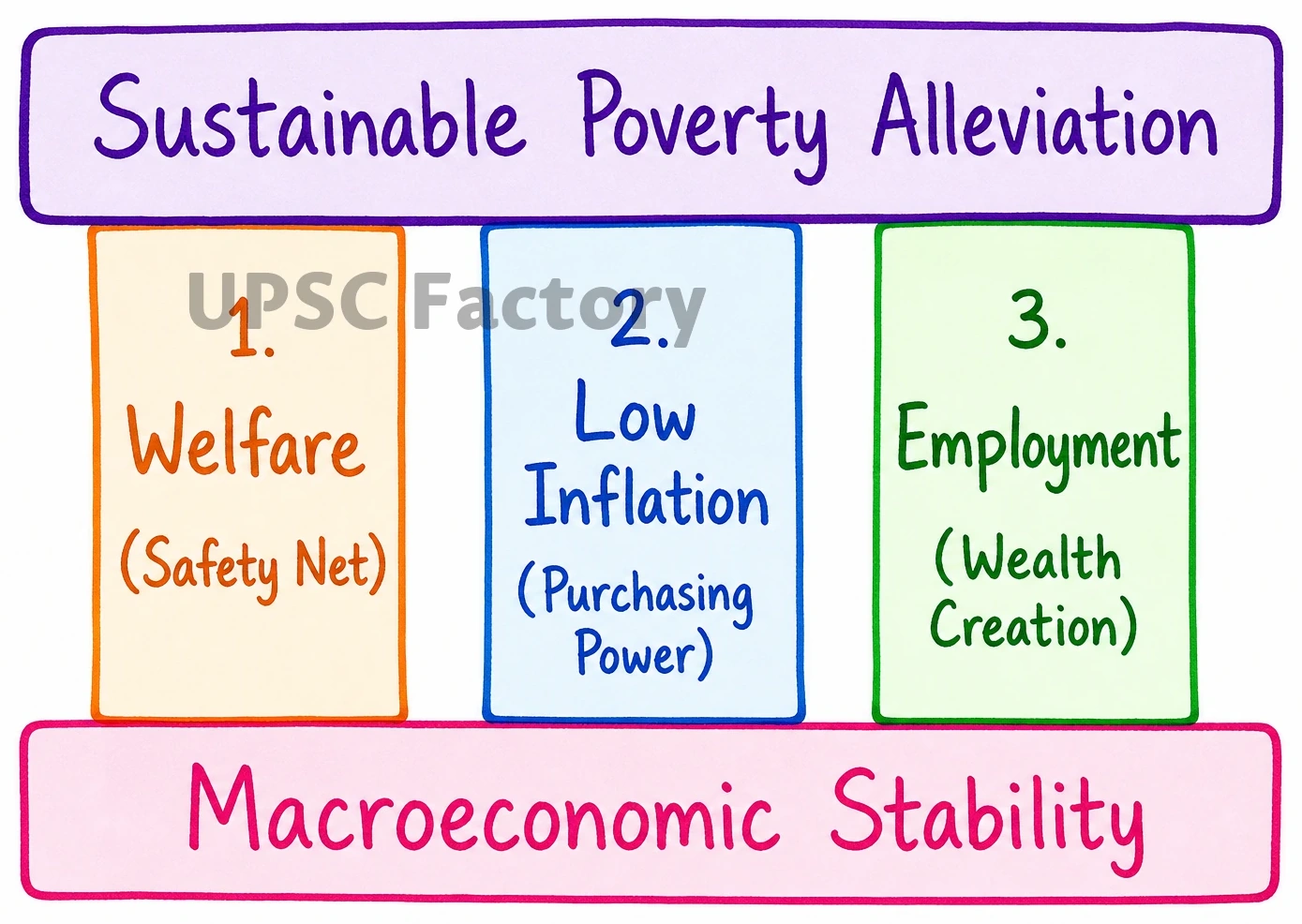
2. Impact of Inflation: The “Regressive Tax”
- Engel’s Law Dynamics: Unchecked food inflation disproportionately consumes the poor’s income, crowding out education and nutrition.
- Erosion of Real Wages: Fixed DBT cash transfers and unorganized sector wages rapidly lose their purchasing power.
- Vulnerability to Debt: Healthcare and fuel inflation force marginalized families into usurious borrowing, risking Multidimensional Poverty Index (MPI) relapse.
3. Unemployment: Nullifying Welfare Gains
- Informality Crisis: The absence of formal job creation forces ~90% of the workforce into precarious, low-paying informal roles without social security.
- Rural Distress Indicator: Structural joblessness drives distress migration, reflected in the sustained high demand for basic MGNREGA work.
- Demographic Liability: Prolonged youth unemployment breeds deskilling, exacerbates income inequality, and limits economic participation (PLFS data).
4. Way Forward: Macro-Social Integration
- Supply-Side Management: Control core food inflation via robust agri-logistics and decentralized warehousing (e-NAM, PM-SAMPADA).
- Labor-Intensive Growth: Expand PLI schemes explicitly to employment-elastic MSME sectors (textiles, leather, food processing).
- Market-Linked Skilling: Align national vocational frameworks directly with emerging industrial demands (NEP 2020, PMKVY 4.0).
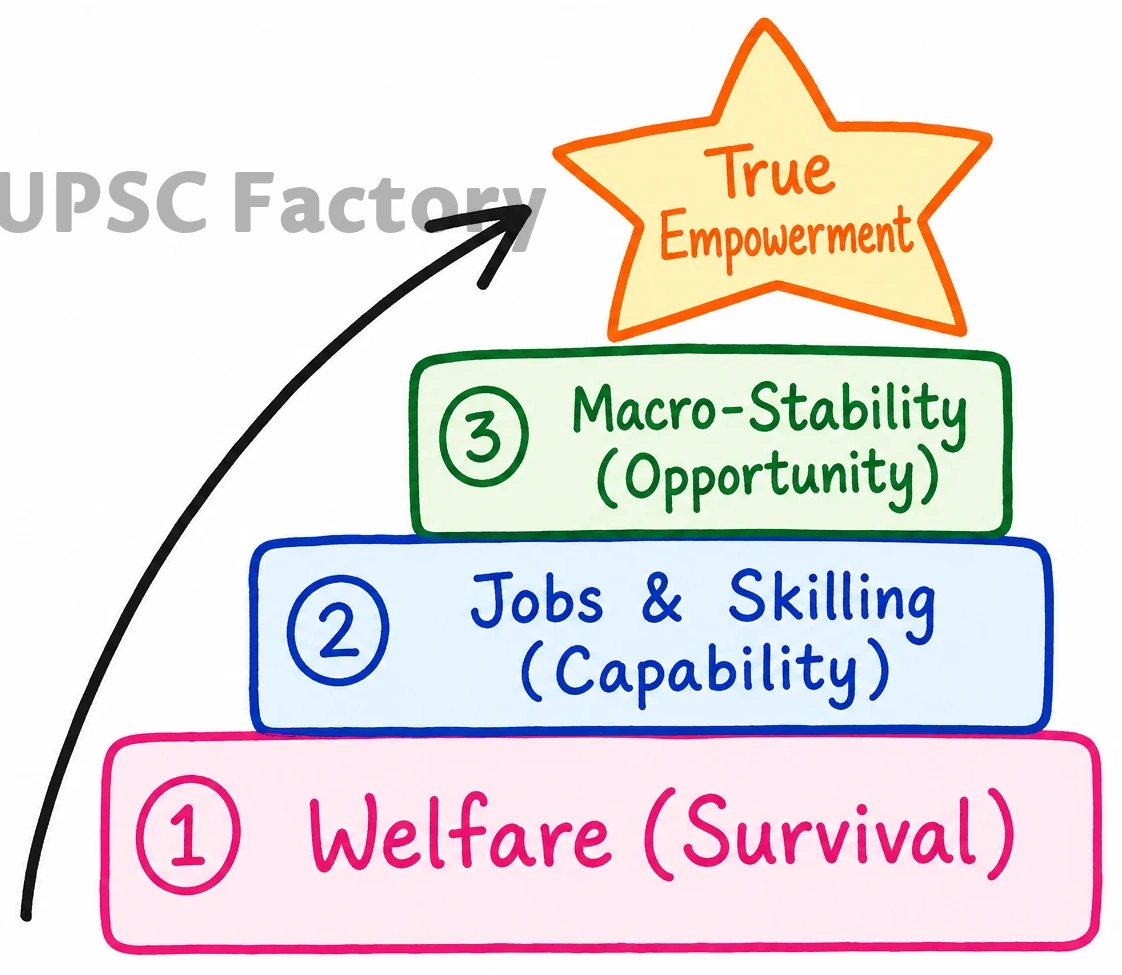
True empowerment necessitates transitioning from a ‘welfare-dependent’ framework to an ‘opportunity-driven’ ecosystem, synergizing macroeconomic stability with long-term inclusive growth.